
Type & Discipline
Transpersonal psychotherapy is an integrative clinical framework rather than a single manualized protocol, distinguished by its claim that spiritual, transcendent, and peak or unitive dimensions of experience are legitimate to psychological health rather than symptoms to be reduced 4. It concerns itself explicitly with “development beyond the ego or ‘self’” and treats experiences such as interconnectedness and expanded awareness as therapeutically meaningful 4. In practice it addresses “mental, physical, social, emotional, creative, and intellectual needs, with an emphasis on the role of a healthy spirit in healing,” holding that the person comprises “intangible, or transcendent, factors that make up the whole person” 1. Its institutional home in organized psychology is the Society for Humanistic Psychology (APA Division 32), which names transpersonal psychology as one of a “constellation of ‘humanistic psychologies’” alongside the Maslowian, Rogerian, and existential orientations 6. The tradition is often called the “Fourth Force” because it positions itself beyond psychoanalysis, behaviorism, and humanistic psychology, extending the third force’s focus on growth into the spiritual and self-transcendent domain LLM. As a framework it gives rise to specific techniques and borrows others, but it is best understood as an orienting stance toward the whole person — body, mind, and spirit — rather than a discrete, trial-validated treatment 5.
Creators & Lineage
The movement’s motivational backbone comes from Abraham Maslow, who in the 1960s formalized the approach with associates and coined the language for “reaching beyond humanistic concerns,” later expanding his hierarchy of needs to include self-transcendence and arguing that peak experiences are essential to human development 1 4. Carl Jung supplied the depth-psychological lineage, legitimizing spiritual themes through his work on archetypes and the collective unconscious 4. Stanislav Grof, a Czech psychiatrist named in the concept’s own key-figures list, continued developing the therapy and is associated with the exploration of altered states, including his early LSD-assisted work and the later development of breath-based methods 1 4. John Welwood, the other named figure, is most closely associated with the clinical concept of spiritual bypassing, the use of spiritual ideas to sidestep unfinished psychological work — a caution that has become central to the field’s self-understanding LLM. Ken Wilber contributed a crucial conceptual distinction between “pre-rational” states (such as the psychotic) and “trans-rational” states (a spiritually mature consciousness), guarding against the conflation of regression with transcendence 4.
The intellectual lineage the concept identifies runs through transpersonal psychology itself, humanistic psychology, existential psychotherapy, and Jungian analytical psychology — adjacent traditions that share a rejection of reductive accounts of the person and a commitment to subjective, lived experience 6. There is, in addition, a scholarly literature that treats transpersonal psychotherapy as a distinct field of approaches, reflected in special-topic academic collections and in reference works such as the Wiley-Blackwell Handbook of Transpersonal Psychology, which gathers the field’s theory and methods in one place 2 3. These traditions converge on the view that spirituality and self-transcendent experience belong inside, not outside, the clinical conversation 5.
Core Principles
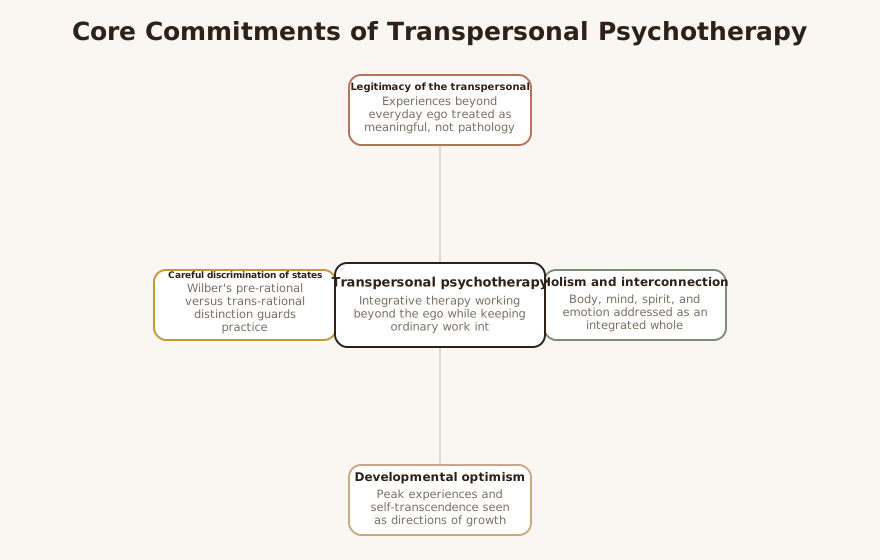
The framework rests on a handful of interlocking commitments. The first is the legitimacy of the transpersonal: experiences that “go beyond our everyday self-awareness and ego” are treated as connecting the person’s “human essence to a more meaningful reality” rather than as pathology to be explained away 5. The second is holism and interconnection — body, mind, spirit, emotions, thoughts, and sensations are addressed as an integrated whole, sometimes framed through the idea of non-duality, in which the client is regarded as “interconnected with everything in the universe” 5. The third is a developmental optimism inherited from humanistic psychology: peak experiences are held to be profoundly meaningful moments that can lead toward compassion and wisdom, and self-transcendence is treated as a genuine direction of growth 4.
A fourth principle, and the one with the most clinical bite, is the careful discrimination of states. Wilber’s pre-rational/trans-rational distinction is the field’s safeguard against romanticizing breakdown: not every loss of ordinary boundaries is a spiritual opening, and the framework asks the clinician to tell apart regression from transcendence 4. Alongside this sits the concept of spiritual emergence, understood as a process of personal growth that can become turbulent, and its shadow concept, spiritual bypassing, the avoidance of “painful emotions or unresolved psychological issues” by means of spiritual belief 4. Taken together, these principles ask the clinician to honor the spiritual dimension while keeping ordinary psychological work fully in view LLM.
Interventions & Techniques
Transpersonal psychotherapy is technique-pluralistic, drawing on attentional, depth-psychological, existential, somatic, and (historically) biochemical methods 4. The attentional cluster includes mindfulness, guided imagery, and hypnosis; the depth-psychological cluster includes Jungian analysis and psychosynthesis; the existential cluster includes meaning-focused inquiry and logotherapy-style dialogue 4. Psychology Today’s overview lists a practical toolkit of meditation, guided visualization, hypnotherapy, dream work, art-making, music therapy, journaling, and holotropic breathwork, with psychedelic-assisted methods noted as historical but of resurgent interest 1. Clinical-practice descriptions add yoga, breathing techniques, and “music, drumming, and chanting,” all aimed at helping clients “gain access to their innate wisdom and compassion” 5.
Two somatic and biochemical methods deserve naming because they carry distinct risk profiles. Holotropic breathwork, associated with Grof, uses accelerated breathing to occasion non-ordinary states; psychedelic-assisted therapy, also part of Grof’s early lineage, uses substances such as LSD or psilocybin to similar ends 4. Both are powerful state-shifting interventions and are not appropriate for routine, unscreened outpatient use LLM. For most clinicians, the transpersonal contribution to everyday practice is gentler: a spiritually inclusive stance, meaning-focused inquiry, mindfulness, and imagery delivered within an established psychotherapy 5.
LLM-generated illustrative example (not a guideline): A client describes a recurring experience during meditation of “dissolving into something larger” that frightens and intrigues them. Rather than pathologizing or sensationalizing it, the clinician helps the client describe the experience in their own words, situates it within the client’s values and history, and works to integrate its meaning into ordinary life — neither dismissing it as a symptom nor treating it as a destination. LLM
Evidence Base
The honest assessment is that transpersonal psychotherapy is an established framework with an emerging evidence base, not a trial-validated protocol for any specific disorder LLM. It is institutionally recognized through APA Division 32, which lists transpersonal approaches among the therapies it represents, and it has a scholarly literature of approaches and a major reference handbook 6 2 3. But Psychology Today is candid that the therapy “has drawn criticism for being outside the mainstream of psychology,” even as that position shifts with the mainstreaming of meditation and mindfulness 1. None of the sources here presents controlled outcome data demonstrating efficacy for a named condition, so the framework should not be offered to clients as a first-line, evidence-based treatment for a specific diagnosis LLM.
The defensible clinical position is that benefit plausibly operates through recognized common factors and well-supported component techniques rather than through any unique transpersonal mechanism: the therapeutic relationship, expectancy and hope, meaning-making, and mindfulness and imagery practices that have their own evidence outside this framework LLM. Several of the techniques the field employs — mindfulness, guided imagery, meaning-focused work — are independently supported, which is why transpersonal elements can be integrated into evidence-based care even though the overarching framework carries no trial-level efficacy claim in these sources 1 4. Psychedelic-assisted therapy, one historical strand, is the subject of a distinct and rapidly developing research program that should be evaluated on its own evidence rather than folded into general claims about transpersonal psychotherapy 1.
Populations & Indications
Within its own framing, transpersonal psychotherapy is offered to adults seeking spiritual integration, people in existential or spiritual crisis, clients whose distress centers on meaning, individuals exploring peak or mystical experiences, and the bereaved 4 5. Psychology Today lists anxiety, depression, addictions, phobias, and other mood and behavioral problems among the presentations to which the therapy is applied 1. UPS Education describes its use with borderline personality disorder, schizophrenia, and existential crises, “particularly when traditional approaches are insufficient” — a phrase clinicians should read with care, since several of those conditions have established first-line treatments that must remain primary 4. Clinical-practice accounts emphasize a gentler indication: clients wanting to develop self-awareness, access inner wisdom, and build compassion and acceptance toward themselves and others 5.
From a clinical standpoint, the clients most likely to seek and tolerate this framing are spiritually oriented people, those drawn to contemplative or meaning-centered work, and clients for whom a purely symptom-focused account of their distress feels incomplete LLM. The crucial caveat is that “indication within the transpersonal model” is not the same as “clinical indication”: where a presentation has a strong evidence-based treatment — exposure for certain anxiety disorders, antipsychotic and psychosocial care for schizophrenia — that care should lead, with the transpersonal stance complementing rather than replacing it LLM.
Problems-for-Work
The framework’s vocabulary maps onto several presentations clinicians see regularly. Loss of meaning and demoralization are the paradigm case: meaning-focused inquiry and the developmental optimism of peak-experience theory give the work a direction beyond symptom relief 4. Existential crisis is addressed as an ordinary human question about purpose, freedom, and mortality rather than as pathology, in line with the field’s existential lineage 6. Grief and bereavement are served by a stance that treats the search for continuing meaning and connection as legitimate clinical material 5. Spiritual crisis and spiritual emergency — turbulence arising from a spiritual opening — are named directly by the model, which asks the clinician to distinguish growth-related upheaval from a deteriorating mental state 4. Trauma-related disconnection can be approached through embodied, present-centered practices that aim to restore a felt sense of wholeness, while keeping an evidence-based trauma treatment as the actual intervention 5.
LLM-generated illustrative example (not a guideline): A client in midlife reports that a recent loss has left them feeling that “nothing means anything anymore.” Within an established psychotherapy, the clinician uses meaning-focused inquiry and a brief mindfulness practice to help the client re-contact what still feels alive and worth moving toward, treating the spiritual dimension as one source of meaning among several rather than the answer. LLM
LLM-generated illustrative example (not a guideline): A client describes an intense “awakening” experience accompanied by little sleep and grandiose certainty. The clinician resists framing this as purely spiritual, screens carefully for mania and psychosis, and prioritizes psychiatric assessment and stabilization before any meaning-making work. LLM
Contraindications, Cautions & Cultural Humility
The single most important safety issue is the misclassification of serious mental illness as spiritual experience LLM. Wilber’s pre-rational/trans-rational distinction exists precisely to prevent treating psychotic or manic states as spiritual emergence, and a clinician working in this frame must screen rigorously and ensure that psychosis, mania, acute suicidality, and severe instability receive standard evidence-based care as the primary intervention 4. State-shifting techniques such as holotropic breathwork and psychedelic-assisted methods carry their own risks and demand specialized screening, training, and settings; they are not appropriate for routine, unscreened outpatient practice LLM.
The field’s signature relational caution is spiritual bypassing — the use of spiritual belief to “avoid facing painful emotions or unresolved psychological issues” — which can let both client and clinician collude in avoidance while appearing to do deep work 4. UPS Education names further risks specific to this tradition: narcissistic inflation, and the misuse of spiritual authority that can create unhealthy power dynamics, concluding that therapist integrity, emotional maturity, and genuine personal practice are essential safeguards 4. Cultural humility is also essential because transpersonal practice borrows heavily from non-Western contemplative traditions — meditation, yoga, vipassana, drumming, and chanting among them 4 5. Borrowing these decontextualized can replicate the appropriation problems seen in other spiritually framed practices, so the clinician should name the lineage of any borrowed practice honestly, calibrate to the client’s own tradition and values rather than imposing a particular spirituality, and never present a decontextualized ritual as authentically belonging to its source culture LLM.
Treatment-Plan Suggestions & SMART Objectives
The objectives below translate transpersonal aims — meaning, integration, present-centered awareness, and a spiritually inclusive stance — into documentable goals delivered inside a recognized psychotherapy, paired with disorder-specific evidence-based care where a presentation calls for it LLM.
| Goal | SMART objective (example) | Mechanism |
|---|---|---|
| Restore a sense of meaning after loss | Within 10 sessions, client will name 2 personally held sources of meaning and increase engagement with one, tracked weekly | Meaning-focused inquiry 4 |
| Reduce existential distress | Over 8 weeks, client will articulate and discuss 1 existential concern (purpose, mortality) per session and report change in distress on a self-report scale | Existential dialogue within a growth-oriented stance 6 |
| Process grief and continuing connection | Within 12 sessions, client will complete 1 structured meaning-reconstruction exercise and report a shift in distress (SUDS) | Bereavement meaning-making 5 |
| Increase present-moment awareness | For 6 weeks, client will practice a brief mindfulness exercise 4x/week and log effects on mood and reactivity | Mindfulness / attentional regulation 1 |
| Integrate a peak or non-ordinary experience | Within 8 sessions, client will describe 1 such experience and connect it to 1 concrete value-aligned action | Integration of self-transcendent experience 4 |
| Counter trauma-related disconnection | Over 6 weeks, client will report 2 grounding-and-presence experiences per week, journaled, alongside an evidence-based trauma protocol | Embodied present-centered awareness 5 |
| Reduce spiritual bypassing | Within 10 sessions, client will identify 2 instances of using spiritual ideas to avoid an emotion and stay with the underlying feeling | Naming and reversing avoidance 4 |
| Stabilize before depth work | Within 4 weeks, client will establish 1 concrete safety/stabilization plan before any state-shifting or depth technique is introduced | Sequencing safety ahead of exploration 4 |
Common Misconceptions
“Transpersonal therapy is parapsychology or fringe spiritualism.” Psychology Today is explicit that the approach “is not a parapsychology,” and its mainstreaming has followed the integration of meditation and mindfulness into ordinary practice 1. “Any boundary-dissolving or ‘awakening’ experience is spiritual growth.” Wilber’s pre-rational/trans-rational distinction exists precisely to separate transcendence from regression and to prevent psychotic or manic states from being romanticized as spiritual emergence 4. “Spiritual practice is enough on its own.” The concept of spiritual bypassing names the failure mode in which spiritual belief is used to avoid painful emotions and unresolved psychological work, which is why the framework pairs spiritual openness with ordinary depth work 4. “It replaces psychiatric or evidence-based care.” Several of the conditions named in the literature have strong first-line treatments that must remain primary; the transpersonal stance complements rather than supplants them 1 4. “It is a validated, trial-tested treatment.” The sources here present concepts, history, and clinical description, not controlled outcome data, so the framework is established and emerging — not trial-validated for a specific disorder 1 LLM.
Training & Certification
There is no single license called “transpersonal psychotherapist”; the framework is practiced by licensed mental health professionals who incorporate its principles into their existing scope LLM. Psychology Today notes plainly that “no official accreditation is required to practice this therapy,” while pointing to dedicated formal training such as that offered by Sofia University 1. The field’s professional and continuing-education home in the United States is APA Division 32, the Society for Humanistic Psychology, which represents transpersonal alongside humanistic and existential approaches and supports scholarship and professional development in the tradition 6. For the more powerful techniques — holotropic breathwork and psychedelic-assisted methods in particular — competence requires specialized, supervised training well beyond a general clinical license, and the relevant credentials that govern practice remain the clinician’s licensure and the evidence-based modalities they are trained in LLM.
Key Terms
- Transpersonal: experience that goes “beyond our everyday self-awareness and ego,” connecting the person to a more meaningful reality 5.
- Fourth Force: the tradition’s self-designation as extending beyond psychoanalysis, behaviorism, and humanistic psychology into the spiritual and self-transcendent LLM.
- Self-transcendence: Maslow’s extension of the needs hierarchy beyond self-actualization, treating reaching beyond the self as a genuine developmental aim 4.
- Peak experience: a profoundly meaningful moment held to lead toward compassion and wisdom 4.
- Spiritual emergence: a process of personal growth that can become turbulent and require clinical support 4.
- Spiritual bypassing: the use of spiritual belief to avoid painful emotions or unresolved psychological issues 4.
- Pre-rational vs. trans-rational: Wilber’s distinction between regressed states (such as the psychotic) and spiritually mature consciousness 4.
- Holotropic breathwork: an accelerated-breathing method, associated with Grof, used to occasion non-ordinary states 1 4.
- Non-duality: the view of the client as interconnected with everything, used to frame body-mind-spirit integration 5.
Resources & Further Reading
▶ Watch — a video introduction to this concept:
- Transpersonal Therapy — Psychology Today
- Approaches to Transpersonal Psychotherapy: Introduction to Special Topic Section — ResearchGate
- The Wiley-Blackwell Handbook of Transpersonal Psychology (Friedman & Hartelius, eds.)
- Transpersonal Psychotherapy: Bridging Spirituality and Clinical Psychology — UPS Education
- Exploring Transpersonal Psychology: Connecting Body, Mind and Spirit — Grace and Gratitude Counseling
- About the Society for Humanistic Psychology — APA Division 32
Reflective / Supervision Questions
- When a client frames their distress in spiritual terms, how do I honor that frame while still screening rigorously for psychosis, mania, or another condition that needs evidence-based care first? 4 LLM
- Where is the line, for this client, between genuine spiritual work and spiritual bypassing — and am I colluding with avoidance because the spiritual material feels more comfortable than the painful affect underneath? 4 LLM
- For which clients would state-shifting techniques like breathwork be contraindicated, and how would I screen and sequence safety before introducing anything destabilizing? LLM
- When I borrow a contemplative practice from a non-Western tradition, am I naming its lineage honestly and calibrating to the client’s own values rather than importing my own spirituality? 4 5 LLM
- Am I representing the evidence status of this framework honestly — as an established, emerging approach rather than a trial-validated protocol for this client’s specific condition? 1 LLM