
Type & Discipline
Common factors is not a school of therapy but a meta-theoretical framework within psychotherapy research and the broader project of psychotherapy integration 6. It is best understood as an empirically derived account of why psychotherapy works, applicable across orientations rather than competing with them 1. The framework holds that ingredients shared by virtually all bona fide therapies — a healing relationship, an emotionally charged bond, a plausible explanation for distress, and active participation by both parties — drive the bulk of observed change 5. Because it operates one level above any specific modality, clinicians of any orientation can use it to sharpen what they already do rather than adopt a new protocol LLM.
The discipline that produced it is comparative outcome research, particularly meta-analysis of head-to-head trials and of relationship variables 1. Its modern theoretical home is Wampold’s contextual model, which positions the common factors as the operative pathways of change and stands in deliberate contrast to the medical model assumption that specific techniques targeting specific deficits are what heal 4.
Creators & Lineage
The lineage begins with Saul Rosenzweig, who in 1936 invoked the Dodo bird from Alice in Wonderland — “Everybody has won, and all must have prizes” — to capture his observation that disparate therapies produced roughly equivalent outcomes, implying shared rather than unique mechanisms 6. The idea matured under Jerome Frank, whose Persuasion and Healing framed psychotherapy alongside other culturally sanctioned forms of healing and identified its common elements: an emotionally charged confiding relationship, a healing setting, a rationale or myth that explains symptoms, and a ritual or procedure that both parties believe in 5. Frank’s central construct was demoralization — the loss of hope and sense of mastery he saw as the common entry state of those seeking help, and the target that all therapies implicitly address 5.
Carl Rogers contributed the relational substrate, proposing empathy, unconditional positive regard, and congruence as conditions of therapeutic change that any effective relationship must contain 6. Edward Bordin reformulated the alliance into its now-standard tripartite structure of bond, agreement on goals, and agreement on tasks, giving the framework a measurable centerpiece 2. Bruce Wampold, with Zac Imel, synthesized these strands into the contextual model and marshalled the meta-analytic evidence in The Great Psychotherapy Debate, becoming the framework’s principal contemporary advocate and methodologist 4. Wampold also co-authored the third edition of Persuasion and Healing, explicitly linking Frank’s mid-century insight to current outcome science 5.
Core Principles
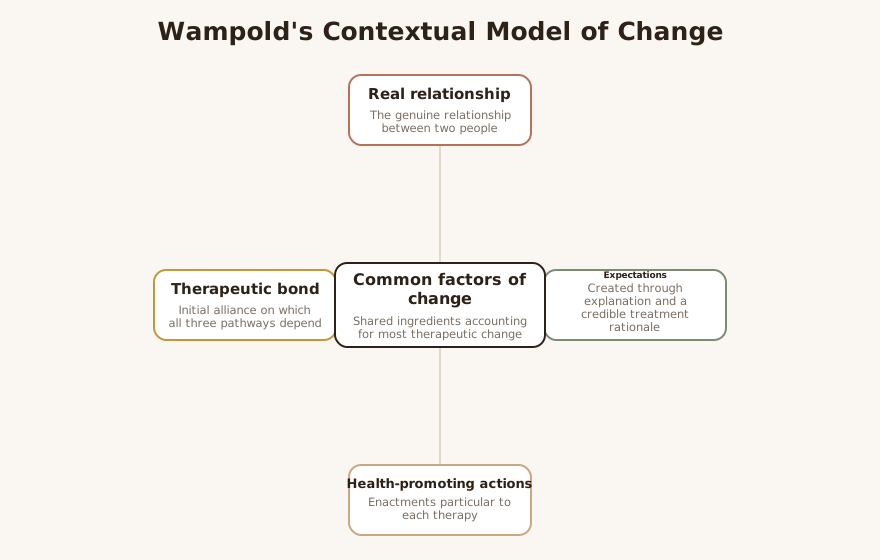
The foundational claim is that the variance in psychotherapy outcomes attributable to common factors substantially exceeds the variance attributable to specific ingredients 1. Wampold’s contextual model proposes three pathways through which change occurs: the real relationship between two people, the creation of expectations through explanation and a credible treatment, and the enactment of health-promoting actions particular to each therapy 1. All three depend on an initial therapeutic bond being established before the work can proceed 1.
The alliance is the most studied common factor and shows a consistent, modest-to-moderate association with outcome across hundreds of studies, with the relationship holding regardless of treatment type, presenting problem, or outcome measure 2. Crucially, the alliance is conceived as more than a precondition or simple rapport: it is the collaborative, purposive engagement of client and therapist around shared goals and agreed tasks, and it appears to be partly therapeutic in itself 2. Evidence that the alliance predicts subsequent symptom change, rather than merely reflecting prior improvement, supports reading it as an active contributor 2.
A second principle is that a believable rationale and the expectations it generates are not inert packaging but working components 1. When a client accepts an explanation for their suffering and a coherent path out of it, hope and expectancy are mobilized, directly countering the demoralization Frank identified 5. A third principle is that effective therapists differ from one another more than treatments do — therapist effects are real and often exceed the differences between bona fide treatments 1.
Interventions & Techniques
Because the framework is not a protocol, its “interventions” are the deliberate cultivation of the factors themselves LLM. The APA Interdivisional Task Force on Evidence-Based Therapy Relationships identified several relationship elements as demonstrably effective, giving clinicians concrete targets: the alliance in individual, child/adolescent, and couple/family therapy; cohesion in group therapy; empathy; collecting and delivering client feedback; and goal consensus and collaboration 3. Positive regard, congruence/genuineness, and the management of countertransference were judged probably effective 3.
In practice, this translates to early and explicit negotiation of goals and tasks so that bond, goals, and tasks are aligned from the outset 2. It means routinely monitoring the alliance and soliciting client feedback, since formal feedback systems are themselves an evidence-based relational practice 3. It means offering a credible, culturally congruent rationale for the chosen approach to mobilize expectancy 1.
LLM-generated illustrative example (not a guideline): A clinician beginning trauma work pauses before introducing exposure to say, “Here’s why avoidance keeps the fear alive, and here’s how facing it gradually retrains your nervous system — does that explanation fit your experience?” The technique that follows is real, but the shared, believable rationale is what converts it into mobilized hope LLM.
Repairing alliance ruptures is a defining technique within this lens, because ruptures are common and their skilled resolution is associated with better outcomes 2. The framework reframes a rupture not as a derailment but as an opportunity to model that conflict in a relationship can be named and survived LLM.
Evidence Base
The evidence base is established and mature, drawing on decades of meta-analysis 1. The most robust finding is the alliance–outcome relationship, replicated across many hundreds of studies and meta-analyses with a stable, moderate effect that holds across modalities and presenting problems 2. Wampold’s 2015 synthesis estimated that common factors collectively account for a far larger share of outcome variance than specific techniques, with the alliance, empathy, expectations, and therapist effects each contributing meaningfully and specific ingredients contributing comparatively little 1.
Honesty about the evidence requires several caveats. The alliance–outcome correlation is correlational, and disentangling the alliance as cause from the alliance as a by-product of early improvement remains an active methodological debate; the strongest studies that separate within-client from between-client variance support a causal reading, but it is not settled 2. The relative-efficacy literature — the finding that bona fide treatments produce broadly equivalent outcomes (the “Dodo bird verdict”) — is contested by proponents of the medical model, and the magnitude of common-factor effects depends on how variance is partitioned 4. The framework is built primarily on adult individual psychotherapy in Western settings, and generalization to all populations is an inference rather than a demonstrated fact for every group 1. None of this overturns the central claim, but it should temper any reading of common factors as the whole story rather than the larger part of it 4.
Populations & Indications
The framework’s defining feature is breadth: because the common factors are present in all bona fide therapies, they are theorized to operate across all diagnostic groups rather than being specific to a disorder 1. The alliance has been studied and supported in adults, in children and adolescents, and in couple and family therapy, and group cohesion serves the analogous function in group treatment 3. This makes the framework directly relevant to people in individual, couples, family, and group modalities alike 3.
For diverse cultural populations, the framework is both a strength and a responsibility: Frank’s anthropological framing explicitly situated psychotherapy among culturally sanctioned healing practices, implying that the rationale offered must fit the client’s cultural worldview to be credible 5. The factors themselves — feeling understood, being offered hope, collaborating on a plausible plan — are plausibly trans-cultural, but their delivery must be tailored LLM. The framework is indicated, in effect, wherever psychotherapy itself is indicated, functioning as a baseline of relational competence beneath whatever specific approach is chosen LLM.
Problems-for-Work
Demoralization and hopelessness. This is the framework’s signature target, the state Frank saw beneath presenting symptoms; mobilizing expectancy through a credible rationale directly addresses it 5.
Therapeutic alliance rupture. The framework treats ruptures as workable clinical events whose repair predicts better outcomes, making rupture itself a focus rather than an obstacle 2.
Low treatment engagement and dropout. A strong early alliance and explicit goal consensus are among the most reliable correlates of staying in treatment, so attending to the factors is a direct intervention on engagement 3.
Symptom distress across depression, anxiety, and PTSD. Because outcome is so strongly tied to the relationship and to mobilized expectation, these common-factor pathways contribute to symptom reduction across these presentations regardless of the specific protocol used 1.
Low self-efficacy and interpersonal problems. The collaborative, agentic stance built into the alliance — the client as active participant in agreed tasks — can itself rebuild a sense of mastery 2.
LLM-generated illustrative example (not a guideline): A demoralized client with chronic depression has “failed” two prior treatments. Rather than immediately selecting a new protocol, the clinician first works to restore expectancy — naming the demoralization, framing the prior “failures” as information, and co-authoring a believable account of what might work this time. Engagement and hope rise before any technique is deployed LLM.
Contraindications, Cautions & Cultural Humility
The framework has no contraindications in the usual sense, since it describes relational conditions present in all good therapy LLM. The genuine cautions are about misapplication. Treating “common factors” as license to abandon structure or evidence-based procedures is a misreading: the contextual model includes health-promoting actions as one of its three pathways, and bona fide treatments still require coherent technique 1. The alliance is necessary but not sufficient, and warmth without a credible plan can leave a client supported but not helped LLM.
A second caution concerns the alliance as a clinical signal: a smooth alliance is not always a good one, and an apparently strong bond can mask avoidance or compliance, while productive work sometimes requires tolerating tension 2. Therapist effects cut both ways — the same data showing that excellent therapists outperform also imply that some therapists reliably do worse, which argues for routine outcome monitoring rather than assumed competence 1.
Cultural humility is structurally central rather than an add-on. Frank’s framing makes the credibility of the therapeutic rationale dependent on its fit with the client’s cultural understanding of suffering and healing, so a rationale that ignores the client’s worldview undermines the very factor it is meant to mobilize 5. Delivering empathy, regard, and goal consensus across cultural difference requires adapting the form while preserving the function, and assuming the factors are “universal” in expression can itself be a microaggression LLM.
Treatment-Plan Suggestions & SMART Objectives
| Goal | SMART objective (example) | Mechanism |
|---|---|---|
| Strengthen the therapeutic alliance | Within the first 3 sessions, client and therapist will agree on a written list of 2–3 treatment goals and the tasks to reach them, reviewed at session 6 2 | Bond–goal–task alignment (Bordin) 2 |
| Restore hope / reduce demoralization | Over 6 sessions, client will report increased confidence that change is possible on a 0–10 scale, rising by at least 2 points 5 | Expectancy mobilized by credible rationale 5 |
| Reduce risk of dropout | Client will complete a brief alliance/feedback measure at the end of every session for 8 weeks, with ruptures addressed within one session 3 | Routine feedback as evidence-based practice 3 |
| Repair an existing rupture | Within 2 sessions of a noted rupture, client and therapist will name the disagreement directly and re-negotiate the task, with client rating the repair as “resolved” 2 | Rupture-repair process 2 |
| Increase client agency / self-efficacy | Over 8 weeks, client will independently propose at least one between-session task in 3 of 4 consecutive sessions 2 | Active collaboration in agreed tasks 2 |
| Improve goal consensus | By session 4, client and therapist will rate goal agreement at ≥8/10 on a shared checklist 3 | Goal consensus and collaboration 3 |
| Deepen felt understanding | Client will report feeling “understood by my therapist” at ≥4/5 on a session rating for 4 consecutive sessions 3 | Empathy as a demonstrably effective element 3 |
Common Misconceptions
“Common factors means technique doesn’t matter.” The framework holds that techniques matter less than the relational and expectancy pathways, not that they are irrelevant; the contextual model explicitly retains health-promoting actions as a change pathway, and a therapy with no credible procedure cannot mobilize expectancy 1.
“The Dodo bird verdict proves all therapies are identical.” Equivalence findings refer to bona fide, structured therapies and are an average across trials; they do not license abandoning evidence-based practice, and the verdict itself remains contested 4.
“The alliance is just rapport or being nice.” The alliance is a structured, purposive collaboration around goals and tasks, not warmth alone, and an overly comfortable relationship can be clinically inert 2.
“Common factors is anti-research or atheoretical.” It is a research-derived meta-theory built on decades of meta-analysis, and Wampold’s contextual model is an explicit, testable account of mechanism 1.
“If outcome is the relationship, the therapist is interchangeable.” The data show the opposite: therapist effects are substantial, meaning who provides the therapy matters considerably 1.
Training & Certification
There is no certification in “common factors,” because it is a framework rather than a proprietary modality LLM. Competence is developed instead through training in the constituent skills — alliance formation, empathic attunement, goal negotiation, soliciting feedback, and rupture repair — which appear across graduate curricula and supervision rather than in a branded credential 3. The APA Division 29 / 12 Task Force reports function as the de facto practice guideline, translating the evidence into trainable relationship behaviors and recommending that these be taught and assessed 3. Routine outcome and alliance monitoring (feedback-informed treatment) is the most concrete trainable practice and has its own measures and procedures 3. The Great Psychotherapy Debate and Persuasion and Healing serve as the foundational texts for clinicians wanting depth in the model 4.
Key Terms
Common factors — the ingredients shared across therapies (relationship, empathy, hope, expectancy, rationale) theorized to account for most of the change 6. Contextual model — Wampold’s framework specifying three change pathways (real relationship, expectations, health-promoting actions), contrasted with the medical model 1. Therapeutic alliance — the bond plus agreement on goals and tasks between client and therapist 2. Dodo bird verdict — the empirical finding of broadly equivalent outcomes across bona fide therapies, named from Rosenzweig’s 1936 metaphor 6. Demoralization — Frank’s construct for the loss of hope and mastery that he saw as the common state of help-seekers 5. Expectancy — the mobilization of hope and anticipated benefit produced by a credible rationale 1. Therapist effects — the substantial differences in outcome attributable to who provides the therapy 1. Alliance rupture — a strain or breakdown in the bond, goals, or tasks, whose repair predicts better outcomes 2.
Resources & Further Reading
▶ Watch — a video introduction to this concept:
- Wampold BE (2015). How important are the common factors in psychotherapy? An update. World Psychiatry
- Wampold BE & Flückiger C (2023). The alliance in mental health care: conceptualization, evidence and clinical applications. World Psychiatry
- Norcross JC & Wampold BE. Conclusions and Recommendations of the Interdivisional (APA Divisions 12 & 29) Task Force on Evidence-Based Therapy Relationships
- Wampold BE & Imel ZE. The Great Psychotherapy Debate, 2nd ed.
- Frank JD, Frank JB & Wampold BE. Persuasion and Healing: A Comparative Study of Psychotherapy
- Common factors theory — Wikipedia
Reflective / Supervision Questions
- When a case stalls, do I first examine the alliance and the client’s hope, or do I reach immediately for a different technique? LLM
- Can I name a recent alliance rupture I noticed in real time, and what did I do with it? 2
- How do I solicit honest feedback from clients who are inclined to please me, and would I actually know if my alliance ratings were inflated? 3
- Is the rationale I offer this particular client credible to them, given their cultural understanding of their suffering, or only to me? 5
- If therapist effects are real, what evidence do I have about whether I am among the more or less effective therapists, and am I willing to track my own outcomes? 1
- Where am I at risk of using “the relationship is what matters” to avoid delivering structured, effective procedures? 1