
Music therapy is one of the oldest and most institutionally established of the arts-based therapies, yet it remains widely misunderstood by referring clinicians who conflate it with “music for relaxation” or with a music education activity. LLM This article frames music therapy for the practicing psychotherapist, social worker, or psychiatrist who may refer to, collaborate with, or work alongside a board-certified music therapist, and clarifies what the evidence does and does not support. LLM
Type & Discipline
Music therapy is a clinical, evidence-based discipline defined by the use of music experiences and the relationships that develop through them as dynamic forces of change. 5 It is a distinct allied-health profession, not a technique that a generalist therapist applies casually; in the United States it is practiced by professionals who hold the MT-BC (Music Therapy, Board Certified) credential. 4 Practically, it is the use of music interventions to accomplish individualized goals such as reducing stress, improving mood, and supporting self-expression within a therapeutic relationship. 4
The discipline sits within the broader family of arts-based and creative arts therapies, alongside art, dance/movement, and drama therapy, and shares with them the premise that nonverbal, sensory, and aesthetic processes can mobilize change where talk alone stalls. LLM It is delivered across psychiatric, medical, rehabilitative, hospice, educational, and community settings, which means a referring clinician will encounter very different presentations of the same profession depending on context. 4
Creators & Lineage
Music therapy has deep cross-cultural roots in the use of music for healing, but its formalization as a profession in the United States dates to the mid-20th century, prompted in part by musicians playing for hospitalized veterans after the World Wars and clinicians observing measurable responses. 4 The intellectual scaffolding of the modern profession owes much to Kenneth E. Bruscia, whose Defining Music Therapy gave the field its working definitions, its taxonomy of clinical practices, and a framework distinguishing the many ways music functions therapeutically. 5 Bruscia’s analysis of music therapy as a reflexive process of intervention through music experiences and therapeutic relationship remains foundational to how clinicians conceptualize their work. 5
The modality draws on humanistic psychology (emphasis on the therapeutic relationship, self-actualization, and the client’s own resources), and it has cross-pollinated with expressive arts therapy and the wider creative arts therapy movement. LLM A major specialized branch, Neurologic Music Therapy, applies models of music perception and production in the brain to motor, speech, and cognitive rehabilitation, and represents the most medicalized lineage of the field. LLM
Core Principles
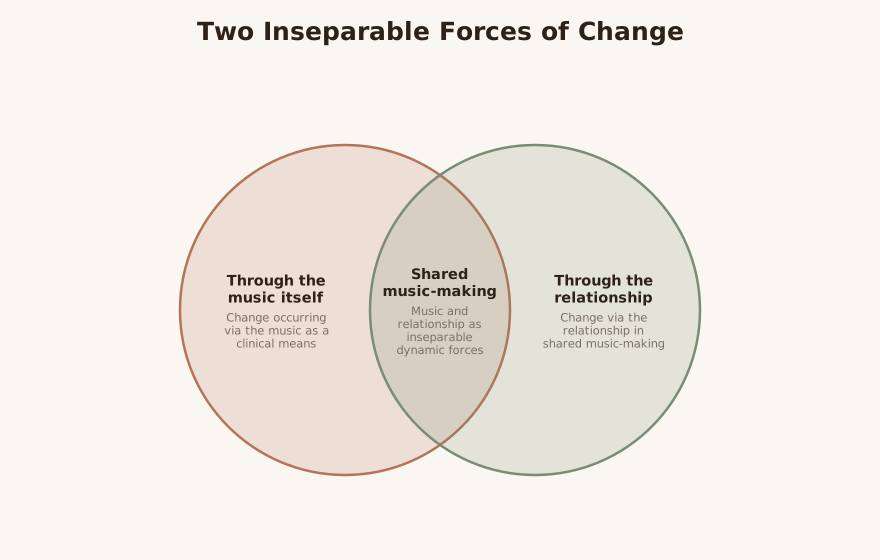
Several principles distinguish clinical music therapy from incidental musical activity. First, the music is a means, not an end: goals are clinical (affect regulation, communication, social engagement, pain coping) rather than musical proficiency. 4 Second, change is understood to occur both through the music itself and through the relationship that develops in shared music-making—Bruscia’s framing treats these as inseparable dynamic forces. 5 Third, no musical skill is required of the client; the therapist meets the client at their level and the value lies in participation, not performance. 4
A further principle is individualization. Interventions are selected and adapted to the person’s culture, history, preferences, and presenting needs, because musical meaning is highly personal and a song that soothes one client may distress another. LLM Finally, music therapy is conceived as relational and embodied—it engages attention, motor systems, breath, and autonomic arousal simultaneously, which is part of why it reaches clients who are preverbal, aphasic, cognitively impaired, or defended against verbal processing. LLM
Interventions & Techniques
Clinical practice is conventionally organized into four broad method families, all of which a credentialed therapist may combine within a session. Improvisation involves the client and therapist creating spontaneous music together on instruments or voice, used to externalize affect, build attunement, and explore relational patterns nonverbally. LLM Receptive (listening-based) methods use selected or live music for relaxation, mood induction, reminiscence, imagery work, or pain and anxiety management. 4 Re-creative methods involve performing or reproducing existing music—singing familiar songs, playing structured parts—which supports memory, motor sequencing, and a sense of mastery. LLM Songwriting and composition help clients author and externalize narrative, identity, and emotional content in a contained form. LLM
In medical and procedural settings, therapists also use music for entrainment of breathing and movement and to modulate the experience of pain and distress. 4 The technique chosen follows the clinical target: receptive listening for an agitated, overstimulated hospitalized patient; improvisation for an adolescent who cannot yet name feelings; re-creative singing for a person with dementia whose autobiographical and procedural musical memory remains accessible long after language declines. LLM
LLM-generated illustrative example (not a guideline): A music therapist working with a withdrawn teenager who shuts down in talk therapy might begin with shared drum improvisation, letting tempo and dynamics carry frustration the teen cannot verbalize, then gradually introduce lyric analysis of songs the teen chooses to open a verbal channel into identity and mood. LLM
Evidence Base
The maturity of the evidence base is best described as established but uneven: music therapy has a sizable controlled-trial and meta-analytic literature, with the firmest support concentrated in a few indications. 3 The strongest signal is in depression. A systematic review and meta-analysis of randomized controlled trials found that music therapy added to treatment as usual produced short-term reductions in depressive symptoms compared with treatment as usual alone, with acceptable dropout rates suggesting it is tolerable. 1 A separate meta-analysis of RCTs likewise reported that music therapy significantly reduced depressive symptoms relative to control conditions, reinforcing the adjunctive benefit. 6
In oncology supportive care, a Cochrane review update synthesized by the American Music Therapy Association concluded that music interventions may have beneficial effects on anxiety, pain, fatigue, and quality of life in people with cancer, supporting its use as a supportive (not curative) intervention. 2 More broadly, the profession’s research base spans psychiatric, medical, neurorehabilitative, and developmental populations, and is curated and summarized by AMTA as part of an ongoing effort to ground practice in evidence. 3
Honest appraisal requires noting the limits. Much of the depression evidence reflects short-term effects, heterogeneous protocols, and added-to-usual-care designs rather than head-to-head comparisons with established psychotherapies. 1 Trials vary in dose, method family, and therapist training, and effect sizes should be read as supporting music therapy as an adjunct rather than a replacement for first-line treatment. 16 Where evidence is presented by professional or hospital organizations rather than primary trials, claims about broad applicability outrun the controlled data and should be weighted accordingly. 4
Populations & Indications
The modality is applied across the lifespan and across acuity levels. In pediatrics it is used with children with developmental disabilities and people with autism spectrum disorder, where music supports communication, joint attention, and social engagement. 4 With adolescents it offers a nonverbal entry point for emotional expression and identity work. LLM In geriatrics it is heavily used with people with dementia and older adults, where preserved responsiveness to music supports mood, agitation reduction, and reminiscence. 4
In medical and psychiatric contexts it serves hospitalized patients, people with chronic illness, and oncology patients for symptom and distress management. 24 It is also applied with veterans, where music-based work is used to address stress, mood, and trauma-related symptoms. LLM Across these groups the common thread is that music reaches affect, arousal, and memory through channels that do not depend on intact verbal processing. LLM
Problems-for-Work
- Major depressive disorder and stress: Adjunctive music therapy can reduce depressive symptoms and is well tolerated, making it a reasonable add-on for clients in concurrent psychotherapy or pharmacotherapy. 16
- Anxiety and chronic pain: In medical settings, music interventions are associated with reductions in anxiety, pain, and fatigue, supporting use during procedures, hospitalization, and oncology care. 24
- Dementia and emotional dysregulation in older adults: Familiar music can lower agitation and lift mood by tapping preserved musical memory. 4
- Autism spectrum disorder, communication deficits, and social skills deficits: Structured and improvised music-making provides a predictable, motivating medium for turn-taking, joint attention, and expressive communication. 4
- PTSD, grief, and emotional dysregulation: Songwriting and improvisation can externalize and contain affect that is difficult to verbalize, used adjunctively within trauma-informed care. LLM
- Neurorehabilitation needs: Rhythmic and re-creative methods (the neurologic music therapy branch) are used to support gait, motor sequencing, and speech recovery. LLM
LLM-generated illustrative example (not a guideline): For a grieving older adult with early dementia, a therapist might use re-creative singing of songs from the client’s young adulthood to access autobiographical memory, opening space for reminiscence and shared affect that the client can no longer initiate through conversation alone. LLM
Contraindications, Cautions & Cultural Humility
Music therapy is generally low-risk, but it is not inert. Music is a potent affective and autobiographical cue, and a piece tied to trauma, loss, or a destabilizing memory can flood or dysregulate a client rather than soothe them. LLM Receptive listening with highly arousing or emotionally loaded material warrants the same titration and stabilization logic used in any trauma-informed work. LLM In acute psychosis, severe agitation, or sensory hypersensitivity (including some autistic clients), overstimulating musical environments may worsen distress and should be adapted or avoided. LLM
Cultural humility is central because musical meaning is inseparable from culture, generation, religion, and personal history; imposing the therapist’s musical canon can be alienating or invalidating, whereas eliciting the client’s own repertoire respects their identity and increases engagement. LLM Practitioners should also be honest with clients and referrers about scope: music therapy is supportive and adjunctive for most indications, not a stand-alone cure, and should not displace evidence-based first-line care for serious conditions. 24 Finally, the work should be delivered by appropriately credentialed practitioners (MT-BC in the U.S.), since the clinical use of music differs fundamentally from recreational or educational music activity. 4
Treatment-Plan Suggestions & SMART Objectives
| Goal | SMART objective (example) | Mechanism |
|---|---|---|
| Reduce depressive symptoms | Client will participate in weekly adjunctive music therapy and report a measurable decrease on a depression rating scale over 8 weeks | Adjunctive music therapy reduces short-term depressive symptoms vs. usual care alone 16 |
| Lower procedural/illness-related anxiety | Hospitalized client will use a therapist-guided receptive listening protocol before procedures, with anxiety ratings reduced across 3 sessions | Music interventions reduce anxiety, pain, and fatigue in medical populations 24 |
| Improve affect regulation in an adolescent | Client will identify and express one emotion per session via improvisation or chosen songs across 6 weeks | Nonverbal music-making externalizes affect that resists verbalization LLM |
| Support communication/social engagement (ASD) | Client will sustain reciprocal turn-taking in structured music tasks for an increasing duration over 10 sessions | Predictable, motivating musical structure scaffolds joint attention and turn-taking 4 |
| Reduce agitation in dementia | Client will engage in familiar-song singing 3x/week with documented reduction in agitation episodes | Preserved musical memory supports mood and lowers agitation 4 |
| Process grief/trauma narrative | Client will compose one song or lyric piece expressing a loss across 4 sessions, then debrief verbally | Songwriting contains and externalizes difficult affect within a safe form LLM |
| Build coping/relaxation skills | Client will independently apply a music-based relaxation strategy during high-stress moments, reported at each session | Receptive music supports autonomic down-regulation and stress relief 4 |
Common Misconceptions
A persistent misconception is that music therapy means listening to relaxing music; in fact receptive listening is only one of four method families, and the discipline equally encompasses active improvisation, re-creative performance, and songwriting. LLM A second is that clients need musical talent—they do not; participation, not performance, is the therapeutic vehicle. 4 A third is that any clinician who uses music in session is “doing music therapy”; the profession is a credentialed allied-health discipline distinct from incidental or recreational music use. 4
A fourth misconception is that music therapy is a fringe or unevidenced practice. While its evidence is uneven, there is a meaningful controlled-trial literature, with replicated adjunctive benefit in depression and supportive benefit in oncology care. 126 The corresponding over-claim—that it cures depression or replaces standard care—is equally inaccurate; the data support it as an adjunct, not a substitute. 12
Training & Certification
In the United States, professional music therapists complete academic and clinical training and hold the MT-BC (Music Therapy, Board Certified) credential, which signals that the practitioner is qualified to deliver clinical music interventions. 4 This credentialing distinguishes clinical music therapy from the use of music by educators, performers, or other health professionals, and is the appropriate marker for referral and collaboration. 4 The American Music Therapy Association serves as the U.S. professional body, maintaining standards and curating the research base that informs practice. 3 Bruscia’s Defining Music Therapy is a standard conceptual reference in training, providing the definitions and taxonomy that organize how clinicians understand and document their work. 5
Key Terms
- Improvisation: Spontaneous, co-created music used to externalize affect and build relational attunement nonverbally. LLM
- Receptive method: Listening-based intervention for relaxation, mood, reminiscence, imagery, or pain/anxiety management. 4
- Re-creative method: Performing or reproducing existing music to support memory, motor sequencing, and mastery. LLM
- Songwriting/composition: Authoring music or lyrics to externalize narrative, identity, and emotion in a contained form. LLM
- MT-BC: Music Therapy, Board Certified—the U.S. clinical credential for professional music therapists. 4
- Neurologic Music Therapy: A specialized, brain-based branch applying music to motor, speech, and cognitive rehabilitation. LLM
- Dynamic forces of change: Bruscia’s framing of music experiences and the therapeutic relationship as the inseparable agents of change. 5
Resources & Further Reading
▶ Watch — a video introduction to this concept:
- Music therapy for patients with depression: systematic review and meta-analysis of RCTs (BJPsych Open)
- Effects of music therapy on depression: a meta-analysis of RCTs (PLOS ONE)
- Music Therapy and Cancer Patients: Cochrane Review Update (American Music Therapy Association)
- Research (American Music Therapy Association)
- Defining Music Therapy, 3rd Edition — Kenneth E. Bruscia (Barcelona Publishers)
- What Is Music Therapy, and How Can It Help Me? (Cleveland Clinic)
Reflective / Supervision Questions
- When I refer a client for “music therapy,” am I confident the practitioner holds an MT-BC credential, and do I understand which method family fits this client’s needs? LLM
- Where am I tempted to use music in my own sessions, and am I framing it honestly as a medium within my billable modality rather than presenting myself as a music therapist? LLM
- For this client, have I considered that a specific song or genre could dysregulate rather than soothe, and how would I titrate and stabilize if it did? LLM
- Whose musical culture is governing the work—mine or the client’s—and what would change if I elicited their repertoire first? LLM
- Am I positioning music therapy accurately as an adjunct to first-line care for serious conditions, rather than overstating it as a stand-alone treatment? 12