
Type & Discipline
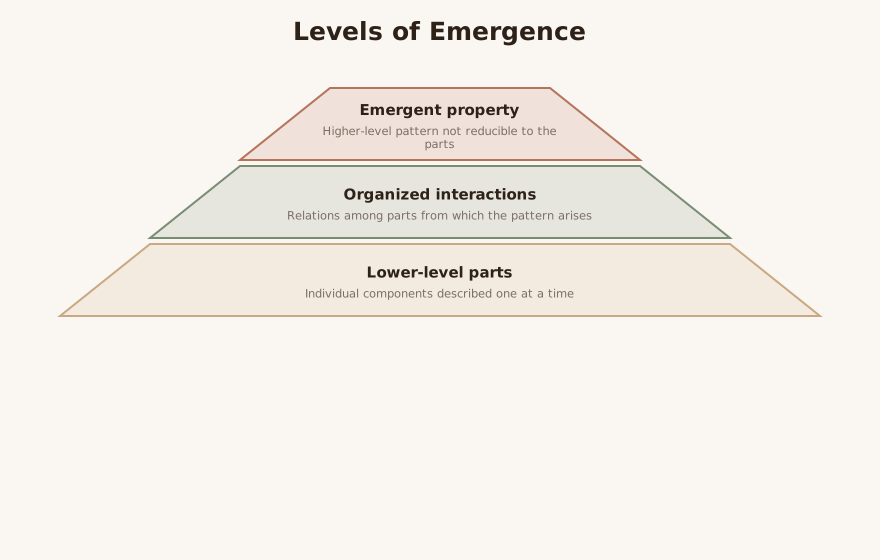
Emergence is a theory in complexity science and the philosophy of science, not a psychotherapy or a clinical protocol 1. Its core claim is that wholes can possess properties and behaviors that their parts, taken in isolation, do not have and could not straightforwardly predict 2. Philosophers distinguish weak emergence, where higher-level patterns are unexpected but in principle derivable from and consistent with the underlying parts, from strong emergence, where higher-level properties are held to be irreducible to, and not deducible from, the lower-level facts even in principle 3. The concept sits within a larger family of complexity and systems thinking that studies how organized order arises from many interacting components 4. For the practicing therapist, emergence is best understood as a conceptual lens that organizes how we think about systems, rather than as a billable treatment in its own right LLM.
This distinction matters from the first paragraph because the article’s evidentiary claims live in two very different registers LLM. As a theory, emergence is mature and widely discussed across physics, biology, and philosophy of mind 2. As a clinical application, its use in therapy is inferential and analogical — borrowed metaphor and framing — and has not been tested as a discrete intervention LLM.
Creators & Lineage
The modern vocabulary of emergence has deep roots in 19th- and 20th-century philosophy of science, including the British Emergentists who debated whether life and mind were reducible to physics and chemistry 2. The most quoted modern articulation belongs to physicist Philip Anderson, whose 1972 essay “More Is Different” argued that at each level of complexity entirely new properties appear, so that the behavior of large aggregates is not a simple extrapolation of the properties of a few particles 4. This “more is different” formula is the single line most worth carrying into the consulting room, because it reframes a couple or family as a level of organization with its own properties rather than a sum of individuals LLM.
The contemporary philosophical framing owes much to David Chalmers, whose treatment of strong versus weak emergence has shaped how the field separates genuinely irreducible novelty from merely surprising-but-derivable complexity 3. More recent work continues to probe the boundary between the two, including formal arguments about how strong-emergence-like behavior might arise out of weak-emergence substrates 5. For clinicians, the relevant lineage is the systems tradition that grew alongside these ideas: general systems theory, dynamical systems theory, and family systems theory all treat interaction patterns, feedback, and organization as primary units of analysis 4. These are the bridges through which an abstract complexity concept becomes clinically usable LLM.
Core Principles
The foundational principle is non-reducibility: a system’s higher-level properties cannot be fully captured by describing its parts one at a time 2. Closely related is non-predictability, the idea that even with full knowledge of the components, the emergent pattern may not be forecastable in advance, especially in the strong case 3. A third principle is that emergence is relational — properties belong to the organization and interaction of parts, not to the parts themselves 4. Emergence is therefore tightly linked to ideas of supervenience and levels of description, in which higher-level facts depend on lower-level ones without being reducible to them 1.
A further principle relevant to therapy is downward influence: in many emergentist accounts the higher level can constrain or shape the behavior of the lower-level components from which it arose 1. Translated to practice, this is the observation that a family’s established pattern — its “way things go” — shapes how each individual behaves, even as that pattern is itself produced by those same individuals LLM. Finally, weak emergence reminds us that “unpredictable” need not mean “mysterious”; many emergent patterns are fully consistent with the parts and become legible once we model the interactions rather than the individuals 3.
Interventions & Techniques
Emergence does not supply techniques of its own; it supplies a stance that informs how existing systemic techniques are selected and explained LLM. The first move is a unit-of-analysis shift: the clinician treats the relationship, family, or group — not the individual — as the system whose properties are being assessed and changed LLM. From that stance, several established systemic techniques become coherent applications LLM.
Pattern tracking and circular questioning map the feedback loops through which a presenting symptom is maintained, on the assumption that the symptom is an emergent product of repeated interaction rather than a property of one member LLM. Reframing relocates the “problem” from a person to a pattern, which lowers blame and opens leverage points LLM. Enactments and structural interventions deliberately perturb the system’s interaction sequence so a new, more adaptive pattern has room to self-organize LLM. In group work, the facilitator attends to the group-as-a-whole — norms, roles, and climate — as emergent phenomena that can be named and shaped rather than reduced to individual contributions LLM. Across all of these, the common thread is intervening at the level of interaction, because that is the level at which the emergent property actually lives LLM.
LLM-generated illustrative example (not a guideline): A couple presents with “his anger and her withdrawal.” Rather than treating two separate problems, the clinician tracks the cycle — a bid, a perceived criticism, a raised voice, a shutdown, a longer silence, more pursuit — and names the cycle itself as the client. The emergent pattern is the target; neither partner’s trait is. LLM
Evidence Base
Honesty about maturity requires holding two facts side by side LLM. As a theory within complexity science and philosophy of science, emergence is well-established and extensively developed, with a substantial literature analyzing weak versus strong forms, supervenience, and downward causation 1. Reference and encyclopedic treatments present it as a serious, mainstream — if still contested — concept rather than a fringe idea 2. The internal debates are live: there is ongoing argument about whether strong emergence is coherent at all, and recent formal work explores how it might be reconstructed from weaker foundations 5.
What does not exist is an evidence base for “emergence” as a clinical treatment LLM. There are no randomized trials, manualized protocols, or outcome studies of emergence-as-therapy, because it is a conceptual lens, not an intervention LLM. The empirical support that clinicians can legitimately lean on belongs to the systemic modalities that operationalize emergent thinking — family therapy, couples therapy, and group psychotherapy — each of which has its own (separate) evidence base LLM. The correct claim is therefore narrow: emergence is an established theory whose clinical value is heuristic and framing-related, and any outcome claims must be borrowed from the validated modality used to deliver the work, not from emergence itself LLM.
Populations & Indications
The lens is most indicated wherever the clinically meaningful unit is larger than one person LLM. Family and couple systems are the paradigm case, because relational symptoms are naturally read as emergent properties of interaction LLM. Group therapy facilitators and members benefit when group-level phenomena — cohesion, scapegoating, subgrouping — need to be understood as products of the whole LLM. Organizations and communities are an apt application when dysfunction recurs regardless of which individuals occupy which roles, suggesting a structural rather than personal driver LLM.
People in complex life transitions can be served by the framing when a destabilized system is reorganizing and new patterns are forming LLM. Systems theorists and clinicians use the concept to keep multi-level formulations coherent, and researchers studying interaction data draw on emergence to justify modeling patterns rather than isolated variables 4. The lens is least relevant when a problem is genuinely individual and intrapsychic and adding a systemic frame would obscure rather than clarify LLM.
Problems-for-Work
Family conflict. Recurrent conflict is framed as an emergent cycle the family co-produces; the work targets the sequence and its triggers rather than assigning a culprit LLM.
Relationship dynamics. Pursue-withdraw, criticism-defense, and similar couple patterns are treated as system-level properties, intervened on through enactment and cycle interruption LLM.
Systemic dysfunction. When a “fixed” individual problem reappears, the clinician looks for the system property that regenerates it, consistent with the principle that higher-level organization constrains its parts 1.
Group process difficulties. Stalled or hostile group climates are addressed at the level of group norms and roles, the emergent properties that no single member controls LLM.
Reductionistic thinking. The lens is itself an antidote to “it’s all just one person’s problem”; “more is different” gives the clinician language for why the whole behaves differently than the parts 4.
Complex psychosocial problems. Multi-causal presentations are formulated across levels — individual, relational, community — without collapsing them into a single linear cause LLM.
Organizational dysfunction. Persistent team or institutional patterns are read as structural and self-organizing, directing intervention toward feedback loops and incentives rather than personnel alone LLM.
Contraindications, Cautions & Cultural Humility
The chief caution is overreach: treating an evocative metaphor as if it were validated mechanism LLM. Because strong emergence remains philosophically contested, clinicians should avoid invoking “emergence” as a quasi-mystical explanation that ends inquiry rather than guiding it 3. A systemic frame can also be misused to dilute individual accountability — for example, reframing abuse as a “cycle both partners create”; safety, power, and harm must never be flattened into symmetrical “patterns” LLM. Where there is violence, coercion, or active risk, individual safety planning takes precedence over systemic reframing LLM.
The lens can mask intrapsychic or biological contributors (trauma, mood disorders, neurodevelopmental conditions) if everything is attributed to “the system”; sound formulation keeps multiple levels in view rather than privileging one 1. Culturally, what counts as a healthy family or group “pattern” is shaped by cultural norms about hierarchy, gender, and interdependence, so the clinician must hold their model of the system humbly and let the family define its own emergent properties LLM. Cultural humility also means recognizing that a complexity vocabulary is a Western academic frame and may not match a client’s own way of describing how their relationships work LLM.
Treatment-Plan Suggestions & SMART Objectives
| Goal | SMART objective (example) | Mechanism |
|---|---|---|
| See the problem as a pattern, not a person | Within 4 sessions, the couple will jointly describe their recurring conflict cycle in 3 steps without assigning sole blame, in 2 of 3 consecutive sessions | Relocates symptom from individual to emergent interaction pattern 4 |
| Interrupt a maintaining loop | Over 8 weeks, the family will use one agreed “pause” signal to break the escalation sequence at least twice per week, logged in a shared sheet | Perturbs the feedback loop so a new pattern can self-organize LLM |
| Name group-level dynamics | By session 6, the group will identify 2 group norms (e.g., scapegoating, conflict-avoidance) affecting the climate, reported in group | Makes emergent group-as-a-whole properties explicit and workable LLM |
| Reduce reductionistic attribution | Within 5 sessions, client will reframe 3 “it’s all his fault” statements into pattern-level descriptions, rated by clinician | Counters reductionism using “more is different” framing 4 |
| Map multi-level contributors | By week 4, client and clinician will complete a 3-level formulation (individual / relational / community) of the presenting problem | Keeps higher- and lower-level factors in view without collapse 1 |
| Stabilize a system in transition | Over 6 weeks, the family will establish 2 new predictable routines during the transition, sustained for 3 consecutive weeks | Supports adaptive reorganization as new patterns emerge LLM |
| Shift structural drivers in a team | Within 1 month, the team will redesign 1 feedback loop (e.g., handoff process) and review its effect at 30 days | Targets self-organizing structure rather than individuals LLM |
Common Misconceptions
A frequent error is treating emergence as magic — assuming that because a property is “emergent” it is therefore inexplicable or supernatural; weak emergence is fully consistent with, and often derivable from, the underlying parts 3. A second misconception conflates “complicated” with “emergent”; emergence specifically concerns novel higher-level properties arising from interaction, not mere quantity of detail 2. A third is the belief that strong emergence is settled science; in fact its very coherence is debated, and some work tries to recover it from weaker premises rather than assuming it 5.
Within clinical settings, the most consequential misconception is that “systemic” means “no one is responsible.” Emergence describes how patterns arise; it does not erase individual agency, choice, or accountability, and it must not be used to neutralize harm LLM. Finally, clinicians sometimes assume emergence is itself a treatment with its own evidence; it is a framing concept, and its clinical legitimacy comes entirely from the validated modalities through which it is enacted LLM.
Training & Certification
There is no certification in “emergence” as a clinical method, because it is a theory rather than a credentialed therapy LLM. Clinicians acquire the conceptual grounding through complexity-science and philosophy-of-science literature, where the weak/strong distinction and supervenience are standard topics 1. The applied competence, however, is gained through training in the systemic modalities that operationalize it LLM.
Practically, that means structured training and supervision in family and couples therapy (for example, structural, strategic, and other systemic models) and in group psychotherapy, each of which has its own recognized training pathways and supervision requirements LLM. A clinician seeking to use emergence well should therefore pursue credentialing in a systemic modality and treat emergence as a cross-cutting theoretical orientation layered on top of that training LLM. Familiarity with the primary complexity literature strengthens formulation but is not, by itself, a clinical qualification 2.
Key Terms
Emergence — the arising of higher-level properties or patterns from the interaction of lower-level parts, not reducible to or predictable from those parts alone 2. Weak emergence — emergent properties that are unexpected yet in principle derivable from and consistent with the underlying components 3. Strong emergence — emergent properties held to be irreducible and not deducible even in principle from the lower level 3. Reductionism — the view that a whole can be fully explained by analyzing its parts, the position emergence resists 2.
Supervenience — the dependence of higher-level facts on lower-level ones such that there can be no higher-level change without a lower-level change 1. Downward causation — the idea that emergent higher levels can constrain or influence the lower-level parts they arise from 1. “More is different” — Philip Anderson’s formulation that new properties appear at each level of organization, so aggregates are not simple extrapolations of their parts 4. Self-organization — the spontaneous appearance of ordered patterns from local interactions without external design, a hallmark of complex systems 4.
Resources & Further Reading
▶ Watch — a video introduction to this concept:
- Stanford Encyclopedia of Philosophy — “Emergent Properties”
- Internet Encyclopedia of Philosophy — “Emergence”
- Chalmers, D. J. — “Strong and Weak Emergence”
- Wikipedia — “Emergence”
- “Strong Emergence Arising from Weak Emergence” (arXiv 2202.00431)
Reflective / Supervision Questions
- When you formulated this case, did you treat the individual or the relationship/group as the primary unit, and what did that choice make visible or invisible LLM?
- Where in your current caseload might a stubborn “individual” problem actually be an emergent property the system keeps regenerating LLM?
- Are you using “it’s systemic” to open inquiry into specific feedback loops, or to close it with a comforting abstraction LLM?
Have you guarded against using a systemic frame to dilute accountability for harm, power imbalance, or safety risk LLM? Whose cultural definition of a healthy family or group pattern is operating in your formulation — yours or the client’s LLM? And finally, are your documented outcome and medical-necessity claims anchored in the validated modality you are actually billing, rather than in emergence theory itself LLM?