
Type & Discipline
Vipassana (Pali; literally “special seeing,” from vi- “special, super” and -passanā “seeing”) is a contemplative practice drawn from Buddhist meditative tradition, commonly translated as “insight” or “clear-seeing” meditation. 1 It is not a treatment protocol, a credentialed modality, or a clinical technique in itself; it is a method of sustained attention with a specific aim — to see experience “as it really is.” 4 One classical teacher describes it as “looking into something with clarity and precision, seeing each component as distinct and separate,” and the contemporary teacher Bhante Gunaratana defines it as “a clear awareness of exactly what is happening as it happens.” 13
Within the broader landscape of meditation, vipassana belongs to the family of open-monitoring practices — “the practice of sitting with a wide, non-directed awareness, noticing thoughts, feelings, and sensations as they arise and dissolve, without chasing or suppressing any of them.” 7 This distinguishes it from focused-attention (concentration) practices, which sustain attention on a single anchor such as the breath or a mantra. 7 For clinicians, the most useful framing is that vipassana is the contemplative root of the secular mindfulness-based interventions now embedded in evidence-based care, rather than a freestanding therapy a clinician would deliver and document on its own. LLM
Creators & Lineage
Vipassana is presented in the Buddhist tradition as a practice taught by the Buddha and threaded through the early canon, where it is paired with samatha (calm/tranquility) as two complementary mental qualities. 1 In the early texts these were not separate practices but qualities cultivated together; later scholastic traditions divided them into distinct paths, with samatha developing concentration and stability and vipassana discerning the true nature of phenomena. 1
The modern transmission relevant to clinicians runs through the twentieth-century Burmese Vipassana movement. 2 Ledi Sayadaw (1846–1923) “prepared groundwork by re-introducing the practice of meditation, based on the Abhidhamma.” 2 Mahasi Sayadaw (1904–1982) popularized the “New Burmese Method,” emphasizing vipassana through satipatthana (mindfulness) practice and the moment-by-moment noting or labeling of mental and physical events. 24 U Ba Khin (1899–1971), a Burmese lay master, taught the lineage’s most globally visible figure, S. N. Goenka (1924–2013), an Indian lay teacher who carried the practice worldwide. 2 Goenka taught that conversion to Buddhism was unnecessary to practice, which made the method readily transmissible across religious lines; his courses are “usually taught in 10-day retreats, in which 3 days are given to the practice of anapanasati [breath awareness] … and the rest of the time is given to Vipassanā in the form of ‘body sweep’ practice.” 2
The practice reached the West largely through teachers who trained in this Asian lineage and then founded the Insight Meditation Society (IMS) in Barre, Massachusetts in 1976 — Jack Kornfield, Joseph Goldstein, and Sharon Salzberg. 25 Goldstein “has been leading insight and lovingkindness meditation retreats worldwide since 1974,” trained “under eminent teachers from India, Burma and Tibet,” and authored foundational texts including Mindfulness: A Practical Guide to Awakening and Insight Meditation: The Practice of Freedom. 5 He frames vipassana as a direct, experiential insight into the workings of the mind rather than a belief to be adopted. 6 From these roots, since the 1980s the movement “has given way to the largely secularised ‘mindfulness’ practice,” prioritizing “the awareness that arises by paying attention on purpose, in the present moment, and non-judgmentally” — the lineage that produced Mindfulness-Based Stress Reduction, Mindfulness-Based Cognitive Therapy, and the mindfulness module of Dialectical Behavior Therapy. 2LLM
Core Principles
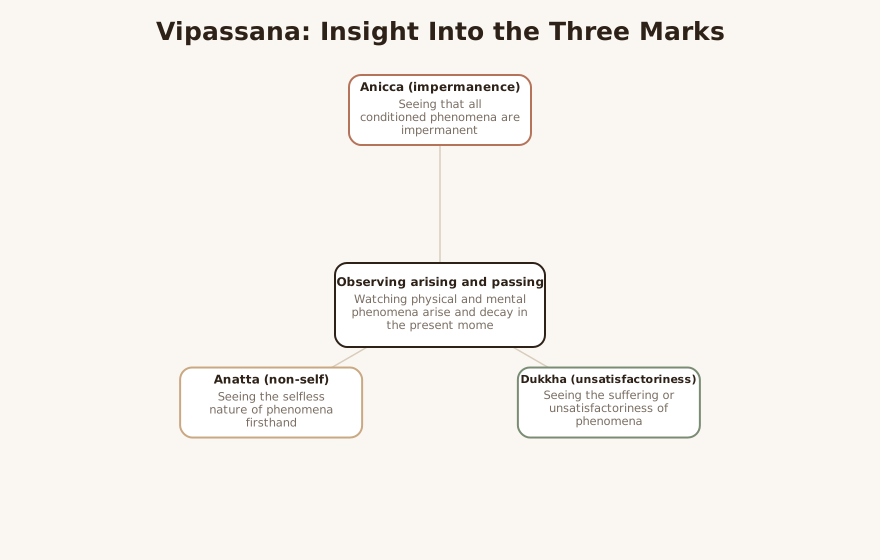
1. Insight into the three marks of existence. Vipassana seeks direct, experiential insight into the ti-lakkhana — the three characteristics said to mark all conditioned phenomena: anicca (impermanence), dukkha (suffering or unsatisfactoriness), and anattā (non-self). 1 The stated object of the practice is “to learn to see the truth of impermanence, unsatisfactoriness, and selflessness.” 3
2. Observing arising and passing. The method works by observing “the continuous, lightning-fast process of the arising and decay of physical and mental phenomena, completely in the present moment.” 4 By watching bodily sensations and mental events come and go, the practitioner perceives their impermanent, unsatisfactory, and selfless nature firsthand rather than as an idea. 14
3. Concentration in service of insight. Vipassana characteristically uses concentration as a tool, not an end. 3 As Gunaratana puts it, “the meditator uses his concentration as a tool by which his awareness can chip away at the wall of illusion.” 3 Lineages differ on emphasis: U Ba Khin and Goenka develop calm concentration first, whereas the Mahasi method develops insight through noting “without preliminary concentration training.” 24
4. Equanimity toward experience. The functional payoff most relevant to clinicians is a non-reactive stance: observing sensations, thoughts, and urges without reflexively grasping the pleasant or pushing away the unpleasant. LLM In open-monitoring terms, this is “noticing thoughts, feelings, and sensations as they arise and dissolve, without chasing or suppressing any of them.” 7
Interventions & Techniques
Vipassana itself is a structured attentional practice; the clinically usable techniques are the elements that secular mindfulness programs have absorbed from it. LLM
Breath awareness (anapana) as an anchor. Practice typically begins with sustained attention to the physical sensation of breathing — for example, at the nostrils — gently returning attention each time the mind wanders: “Gently, but firmly … simply return to the simple physical sensation.” 3 In Goenka-lineage courses, several days are devoted to this concentration foundation before insight practice. 2
Body scan / “body sweep.” A signature method is the systematic sweep of attention through the body, observing sensations arise and pass region by region. 2 This sensation-anchored observation is the direct ancestor of the body-scan exercises used across MBSR and MBCT. LLM
Noting / labeling. In the Mahasi-derived approach, the practitioner silently notes mental and physical phenomena as they arise (“rising,” “thinking,” “hearing”), which builds meta-awareness and decentering — observing experience rather than being fused with it. 24
Open monitoring / choiceless awareness. Beyond a single anchor, the practitioner rests in “a wide, non-directed awareness,” tracking whatever arises without preference. 7 This is the open-monitoring pole of meditation, contrasted with focused-attention concentration. 7
LLM-generated illustrative example (not a guideline): A clinician adapts a brief, secular body-scan for a stressed client. The client is guided to move attention slowly from feet to head, simply noting “warmth,” “tension,” or “neutral” at each region, and to observe — without fixing anything — how each sensation shifts within seconds. The aim is not relaxation per se but practiced contact with the changing, non-permanent character of bodily experience. LLM
Evidence Base
Honesty about maturity is essential. As a contemplative practice, vipassana is established — an ancient, well-documented method with a continuous transmission lineage and a large global teaching infrastructure. 12 As a standalone clinical intervention with its own dedicated outcome trials, however, “vipassana therapy” is not a discrete, manualized treatment, and clinicians should not present the retreat practice itself as a proven medical intervention. LLM
The defensible clinical evidence belongs to the secular mindfulness-based therapies that carry vipassana’s functional core — MBSR, MBCT, and the mindfulness skills of DBT — each with its own controlled literature for conditions such as stress, anxiety, depressive relapse, and emotion dysregulation. 2LLM Clinicians should anchor evidentiary claims there rather than to the contemplative practice as such. LLM
Two further evidence signals are worth noting at the level of the source explainers. First, the open-monitoring literature describes mechanism-level effects: reduced “repetitive negative thinking; lower trait anxiety” through training people to “observe worry without engaging it,” and “faster recovery from negative affect; less emotional reactivity” via strengthened “prefrontal regulation of the amygdala.” 7 These are reported as research-linked effects of the open-monitoring style, not as guideline-grade clinical endorsements, and should be weighted accordingly. 7LLM Second, in applied settings, vipassana was introduced to India’s Tihar Jail in 1993, with the documentary Doing Time, Doing Vipassana reporting that “inmates who completed the ten-day course were less violent and had a lower recidivism rate” — a real-world signal, but observational and not a controlled trial. 2 Stated plainly: the practice is mature; the secular mechanisms it informs have their own evidence base; the retreat practice itself has limited rigorous clinical-trial support and should be framed cautiously. LLM
Populations & Indications
Vipassana-informed work is most natural for clients suited to mindfulness and acceptance approaches. LLM The lineage and source material point to several populations: meditators and others with an existing contemplative interest, who can extend their practice toward insight; adults under stress, where present-moment, non-reactive observation is most directly transferable to secular stress-reduction work; and people with anxiety, where observing worry without engaging it maps onto established decentering mechanisms. 7LLM
It is also relevant for people with chronic pain, where sensation-by-sensation observation can reframe pain as a fluctuating process rather than a fixed monolith; for incarcerated populations, given the documented prison-program history; and for people in recovery from addiction, where non-reactive observation of urges supports urge surfing. 24LLM In every case, the clinically responsible move is to deliver the mechanism (decentering, equanimity, interoceptive awareness) within a secular, evidence-based container rather than prescribing intensive residential retreat practice as treatment. LLM
Problems-for-Work
- Anxiety and rumination. Open-monitoring practice trains the client to “observe worry without engaging it,” loosening fusion with repetitive thought and reducing trait anxiety. 7
- Reactivity and emotion dysregulation. Watching sensations and emotions arise and pass builds equanimity and “less emotional reactivity,” supporting distress tolerance. 7LLM
- Chronic pain. Body-scan-style observation reframes pain as a changing process to be witnessed rather than a static, total state to be resisted. 4LLM
- Substance use disorder. Direct observation of urges arising and ceasing supports non-reactive “urge surfing,” a corollary of the impermanence the practice reveals. 4LLM
- Stress and insomnia. Sustained, present-moment attention to the breath and body offers a portable down-regulation skill for arousal and pre-sleep rumination. 3LLM
LLM-generated illustrative example (not a guideline): A client in early recovery reports intense cravings each evening. Within a secular mindfulness frame, the clinician coaches a 90-second practice of observing the craving’s bodily sensations — where it sits, its intensity, its edges — and tracking how it crests and subsides if not acted upon. Over weeks, the client gathers lived evidence that the urge is a passing event rather than a command, reducing reactive use. LLM
Contraindications, Cautions & Cultural Humility
The clearest documented caution concerns the open-monitoring style itself: “wide, unanchored awareness can destabilize people with certain trauma histories,” and the recommended response is to return to “breath focus or seek guidance from a trained teacher.” 7 For clients with trauma, dissociation, or fragile identity, intensive interoceptive or sensation-watching practice should be titrated, grounded, and never assumed safe simply because it is “mindful.” 7LLM
A second caution is dose and setting. The intensive 10-day residential retreat is a demanding, silent, multi-hour-per-day practice that is not equivalent to a brief in-session exercise, and it is a poor first recommendation for clients with acute symptoms, limited support, or destabilizing histories. 2LLM What clinicians can responsibly offer is the secularized, graded version inside an evidence-based modality, with attention to titration. LLM Watch, too, for spiritual bypassing — using “everything is impermanent” or “observe and let go” to suppress legitimate emotion rather than to relate to it differently. LLM
On cultural humility: vipassana is a sacred practice within living Buddhist traditions, held in its source lineages as a path to liberation, not merely a coping tool. 14 Although Goenka explicitly taught that the technique can be practiced without religious conversion, clinicians should still name the Buddhist origins, avoid presenting a decontextualized “technique” as their own invention, and remain attentive to clients for whom the religious framing is resonant or, conversely, in tension with their own faith. 2LLM
Treatment-Plan Suggestions & SMART Objectives
| Goal | SMART objective (example) | Mechanism |
|---|---|---|
| Reduce reactivity to distressing emotions | Within 6 weeks, client completes a 5-minute “observe and let pass” sensation practice 4x/week, reviewed in session | Equanimity; less emotional reactivity via non-reactive observation 7 |
| Decrease worry/rumination | Within 6 weeks, client applies an “observe worry without engaging it” practice to 3 noted worry episodes/week, logged | Decentering from transient mental events 7 |
| Build interoceptive awareness for anxiety | Within 8 weeks, client completes a brief body scan 5x/week and rates ability to notice sensations without acting (≥6/10) | Sensation-anchored present-moment attention 23 |
| Improve urge management in recovery | Over 8 weeks, client applies urge-surfing observation to ≥70% of logged cravings and rates post-urge intensity | Observing urges arise and cease without acting 4 |
| Reduce secondary suffering from chronic pain | Over 8 weeks, client tracks pain as a fluctuating (not fixed) rating during a brief body scan 5x/week | Reframing pain as a changing process, not a monolith 4 |
| Strengthen present-moment attentional control | Within 6 weeks, client practices 10 minutes of breath-anchored attention daily, returning attention when the mind wanders | Concentration as a foundation for insight 3 |
| Lower pre-sleep arousal/rumination | Within 6 weeks, client uses a 10-minute body-scan at bedtime ≥5 nights/week and rates sleep-onset distress (0–10) | Present-moment attention down-regulates arousal 3LLM |
Common Misconceptions
“Vipassana means clearing or emptying the mind.” It is the opposite — a “clear awareness of exactly what is happening as it happens,” including thoughts, rather than an attempt to stop thought. 3 The practitioner observes mental events; they do not erase them. 4
“It’s just relaxation / a calming technique.” Calm (samatha) and insight (vipassana) are distinct; concentration is used as a tool to “chip away at the wall of illusion,” and the stated aim is insight into impermanence, unsatisfactoriness, and selflessness, not relaxation. 13
“Concentration and insight are the same thing.” Open monitoring (tracking everything that arises, with no fixed anchor) and focused attention (sustaining attention on a single object) are different attentional modes with different strengths; vipassana is centrally the open-monitoring mode. 7
“Awareness alone is the point.” In the source tradition the insight must be seen directly and lived through sustained observation — “to see things as they are” — not merely understood as an idea. 4LLM
“It is inherently safe for everyone.” Wide, unanchored awareness can destabilize people with certain trauma histories, which is why titration and trained guidance matter. 7
Training & Certification
There is no clinical “vipassana therapist” certification, because vipassana is a contemplative practice rather than a credentialed treatment. LLM On the contemplative side, the practice is transmitted through residential courses and teaching organizations within the lineage — most visibly the Goenka-tradition 10-day retreats and the Western insight-meditation infrastructure built around the Insight Meditation Society and the Barre Center for Buddhist Studies. 25 Teachers such as Joseph Goldstein exemplify the depth of training and decades of practice expected to teach the method itself. 5
For clinicians who intend to deliver and document this work, the relevant credentials are in the secular therapies that carry the concept: structured MBSR and MBCT teacher training, and DBT mindfulness-module competency, each with supervision and consultation. 2LLM A personal meditation practice deepens a clinician’s ability to teach observation skillfully and to anticipate the destabilization risks, but it is not a substitute for training in the evidence-based clinical container in which the work is actually delivered. 7LLM
Key Terms
- Vipassana — “insight” or “clear-seeing” meditation; observing phenomena “as they really are.” 14
- Samatha — calm/tranquility meditation; concentration and mental stability, complementary to vipassana. 1
- Ti-lakkhana (three marks of existence) — anicca (impermanence), dukkha (unsatisfactoriness), anattā (non-self). 1
- Anicca — impermanence; the continuous arising and passing of all conditioned phenomena, observed directly in practice. 14
- Anattā — non-self; the selfless character of the process of arising and decay. 14
- Anapana(sati) — mindfulness of breathing; the concentration foundation that opens many vipassana courses. 2
- Body sweep / body scan — systematic observation of sensations through the body, a signature Goenka-lineage method. 2
- Noting / labeling — silently naming mental and physical events as they arise (Mahasi method). 24
- Open monitoring — wide, non-directed awareness of whatever arises, without chasing or suppressing it; the meditation family vipassana belongs to. 7
- Equanimity — the non-reactive, balanced stance toward arising and passing experience that the practice cultivates. LLM
Resources & Further Reading
▶ Watch — a video introduction to this concept:
- Vipassanā (Samatha-vipassanā) — Wikipedia
- Vipassana movement — Wikipedia
- What Exactly Is Vipassana Meditation? — Tricycle
- What is Vipassana? — Buddho.org
- Joseph Goldstein — Insight Meditation Society
- Vipassana & the experience of insight into the mind — Joseph Goldstein (YouTube)
- Open Monitoring Meditation (Vipassana) — Neurolaunch
Reflective / Supervision Questions
- When I introduce sensation- or open-monitoring practice, have I screened for trauma history or dissociation and titrated accordingly, rather than assuming “mindful” equals “safe”? 7
- Am I matching dose to the client — a brief, graded in-session exercise versus an intensive residential retreat — and is my recommendation appropriate to their current stability and supports? 2LLM
- Am I distinguishing concentration (calming, anchoring) from insight (observing impermanence and reactivity), and choosing the mode that fits this client’s goal? 13
- Could this client be using “observe and let go” to bypass or suppress an emotion that actually needs to be approached and validated? LLM
- Which secular, evidence-based modality (MBSR, MBCT, DBT mindfulness) am I actually delivering this within, and does my documentation reflect that mechanism rather than the contemplative label? 2LLM
- Am I naming the Buddhist origins of this practice and holding it with cultural humility, while remaining attentive to how the framing lands for a client of a different faith or worldview? 14LLM