
Type & Discipline
Behavior therapy (first-wave behaviorism) is a treatment modality within clinical psychology grounded in the experimental study of learning 1. It is the original behavioral paradigm: it conceptualizes psychological disorders as learned responses that can be modified through the same conditioning principles that produced them, without appeal to internal cognition 1. The discipline draws a clean line between methodological behaviorism — Watson’s position that only observable behavior is the legitimate object of study — and radical behaviorism, Skinner’s later view that private events such as thoughts and feelings are themselves covert behaviors obeying the same laws of learning 1. In its first-wave form, the clinical target is always the observable response and the environmental contingencies that maintain it, not the meaning a client assigns to it 1.
This article describes “first-wave” behavior therapy specifically: the conditioning-based interventions that predate the cognitive turn of the 1960s and that remain in active clinical use today 1. It is the historical and mechanistic foundation on which cognitive-behavioral therapy (CBT) was later built 1.
Creators & Lineage
The intellectual lineage runs from laboratory animal research to the clinic 1. Pavlov’s work on conditioned reflexes established classical conditioning — the pairing of a neutral stimulus with one that already elicits a response — and Watson’s behaviorist philosophy translated this into a program for psychology that emphasized observable behavior over mental processes 1. Skinner extended the framework with operant conditioning, the study of how behavior is shaped by its consequences, and contributed the functional analysis of behavior and the broader philosophy of behavioral science 14.
A pivotal clinical moment came with Hans Eysenck’s 1952 analysis comparing psychotherapy outcomes against untreated controls, which concluded that the prevailing psychotherapy of the era was no better than no psychological treatment at all 1. This critique damaged the credibility of psychoanalysis and opened space for learning-based approaches 1.
Joseph Wolpe (1915–1997) supplied the first empirically validated behavioral treatment for a clinical disorder 13. A South African physician who treated “war neuroses” during World War II and was influenced by Pavlov and Hull, Wolpe induced experimental “neurosis” in cats with shock, then gradually reintroduced feeding in environments increasingly similar to the shock chamber until the animals ate calmly where they had previously been fearful 3. From this he derived the reciprocal inhibition principle: an anxiety-response habit can be weakened by evoking a response incompatible with anxiety in the presence of the anxiety-evoking stimulus 3. Adopting Jacobson’s progressive relaxation as that incompatible response and using imagined scenes for controlled, graded exposure, Wolpe built systematic desensitization — a measurable, stepwise procedure that forced mainstream psychology to recognize behavior therapy’s effectiveness 3. His reciprocal-inhibition model is widely regarded as a unique contribution to the eventual evolution of cognitive-behavioural therapy 2.
Core Principles
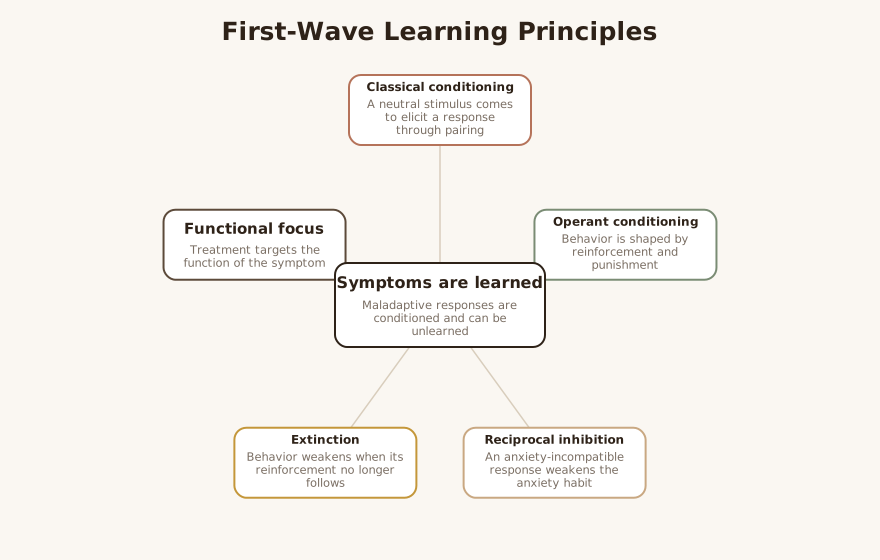
First-wave behavior therapy rests on a small set of learning principles applied directly to symptoms 1.
- Symptoms are learned. Maladaptive responses — a phobia, a compulsion, bed-wetting — are acquired through conditioning and can be unlearned through conditioning, rather than treated as surface signs of unconscious conflict 13.
- Classical conditioning. A previously neutral stimulus comes to elicit a response (often fear) through pairing; treatment works by altering that learned association 13.
- Operant conditioning. Behavior is shaped by its consequences: reinforcement increases the likelihood a behavior recurs, while punishment decreases it 46. Reinforcement and punishment each have positive (something added) and negative (something removed) forms 4.
- Reciprocal inhibition. A response incompatible with anxiety, evoked in the presence of the feared stimulus, weakens the anxiety habit — the original rationale for pairing relaxation with graded exposure 3.
- Extinction. When the reinforcement or feared-outcome that maintained a behavior no longer follows it, the behavior gradually weakens 46.
- Functional focus. The clinician analyzes the antecedents and consequences maintaining a behavior, then changes those contingencies, rather than interpreting internal states 1.
Interventions & Techniques
Systematic desensitization. The patient is trained in relaxation, constructs a hierarchy of feared situations from least to most threatening, and then progressively imagines or approaches each step while remaining relaxed, transferring the gains to real-life situations 3. Wolpe’s innovation was the use of controlled, graded imagined scenes paired with an anxiety-inhibiting relaxation response 3.
Exposure. The graded confrontation of feared stimuli is the active ingredient that descended directly from Wolpe’s work and remains central to anxiety treatment 23. Note that the field’s understanding of why exposure works has shifted away from Wolpe’s reciprocal-inhibition account toward learning mechanisms such as habituation and extinction, which has clinical consequences discussed under Common Misconceptions 2.
Operant techniques (contingency management). Clinicians manipulate consequences to change behavior 46:
- Positive reinforcement — adding a desirable consequence to strengthen a behavior (praise, tokens) 4.
- Negative reinforcement — removing an aversive condition to strengthen a behavior 4.
- Punishment — adding an aversive consequence or removing a valued one to weaken a behavior 4.
- Shaping — reinforcing successive approximations toward a target behavior 4.
- Extinction — withholding the reinforcement that has maintained a behavior 46.
Schedules of reinforcement matter for durability: continuous reinforcement produces fast learning but quick extinction, whereas a variable-ratio schedule produces responding that is highly resistant to extinction 4. This is clinically relevant both for building new behaviors and for understanding why some maladaptive behaviors (e.g., intermittently reinforced gambling) are so persistent 4.
LLM-generated illustrative example (not a guideline): A client with a driving phobia builds a hierarchy from “sitting in a parked car” to “merging onto a highway.” Early sessions pair brief, manageable steps with paced breathing; later sessions emphasize staying in the situation long enough for anxiety to decline on its own. LLM
Evidence Base
The maturity of first-wave behavior therapy is best described as established LLM. Systematic desensitization was the first behavioral treatment to be empirically validated for a clinical disorder, specifically specific phobias, and the body of measurable, stepwise research it generated compelled mainstream psychology to take behavior therapy seriously 13. Exposure-based methods derived from this lineage remain foundational to evidence-based practice for anxiety 12.
Two honest caveats temper the picture. First, behavioral techniques drew early criticism for limited efficacy with disorders dominated by negative affect, such as depression — a gap that motivated the 1960s cognitive turn and the development of CBT 1. Second, the mechanism Wolpe proposed (reciprocal inhibition) has not held up as the best explanation; the field increasingly attributes exposure’s effects to habituation and extinction-based learning rather than to relaxation reciprocally inhibiting anxiety 2. The treatments work, in other words, but partly for reasons other than the ones their originator gave 2. There is also an ongoing scholarly debate about whether the behavioral components, rather than the cognitive components, drive much of CBT’s effectiveness 1.
Populations & Indications
First-wave behavioral methods apply across a broad range of populations LLM. Children and adolescents are well served by operant and conditioning approaches for problems such as enuresis (e.g., bell-and-pad conditioning) and disruptive behavior 5. Adults with anxiety disorders and people with phobias are the classic indication for systematic desensitization and exposure 13. Individuals with OCD are treated with exposure-based behavioral procedures 5. People with autism and developmental disabilities are a major population for operant, skill-building, and contingency-management interventions 56. Adults with addictive behaviors are addressed through contingency management and the analysis of reinforcement contingencies that maintain use 46.
Problems-for-Work
- Specific phobias — graded exposure / systematic desensitization up an individualized fear hierarchy 3.
- Panic disorder and agoraphobia — interoceptive and situational exposure to feared sensations and avoided settings 13.
- Obsessive-compulsive disorder — exposure with prevention of the compulsive response 5.
- Generalized anxiety disorder — relaxation training and exposure to worry-eliciting content, though anxiety dominated by cognition was an early limitation of purely behavioral methods 1.
- Posttraumatic stress disorder — exposure to trauma-related memories and cues 1.
- Enuresis — classical-conditioning approaches such as the bell-and-pad method 5.
- Tic disorders — behavioral procedures that alter the contingencies and antecedents around the tic 5.
- Maladaptive learned behaviors generally — functional analysis followed by reinforcement, extinction, or shaping 46.
LLM-generated illustrative example (not a guideline): For a child with nocturnal enuresis, a bell-and-pad device pairs the sensation of a full bladder with waking, gradually conditioning the child to wake before voiding. LLM
Contraindications, Cautions & Cultural Humility
Behavioral interventions are powerful precisely because they change contingencies and confront avoided stimuli, which creates specific cautions LLM. Aversive procedures and punishment carry ethical and clinical risk and should be approached conservatively; reinforcement-based methods are generally preferred where effective 4. Exposure must be paced and consented; pushing a client up a hierarchy too fast can sensitize rather than extinguish fear LLM. Because first-wave methods deliberately bracket cognition and meaning, a purely behavioral formulation can miss the cultural, relational, and contextual significance a behavior holds for a client — a known limitation that the cognitive turn was partly intended to address 1.
Cultural humility is essential when defining a “maladaptive” behavior or selecting reinforcers: what counts as a problem behavior, an acceptable reward, or a feared situation is shaped by culture, family system, and context, and the clinician should define targets collaboratively rather than imposing them LLM. Functional analysis should explicitly include the client’s environment and values, not only the topography of the behavior LLM.
Treatment-Plan Suggestions & SMART Objectives
| Goal | SMART objective (example) | Mechanism |
|---|---|---|
| Reduce phobic avoidance | Client will complete all 8 steps of an individualized fear hierarchy within 12 weekly sessions, rated 0–100 SUDS, with peak SUDS ≤30 on the top item | Graded exposure / systematic desensitization 3 |
| Decrease compulsive behavior | Client will resist the target compulsion in 4 of 5 daily exposure trials, logged on a self-monitoring form, by week 10 | Exposure with response prevention 5 |
| Build a skill deficit | Client will independently perform the target self-care routine in 80% of opportunities across 2 weeks | Shaping via reinforcement of successive approximations 4 |
| Extinguish an attention-maintained behavior | Caregivers will withhold reinforcement for the target behavior in 90% of observed instances over 3 weeks | Extinction of an operant contingency 46 |
| Reduce panic-related avoidance | Client will enter 3 previously avoided situations weekly and remain until anxiety declines by half, logged for 8 weeks | Situational exposure / habituation 12 |
| Resolve nocturnal enuresis | Child will achieve 14 consecutive dry nights using a bell-and-pad protocol within 16 weeks | Classical-conditioning of arousal to bladder cues 5 |
| Increase a low-frequency adaptive behavior | Client will earn tokens for the target behavior, reaching a set criterion 5 days per week for 1 month | Positive reinforcement / contingency management 46 |
Common Misconceptions
- “Behavior therapy ignores thoughts entirely.” First-wave behavior therapy brackets cognition by design, but Skinner’s radical behaviorism explicitly treated private events such as thoughts as covert behavior subject to the same laws — so the framework is less dismissive of inner experience than the caricature suggests 1.
- “Relaxation is what makes exposure work.” This was Wolpe’s reciprocal-inhibition hypothesis, but the field now attributes exposure’s effects more to habituation and extinction; relaxation is helpful for tolerability but is not the proven active mechanism 2.
- “It’s just symptom removal that produces symptom substitution.” This was a psychoanalytic objection; the empirical track record of systematic desensitization for phobias did not bear out the prediction, and the validated, measurable results pushed the field toward behavioral methods 13.
- “Behavioral methods are equally effective for everything.” They drew early criticism for limited efficacy in disorders dominated by negative affect such as depression, which is precisely what motivated the cognitive turn 1.
- “Punishment is the core of behavior change.” Operant change rests at least as much on reinforcement, shaping, and extinction; reinforcement schedules — not punishment — explain much of behavioral durability 46.
Training & Certification
First-wave behavioral skills are typically acquired as part of broader clinical training in behavior therapy and CBT rather than through a single freestanding credential LLM. The classic procedures — hierarchy construction, relaxation training, graded exposure, functional analysis, and contingency management — are documented in open clinical texts and educational resources and are learned through supervised practice 35. Clinicians working intensively with operant methods in developmental-disability and autism settings often pursue specialized behavior-analytic training and supervision LLM. Because the techniques are embedded in widely taught evidence-based psychotherapies, competence is usually demonstrated within those modalities and their supervision structures 1.
Key Terms
- Classical conditioning — learning in which a neutral stimulus comes to elicit a response through pairing with a stimulus that already elicits it 13.
- Operant conditioning — learning in which behavior is shaped by its consequences 46.
- Reinforcement — a consequence that increases the future likelihood of a behavior; positive (added) or negative (removed) 4.
- Punishment — a consequence that decreases the future likelihood of a behavior; positive or negative 4.
- Reciprocal inhibition — weakening an anxiety habit by evoking an incompatible response in the presence of the feared stimulus 3.
- Systematic desensitization — graded exposure up a fear hierarchy paired with relaxation 3.
- Shaping — reinforcing successive approximations toward a target behavior 4.
- Extinction — the weakening of a behavior when its maintaining reinforcement or feared outcome no longer follows 46.
- Schedules of reinforcement — the timing/frequency rules (continuous, fixed/variable ratio and interval) that determine learning speed and resistance to extinction 4.
- Functional analysis — identifying the antecedents and consequences that maintain a behavior 1.
Resources & Further Reading
▶ Watch — a video introduction to this concept:
- Behavior therapy: roots, evolution, and reflection on the relevance of behaviorism in the clinical context (Redalyc)
- Psychotherapy by Reciprocal Inhibition: Wolpe’s unique legacy to the evolution of cognitive-behavioural therapy (BJPsych Advances, Cambridge)
- Joseph Wolpe and Systematic Desensitization (Athabasca University)
- Operant Conditioning in Psychology: B.F. Skinner Theory (Simply Psychology)
- Behavior Therapy (Understanding Psychological Disorders, Baylor open textbook)
- Operant conditioning (Wikipedia)
Reflective / Supervision Questions
- For a given case, can I write a clean functional analysis — antecedents, behavior, consequences — before selecting any technique? LLM
- Am I clear, with each exposure client, about whether I am using relaxation for tolerability versus assuming it is the mechanism of change? LLM
- When I label a behavior “maladaptive,” whose standard am I applying, and have I checked it against the client’s culture, values, and context? LLM
- Where am I relying on punishment when reinforcement, shaping, or extinction would be more effective and less risky? 4
- If a behavioral plan is not working, can I distinguish a flawed contingency analysis from a problem better addressed by cognitive or contextual methods? 1
- How do I document the behavioral components of my work so they are visible as part of a recognized psychotherapy I am delivering? LLM