
Type & Discipline
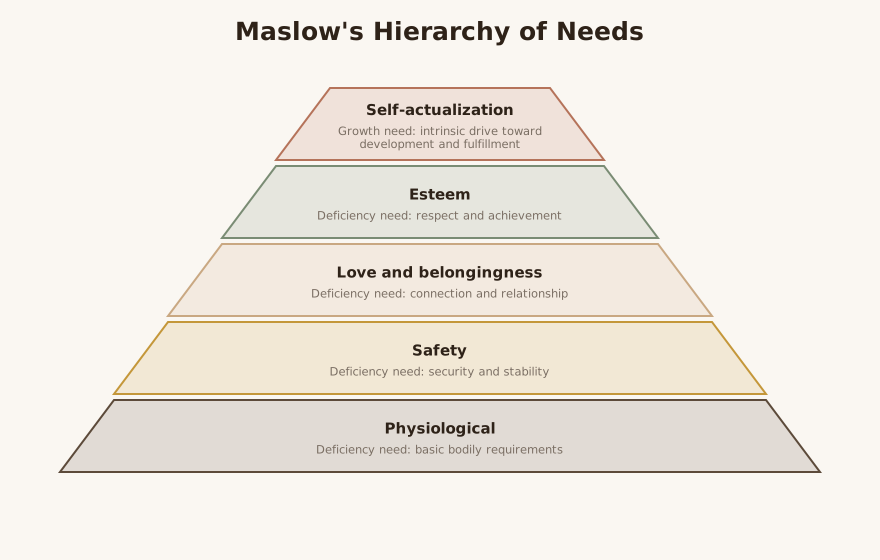
Maslow’s hierarchy of needs is a theory of human motivation rooted in humanistic psychology, the “third force” that positioned itself against both psychoanalysis and behaviorism by foregrounding growth, agency, and meaning 2. It is a conceptual framework rather than a manualized treatment, and clinicians use it as a lens on motivation, not as a standalone therapy LLM. The model organizes human needs into ascending tiers, moving from physiological and safety needs through belonging and esteem to self-actualization at the apex 1. For practicing therapists, its value lies less in its empirical precision and more in its clinical orienting power: it offers a shared language for why a client’s stated growth goals may stall when more fundamental needs go unmet LLM.
Creators & Lineage
Abraham Maslow introduced the theory in his 1943 Psychological Review paper “A Theory of Human Motivation,” and expanded it in his 1954 book Motivation and Personality and later writings through the 1960s and 1970s 1. The term “self-actualization” itself was coined earlier by Kurt Goldstein, a neuroanatomy and psychiatry specialist, who treated it as the ultimate goal of all organisms; Maslow narrowed it to humans and argued it emerges as a motivator only after more basic needs are met 3. A persistent historical misconception is that Maslow drew the famous pyramid himself — he did not; the pyramidal depiction was first popularized by the consulting psychologist Charles McDermid in a 1960 Business Horizons article 1. In his later work Maslow added a level above self-actualization, self-transcendence, which Mark Koltko-Rivera argued in 2006 had been largely overlooked and deserves rediscovery 4. Lineage-wise, the theory sits alongside Carl Rogers’s person-centered therapy, existential psychology, and the later emergence of positive psychology, all of which share Maslow’s humanistic premise that people are oriented toward growth 2.
Core Principles
The original model describes five tiers: physiological needs, safety needs, love and belongingness, esteem, and self-actualization 2. Maslow divided these into two qualitatively different categories: deficiency needs (D-needs), which arise from lack or deprivation and which the lower four tiers represent, and growth or being needs (B-needs), which are intrinsic drives toward development and fulfillment 2. The central clinical idea is that unmet deficiency needs dominate attention and motivation — a hungry or unsafe person has little capacity to invest in esteem or self-realization 1. In his expanded model Maslow inserted cognitive needs (knowledge, understanding) and aesthetic needs (beauty, order) between esteem and self-actualization, and ultimately placed self-transcendence at the summit 2. Critically, the ordering is not rigid: Maslow himself emphasized that a need does not require 100% satisfaction before the next emerges, describing instead decreasing percentages of satisfaction across tiers 1. People can and do pursue several levels simultaneously, and individual or situational differences reshape the priority order 2.
Interventions & Techniques
The hierarchy is not itself a set of techniques; it is a formulation tool that shapes where therapeutic attention goes first LLM. In practice, a clinician uses it to triage — stabilizing physiological and safety concerns (sleep, food security, housing, freedom from violence) before expecting a client to engage growth-oriented work LLM. Working with belonging needs maps cleanly onto interventions that build social connection and reduce isolation, while esteem work aligns with mastery experiences, competence-building, and recognition 2. At the self-actualization tier, Maslow’s view that “painters need to paint, writers need to write, musicians need to play” translates clinically into helping clients identify and pursue their authentic talents and values 3. Maslow also described peak experiences — moments of profound joy, clarity, and self-transcendence — which clinicians can help clients notice, savor, and integrate rather than dismiss 4. The self-transcendence level points toward interventions involving meaning, connection to something beyond the self, and service, which overlap with existential and meaning-centered approaches 5.
LLM-generated illustrative example (not a guideline): A client presents wanting to “find their purpose” but is sleeping four hours a night, behind on rent, and recently estranged from family. Rather than launching into values clarification, the clinician sequences the work — coordinating around sleep and housing stability, then rebuilding social connection — before purpose-focused work becomes realistically engageable. LLM
Evidence Base
Honesty about evidence is essential here. As a humanistic framework, Maslow’s theory is well established and culturally pervasive, but the specific empirical claim — that needs are satisfied in a fixed rank order — has weak support 1. A 1976 review found little evidence for the specific ranking Maslow described, and self-actualization in particular remains difficult to operationalize and test scientifically 12. Maslow’s own evidence base for self-actualization was a subjective biographical analysis of a small, hand-picked sample, which limits generalizability 2. Cross-cultural research further undercuts a universal ordering: studies in collectivist contexts find community and belonging needs ranked above individual self-actualization, contradicting the Western individualistic sequence 1. The maturity of the theory should therefore be read as established as a conceptual and humanistic framework, not as an empirically validated stage model LLM. Its clinical usefulness rests on heuristic value and face validity rather than on predictive precision LLM.
Populations & Indications
The framework is most clinically useful with adults seeking personal growth and clients already engaged in humanistic or person-centered therapy, where its growth orientation is congruent with the modality 2. It is especially relevant for people experiencing unmet basic needs — those recovering from deprivation, homelessness, or material insecurity — because it makes explicit why higher-order goals feel inaccessible until safety stabilizes 1. It offers a natural map for individuals in career and life transitions and for students navigating identity and direction, where esteem, cognitive, and self-actualization needs are salient 7. The self-transcendence tier is indicated when clients raise questions of meaning, legacy, or connection beyond the self 5. Across these populations the model functions as a formulation and psychoeducation aid rather than a diagnostic instrument LLM.
Problems-for-Work
The hierarchy gives clinicians a vocabulary for several presenting concerns LLM. Unmet safety needs and anxiety related to insecurity map directly onto the second tier, suggesting stabilization before deeper work 1. Lack of belonging corresponds to the love/belongingness tier and points to connection-building interventions 2. Low self-esteem and motivation deficits can be reframed as esteem-tier work, where competence and recognition restore drive 2. Burnout and demoralization can be understood as depletion of deficiency needs (rest, safety, belonging) that blocks access to growth-oriented engagement LLM. Lack of fulfillment, identity and purpose concerns, and existential meaninglessness correspond to the self-actualization and self-transcendence tiers, linking to existential and positive-psychology interventions 45.
LLM-generated illustrative example (not a guideline): A high-performing clinician-client reports burnout and a flat sense that “nothing matters anymore.” Framing this as eroded belonging and esteem needs (isolation, loss of recognized competence) reorients the work toward reconnection and restoring mastery, rather than treating the meaninglessness as a purely existential problem. LLM
Contraindications, Cautions & Cultural Humility
There are no medical contraindications to using a conceptual framework, but there are real cautions LLM. The most important is cultural: the hierarchy reflects Western individualistic values, and applying its ordering uncritically to clients from collectivist cultures can misread their priorities — research shows community needs may legitimately rank above individual self-actualization 1. Indigenous scholars, notably from the Blackfoot tradition, have argued that Maslow drew on their philosophy’s circular, interconnected view of needs without adequate acknowledgment, and that a linear ascending pyramid distorts that worldview 1. Clinically, the model can also be misused to imply that clients in poverty or crisis are incapable of meaning or growth until basic needs are perfectly met — but people do pursue higher needs amid deprivation, and Maslow himself rejected a rigid threshold 1. Clinicians should treat the hierarchy as flexible and individualized, not as a gate that disqualifies clients from growth work 3. Cultural humility means asking each client how they order their own needs rather than assuming the pyramid applies LLM.
Treatment-Plan Suggestions & SMART Objectives
| Goal | SMART objective (example) | Mechanism |
|---|---|---|
| Stabilize safety needs | Client will establish a consistent sleep window of 7 hours on 5 of 7 nights within 6 weeks, logged daily | Satisfying deficiency needs frees attentional and motivational capacity for higher-order work 1 |
| Increase belonging | Client will initiate one social contact per week and report on it in session for 8 consecutive weeks | Addresses the love/belongingness tier to reduce isolation 2 |
| Rebuild esteem | Client will identify and complete one weekly mastery activity and rate competence (0–10) for 8 weeks | Esteem-tier reinforcement restores self-respect and motivation 2 |
| Reduce motivation deficit | Client will name 3 personal values and take one value-aligned action weekly for 6 weeks | Reconnects behavior to B-needs/growth motivation 2 |
| Pursue self-actualization | Client will dedicate 2 hours weekly to an identified authentic talent and review progress monthly | Operationalizes Maslow’s “painters need to paint” growth principle 3 |
| Cultivate meaning / transcendence | Client will engage in one service or connection-beyond-self activity biweekly and reflect on its meaning | Targets the self-transcendence level 5 |
| Notice peak experiences | Client will record one moment of clarity, awe, or absorption weekly for 8 weeks | Helps integrate peak/being experiences 4 |
| Counter demoralization | Client will track 3 daily instances of competence or connection for 4 weeks | Rebuilds deficiency-need satisfaction to lift demoralization LLM |
Common Misconceptions
The most widespread misconception is that Maslow created the pyramid — the pyramidal diagram was popularized later, by Charles McDermid in 1960, and the visual rigidity it implies overstates Maslow’s actual position 1. A second is that needs must be fully satisfied in strict order; Maslow explicitly described partial, overlapping satisfaction rather than discrete thresholds 1. A third is that self-actualization is the top of the model — in Maslow’s later work, self-transcendence sits above it, a level Koltko-Rivera argued has been systematically neglected in textbooks and popular accounts 45. A fourth is that the ranking is empirically validated and universal; in fact, evidence for the specific ranking is weak and cross-culturally variable 1. Finally, “self-actualization” is often treated as a rare elite achievement, whereas Maslow viewed it as relatively rare but manifesting differently and ordinarily across individuals 3.
Training & Certification
There is no certification in Maslow’s hierarchy, because it is a theory rather than a credentialed treatment modality LLM. Clinicians typically encounter it within graduate coursework in personality, motivation, and humanistic psychology, and it is foundational background for training in person-centered and existential approaches 2. Therapists wishing to apply its growth orientation rigorously are better served by pursuing training in established humanistic modalities and in positive-psychology or meaning-centered interventions, where the constructs are operationalized for practice 7. Familiarity with the later self-transcendence formulation requires reading beyond the standard five-tier textbook version, as that level is frequently omitted 4.
Key Terms
Deficiency needs (D-needs): motivations arising from lack or deprivation, comprising the lower tiers 2. Growth/being needs (B-needs): intrinsic drives toward development and fulfillment at the upper tiers 2. Self-actualization: the process of reaching one’s full potential, the realization of authentic talents and capacities 3. Self-transcendence: Maslow’s later apex level, oriented to connection with something beyond the self 5. Peak experiences: moments of profound joy, clarity, and absorption associated with self-actualization and transcendence 4. Physiological, safety, belonging, esteem: the four ascending deficiency tiers below self-actualization 1.
Resources & Further Reading
▶ Watch — a video introduction to this concept:
- A Theory of Human Motivation (Maslow, 1943) — via “Maslow’s hierarchy of needs,” Wikipedia
- Maslow’s Hierarchy of Needs — Simply Psychology
- Self-actualization — Encyclopaedia Britannica
- Rediscovering the Later Version of Maslow’s Hierarchy of Needs: Self-Transcendence (Koltko-Rivera, 2006) — ResearchGate
- Maslow’s Hierarchy of Needs — the sixth level (self-transcendence) — The British Psychological Society
- Human Needs, Characteristics of Self-Actualization (Maslow) — YouTube
- Self-Actualization: Maslow’s Hierarchy of Needs — Interaction Design Foundation
Reflective / Supervision Questions
- When a client states a growth-oriented goal, how do I assess whether more fundamental deficiency needs are stable enough to support that work? LLM
- Am I imposing an individualistic ordering of needs on a client whose culture may prioritize belonging or community above individual self-actualization? 1
- How do I avoid using the hierarchy to imply that clients in crisis or poverty cannot access meaning or growth? 1
- Do I attend to self-transcendence and meaning, or do I stop my formulation at self-actualization? 4
- Where in my caseload am I treating Maslow’s model as empirically settled fact rather than a flexible heuristic with weak support for its ranking? 1