
Spiritual bypassing names a defensive maneuver clinicians encounter constantly but often miss: a client uses genuine spiritual belief or practice to step around emotional pain rather than through it 2. It is not a diagnosis and not a critique of spirituality itself — it is a description of how an authentic resource can be conscripted into avoidance 3. This article orients practicing therapists to the construct, its evidence, and how to work with it without pathologizing healthy faith.
Type & Discipline
Spiritual bypassing is a clinical construct rather than a treatment modality or a diagnosis 6. It originated in transpersonal psychology — the branch concerned with spiritual and self-transcendent dimensions of experience — and crossed into mainstream clinical and counseling psychology 3. Conceptually it sits at the intersection of the psychology of religion and the study of defense and avoidance, describing a process by which spiritual ideas are used “to sidestep or avoid facing unresolved emotional issues, psychological wounds, and unfinished developmental tasks” 2. Because it is a construct, it has no manualized protocol; it is something you assess for and then address within an existing therapeutic frame LLM.
Creators & Lineage
The term was coined by John Welwood, an American psychologist and Buddhist teacher, in a 1984 article, “Principles of Inner Work: Psychological and Spiritual” 3. Welwood arrived at it by observing members of spiritual communities who were doing serious practice yet seemed to be “using meditation or their spiritual involvements to bypass certain kinds of personal emotional ‘unfinished business’” 3. He named it “this tendency to try to avoid or prematurely transcend basic human needs, feelings, and developmental tasks” 3. Welwood later developed the surrounding framework in Toward a Psychology of Awakening (2000), arguing that traditions both Eastern and Western often elevate absolute over relative truth and the impersonal over the personal, which becomes harmful when it substitutes for human development 1.
The construct was later extended into the addiction field and operationalized empirically by a counseling-psychology research group — notably Craig S. Cashwell and Jesse Fox, who built the first validated measure 3. Robert Augustus Masters popularized the concept for clinical and lay audiences 4. Its lineage thus braids transpersonal psychology, psychodynamic accounts of defense, and later integrations with Acceptance and Commitment Therapy and Spiritually Integrated Psychotherapy 5.
Core Principles
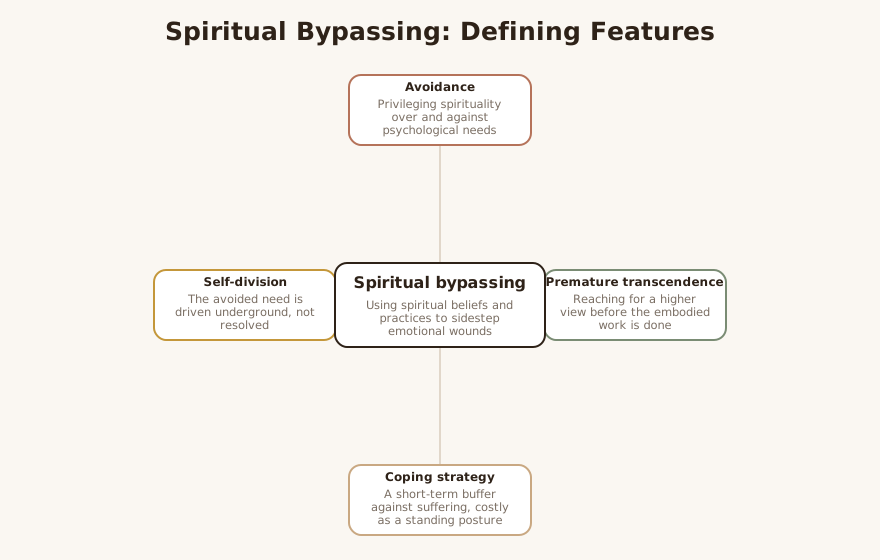
The defining feature across every definition is avoidance — using spirituality to sidestep painful or potentially painful experience 3. Fox, Picciotto, and Cashwell define it as a “defensive psychological posture cultivated by a tendency to privilege or exaggerate spiritual beliefs, emotions, or experiences over and against psychological needs,” creating a means of avoiding difficult emotions 3. Welwood’s clinical insight is that the avoided need does not disappear: “one might… try to practice nonattachment by dismissing one’s need for love, but this only drives the need underground, where it is likely to become acted out in covert, unconscious, and possibly harmful ways” 2.
A second principle is premature transcendence — reaching for a “higher” perspective before the lower, embodied work is done 3. A third is that bypassing is, at root, a coping strategy — sometimes adaptive in the short term as a buffer against unbearable suffering, but ultimately “a temporary solution and an obfuscation of authentic spirituality” when it becomes the standing posture 3. Welwood framed the cost in terms of self-division, citing the teacher Swami Prajnanpad’s line that “idealism is an act of violence” against authentic presence 2.
Interventions & Techniques
Because bypassing is a construct, “treatment” means integrating its recognition into your existing modality rather than running a separate protocol LLM. The literature converges on an integrative approach that pairs spiritual practice with psychotherapy rather than asking the client to abandon either 5. Practical strategies named in the transpersonal literature include shadow work, body-centered therapies for emotional processing, and mindfulness-based psychotherapy that uses meditation to increase contact with avoided affect rather than to escape it 5. The therapeutic aim is to develop emotional intelligence alongside spiritual wisdom and to cultivate vulnerability and self-compassion in place of detachment 5.
Welwood’s own prescription was developmental balance: cultivate the human and the spiritual dimensions together rather than transcending one for the other 2. In acceptance-based terms, this means helping clients hold spiritual values and make experiential contact with grief, anger, or fear, so that practice stops functioning as avoidance LLM. Lower-intensity engagement methods such as focusing and motivational interviewing have been suggested where direct confrontation would mobilize defenses 6.
LLM-generated illustrative example (not a guideline): A client responds to every prompt about her divorce with “everything happens for a reason” and a quick return to gratitude practice. The clinician reflects the move gently — “I notice we lift up toward the meaning right as the hurt shows up” — and invites thirty seconds of staying with the body sensation before any reframe. The reframe is not forbidden; it is sequenced after contact, not used to skip it LLM.
Evidence Base
Honesty about maturity matters here. The construct is established — recognized across transpersonal and clinical psychology since 1984, supported by decades of theoretical and clinical writing and one validated instrument family 3. The empirical base, however, is limited: research “has remained stagnant since 2010,” only one research team has attempted to empirically substantiate the model, and Wikipedia’s review notes that for much of its history “no psychometrically sound measures of the phenomenon exist[ed]” 3 6.
The measurement breakthrough is the Spiritual Bypass Scale-13 (SBS-13), developed by Fox, Cashwell, and Picciotto and validated on a U.S. norming sample, with a Brazilian-Portuguese adaptation confirming a two-factor structure (CFI = .95; alpha = .72–.86) 3. The two factors are Psychological Avoidance and Spiritualizing 3. Crucially, the relationship to distress is complex, not linear: the two factors predicted distress in opposite directions — Psychological Avoidance related negatively to depression, while Spiritualizing related positively to stress and anxiety — which the authors say “helps explain why spiritual bypass can be so emotionally stunting” 3. Spiritual bypass correlated strongly with both spirituality and religiosity, situating it specifically within devout populations 3. The evidence is therefore correlational and self-report; there are no treatment trials, and findings should not be read as “bypassing causes depression and anxiety” LLM.
Populations & Indications
Bypassing is concentrated where serious spiritual practice meets unresolved psychological material. Relevant populations include meditators and contemplative practitioners, religiously or spiritually identified clients, members of spiritual communities, and New Age and wellness community members 3. It is clinically salient with trauma survivors, for whom transcendence can become a sophisticated route around intrusions and grief, and with adults in psychotherapy who present with high spiritual fluency yet stalled affect 4. Because SBS scores rise with religiosity and spirituality, the indication is not “this client is spiritual” but “this client’s spirituality is doing the work that emotional processing should be doing” 3.
Problems-for-Work
Bypassing maps onto several familiar treatment targets LLM.
- Experiential and emotional avoidance — spirituality functions as the avoidance behavior; the work is restoring contact with avoided internal experience 3.
- Repressed anger — Psychology Today describes a woman raised by a narcissistic parent who suppressed anger through Transcendental Meditation and spiritual reading; therapy revealed the pattern blocked authentic self-expression, and her relationships improved once she addressed the underlying material while keeping her practice 4.
- Grief avoidance — “everything happens for a reason” deployed to close down mourning rather than metabolize it 4.
- Spiritual narcissism — self-righteous superiority and a sense of being “more evolved,” a noted consequence of chronic bypassing 5 6.
- Relationship dysfunction — detachment marketed as equanimity that prevents authentic connection 5.
Contraindications, Cautions & Cultural Humility
The single most important caution is do not pathologize healthy religious or spiritual coping LLM. Clinicians do not automatically regard bypassing as unhealthy; when it is temporary and buffers acute stress it may be adaptive, and some “bypassing” behaviors may reflect normal developmental stages 6. The SBS literature is explicit that spirituality is “a non-reductive phenomenon that can be authentic and life-giving,” not merely a mask for hidden drives — distinguishing this construct from the reductive “hermeneutic of suspicion” of Marx, Nietzsche, and Freud 3.
A key clinical discrimination is between adaptive deferral and bypassing: Pargament’s collaborative or deferring problem-solving can be entirely appropriate (e.g., a chronic illness with no medical remedy), whereas bypassing places its weight on avoidance of difficult experience 3. Cultural humility requires holding the client’s tradition as a real resource and locating the problem in the avoidant use of it, not in the belief itself LLM. Naming “bypassing” too early can rupture the alliance and confirm a client’s fear that therapy is hostile to their faith; lead with curiosity, not labeling LLM.
Treatment-Plan Suggestions & SMART Objectives
| Goal | SMART objective (example) | Mechanism |
|---|---|---|
| Increase contact with avoided affect | Within 6 sessions, client will stay with a distressing emotion for 60 seconds before reframing, in 3 of 5 in-session prompts | Reduces experiential avoidance by interrupting premature transcendence 3 |
| Differentiate practice from escape | Within 8 weeks, client will name 2 instances where spiritual practice was used to avoid an emotion, logged between sessions | Builds metacognitive awareness of the bypass move 5 |
| Reintegrate disowned anger | Over 10 sessions, client will identify and verbalize one previously suppressed grievance per week | Restores access to repressed affect driven “underground” 2 |
| Process avoided grief | Within 12 weeks, client will complete one structured mourning task without defaulting to a meaning-making reframe | Counters grief avoidance via sequenced exposure 4 |
| Increase distress tolerance | Within 8 sessions, client will use one body-based regulation skill during distress rather than dissociating into transcendence | Raises tolerance so affect need not be bypassed 5 |
| Preserve healthy spirituality | Ongoing: client will continue valued spiritual practice while reporting weekly on its function (resource vs. avoidance) | Integrates, rather than removes, authentic practice 1 |
| Reduce spiritual self-righteousness | Within 10 sessions, client will identify 2 relationships strained by detachment and attempt one act of vulnerable contact | Targets spiritual narcissism and relational withdrawal 5 |
Common Misconceptions
“Spiritual bypassing means the client’s spirituality is the problem.” No — the construct holds spirituality as authentic and life-giving; the problem is its avoidant deployment 3. “Bypassing is always pathological.” No — clinicians treat brief, stress-buffering use as potentially adaptive, and it may correspond to normal developmental phases 6. “It reliably produces depression and anxiety.” The data are mixed and counterintuitive: the two factors relate to distress in opposite directions, so blanket causal claims overreach 3. “It’s the same as Freud’s view that religion masks drives.” It is the opposite — scholars of bypass reject that reductive frame 3. “It only affects ‘New Age’ clients.” SBS scores rise with religiosity across traditions, including devout Christian and Buddhist practitioners 3.
Training & Certification
There is no certification in spiritual bypassing, because it is a construct rather than a modality LLM. Competence is built by training in the parent frameworks: transpersonal psychology, Spiritually Integrated Psychotherapy, Acceptance and Commitment Therapy, and trauma-focused care, combined with familiarity with the psychology-of-religion literature 5. Reading Welwood’s Toward a Psychology of Awakening and the SBS validation work gives clinicians the conceptual and assessment grounding 1 3. The practical skill — distinguishing avoidance-in-practice from authentic devotion — is honed in supervision, not by credential LLM.
Key Terms
- Spiritual bypassing — using spiritual ideas/practices to avoid unresolved emotional wounds and developmental tasks 2.
- Premature transcendence — reaching for a higher perspective before doing the embodied, relative-truth work 3.
- Psychological Avoidance — SBS factor: sidestepping difficult emotions through spiritual beliefs (e.g., preferring spiritual guidance over psychological help) 3.
- Spiritualizing — SBS factor: over-attributing spiritual significance to ordinary hardship (e.g., reading another’s difficulty as “spiritual attack”) 3.
- Relative vs. absolute truth — Welwood’s distinction; bypassing over-privileges the absolute/impersonal at the cost of human, relational reality 1.
- Spiritual narcissism — superiority and self-righteousness arising from chronic bypassing 5.
Resources & Further Reading
▶ Watch — a video introduction to this concept:
- Welwood, J. (2000). Toward a Psychology of Awakening. Shambhala.
- Spiritual Bypassing: An Interview with John Welwood (2011)
- Picciotto, Fox, Cashwell, & Neto (2018). The Spiritual Bypass Scale-Brazilian Adaptation (full-text PDF)
- What Is Spiritual Bypassing? (Psychology Today)
- Spiritual Bypass: Avoiding Personal Growth Through Spiritual Practices (iResearchNet)
- Spiritual bypass (Wikipedia)
- Spiritual Bypassing (Spiritual Care, 2025)
Reflective / Supervision Questions
- When a client reaches for a spiritual reframe, can I tell whether it is integration or escape — and what cues am I using? LLM
- Am I at risk of pathologizing this client’s faith because it differs from my own worldview? 3
- Where in my own practice or worldview do I use a “higher perspective” to avoid difficult feeling? 2
- Have I distinguished adaptive deferral from avoidance before naming “bypassing” to the client? 3
- Does my treatment plan preserve the client’s authentic spiritual resources while restoring contact with avoided affect? 1