
Type & Discipline
Transpersonal psychology is a theoretical school and clinical orientation within psychology rather than a single manualized treatment, sometimes also termed “spiritual psychology” 1. Its defining aim is to “integrate the spiritual and transcendent human experiences within the framework of modern psychology” 1. The term itself means “beyond the personal,” and the field studies experiences that extend awareness “beyond (trans) our individual sense of embodied identity (personal)” 3. Abraham Maslow named it the “fourth force” in psychology, positioning it beyond the three dominant schools of the era – behaviorism, psychoanalysis, and humanistic psychology 2. It is best understood as an extension of humanistic psychology that incorporates spiritual and transcendent dimensions, addressing what its proponents call the “further reaches” of human potential and experience 6. Like its humanistic parent, it functions as a philosophy of persons and an orienting stance toward growth rather than a discrete, trial-validated modality LLM.
Its formal home within organized American psychology is the Transpersonal Psychology Special Interest Group of APA Division 32, the Society for Humanistic Psychology 6. That group describes the field as embracing “the totality of being human, including expanded states of awareness, spirituality,” and as rooted in the worldviews of William James, Carl Jung, Abraham Maslow, and others 6. The discipline is therefore continuous with, not a replacement for, the humanistic tradition; it adds a vertical, spiritual axis to humanistic psychology’s emphasis on individual uniqueness and self-actualization 2.
Creators & Lineage
The field crystallized from a 1967 task force in Menlo Park, California, whose members included Abraham Maslow, Stanislav Grof, Anthony Sutich, James Fadiman, Miles Vich, and Sonya Margulies 4. It was Grof who suggested the term “transpersonal psychology,” a proposal Maslow and Sutich accepted 4. The movement was then institutionalized rapidly: the Journal of Transpersonal Psychology began in 1969, the Association for Transpersonal Psychology was founded in 1972, the International Transpersonal Association held its first conference in 1973, and the Institute of Transpersonal Psychology (later Sofia University) was created in 1975 2. The field emerged during the late 1960s under the influence of countercultural movements and Eastern traditions such as yoga and Buddhism 2.
Three figures anchor its theoretical lineage. Abraham Maslow supplied the bridge from humanistic psychology: his hierarchy of needs culminates in self-actualization, the level at which transpersonal psychology operates, and his concept of “peak experiences” described moments containing “a sense of connection with universal flow or the divine” that presaged the field’s focus on transcendence beyond ego-centered functioning 4. Stanislav Grof contributed the field’s clinical and experiential core; his psychedelic research was credited with revealing “a deeply spiritual dimension of the psyche,” and he later coined “holotropic” – from holos (wholeness) and trepein (moving toward) – to describe human movement toward wholeness through non-ordinary states of consciousness 4. Ken Wilber developed an evolutionary, integral framework positioning consciousness development across multiple stages and dimensions, though he is now best understood as having moved beyond the transpersonal label into his own integral theory 4.
Several adjacent traditions feed the lineage. Carl Jung’s depth psychology rejected Freud’s dismissal of spiritual experience as pathology and instead viewed such experiences as “optimal for mental health, especially during midlife and old age,” supplying the archetypes and collective unconscious as structures for understanding transpersonal material 3. Roberto Assagioli’s psychosynthesis offered “a psychology of the self in its most holistic transpersonal sense,” aiming at integration of physical, emotional, and spiritual dimensions 3. William James’s nineteenth-century work on religious experience is cited as an early precedent 4. Existential psychology and contemplative Eastern traditions – Buddhist meditation, Vedic inquiry, shamanic healing – round out the family, and the field notes that “most non-Western psychologies can be considered transpersonal” insofar as their healing practices involve community, the natural environment, and appeals to the sacred 3.
Core Principles
The field rests on the premise that spiritual and transcendent experiences are “essential to the human condition as a whole,” not merely individual pathology to be explained away 2. From this follows a commitment to studying non-ordinary states of consciousness “such as those experienced during meditation, after ingesting psychedelics, or during peak performance” 3. Where mainstream psychiatry has tended to medicalize such states, transpersonal psychology treats them as potentially meaningful and developmentally significant 4.
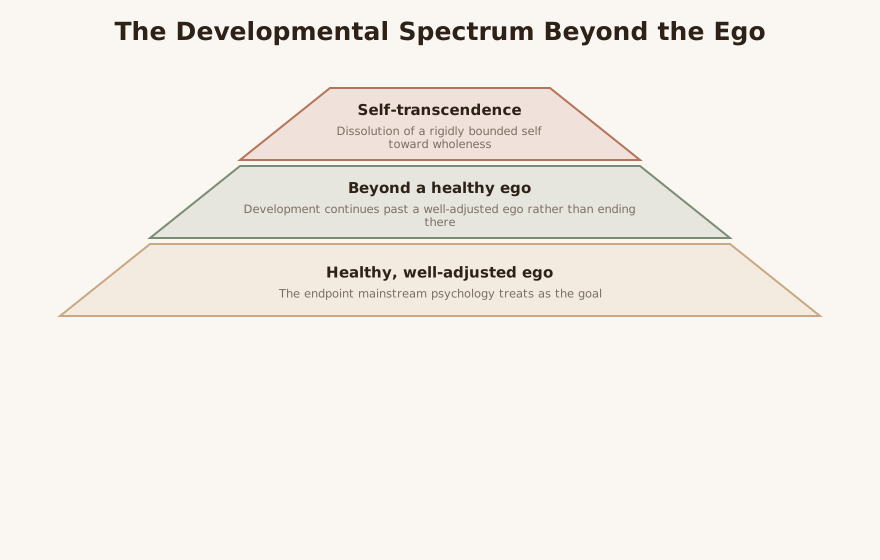
A second principle is the developmental spectrum beyond the ego. The field holds that human development does not terminate at a healthy, well-adjusted ego but can continue toward self-transcendence and the dissolution of a rigidly bounded sense of self 1. Self-transcendence, ego dissolution, and the realization of holistic human potential are organizing constructs of the field 1. Maslow’s peak experiences and Grof’s holotropic experiences both name this same directional pull “toward wholeness” beyond ordinary ego functioning 4.
A third principle is the integration of psychology with spirituality without collapsing into religion. Grof characterized the field as addressing “major misconceptions of mainstream psychiatry and psychology concerning spirituality and religion” 3. The aspiration is to study spiritual experience empirically and clinically while remaining a psychology, a boundary the field itself acknowledges is contested and difficult to police 1. A fourth, relational principle frames the clinician as “a catalyst for helping clients and patients reach conclusions that resonate with them on a personal level” rather than an external expert, with therapeutic emphasis on strengthening “bonds among individuals, the other people in their lives, and nature” 2.
Interventions & Techniques
Transpersonal therapy is defined less by a fixed protocol than by the integration of conventional clinical work with practices that engage transcendent experience 2. Commonly described methods include meditation and mindfulness, guided imagery, dream work and Jungian active imagination, breathwork, journaling, and expressive arts using “paint, clay, dance, photography, poetry, or music” to facilitate contact with inner creative impulse and higher consciousness 3. Buddhist-derived approaches, including mindfulness- and compassion-based interventions “with roots in the Buddhist philosophy of mind,” are frequently incorporated 3.
The field also encompasses several more intensive and higher-risk applications. Grof’s Holotropic Breathwork uses accelerated breathing and music to occasion holotropic, non-ordinary states intended to move the person “toward wholeness” 4. Psychedelic-assisted psychotherapy – using substances such as psilocybin, MDMA, and ketamine within structured protocols of preparation, medicine session, and integration – is increasingly situated within the transpersonal frame for trauma and treatment-resistant conditions 3. Adjacent practices described in the literature include social prescribing to reconnect isolated individuals with community and cultural identity, and non-medical end-of-life “soul midwifery” care 3. A central clinical task across all of these is the integration of peak, mystical, or holotropic experiences into ordinary life so that they become stabilizing and meaning-making rather than disorganizing LLM.
LLM-generated illustrative example (not a guideline): A long-term meditator arrives shaken after a retreat in which the sense of being a separate self briefly dropped away, leaving them frightened that they are “losing their mind.” Rather than pathologizing the episode or amplifying it, the clinician first screens for safety and for psychotic or manic features, then – finding none – helps the client name the experience, place it within their contemplative practice, and metabolize it into a clearer sense of meaning rather than a crisis LLM.
Evidence Base
The honest position is that transpersonal psychology is an established and durable school or movement rather than an established body of outcome evidence LLM. Its institutional standing is real: a dedicated journal since 1969, a professional association since 1972, an APA Division 32 special-interest group, and a substantial theoretical literature, including the Wiley-Blackwell Handbook of Transpersonal Psychology 5. “Established” here should be read as long-standing and institutionalized, not as trial-validated for any specific disorder LLM.
The field’s scientific status is openly contested, and clinicians should represent this plainly to clients. Transpersonal psychology “is not universally recognized as a scientific field” because empirical methods vary widely among practitioners, and it remains “an alternative approach to established clinical schools of psychology and psychiatry” 2. Critics cite a “lack of conceptual, evidentiary, and scientific rigor,” including inadequate operationalization of core concepts, insufficient attention to biological foundations, and unclear boundaries between psychology, spirituality, and religion 1. Ernest Hilgard regarded it as a “fringe movement,” and Albert Ellis questioned both its therapeutic efficacy and its scientific status 1. A core structural problem is that experiential therapies are “difficult to operationalize for rigorous scientific testing” 3.
There are pockets of converging empirical interest. Neuroscience increasingly documents measurable changes in brain structure and brain waves during meditation, although “the mechanisms behind these changes remain a mystery” 3. The field also influenced the inclusion of “Religious or spiritual problem” as a diagnostic category in the DSM in 1993, recognizing psychoreligious and psychospiritual concerns as legitimate clinical foci 2. The defensible clinical stance is to use the transpersonal frame for meaning, integration, and the relational stance, while delivering disorder-specific care through approaches with stronger trial support wherever those are indicated LLM.
Populations & Indications
The framework is best suited to adults engaged in spiritual growth and meaning-making, where the goal is not symptom suppression but a fuller, more integrated way of living 2. It is a natural fit for meditators and contemplatives who encounter strong or destabilizing states in the course of practice and need help making sense of them 3. Clients in existential crisis or existential distress – confronting purpose, mortality, and the limits of the ego – are served by a frame that treats these as ordinary, even developmentally important, human questions rather than as pathology 1.
The literature also points to applications in end-of-life care and existential concerns, personal development, treatment-resistant depression and anxiety, chronic PTSD and trauma, and addiction, frequently in conjunction with the more intensive experiential or psychedelic-assisted methods within the family 3. A distinct indication is the person undergoing a spiritual emergence or spiritual emergency, in whom an unfolding transformative process has become overwhelming and needs containment and skilled accompaniment rather than only suppression 1. Across these populations, the unifying indication is a person for whom the spiritual or transcendent dimension of their experience is central to the clinical picture LLM.
Problems-for-Work
The framework speaks most directly to loss of meaning and existential crisis, reframing them as growth-relevant rather than purely symptomatic and locating the work in meaning-making and self-transcendence 1. It is well matched to spiritual crisis and spiritual emergency, where a transformative or non-ordinary experience has become destabilizing and the clinical task is to help the client integrate rather than merely shut down the process 1. It is frequently applied to identity issues, particularly where a client’s sense of self is reorganizing around spiritual or transpersonal experience 3.
LLM-generated illustrative example (not a guideline): A client in their fifties describes a midlife unraveling – a successful career now feels hollow and “not who I really am.” Within a transpersonal frame, and drawing on the Jungian view of midlife as a time when spiritual questions become central, the clinician helps the client explore the felt emptiness, attend to recurring dreams and images, and articulate a sense of purpose that extends beyond the social roles that have stopped fitting LLM.
Grief and demoralization are addressed by restoring a sense of connection – to others, to nature, and to the sacred – which the field treats as a primary therapeutic aim 2. Difficulties with self-transcendence, including both the fear of ego dissolution and the failure to integrate genuine peak experiences, are worked through naming, contextualizing, and stabilizing those states rather than amplifying or pathologizing them 1. Across these applications, the consistent move is to treat the spiritual content of distress as meaningful clinical material LLM.
Contraindications, Cautions & Cultural Humility
The single most important caution for clinicians is the spiritual-emergency versus psychosis-or-mania differential LLM. Because the field deliberately resists pathologizing non-ordinary states, there is a real risk of romanticizing an acute psychotic or manic episode as “spiritual emergence” and thereby delaying needed assessment, stabilization, and possibly medication LLM. The responsible stance is to screen carefully for psychotic and mood-disorder features, ensure safety, and stabilize first; a transpersonal interpretation is appropriate only once dangerous and treatable conditions have been ruled out LLM. Acute crisis, active psychosis, acute suicidality, and significant instability call for structure, containment, and evidence-based stabilization, not open-ended exploration of transcendent states LLM.
The intensive experiential methods within the family carry their own risks. Holotropic Breathwork and psychedelic-assisted psychotherapy occasion powerful non-ordinary states and are not routine outpatient tools; they require specialized training, screening, set-and-setting controls, and integration support, and they can destabilize vulnerable clients LLM. Psychedelic-assisted work in particular should be pursued only within appropriate legal and clinical protocols, not improvised in ordinary practice 3. Clients seeking brief, structured, skills-focused help may also find an open-ended, spiritually oriented approach a poor fit, which makes informed consent about the method and its contested evidence base important LLM.
Cultural humility is essential and runs in two directions. The field draws heavily on Eastern, Indigenous, and shamanic traditions, and clinicians should engage these with respect for their living contexts rather than extracting techniques in a way that flattens or appropriates them 3. At the same time, the clinician should not assume that every client shares a transpersonal worldview; spirituality must be assessed in the client’s own terms, and the frame held lightly rather than imposed LLM. The field’s own contemporary emphasis on inclusivity, ecology, and social justice reflects an awareness that transcendence is articulated differently across cultures and communities 6.
Treatment-Plan Suggestions & SMART Objectives
| Goal | SMART objective (example) | Mechanism |
|---|---|---|
| Restore a sense of meaning and purpose | Within 10 sessions, client will name 2 sources of meaning that extend beyond current social roles and increase engagement with one | Self-transcendent meaning-making 1 |
| Integrate a peak or non-ordinary experience | Over 6 weeks, client will produce a written or expressive-arts account of a significant experience and identify 1 way it informs daily life | Integration of transcendent states into ordinary functioning 3 |
| Stabilize a spiritual emergency | Within 4 weeks, client will follow a concrete safety-and-grounding plan and report reduced overwhelm, after psychosis/mania have been ruled out | Containment and accompaniment of an unfolding transformative process 1 |
| Strengthen connection and reduce isolation | Over 8 weeks, client will re-engage 1 community, relational, or nature-based source of connection at least weekly | Strengthening bonds among self, others, and nature 2 |
| Work with existential distress about mortality | Within 12 sessions, client will articulate a personally meaningful stance toward finitude in their own words | Existential meaning-making within a transpersonal frame 1 |
| Use contemplative practice for self-regulation | For 6 weeks, client will maintain a regular meditation or mindfulness practice and track shifts in affect and awareness | Cultivation of non-ordinary and reflective states of consciousness 3 |
| Clarify identity reorganizing around spiritual experience | Within 10 sessions, client will distinguish inherited roles from a personally endorsed sense of self and self-beyond-ego | Spectrum-of-development self-exploration beyond the ego 1 |
Common Misconceptions
A frequent error is treating every intense or non-ordinary experience as a spiritual breakthrough; the field’s refusal to pathologize such states does not relieve the clinician of the duty to rule out psychosis, mania, and medical causes first LLM. A second misconception is that transpersonal psychology is the same as religion or requires a specific creed; the field aspires to study spiritual experience as a psychology and explicitly frames itself as correcting “misconceptions of mainstream psychiatry and psychology concerning spirituality and religion,” not as endorsing any one tradition 3. A third is that the approach is fully evidence-based and mainstream; in fact it “is not universally recognized as a scientific field” and is criticized for limited rigor 2.
A fourth misconception conflates the broad transpersonal frame with its most intensive techniques, assuming that working transpersonally means doing breathwork or psychedelics; much transpersonal practice is ordinary talk therapy attentive to meaning, dreams, and connection, with the high-intensity methods reserved for specialized settings LLM. A fifth is reading “beyond the ego” as a devaluation of healthy ego functioning; in the developmental-spectrum view, a stable ego is the platform from which self-transcendence becomes possible, not something to be bypassed LLM. Finally, Ken Wilber is sometimes cited as the field’s current standard-bearer, when he is more accurately described as having moved beyond the transpersonal label into his own integral theory 4.
Training & Certification
There is no single license called “transpersonal psychologist”; the orientation is practiced by licensed mental health professionals who incorporate its principles into their established scope of practice LLM. The field’s professional and continuing-education home in organized American psychology is the Transpersonal Psychology Special Interest Group within APA Division 32, the Society for Humanistic Psychology, whose members focus on the history and philosophy of the field, scholarship and research, direct transpersonal experiences, and practical applications 6. Membership is open to both APA members and non-members, with no cost to join the special-interest group at this time 6.
Dedicated graduate training has historically been offered at institutions such as the former Institute of Transpersonal Psychology, now Sofia University, alongside the Association for Transpersonal Psychology and the Journal of Transpersonal Psychology, which remain influential despite limited mainstream academic recognition 2. Clinicians who wish to use the more intensive experiential methods within the family – Holotropic Breathwork or psychedelic-assisted psychotherapy – should pursue method-specific, supervised training and operate within the relevant legal and clinical protocols rather than improvising LLM. Many generalist therapists integrate transpersonal sensibilities – attention to meaning, spirituality, and integration of significant experiences – into otherwise integrative practice, which is legitimate provided competence and scope are represented honestly LLM.
Key Terms
Transpersonal – “beyond the personal”; experience that extends awareness beyond the individual, embodied sense of identity 3. Fourth force – Maslow’s designation of the field as an alternative beyond behaviorism, psychoanalysis, and humanistic psychology 2. Self-transcendence – movement of awareness and identity beyond the bounded ego, an organizing aim of the field 1. Peak experience – Maslow’s term for moments containing “a sense of connection with universal flow or the divine” 4. Holotropic – Grof’s coinage, from holos (wholeness) and trepein (moving toward), describing the psyche’s movement toward wholeness through non-ordinary states 4. Non-ordinary states of consciousness – altered states such as those occurring in meditation, after psychedelics, or during peak performance 3. Spiritual emergency – a transformative or spiritual process that has become overwhelming and requires containment and skilled support 1. Spectrum of consciousness / development – the view that development can continue across stages beyond the healthy ego toward transcendence 1. Integration – the clinical task of metabolizing peak, mystical, or holotropic experiences into stable, meaningful daily functioning LLM. Psychosynthesis – Assagioli’s framework described as “a psychology of the self in its most holistic transpersonal sense,” integrating physical, emotional, and spiritual dimensions 3.
Resources & Further Reading
▶ Watch — a video introduction to this concept:
- Transpersonal psychology – Wikipedia
- Transpersonal Psychology – EBSCO Research Starters
- What Is Transpersonal Psychology? 9 Examples and Theories – PositivePsychology.com
- History of Transpersonal Psychology – GROF Legacy Project
- The Wiley-Blackwell Handbook of Transpersonal Psychology (Friedman & Hartelius, eds.)
- Transpersonal Psychology Special Interest Group – APA Division 32
Reflective / Supervision Questions
- When a client presents with an intense non-ordinary experience, how reliably do I distinguish a spiritual emergency from an emerging psychotic or manic episode, and what is my threshold for stabilizing first LLM?
- Am I holding the transpersonal frame as one possible lens, or am I imposing a spiritual worldview on a client who does not share it LLM?
- How do I represent the evidence status of this approach honestly – as an established, institutionalized tradition rather than a trial-validated treatment for the client’s specific condition LLM?
- Where do I draw the line between integrating transpersonal sensibilities into my practice and using intensive methods (breathwork, psychedelics) that require specialized training and protocols I may not have LLM?
- When I draw on Eastern, Indigenous, or shamanic practices, am I engaging them with cultural humility and respect for their living contexts, or extracting techniques in a way that flattens them LLM?
- How do I help a client integrate a genuinely meaningful peak experience without either inflating it into a crisis or dismissing it as noise LLM?