
Type & Discipline
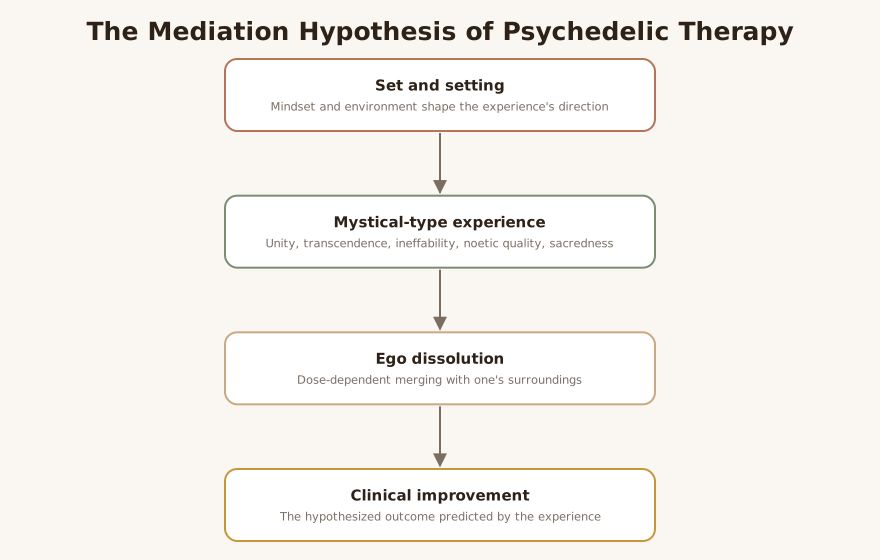
Psychedelic-assisted therapy is a treatment modality in which a serotonergic psychedelic compound is administered within a structured course of psychological support, on the working hypothesis that the quality of the acute drug experience mediates lasting clinical change 1. It sits at the intersection of psychiatry, neuroscience, and psychotherapy, and is commonly grouped within neuromodulatory and somatic approaches because the intervention begins with a pharmacological alteration of consciousness rather than with verbal technique LLM. The most-studied compound is psilocybin, with ketamine and ayahuasca also represented in the clinical literature 1.
Unlike a standard medication, the drug here is not taken daily to suppress symptoms; it is given on one or a few occasions, framed and held by therapists before, during, and after dosing 1. The defining premise is mechanistic: that subjective features of the experience — oceanic boundlessness, ego dissolution, a sense of unity — are not side effects but candidate active ingredients 1.
Creators & Lineage
The modern research program is most associated with Roland Griffiths, whose early psilocybin work catalyzed the field and anchored the Johns Hopkins Center for Psychedelic and Consciousness Research, which describes itself as the world’s largest psychedelic science research center 5. The center’s faculty — including Frederick Barrett, Alan Davis, David Yaden, and Albert Garcia-Romeu — has produced over 150 published studies on psychedelics for depression, addiction, and related conditions 5.
The mechanism-focused lineage runs heavily through Imperial College London and King’s College London, where Robin Carhart-Harris and David Nutt developed and validated instruments for the acute experience and tied that experience to outcomes 23. Conceptually, the modality borrows from transpersonal psychology, which foregrounds unitive and self-transcendent states, and it overlaps in practice with mindfulness-based and acceptance-oriented frameworks used to prepare and integrate the experience LLM. Within this lineage, psilocybin-assisted therapy is the most developed exemplar 1.
Core Principles
The organizing construct is the mystical-type experience, defined through Stace’s six dimensions: unity or interconnectedness, transcendence of time and space, ineffability, noetic quality (a sense of encountering objective truth), sacredness, and deeply felt positive mood 1. A “complete” mystical experience combines extrovertive unity (sensing universal connection) with introvertive unity (ego dissolution) 1.
Ego dissolution — a compromised sense of self, with diminished self-referential awareness and a feeling of merging with one’s surroundings — is a distinct, measurable component of this state 2. It is steeply dose-dependent for psychedelics specifically and is conceptually opposite to ego inflation, the confidence-and-self-importance state more typical of stimulants 2.
A second principle is set and setting: the patient’s mindset and the therapeutic environment shape whether the experience trends toward mystical openness or toward anxious dread 1. Because acute anxiety — particularly dread of ego dissolution — predicts worse outcomes, containment is not optional comfort but part of the mechanism 13.
Interventions & Techniques
The clinical sequence has three phases. Preparation builds therapeutic rapport and lowers anticipatory anxiety, often using relaxation and mindfulness techniques so that the patient can meet the experience without fighting it 1. Dosing sessions are conducted with nondirective psychological support; in the treatment-resistant depression trial, patients received a 10 mg psilocybin session followed a week later by a 25 mg session, each held by therapists in a prepared setting 3. Integration follows, translating session material into durable change, sometimes within cognitive-behavioral, motivational, or eclectic frameworks 1.
Measurement is itself a technique. Clinicians and researchers track the acute experience with the Mystical Experience Questionnaire, the Altered States of Consciousness scale (yielding oceanic boundlessness and dread-of-ego-dissolution subscales), and the eight-item Ego-Dissolution Inventory 123. These instruments let teams gauge whether a session reached the hypothesized therapeutic intensity rather than relying on impression alone 3.
Evidence Base
The evidence is emerging, and honesty about its maturity matters. A systematic review of twelve clinical trials found that nine showed significant correlations between mystical-experience intensity and improved outcomes across depression, addiction, and cancer-related distress 1. In treatment-resistant depression, oceanic boundlessness positively predicted symptom reduction while dread of ego dissolution predicted worse outcomes, together explaining 54% of the variance in improvement at five weeks; patients with a “complete” experience showed an 81.8% one-day response rate versus 50% for non-complete experiences 3. A broader meta-analysis concluded that the intensity of the psychedelic experience is reliably associated with clinical improvement 4.
The caveats are substantial. The underlying trials were small (N≈9–51), many were open-label and unblinded, and accompanying psychological support makes it difficult to separate the drug’s effect from concomitant therapy 1. Functional unblinding is near-inevitable because the drug’s effects are obvious, opening the door to expectancy effects 1. Mystical experience is self-reported and non-observable, and several samples lacked demographic diversity 1. Critically, this is association, not established causation — and one long-term follow-up found the mystical-experience advantage faded by 3–4.5 years 1. The field debate is unresolved: some argue subjective mystical effects are not strictly necessary if neuroplastic mechanisms work independently, while others hold that subjective and biological effects act synergistically 1.
Populations & Indications
The strongest mediation signal comes from three populations: patients with treatment-resistant and major depression, people with substance use disorders (alcohol and tobacco), and people facing cancer-related or end-of-life existential distress 1. In these groups, mystical-experience measures correlated robustly with outcomes — for example, drinking reduction correlated with mystical experience at r = −0.82 to −0.89 in alcohol use disorder 1.
Beyond these, the Johns Hopkins program lists active investigation across post-traumatic stress disorder, obsessive-compulsive disorder, chronic pain, eating disorders, and neurodegenerative conditions, reflecting research breadth rather than settled indications 5. Adults who have not responded to conventional treatment, and those with demoralization or anhedonia in the context of serious illness, are the typical candidates in trials LLM. Indication should be read as “studied,” not “approved” LLM.
Problems-for-Work
Treatment-resistant depression. When standard pharmacotherapy and psychotherapy have failed, the modality targets the rigid, self-critical self-narrative; oceanic boundlessness during sessions tracks with relief 3.
LLM-generated illustrative example (not a guideline): A patient with a decade of non-remitting depression describes, in integration, “feeling part of something larger” for the first time, and uses that as an anchor against hopelessness LLM.
Substance use disorders. The work targets entrenched craving and the meaning structures that sustain use; personal meaning and spiritual significance predicted longer abstinence in tobacco studies 1.
End-of-life existential distress. Here the problem-for-work is demoralization and dread of death; meaningfulness and spiritual significance correlated strongly with relief (r ≈ 0.75–0.77) 1.
LLM-generated illustrative example (not a guideline): A patient with terminal cancer reframes remaining time around connection rather than fear after a session marked by unity and acceptance LLM.
Contraindications, Cautions & Cultural Humility
The clinical sources emphasize that a rigorous screening process is required, though they leave its specifics underspecified 1. Standard cautions in this field — personal or family history of psychosis or bipolar disorder, significant cardiac risk, and interactions with serotonergic medications such as SSRIs — are widely treated as relative or absolute contraindications and warrant specialist evaluation before any consideration LLM. Acute anxiety and dread of ego dissolution are not merely unpleasant; they predict poorer outcomes, so destabilization risk must be weighed 13.
Legally and clinically, these compounds remain Schedule I in most jurisdictions; access is confined to clinical trials and limited regulated programs, and the modality is not standard of care LLM. Cultural humility is essential: many of these substances carry long indigenous and ceremonial lineages, and clinicians should be mindful of appropriation, context, and the difference between medicalized and traditional use LLM. Sample diversity in the evidence base is limited, so generalization across cultural and demographic groups is uncertain 1.
Treatment-Plan Suggestions & SMART Objectives
| Goal | SMART objective (example) | Mechanism |
|---|---|---|
| Reduce treatment-resistant depressive burden | Within a structured preparation-dosing-integration protocol, reduce QIDS score by a clinically meaningful margin within 5–12 weeks | Oceanic boundlessness predicting symptom reduction 3 |
| Lower anticipatory and acute session anxiety | Complete ≥3 preparation sessions using relaxation/mindfulness before dosing, reported in patient log | Set-and-setting minimizing dread of ego dissolution 1 |
| Strengthen meaning and connection | Identify and document 2 personally meaningful anchors during integration within 2 weeks of dosing | Noetic quality and unity dimensions of mystical experience 1 |
| Support substance-use reduction | Reduce frequency of target substance use by a defined percentage over a 6-month follow-up window | Mystical experience associated with reduced consumption 1 |
| Ease end-of-life existential distress | Increase self-reported meaningfulness on a validated measure within 6 weeks | Sacredness and positive-mood dimensions 1 |
| Track experience quality as a process marker | Administer the Ego-Dissolution Inventory and ASC after each session and review in integration | Ego dissolution as a measurable mediator 23 |
| Consolidate gains through integration | Attend ≥4 integration sessions within 8 weeks post-dosing, applying session insights to one concrete behavior change | Translation of acute experience into durable change 1 |
Common Misconceptions
That the drug alone produces the benefit. The evidence ties outcomes to the quality of the experience and to the surrounding psychological support, not to dosing in isolation 13. That a bigger dose simply means a better result; what predicts improvement is the mystical character of the experience, while acute dread predicts the opposite 3. That mystical-experience evidence transfers to every indication — it does not, and the strongest signal is in depression, addiction, and existential distress, while PTSD trials largely rest on a different empathogen paradigm that does not reliably produce ego dissolution LLM. That the benefit is permanent after one session; at least one long-term follow-up found the mystical-experience advantage faded over years 1. That the modality is established care, when it remains investigational LLM.
Training & Certification
Formal credentialing pathways are still consolidating, and the clinical sources here do not define a certification standard LLM. The Johns Hopkins center offers an online course on psychedelics, student internships, and an integration clinic that supports people experiencing difficulties after psychedelic use, illustrating the kind of academically anchored training and resources available in the field 5. In practice, clinicians delivering this modality typically work within research protocols or regulated programs that supply their own preparation and supervision requirements LLM. Therapists interested in entering the field should expect competencies in screening, holding nondirective support during altered states, and structured integration LLM.
Key Terms
- Mystical-type experience — a state defined by unity, transcendence of time and space, ineffability, noetic quality, sacredness, and positive mood 1.
- Ego dissolution — a compromised sense of self with diminished self-referential awareness and a feeling of merging with surroundings; steeply dose-dependent for psychedelics 2.
- Oceanic boundlessness (OBN) — a mystical-type subscale of the ASC that positively predicts depression improvement 3.
- Dread of ego dissolution (DED) — the anxious, destabilizing pole of the experience, which predicts worse outcomes 3.
- Set and setting — the patient’s mindset and the therapeutic environment, shaping whether the experience trends mystical or anxious 1.
- Ego-Dissolution Inventory (EDI) — an eight-item validated self-report measure of ego dissolution 2.
- Integration — the post-session process of translating acute experience into durable behavioral and psychological change 1.
Resources & Further Reading
▶ Watch — a video introduction to this concept:
- Ko, Knight, Rucker & Cleare (2022). Psychedelics, Mystical Experience, and Therapeutic Efficacy: A Systematic Review
- Nour, Evans, Nutt & Carhart-Harris (2016). Ego-Dissolution and Psychedelics: Validation of the Ego-Dissolution Inventory
- Roseman, Nutt & Carhart-Harris (2018). Quality of Acute Psychedelic Experience Predicts Therapeutic Efficacy of Psilocybin for Treatment-Resistant Depression
- The intensity of the psychedelic experience is reliably associated with clinical improvements: a systematic review and meta-analysis (2025)
- Johns Hopkins Center for Psychedelic and Consciousness Research
Reflective / Supervision Questions
- How do I distinguish, in my own assessment, between a therapeutically intense experience and one tipping into destabilizing dread? LLM
- Given the evidence is largely correlational and open-label, how do I hold appropriate uncertainty when discussing this modality with a patient? LLM
- What is my screening threshold for psychosis-spectrum, bipolar, cardiac, and serotonergic-medication risk before referral? LLM
- How do I attend to cultural lineage and avoid appropriation when framing this work? LLM
- For a given patient, is the problem-for-work one where the mystical-experience evidence actually applies, or am I over-extending it? LLM
- How will I structure integration so that acute insight becomes durable change rather than a fading peak? LLM