
Type & Discipline
Psychosynthesis is a depth-oriented, integrative psychotherapy and personal-development framework situated within clinical and transpersonal psychology.4 It is most accurately described as a comprehensive model and a set of techniques rather than a narrow, manualized intervention, and it is often grouped as one of the prime forces in transpersonal psychology, the so-called “fourth force” alongside psychoanalytic, behavioral, and humanistic traditions.7 What distinguishes it from purely analytic approaches is its explicit “bifocal” stance: it attends both to pathology and the personal history of the psyche and to the transpersonal or spiritual dimensions of the person.6
For practicing clinicians, the practical implication is that psychosynthesis offers a structuring map of the psyche plus a toolbox of experiential techniques that can be selectively imported into otherwise conventional treatment.4 LLM Most contemporary therapists encounter it not as their primary license-defining modality but as a lens and a collection of methods—disidentification, subpersonality dialogue, guided imagery, will training—layered onto an established treatment frame.5 LLM
Creators & Lineage
Psychosynthesis was developed by Roberto Assagioli (1888–1974), an Italian psychiatrist who trained in psychoanalysis and was a contemporary of Freud, Jung, and Bleuler.7 He began articulating the approach around 1910 and formally published his framework in 1927, with the egg diagram first presented in 1930 and elaborated in his 1933 article “Dynamic Psychology and Psychosynthesis.”5 7 The canonical English-language statement of the method is his 1965 Psychosynthesis: A Manual of Principles and Techniques, a roughly 323-page volume that was reviewed in the British Journal of Psychiatry the same year.1 2 The text remains in print in a SUNY Press edition.3
Assagioli built upon Freud’s model of the unconscious but rejected key Freudian doctrines, particularly the centrality of sexuality, and unlike Freud he embraced active, directive techniques.7 He famously framed his project as the logical complement to analysis, echoing Jung’s remark that “if there is a ‘psychoanalysis’ there must also be a ‘psychosynthesis.’”7 His relationship to Jung was respectful but distinct; in 1934 he wrote to Jung that his conception of the psyche’s structure differed in important respects, and he integrated spirituality directly into psychological practice in a way he felt Jung did not.6 The lineage thus runs from psychoanalysis (Freud) and analytical psychology (Jung) through humanistic psychology (Maslow’s self-actualization) into transpersonal psychology.6 7 Looking forward, Assagioli’s concept of semi-autonomous subpersonalities is widely recognized as a direct precursor to modern parts-based work such as Internal Family Systems.6
Core Principles
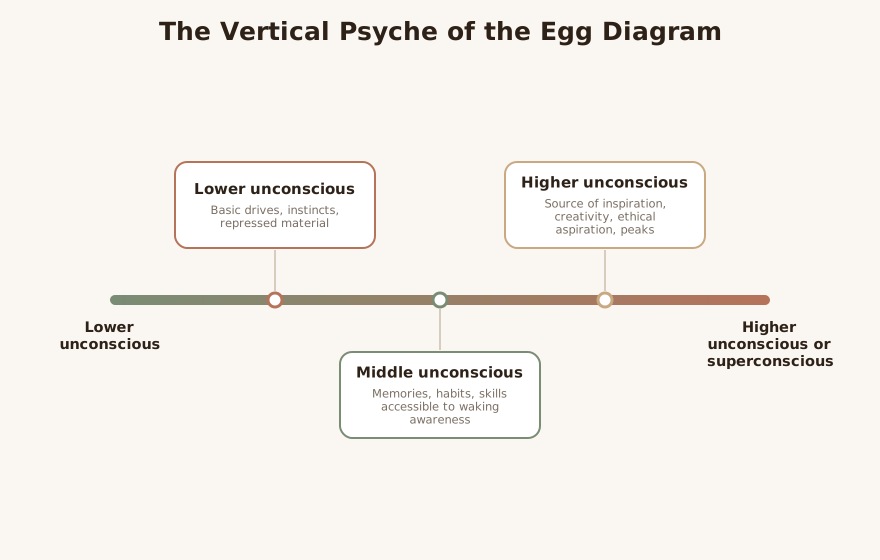
The organizing image is the “egg diagram,” which maps the psyche into seven regions: the lower unconscious (basic drives, instincts, repressed material), the middle unconscious (memories, habits, skills accessible to waking awareness), the higher unconscious or superconscious (the source of inspiration, creativity, ethical aspiration, and peak experiences), the field of consciousness, the conscious personal self or “I,” the transpersonal/Higher Self, and the surrounding collective unconscious, the latter acknowledged from Jung.5 This vertical structure—lower, middle, and higher unconscious—is the feature that most distinguishes psychosynthesis from purely horizontal psychodynamic maps.5 LLM
Several principles follow. First, the personality is naturally multiple: it comprises conflicting subpersonalities rather than a single unified actor, and Assagioli observed that “various personalities and subpersonalities struggle continuously with each other.”4 Second, there is a distinct point of pure self-awareness—the “I”—which can step back from any given content; by disidentifying from competing aspects, a person contacts this center and recovers inner freedom.4 Third, the will is foundational to mental health, conceived not as repressive force but as the directing capacity that enables choice and durable change—Assagioli’s image is an orchestra conductor who directs without suppressing.4 5 Fourth, growth tends toward synthesis: harmonious integration of the personality’s parts around a unifying center, which Assagioli called “unity in diversity.”4 5 Underlying all of this is a developmental optimism—the assumption that the psyche tends, when not obstructed, toward higher integration and meaning.4
Interventions & Techniques
The signature exercise is disidentification, built on a three-part affirmation: “I have a body, but I am not my body. I have emotions, but I am not my emotions. I have a mind, but I am not my mind.”5 Drawing on the Eastern neti neti (“neither this, nor that”) tradition, each statement creates separation between the observing “I” and a transient content, after which a second self-identification phase invites the client to rest as the witnessing observer.5 In practice this functions much like a structured defusion or witnessing exercise familiar from mindfulness-based and acceptance-oriented work.5 LLM
Other core techniques include dialogue with subpersonalities (naming, mapping, and bringing internal parts into relationship with the conscious “I” rather than suppressing them), guided imagery and symbol work, the “ideal model” (visualizing a realistic version of one’s developing potential so that imagination precedes realization), movement and journaling, and will-development exercises distinguishing strong, skilful, and good will.4 5 Shortly before his death in 1974, Assagioli specified seven elements that practitioners should directly experience rather than merely understand intellectually: disidentification, the personal self, the will, the ideal model, synthesis, the superconscious, and the Transpersonal Self.5
LLM-generated illustrative example (not a guideline): A client torn over whether to leave a stable but deadening job describes “one part of me that wants security and another that’s suffocating.” The clinician helps her name these as an Inner Protector and a Restless Seeker, dialogues with each from the standpoint of the observing “I,” and then uses an ideal-model image to clarify what a chosen, willed next step might look like rather than an impulsive flight. LLM
Evidence Base
Honesty about maturity matters here. Psychosynthesis is established as a coherent, durable, and historically influential model with a half-century-plus literature and active training institutes, and its 1965 manual was taken seriously enough to be reviewed in the British Journal of Psychiatry.2 3 However, “established as a tradition” is not the same as “empirically validated.” The framework has limited rigorous outcome research and remains, in Wikipedia’s framing, on the fringes of the official therapy world without substantial mainstream trial support.7 The small extant studies point to techniques aiding culture-shock anxiety, creative expression, and spiritual growth, but these are not the kind of randomized controlled trials that anchor first-line evidence-based treatments.7
Assagioli himself anticipated a core critique, conceding that the approach “accepts too much. It sees too many sides.”7 LLM The honest clinical posture is therefore: use psychosynthesis as a conceptual and experiential complement to empirically supported treatments, not as a substitute for them when a client presents with a condition that has well-validated first-line interventions.7 LLM
Populations & Indications
Psychosynthesis is best indicated for adults engaged in personal-growth or spiritual work and for clients in existential or life-transition distress, where its emphasis on meaning, will, and the superconscious is congruent with the presenting concern.4 5 It is well suited to creative and high-functioning clients who are not in acute crisis but are seeking integration, and to clients exploring identity and meaning.4 LLM Because subpersonality work directly addresses ambivalence, it is also apt for individuals with internal conflict, and its developmental, non-pathologizing stance can be supportive for trauma survivors once stabilization is in place.4 6
The model maps onto a wide range of problems-for-work: identity disturbance, internal conflict and ambivalence, low self-esteem, existential crisis, anxiety, depression, trauma-related fragmentation, lack of meaning or purpose, self-integration difficulties, and explicitly spiritual and religious problems—a domain many secular modalities sidestep but which psychosynthesis treats as legitimate clinical content.4 7 LLM
Problems-for-Work
Internal conflict and ambivalence. Subpersonality mapping externalizes a “stuck” decision into a relationship between identifiable parts, allowing the “I” to mediate rather than be captured.4 Application: a client paralyzed between a pleaser and a rebel can dialogue with each to clarify the legitimate need behind each voice. LLM
Identity disturbance and self-integration difficulties. Disidentification helps a client who over-identifies with a role, emotion, or symptom recover a stable observing center distinct from that content.5 Application: “I am a failure” becomes “a part of me feels like a failure,” loosening fusion. LLM
Existential crisis and lack of meaning. Work with the superconscious, will, and the ideal model reconnects a client to direction and aspiration after a meaning collapse.4 5 Application: clarifying a “good will” project that reorients a directionless period. LLM
Trauma-related fragmentation. Within a phased frame, parts work and the witnessing “I” can help a survivor relate to fragmented self-states without being overwhelmed.6 LLM
Contraindications, Cautions & Cultural Humility
The most clinically significant caution is spiritual bypassing: a premature focus on transpersonal and superconscious material before personal-level wounds are addressed.7 Assagioli himself warned that seekers often skip the grounding work of personal psychosynthesis, and the historical record notes both this risk of premature transpersonal focus and past cult associations around the broader movement.5 7 The clinical rule is to sequence personal before transpersonal work—stabilize, integrate, and build will first.5 LLM
Several other cautions follow. Disidentification and intensive imagery can be destabilizing for clients with dissociative presentations, active psychosis, or unstable trauma symptoms, so titration and prior stabilization are essential.6 LLM Because the model carries an explicit metaphysics of a “Higher Self,” cultural and religious humility is required: the language should be offered as one frame among many, adapted to or set aside for clients whose spiritual or secular commitments differ, never imposed.4 LLM The same overinclusiveness Assagioli acknowledged—“it sees too many sides”—means a clinician must guard against vagueness and keep work tethered to concrete, agreed treatment goals.7 LLM
Treatment-Plan Suggestions & SMART Objectives
| Goal | SMART objective (example) | Mechanism |
|---|---|---|
| Reduce identity fusion | Within 8 weeks, client will demonstrate disidentification by reframing 3 self-critical statements as “a part of me…” during sessions, observed 2x | Disidentification / observing “I” 5 |
| Resolve internal ambivalence | Over 6 sessions, client will name and dialogue with at least 2 conflicting subpersonalities and report one mediated decision | Subpersonality dialogue 4 |
| Restore sense of direction | Within 10 weeks, client will articulate one values-based “ideal model” and take 2 concrete steps toward it | Ideal model + will training 5 |
| Strengthen volitional capacity | Over 4 weeks, client will complete a weekly self-chosen “good will” action and rate follow-through ≥4/5 | Act of will (strong/skilful/good) 4 |
| Increase meaning in life-transition | Within 8 weeks, client will identify 3 sources of meaning and report a measurable rise on a meaning self-rating | Superconscious / synthesis work 4 |
| Reduce ambivalence-driven anxiety | Over 6 sessions, client will use a disidentification exercise during 3 anxious episodes and log the effect | Witnessing self / defusion 5 |
| Integrate fragmented self-states (trauma) | Within 12 weeks, post-stabilization, client will relate to 2 trauma-linked parts from the observing “I” without dysregulation | Parts work within phased frame 6 |
Common Misconceptions
A frequent misconception is that psychosynthesis is primarily a spiritual or religious practice. In Assagioli’s own structure, the bulk of clinical work is personal psychosynthesis—healing wounds, integrating subpersonalities, and building will—with transpersonal work as a later, optional stage, not the entry point.5 7 A second misconception is that “synthesis” means erasing or merging away the parts; in fact the aim is “unity in diversity,” parts brought into relationship under the conscious “I” rather than suppressed.5 A third is that it is merely a softer rebrand of psychoanalysis; Assagioli explicitly embraced active, directive techniques and a vertical model of the higher unconscious that classical analysis lacked.7 5 Finally, some assume it is the same as Jungian therapy; Assagioli himself drew a sharp distinction, holding that his conception of the psyche differed in important respects from Jung’s.6
Training & Certification
Psychosynthesis is taught primarily through dedicated training institutes rather than mainstream university clinical programs, with established centers such as the UK’s Psychosynthesis Trust offering structured training.4 LLM There is no single universal licensing body; psychosynthesis training typically supplements, rather than replaces, a clinician’s primary mental-health license and is pursued as post-qualification or specialized study.4 LLM The foundational reading for any clinician remains Assagioli’s 1965 Manual of Principles and Techniques, available in the SUNY Press edition.1 3 Consistent with Assagioli’s late-life instruction, credible training emphasizes that practitioners directly experience the core elements—disidentification, the “I,” the will, the ideal model, synthesis, the superconscious, and the Transpersonal Self—in their own development, not merely study them.5
Key Terms
- Egg diagram — Assagioli’s map of the psyche across seven regions, including lower, middle, and higher unconscious.5
- Subpersonalities — Semi-autonomous internal parts (e.g., inner critic, pleaser) that conflict and generate ambivalence.4
- The “I” (personal self) — The point of pure self-awareness and will, distinct from ego and from any single content.5
- Disidentification — Stepping back from body, emotions, and mind to recover the observing self.5
- Will — The directing capacity central to mental health; strong, skilful, and good will.5
- Superconscious / higher unconscious — The source of inspiration, creativity, and peak experience.5
- Transpersonal (Higher) Self — The deepest spiritual center toward which growth tends.5
- Synthesis / “unity in diversity” — Harmonious integration of parts around a unifying center.5
- Personal vs. spiritual psychosynthesis — The two developmental stages, personal grounding preceding transpersonal work.7
Resources & Further Reading
▶ Watch — a video introduction to this concept:
- Assagioli, R. (1965). Psychosynthesis: A Manual of Principles and Techniques (full text)1
- British Journal of Psychiatry review of Assagioli’s Manual (1965)2
- Psychosynthesis — SUNY Press edition3
- About Psychosynthesis — The Psychosynthesis Trust (UK)4
- What is Psychosynthesis? Roberto Assagioli’s Psychology — Kenneth Sorensen5
- Roberto Assagioli and His Pioneering Role in the Evolution of Psychotherapy6
- Psychosynthesis — Wikipedia7
Reflective / Supervision Questions
- When I introduce transpersonal or “Higher Self” language, am I responding to the client’s stated frame and values, or importing my own—and have I done sufficient personal-level grounding first?5 LLM
- For this client’s presenting problem, is there a first-line empirically supported treatment that psychosynthesis techniques should complement rather than replace?7 LLM
- Could disidentification or intensive imagery destabilize this particular client (dissociation, psychosis, unstable trauma), and have I stabilized before deepening?6 LLM
- Am I keeping the work tethered to concrete, measurable goals, or has Assagioli’s “it sees too many sides” expansiveness made my treatment plan vague?7 LLM
- How do I distinguish, in my own documentation and reasoning, between the spiritual meaning a client makes and the clinical symptoms I am accountable for treating?4 LLM