
Type & Discipline
Classical psychoanalysis is a theory of mind and a treatment method, not a brief technique or a manualized protocol LLM. It belongs to clinical psychology and the broader discipline of psychoanalysis, which represents, within psychology, professionals committed to the study, practice, and development of psychoanalysis and psychoanalytic psychotherapy 2. As a treatment, it is the most intensive member of the depth/unconscious-process family: a long-term, frequent-session method aimed at structural change rather than symptom relief alone LLM. Practitioners should hold two facts in mind at once: classical psychoanalysis is the historical source of most modern depth work, and it is also a specific high-intensity modality that is now rarely delivered in its full form LLM. The empirical literature you will most often draw on supports its descendants (psychodynamic psychotherapy), not the classical couch-based method itself LLM.
Creators & Lineage
Sigmund Freud is the originator. His clinical and theoretical writings, including A General Introduction to Psychoanalysis, established psychoanalysis as a fundamentally interpretive enterprise in which the psychic processes are themselves unconscious and the conscious mind is only a fragment of total psychic life 4. Freud held that psychoanalysis is learned first through study of one’s own personality, which is one reason a personal training analysis became central to the tradition 4. The familiar Latinate terms id, ego, and superego are James Strachey’s English renderings of Freud’s German das Es, das Ich, and das Über-Ich; Freud formalized this structural model in Das Ich und das Es (1923) 7.
The lineage that grew from Freud is the practical reason this article matters for a contemporary clinician LLM. Ego psychology elaborated the ego’s defensive and adaptive functions; object relations theory shifted the emphasis from drives toward internalized relationships; and psychodynamic psychotherapy distilled the core ideas into a less intensive, more widely practiced format LLM. Jungian analytical psychology branched off early as a distinct depth tradition LLM. When you use transference, defense, or unconscious meaning in everyday practice, you are using Freud’s framework filtered through these descendants LLM.
Core Principles
The first principle is the dynamic unconscious: most of mental life is outside awareness, and conscious thoughts are isolated acts within a larger unconscious totality 4. The second is psychic determinism, the idea that mental events have causes and meanings even when they seem accidental; Freud’s analysis of slips (parapraxes) illustrates this, as when a president declared a session “closed” rather than “open,” betraying an unconscious wish 4. Errors, in this view, are valid psychic acts in which two different intentions collide 4.
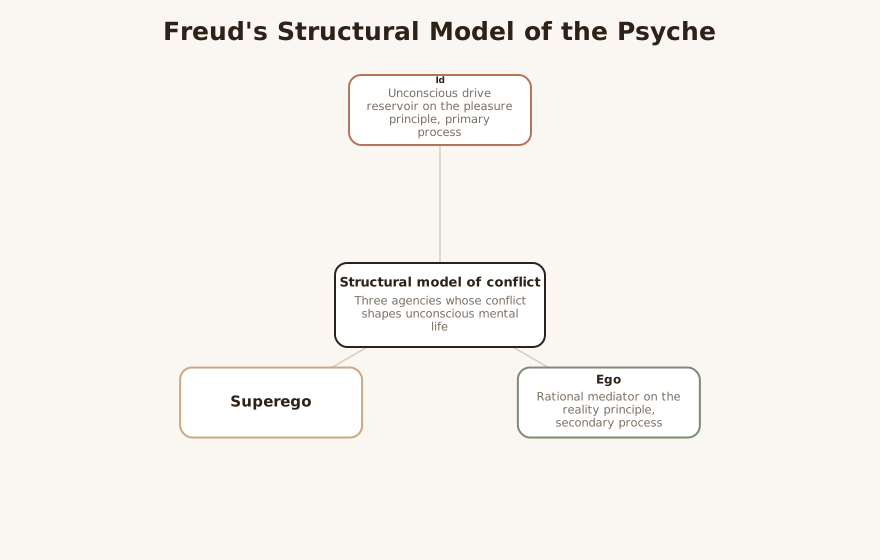
The structural model organizes conflict among three agencies 1. The id is the unconscious reservoir of instinctual drives operating on the pleasure principle, seeking immediate gratification; Freud called it the dark, inaccessible part of the personality 7. It runs on primary process thinking that is primitive, irrational, and fantasy-oriented, a “cauldron of seething excitations” filled with libidinal and aggressive drives 5. The ego is the rational mediator operating on the reality principle and secondary process thinking, finding socially acceptable outlets for impulses; Freud compared it to a rider holding in check the superior strength of a horse 7. The superego is the internalized moral authority, expressed through the conscience (an inner critic generating guilt) and the ego-ideal (aspirational standards) 5.
Conflict is treated as inevitable because the three agencies make incompatible demands 5. When the ego is overwhelmed it deploys defense mechanisms, such as denial, projection, rationalization, and above all repression, to reduce anxiety 7. These defenses consume psychic energy and can produce maladaptive patterns and symptoms 5. Freud also held that sexual impulses play an unusually large role in the causation of nervous and mental disorders, a claim that generated, and still generates, resistance 4. The therapeutic aspiration is captured in Freud’s formulation “Where id was, there ego shall be” — expanding the domain of reflective, self-governing functioning 7.
Interventions & Techniques
The defining technique is free association: the patient is invited to say whatever comes to mind without censoring, on the premise that surface productions lead, by their own logic, toward repressed material 4. The analyst’s stance is interpretive; meaning emerges through dialogue, and the analyst helps the patient uncover meanings the patient already, unconsciously, possesses 4. The clinician attends closely to parapraxes, dreams, and apparent errors as routes to unconscious content 4.
A second pillar is the analysis of resistance and defense. When associations stall, when the patient forgets appointments, or when affect flattens at a charged moment, the analyst reads this as the ego defending against anxiety rather than as mere non-cooperation LLM. A third pillar is transference: the patient unconsciously re-enacts early relational templates within the relationship to the analyst, and the analyst’s task is to recognize and interpret this so the pattern can become conscious and workable LLM. In the classical frame these processes are intensified by external arrangements: frequent sessions (often four to five per week), use of the couch, and the analyst’s relative neutrality, all designed to deepen the transference and surface unconscious material LLM.
LLM-generated illustrative example (not a guideline): A patient repeatedly arrives a few minutes late and apologizes profusely, then falls silent. Rather than coaching punctuality, the analyst gently notes the pattern and the silence that follows, wondering aloud whether something about coming here feels risky. Over weeks this links to a childhood pattern of placating a critical parent — material the patient could not have stated directly at intake LLM.
Evidence Base
Honest framing matters here. Classical psychoanalysis is established as a foundational theory and as the historical wellspring of modern psychotherapy, but its specific high-intensity technique has a thin modern outcome-trial base, partly because multi-year, multi-session-per-week treatments are extraordinarily hard to randomize and fund LLM. The contemporary empirical case is carried largely by its descendant, time-limited psychodynamic psychotherapy, which has a more developed trial literature; classical analysis should not be presented to patients or payers as an evidence-equivalent of manualized short-term treatments LLM. The tradition maintains active scholarly infrastructure — APA Division 39 represents practitioners and researchers committed to psychoanalysis and psychoanalytic psychotherapy 2, and publishes the peer-reviewed quarterly Psychoanalytic Psychology as a venue for theory, practice, and research 62. A clinician should treat specific Freudian metapsychological claims (for example, the universality of particular drive dynamics) as contested theory rather than settled fact, while still finding the clinical constructs of transference, defense, and unconscious conflict useful LLM.
Populations & Indications
Classical and classically-derived psychoanalytic work is most often considered for adults with chronic or characterological difficulties, where the trouble is not a single symptom but a recurring way of being LLM. Typical candidates include people with personality disorders, high-functioning “neurotic” patients with internal conflict despite outward competence, and adults with longstanding relational patterns that repeat across jobs and partners LLM. It also draws patients explicitly seeking depth self-understanding rather than rapid symptom removal, and patients with recurrent depression or anxiety that has not durably resolved with briefer or symptom-focused approaches LLM. Suitability has traditionally rested on capacities the method demands: psychological-mindedness, frustration tolerance, sufficient ego strength to bear an intensifying transference, and the practical means for a long, frequent commitment LLM.
Problems-for-Work
- Neurotic conflict. The paradigm target: internal conflict among wish, prohibition, and reality expressed as symptoms; worked by making the conflict and its defenses conscious 7.
- Recurrent self-defeating patterns. A patient who unconsciously sabotages each promotion is helped to see the superego-driven guilt or fear of surpassing a parent behind it LLM.
- Relationship difficulties. Repeating relational templates are surfaced and re-examined through the transference enacted with the clinician LLM.
- Obsessional symptoms. Understood as defenses (e.g., isolation of affect, undoing) against forbidden aggressive or sexual impulses, addressed by interpreting what the ritual wards off LLM.
- Low self-esteem and identity disturbance. Linked to a harsh superego or unstable internalized images; work aims to soften the inner critic and consolidate a more coherent self LLM.
- Somatic symptom disorder and sexual dysfunction. Approached as possible expressions of unconscious conflict given drive theory’s emphasis on sexuality, while remaining alert to medical causes 4.
LLM-generated illustrative example (not a guideline): A high-achieving professional presents with disabling self-criticism. Sessions reveal that praise triggers panic; over time this connects to an internalized sense that success would betray a struggling sibling. Naming the guilt loosens its grip on her ambition LLM.
Contraindications, Cautions & Cultural Humility
Intensive uncovering work is poorly matched to acute crisis, active psychosis, severe substance dependence, or situations requiring rapid stabilization, where structure and symptom management take priority LLM. Patients with very fragile ego functioning may be destabilized by an intensifying transference and a neutral stance, and need a more supportive frame LLM. The method’s demands — frequent sessions, long duration, significant cost — also raise an access-and-equity concern: classical analysis has historically been available mainly to a narrow demographic, and clinicians should be candid about this rather than treat it as a universal good LLM.
Several Freudian claims warrant explicit cultural humility. Drive theory’s strong emphasis on sexuality, its early views on gender and on women’s development, and its universalizing of culturally specific family structures have been substantially criticized LLM. The framework was built largely from a particular European, early-twentieth-century clientele, and concepts like the “neurotic patient” or a “harsh superego” can pathologize culturally normative experience if applied without care LLM. Use the clinical tools — attention to unconscious meaning, defense, and transference — while holding the metapsychology lightly and checking interpretations against the patient’s own cultural frame LLM.
Treatment-Plan Suggestions & SMART Objectives
| Goal | SMART objective (example) | Mechanism |
|---|---|---|
| Increase insight into recurring conflict | Within 12 weeks, patient will identify and name in session at least 3 instances linking a current symptom to an underlying internal conflict | Making unconscious conflict conscious 7 |
| Recognize characteristic defenses | Within 8 weeks, patient will spontaneously notice and label 2 of their habitual defenses (e.g., rationalization, denial) during a session | Defense analysis reduces automatic, energy-costly defending 5 |
| Use the therapeutic relationship as data | Over 16 weeks, patient will identify at least 2 occasions where they related to the clinician as they do to a key figure in their life | Recognizing and working through transference LLM |
| Soften a harsh inner critic | Within 12 weeks, patient will report a measurable drop in self-critical episodes (self-monitoring log) on 4 consecutive weeks | Modifying punitive superego activity 5 |
| Strengthen reflective functioning | Within 90 days, patient will, in 3 of 4 sessions, pause to consider the meaning of an impulse before acting on a self-defeating urge | Shifting from primary- to secondary-process regulation 5 |
| Interrupt a self-defeating pattern | Within 6 months, patient will demonstrate one altered response in a previously repeating relational scenario | Insight plus working-through of the underlying conflict LLM |
| Tolerate previously avoided affect | Within 10 weeks, patient will stay with and describe a difficult feeling for at least one full session without changing the subject | Lifting repression that drives symptom formation 4 |
Common Misconceptions
A frequent error is conflating “psychodynamic therapy” with “classical psychoanalysis”: the former is the briefer, more common, more evidence-supported descendant, while the latter is the intensive couch-based original LLM. Another is the belief that psychoanalysis is purely about sex; sexuality is emphasized in drive theory, but the working clinical material is conflict, defense, and meaning across all domains of life 4. A third is treating the id/ego/superego as literal brain structures rather than as a conceptual model of competing mental forces 7. Many assume the analyst’s silence means passivity, when neutrality is a deliberate technical stance meant to surface the patient’s own projections and transference LLM. Finally, the popular idea that one “interpretation” produces cure misrepresents the method: change comes through repeated working-through over time, not a single revelation LLM.
Training & Certification
Becoming a credentialed psychoanalyst is a substantial, separate undertaking from generalist mental-health licensure, typically pursued at a psychoanalytic institute and involving didactic coursework, extensive supervised analytic cases, and a personal training analysis — consistent with Freud’s view that the method is learned first through study of one’s own personality 4LLM. Professional homes and continuing-education networks exist for practitioners at all levels: APA Division 39 (the Society for Psychoanalysis and Psychoanalytic Psychology) organizes the field within psychology and publishes scholarly work for ongoing development 26. Clinicians who are not formally trained analysts can still ethically incorporate psychodynamic thinking into licensed practice, provided they represent their scope accurately and do not advertise themselves as psychoanalysts LLM.
Key Terms
- Id — unconscious drive reservoir, pleasure principle, primary-process thinking 75.
- Ego — rational mediator, reality principle, secondary-process thinking 75.
- Superego — internalized moral authority: conscience plus ego-ideal 5.
- Pleasure principle / reality principle — immediate gratification vs. realistic, deferred satisfaction 7.
- Repression / defense mechanisms — the ego’s anxiety-reducing maneuvers (denial, projection, rationalization, repression) 7.
- Free association — saying whatever comes to mind without censorship to access the unconscious 4.
- Transference — re-enacting early relational patterns toward the clinician LLM.
- Resistance — defensive obstruction of the analytic process LLM.
- Parapraxis — a meaningful slip in which two intentions collide 4.
- Working-through — repeated re-examination of conflict over time that produces durable change LLM.
Resources & Further Reading
▶ Watch — a video introduction to this concept:
- What is Psychoanalysis? Part 4 — The Ego, the Id and the Superego (Freud Museum London)
- Society for Psychoanalysis and Psychoanalytic Psychology (APA Division 39)
- About Psychoanalysis (International Psychoanalytical Association, IPA — PDF)
- A General Introduction to Psychoanalysis (Freud, 1920 trans.) — Project Gutenberg
- Id, Ego, and Superego (Simply Psychology)
- Psychoanalytic Psychology — APA journal (Division 39)
- Id, ego and superego — Wikipedia
Reflective / Supervision Questions
- When a patient’s symptom recurs despite insight, what unconscious conflict or defense might the symptom still be serving? LLM
- How do I distinguish clinically useful attention to transference from over-reading the relationship into every interaction? LLM
- Where am I applying Freudian metapsychology as if it were settled fact rather than contested theory, and how would I phrase the same observation more humbly with this patient’s culture in mind? LLM
- Am I representing my scope accurately — psychodynamic-informed psychotherapy versus formal psychoanalysis — to this patient and in my documentation? 2LLM
- For this specific patient, is uncovering, insight-oriented work indicated, or does their current stability call for a more supportive, structured frame? LLM
- What in my own reactions to this patient (countertransference) might be data about how they affect others? LLM