
Type & Discipline
LSD-Assisted Psychotherapy is a psychiatric and psychotherapeutic modality in which a serotonergic psychedelic, LSD (lysergic acid diethylamide), is administered in a small number of supervised dosing sessions embedded within a longer course of drug-free psychotherapy 1. It belongs to the broader family of psychedelic-assisted therapy, alongside psilocybin- and MDMA-assisted approaches 6. Two historically distinct paradigms sit under this heading: psycholytic therapy, using low-to-moderate doses repeatedly at intervals of one to two weeks within a psychoanalytic frame, and psychedelic therapy, using a single moderate-to-high dose aimed at a peak or mystical-type experience 2. The defining feature across both is that the drug is understood not as a stand-alone pharmacological treatment but as a catalyst for psychotherapeutic process, structured by extensive preparation and integration 3. As such it is best classified as a structured, manualizable psychotherapy modality rather than a medication regimen LLM.
Creators & Lineage
LSD was discovered by Albert Hofmann at Sandoz Laboratories in Basel, Switzerland, in 1943, and Sandoz subsequently distributed it to researchers 6. Two regional schools shaped its therapeutic use 4. In North America, the psychiatrist Humphry Osmond — who coined the term “psychedelic,” meaning “mind manifesting” — pioneered the single-large-dose model from 1951 with his colleague Abram Hoffer, theorizing that the drug could induce a new level of self-awareness 4. Osmond and Hoffer applied this approach to alcohol use disorder, treating roughly 2,000 patients and reporting relapse-prevention success rates of around 40 to 45 percent 4. In Europe, Ronald Sandison developed psycholytic therapy in the United Kingdom, pairing multiple smaller doses with psychoanalysis and opening what is described as the world’s first purpose-built LSD therapy clinic at Powick Hospital in 1955 4.
The modality’s named lineage figure, Stanislav Grof, is associated chiefly with the transpersonal-psychology strand of this tradition and with later breathwork techniques connected to his psychedelic work 6. Beyond these origins, the modality is the direct historical ancestor of contemporary psilocybin- and MDMA-assisted psychotherapy, which inherited its set-and-setting framework and its preparation–dosing–integration structure 6.
Core Principles
The central principle is that pharmacology, set, and setting interact to determine outcome — the drug alone does not produce therapeutic change 2. LSD acts primarily as an agonist at serotonin 5-HT2A receptors, the main mediator of psychedelic effects, with additional modulation of dopaminergic, adrenergic, and glutamatergic systems 5. Effects emerge within 20 to 90 minutes and last roughly 6 to 12 hours, requiring full-day sessions 5. “Set” refers to the patient’s mindset, preparation, and intention; “setting” refers to the physical, social, and cultural environment in which dosing occurs 5.
In the psycholytic frame, the patient is expected to remain in communication with the attending therapist and to recognize themselves as actively participating in therapy, rather than passively undergoing a drug experience 3. A realist review of psycholytic studies identified the therapeutic relationship and trust as the central mechanism, with flexible, intuitive therapist styles outperforming rigid ones, and with the quality and quantity of preparation strongly correlated with effectiveness 3. In the psychedelic frame, by contrast, the aim is a single overwhelming mystical-type peak experience, and the strength of that experience has been observed to correlate with better long-term outcomes 2. Both paradigms treat the dosing session as one node within a longer arc of preparation and integration 3.
Interventions & Techniques
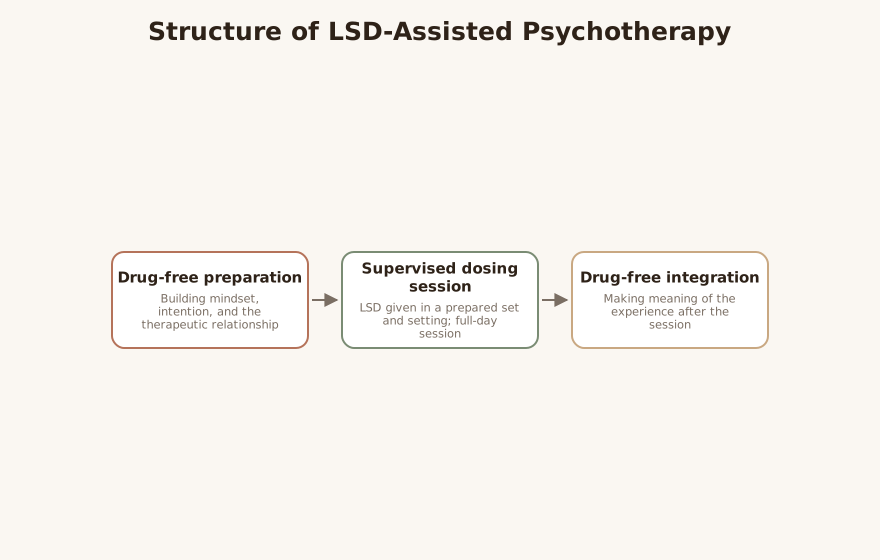
A course of treatment is organized into three phases: preparation, one or more supervised dosing sessions, and integration 6. During the dosing session the patient commonly wears eyeshades and listens to curated music to support an inward focus, while the therapist intervenes only as needed 6. The therapeutic team frequently consists of a man and a woman, both present throughout the experience 6. In modern protocols, full-day sessions of two to three weeks apart are embedded within ongoing drug-free psychotherapy for preparation and integration 1.
Psycholytic technique historically used incremental dosing — beginning around 25 to 50 µg and increasing gradually across multiple sessions — though improvement rates could not be reliably discerned from dose alone 3. Successful psycholytic courses used many sessions, ranging from roughly 10 to 33, rather than a single intervention 3. The realist review highlighted anaclitic techniques addressing trauma through corrective emotional experiences, active transference work in which therapists adopted parental roles, and creative integration activities after sessions as features of higher-performing studies 3. Notably, studies that pharmacologically terminated the drug’s effects with barbiturates or chlorpromazine showed worse outcomes than those allowing natural resolution 3. These technical choices illustrate that the modality’s “active ingredient” is the structured psychotherapeutic container as much as the molecule LLM.
Evidence Base
The evidence base is emerging and immature, and clinicians should frame it as such LLM. The pivotal modern trial is Gasser and colleagues’ double-blind, active-placebo-controlled pilot in Switzerland: only 12 participants with anxiety related to life-threatening illness, with 8 receiving 200 µg LSD and 4 receiving a 20 µg active placebo 1. At two-month follow-up it found significant reductions in state anxiety (p = 0.021, effect size 1.2) and trait anxiety (p = 0.033, effect size 1.1), with benefits sustained and no significant change between the 2- and 12-month assessments 1. No drug-related severe adverse events occurred 1.
A systematic review by Fuentes and colleagues pooled 11 randomized controlled trials conducted between 1950 and 2019 across 567 patients, the majority targeting alcohol use disorder 2. The authors concluded that LSD is a potential therapeutic agent whose evidence to date is strongest for alcoholism, but noted profound methodological limits: most historical studies predate contemporary standards, a 41-year gap separated the last historical trial from the modern era, and double-blinding is essentially impossible because the substance cannot be fully masked 2. Long-term outcomes in several studies converged between LSD and control groups, tempering enthusiasm 2. The psycholytic realist review covered studies published 1954 to 1967, all small, unblinded, and subject to missing data, concluding only that the approach “could be safe and effective in severely ill patients” under proper precautions 3. Interest has revived — the FDA granted breakthrough-therapy designation to an LSD formulation (MM120) for generalized anxiety disorder in 2024, with Phase 2 trials ongoing — but no large modern confirmatory trials of LSD-assisted psychotherapy have yet reported 5.
Populations & Indications
The strongest historical signal is in alcohol use disorder, where the bulk of the controlled trials were conducted and where the systematic review judged the evidence strongest 2. The clearest modern indication is anxiety and existential distress associated with terminal or life-threatening illness, the population studied in the Gasser trial, which reported durable anxiety reduction at one year 1. Historical psycholytic cohorts treated heterogeneous, often treatment-resistant patients with depression, anxiety, obsessive-compulsive presentations, and personality disorders, with selection emphasizing ego strength or motivation for recovery 3. Contemporary literature additionally describes investigational interest in depression and anxiety disorders more broadly, and the wider psychedelic-therapy field overlaps with substance use disorders and end-of-life distress 5. By extension, populations frequently named in the revived field include adults with treatment-resistant depression, patients facing end-of-life existential distress and death anxiety, and people with substance use disorders, though direct LSD trial evidence in several of these groups remains thin LLM.
Problems-for-Work
The problems most directly supported by trial evidence are end-of-life anxiety and alcohol use disorder 12. For end-of-life anxiety and existential distress, the modality’s proposed value is helping a patient confront mortality within a supported altered state and emerge with reduced trait and state anxiety 1.
LLM-generated illustrative example (not a guideline): A patient with metastatic cancer reports paralyzing death anxiety and demoralization; within an investigational protocol, preparation sessions build trust and intention, a supervised dosing session surfaces grief and acceptance, and integration sessions translate the experience into renewed connection with family LLM.
For alcohol use disorder, the historical rationale was that a single profound experience could catalyze motivation to change, though clinicians should note that benefit often waned when patients returned to former stresses without extended integration 5. For treatment-resistant depression and demoralization, the proposed mechanism is disruption of rigid, entrenched cognitive-affective patterns, but this application remains hypothesis-generating rather than established for LSD specifically LLM.
Contraindications, Cautions & Cultural Humility
LSD remains a Schedule I substance under the 1970 Controlled Substances Act, defined as having high abuse potential and no currently accepted medical use, so any therapeutic use occurs only within sanctioned research or expanded-access frameworks 6. Trials consistently exclude individuals with a personal or family history of psychotic disorders or schizophrenia, seizure disorders, stroke history, and significant cardiovascular disease 5. Concurrent serotonergic medications such as SSRIs and MAOIs are contraindicated because of serotonin syndrome risk, and pregnancy and lactation are exclusions 5. Historically, anomalously high doses concentrated serious adverse events including suicide and homicide, underscoring the importance of conservative dosing and screening 3.
Beyond medical screening, the altered, highly suggestible state increases the patient’s vulnerability and raises real risks of therapist misconduct, making boundaries and informed consent paramount 6. Clinicians should hold these tools with cultural humility: the framing of mystical or peak experience, the meaning a patient makes of altered consciousness, and attitudes toward mortality are deeply shaped by culture, spirituality, and prior trauma, and should never be imposed LLM. Honest disclosure of the emerging, uncertain evidence base is itself an ethical obligation LLM.
Treatment-Plan Suggestions & SMART Objectives
The objectives below are illustrative and assume a sanctioned investigational or expanded-access context LLM.
| Goal | SMART objective (example) | Mechanism |
|---|---|---|
| Reduce end-of-life anxiety | Decrease STAI state-anxiety score by a clinically meaningful margin within 2 months of a supervised dosing session | 5-HT2A-mediated altered state plus processed existential material |
| Strengthen readiness for change in alcohol use | Patient articulates and records three concrete change commitments during integration, sustained at 4-week review | Peak/mystical experience catalyzing motivation |
| Build therapeutic alliance before dosing | Complete at least three preparation sessions establishing trust and intention prior to first dose | Therapeutic relationship as core change mechanism |
| Improve emotional processing of trauma | Identify and reframe one core trauma narrative across two integration sessions | Corrective emotional experience / anaclitic technique |
| Reduce existential demoralization | Report increased sense of meaning on a validated measure by 1-month follow-up | Set, setting, and integration of insight |
| Ensure safety and tolerability | Zero drug-related serious adverse events across all sessions, verified by structured monitoring | Conservative dosing and rigorous medical screening |
| Consolidate gains over time | Maintain primary outcome improvement from 2-month to 12-month assessment | Sustained integration and behavioral follow-through |
Common Misconceptions
A frequent misconception is that the drug itself is the treatment; in fact, set, setting, and structured psychotherapy are inseparable from outcome, and the same dose can yield very different results depending on the therapeutic container 2. Another is that LSD-assisted work means a single dramatic dose — historically the psycholytic tradition used low, repeated doses across many sessions for psychoanalytic work 3. It is also commonly assumed the evidence is robust; in reality the modern controlled literature is small, unblinded by necessity, and concentrated in alcohol use disorder and end-of-life anxiety 2. Finally, some assume historical “success rates” transfer directly to clinical practice, but many trials lacked contemporary methodological rigor and showed long-term convergence with controls 2. Clinicians should treat enthusiastic media framing as outrunning the data LLM.
Training & Certification
There is no established, broadly recognized credentialing pathway for LSD-assisted psychotherapy in routine practice, because the substance is Schedule I and authorized work occurs within research protocols 6. Historically, practitioners came from psychiatry and psychoanalysis and trained through apprenticeship within the European psycholytic and North American psychedelic schools 4. In the lineage tradition, Stanislav Grof’s transpersonal and breathwork training represents one experiential pathway influencing later practitioners 6. Clinicians interested today should pursue involvement through sanctioned clinical trials and the structured preparation, dosing, and integration competencies those protocols require, rather than any informal route LLM.
Key Terms
Psycholytic therapy — use of low-to-moderate LSD doses repeatedly at one-to-two-week intervals within a psychoanalytic frame, keeping the patient in communication with the therapist 23. Psychedelic therapy — use of a single moderate-to-high dose aimed at a peak or mystical-type experience 2. Set and setting — the patient’s internal mindset and the external environment, jointly shaping the experience and outcome 5. Integration — post-session therapeutic work translating insights into lasting change 6. 5-HT2A agonism — LSD’s primary pharmacological action at serotonin 2A receptors, mediating its psychedelic effects 5. Anaclitic technique — addressing trauma through corrective emotional experiences within the session 3.
Resources & Further Reading
▶ Watch — a video introduction to this concept:
- Gasser et al. (2014). Safety and Efficacy of LSD-Assisted Psychotherapy for Anxiety Associated With Life-threatening Diseases
- Fuentes et al. (2020). Therapeutic Use of LSD in Psychiatry: A Systematic Review of Randomized-Controlled Clinical Trials
- Grime et al. (2026). Psycholytic Therapy Using LSD: a Realist Review — Brain and Behavior
- A Brief History of Psychedelic Psychiatry — MAPS
- LSD Substance Guide: History, Research, and Psychotherapy Uses — Psychedelic Support
- Psychedelic therapy — Wikipedia
Reflective / Supervision Questions
- How would you communicate the genuinely emerging and uncertain state of the evidence to a patient drawn to this modality by hopeful media coverage LLM?
- When a patient’s altered state heightens suggestibility, what concrete boundary and consent practices would you put in place to protect them LLM?
- How might your own attitudes toward death, spirituality, and mystical experience shape — or distort — your work with a patient facing end-of-life distress LLM?
- Given that the therapeutic alliance appears to be the central mechanism, how would you assess readiness and build trust across preparation sessions before any dosing LLM?
- What would lead you to conclude that this modality is not appropriate for a given patient, and how would you hold that decision with cultural humility LLM?