
Type & Discipline
The Multicultural Orientation (MCO) framework is a “way-of-being” model for culturally responsive psychotherapy that organizes culturally responsive practice around three interrelated process pillars rather than a static set of competencies 1. It sits at the intersection of counseling and clinical psychology and the broader multicultural competence tradition, and it is best understood as an organizing lens layered onto whatever theoretical orientation a clinician already practices, not as a standalone modality 1. Where earlier competence models emphasized the therapist’s knowledge, awareness, and skills as acquirable end states, MCO reframes cultural responsiveness as an ongoing relational stance enacted in the room with each individual client 1.
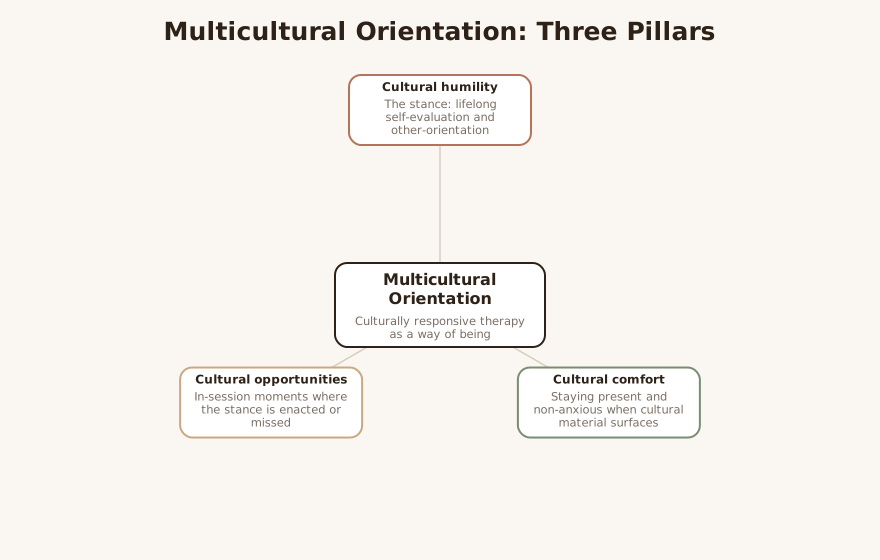
The framework’s three pillars are cultural humility, an other-oriented stance of openness and self-examination regarding one’s cultural limitations; cultural comfort, the therapist’s ease and confidence when cultural content arises; and cultural opportunities, the markers in session that invite engagement with a client’s cultural identity 1. Because these are process variables enacted moment to moment, MCO is compatible with cognitive-behavioral, psychodynamic, humanistic, and systemic work alike LLM. The shift from “competence as a credential” to “orientation as a way of being” is the conceptual move that distinguishes this framework from its predecessors 1.
Creators & Lineage
The intellectual taproot of MCO is the concept of cultural humility introduced by Melanie Tervalon and Jann Murray-García in 1998, originally developed for physician training and multicultural medical education 2. They proposed cultural humility as a deliberate alternative to cultural competence, arguing that culture cannot be mastered as a finite body of knowledge and that the more honest aim is a lifelong commitment to self-evaluation and self-critique 2. Their formulation paired individual self-reflection with attention to redressing power imbalances in the clinician–patient relationship and to institutional accountability, framing humility as both a personal and structural commitment 2.
The framework was elaborated for psychotherapy specifically by Jesse Owen, Joshua Hook, Don Davis, Cirleen DeBlaere, and colleagues, who articulated the three-pillar MCO model and synthesized the supporting literature in a 2018 narrative review 1. The same group’s 2017 book, Cultural Humility: Engaging Diverse Identities in Therapy, translated the framework into clinical practice for a counseling audience 6. The lineage runs from the multicultural counseling competencies that preceded it, through cultural humility as a corrective, and into a model that draws heavily on common-factors and therapeutic-alliance research by treating culturally responsive process as a relationship variable 1. Its emphasis on therapist openness, non-defensiveness, and respect for the client’s frame also shares clear kinship with person-centered therapy LLM.
Core Principles
The first principle is that cultural responsiveness is a process, not a possession; humility is defined by an ongoing, lifelong commitment to self-evaluation rather than by arriving at a state of completed competence 2. A second, closely related principle is other-orientation: the therapist holds curiosity and openness toward the client’s cultural identity and is willing to see the limits of their own understanding rather than positioning themselves as the cultural expert 1. A third principle is the attention to power, since cultural humility was conceived in part as a way to redress the power imbalances inherent in the clinical relationship 2.
A fourth principle is that the three pillars work together: humility provides the stance, cultural comfort governs whether the therapist can stay present and non-anxious when cultural material surfaces, and cultural opportunities are the in-session moments where that stance gets enacted or missed 1. A fifth principle is that culture is individual and intersectional rather than reducible to group membership, so the work is to understand this client’s identities and their salience rather than to apply group-level generalizations 6. A sixth principle, carried from the framework’s origins, is institutional accountability — that culturally humble practice is not only an individual virtue but a stance that organizations and training programs must structurally support 2.
Interventions & Techniques
MCO is enacted through process rather than a fixed protocol, but several concrete practices operationalize it 6. Broaching — the therapist intentionally and gently raising cultural identity, difference, or its relevance to the presenting concern — is a central technique, often through open-ended invitations such as asking what aspects of a client’s background feel most important to them or whether there are cultural considerations the clinician should hold in mind 5. Recognizing and engaging cultural opportunities is a second core skill: when a client references their faith, race, immigration history, or gender, the therapist treats that as an invitation to explore rather than a detail to pass over 1.
Structured self-reflection is a third practice, frequently supported by reflective journaling around prompts such as what assumptions the therapist is bringing into the session, how their own background shapes their interpretations, and what power dynamics they notice in the relationship 5. Rupture repair is a fourth, and a distinctive strength of the framework: when a cultural misunderstanding or microaggression occurs, the culturally humble response is non-defensive curiosity — acknowledging the misstep and inviting the client to help the clinician understand better — rather than justification 5. Ongoing consultation with culturally diverse peers and supervisors is a fifth practice, used deliberately to surface blind spots the therapist cannot see alone 5.
LLM-generated illustrative example (not a guideline): A White therapist working with a Black client notices the client go quiet after the therapist reframes a workplace incident as a “communication problem.” Reading the silence as a missed cultural opportunity and a possible rupture, the therapist says, “I think I may have skipped past something — I wonder if race was part of what happened there, and whether my framing landed wrong.” The client, visibly relieved, names the experience as a microaggression at work, and the dyad’s alliance deepens — directly addressing a therapeutic alliance rupture. LLM
Evidence Base
The maturity of MCO is best described as established as a conceptual and teaching framework, supported by a growing but still largely correlational empirical base rather than by a large bank of randomized controlled trials 1. The 2018 narrative review synthesized studies linking the MCO pillars — particularly cultural humility — to stronger therapeutic alliance and better client-rated outcomes, and proposed mechanisms for how these effects occur 1. Two organizing hypotheses structure much of this work: a “social bond” pathway, in which culturally responsive process strengthens the alliance, and a “social oil” pathway, in which it smooths the broader work of therapy 1.
Clinicians should weigh this evidence honestly. Much of the supporting research is cross-sectional or correlational and relies heavily on client perceptions of therapist humility, which tells us these constructs travel together with good process but does not by itself establish that training therapists in MCO causes better outcomes LLM. The strongest, most consistent signal is the association between client-perceived cultural humility and the therapeutic alliance, with missed cultural opportunities associated with poorer process 1. The framework is widely endorsed and conceptually well institutionalized, and its component practices are low-risk and consonant with general alliance research, but the causal-outcome literature is still developing 1.
Populations & Indications
MCO is indicated broadly because every therapy dyad is a cultural encounter, but it is most clearly salient in cross-cultural dyads where therapist and client differ in race, ethnicity, religion, sexual orientation, gender identity, or immigration history 1. It is particularly relevant for racial and ethnic minority clients, for whom culturally responsive process is associated with stronger engagement and alliance, and for LGBTQ+ individuals individuals whose identities may have been pathologized or overlooked in prior care 6. Immigrants, refugees, and religious or spiritual clients are also core indications, since their cultural frames frequently shape both the presenting concern and their expectations of treatment 6.
The framework is especially valuable wherever cultural mistrust, prior negative experiences with helping systems, or anticipated misunderstanding threaten engagement, because its humility-and-repair stance is designed precisely to build and protect the bond under those conditions 1. It applies to marginalized populations more generally, where the therapist’s willingness to see the limits of their own perspective and to engage power directly can be the difference between a client staying and leaving 2. In supervision contexts, MCO is also applied to the supervisor–supervisee relationship as a parallel cultural encounter that shapes how trainees learn to work across difference 3.
Problems-for-Work
MCO most directly supports work on cultural mistrust in therapy, which the humility stance addresses by making the therapist’s openness, fallibility, and respect for the client’s frame visible and enacted rather than assumed 1. It is well suited to therapeutic alliance ruptures, where the framework’s emphasis on non-defensive acknowledgment and repair gives the clinician a concrete way to metabolize a misstep into deeper trust 5. It is central to addressing microaggressions, both in catching the therapist’s own and in responding when a client names experiences of being slighted 5.
LLM-generated illustrative example (not a guideline): A first-generation immigrant client repeatedly cancels sessions and seems guarded. Rather than coding this as resistance, the therapist broaches it: “I want to make sure therapy fits how you and your family think about these things — what would make this feel more useful to you?” The client describes shame about seeking help outside the family and fear of being misjudged, and naming it openly reduces the drop-out risk — addressing premature treatment dropout and acculturative stress. LLM
The framework supports work on racial and ethnic trauma and discrimination-related distress by treating these as legitimate clinical material to be engaged, not minimized, through recognized cultural opportunities 1. It aids identity-related concerns by giving client and clinician a shared, non-expert way to explore which identities are salient and how 6. And by protecting the alliance across difference, it directly bears on premature treatment dropout, a problem disproportionately affecting clients from marginalized groups when their cultural reality goes unaddressed 1.
Contraindications, Cautions & Cultural Humility
MCO has no clinical contraindication in the usual sense, but it carries real cautions in practice LLM. The first is performative or “checkbox” engagement — superficially acknowledging culture without changing how one actually practices — which the source literature explicitly warns against 5. Closely related is the temptation to treat cultural humility as an achievement, becoming an “expert” at humility, when by definition it is a continuous process and not a destination 5.
A second caution is essentialism: using a client’s group membership to predict their values, which contradicts the framework’s insistence on understanding identity at the individual and intersectional level 6. A third is therapist burden and vicarious distress; sustained engagement with clients’ experiences of oppression can produce secondary trauma, so ongoing supervision and self-care are part of doing this work responsibly 5. A fourth, drawn from the framework’s origins, is the limit of the individual: a clinician’s humility cannot by itself resolve the structural and institutional inequities that shape clients’ lives, which is why Tervalon and Murray-García coupled personal self-critique with institutional accountability 2. Cultural humility is therefore not a posture of self-flagellation but a disciplined, lifelong practice of staying open, repairing well, and recognizing what one cannot know about another person’s world 4.
Treatment-Plan Suggestions & SMART Objectives
| Goal | SMART objective (example) | Mechanism |
|---|---|---|
| Reduce cultural mistrust and strengthen the bond | Within the first 3 sessions, clinician will broach cultural identity at least once and client-rated alliance will be maintained or improved on a session-by-session measure | Enacted humility and openness make the therapist’s respect visible, building trust 1 |
| Repair an alliance rupture across cultural difference | When a cultural misstep occurs, clinician will name it non-defensively and invite the client’s correction within the same or next session, with rupture resolution noted | Non-defensive repair converts a missed opportunity into deepened trust 5 |
| Engage cultural opportunities rather than miss them | Over 6 sessions, clinician will identify and explore at least 4 client-initiated cultural references rather than passing over them | Recognizing cultural opportunities turns identity content into therapeutic material 1 |
| Address discrimination-related distress | Over 8 weeks, client will name 3 experiences of discrimination or microaggression and develop 2 supported coping responses, tracked weekly | Treating oppression as legitimate clinical material validates and targets distress 1 |
| Increase therapist cultural comfort | Across 8 sessions, clinician will complete structured reflective journaling after each session and rate own anxiety when cultural content arises | Reflection reduces avoidance and builds ease with cultural material 5 |
| Clarify salient identities collaboratively | By session 3, client and clinician will identify the 2-3 identities the client rates as most salient to the concern | Individualized, intersectional inquiry prevents group-level assumptions 6 |
| Reduce premature dropout risk | Over the first month, clinician will check fit and expectations at least twice, with attendance and engagement tracked | Protecting the alliance across difference lowers dropout for marginalized clients 1 |
| Build supervisory cultural humility | Across the supervision term, supervisor and supervisee will discuss the cultural dynamics of at least 3 cases and of their own dyad | Parallel-process attention models culturally humble practice for trainees 3 |
Common Misconceptions
A first misconception is that MCO is a discrete therapy; it is an organizing way-of-being framework applied within whatever modality the clinician practices 1. A second is that cultural humility is the same as cultural competence — the framework was built precisely on the distinction, treating competence as a flawed end-state goal and humility as a lifelong process 2. A third is that humility means deferring all expertise or apologizing constantly; it actually means holding an other-oriented stance and repairing well, not abdicating clinical authority 4.
A fourth misconception is that knowing facts about a cultural group equips one to work with its members, when MCO insists on understanding the individual client’s identities and their salience 6. A fifth is that cultural humility is a milestone one can complete and document; the source literature explicitly frames it as continuous and warns against treating it as finished 5. A sixth is that a therapist’s personal humility can substitute for structural change, whereas the original formulation pairs self-critique with institutional accountability 2.
Training & Certification
There is no single credential that confers MCO mastery, consistent with the framework’s own premise that cultural responsiveness is an ongoing process rather than a completed competency 2. The foundational reading is Tervalon and Murray-García’s 1998 article, with their later talks offering an accessible primary-voice elaboration of the principles and practices 2 4. The 2018 narrative review provides the authoritative synthesis of the three-pillar model and its evidence, and the 2017 book Cultural Humility: Engaging Diverse Identities in Therapy is the standard practitioner-facing text 1 6.
Applied skill is developed through supervised practice and through the deliberate use of supervision and consultation as a venue for working on cultural dynamics, including the cultural dimensions of the supervisory relationship itself 3. Accessible practice-oriented resources translate the framework into concrete strategies — reflective journaling, broaching language, and rupture-repair scripts — that clinicians can begin using immediately 5. Because the stance is meant to be lifelong, training is best understood as continuing rather than terminal 2.
Key Terms
Cultural humility: An other-oriented stance defined by a lifelong commitment to self-evaluation and self-critique, openness to the client’s cultural identity, and attention to power imbalances in the relationship 2.
Cultural comfort: The therapist’s ease, calm, and confidence when cultural content arises in session, which governs whether the clinician can stay present rather than avoidant 1.
Cultural opportunities: In-session markers — a client’s reference to faith, race, identity, or migration — that invite engagement with cultural material and can be either taken up or missed 1.
Broaching: The therapist’s intentional, gentle raising of cultural identity and its relevance to the work, often through open-ended invitations 5.
Missed opportunity: A moment when a client offers cultural content and the therapist passes over it, associated in the literature with poorer process 1.
Cultural competence: An earlier model emphasizing acquirable knowledge, awareness, and skills, which MCO critiques as an inadequate end-state goal in favor of humility 2.
Resources & Further Reading
▶ Watch — a video introduction to this concept:
- The Multicultural Orientation Framework: A Narrative Review — Davis, DeBlaere, Owen et al. (2018), Psychotherapy
- Cultural Humility versus Cultural Competence — Tervalon & Murray-García (1998)
- Multicultural Orientation in Psychotherapy Supervision — American Journal of Psychotherapy (2019)
- Cultural Humility: People, Principles, and Practices — Tervalon & Murray-García (video)
- Cultural Humility in Counseling: Key Strategies — Blueprint
- Cultural Humility: Engaging Diverse Identities in Therapy — Hook, Davis, Owen & DeBlaere (APA, 2017)
Reflective / Supervision Questions
- When cultural content surfaces with a client, do I feel the ease to engage it, or do I notice myself steering away — and what drives the avoidance? LLM
- Which cultural opportunities did I take up in my recent sessions, and which did I miss? LLM
- After a cultural misstep or rupture, is my instinct to explain myself or to invite the client to correct me? LLM
- Where am I relying on group-level generalizations instead of asking this client what their identities mean to them? LLM
- How does my own social location shape what I notice, normalize, and overlook with clients who differ from me? LLM
- Am I treating cultural humility as a box I have checked, or as an ongoing practice I am still developing? LLM
- In supervision, how do the cultural dynamics of my relationship with my supervisor or supervisee mirror what happens in my clinical work? LLM