
Type & Discipline
Holotropic Breathwork is an experiential, body-oriented technique rather than a stand-alone, manualized psychotherapy. LLM It belongs to the discipline of transpersonal psychology and to the broader family of non-ordinary-states or experiential methods, which work by deliberately altering consciousness to surface material that ordinary talk therapy may not reach. 1 The method combines sustained accelerated breathing, evocative music, and supportive bodywork to facilitate movement “toward wholeness” — the literal meaning of holotropic, from the Greek holos (whole) and trepein (moving toward). 1 Its theoretical home draws on depth psychology, humanistic and transpersonal psychology, anthropology, Eastern spiritual practice, and psychedelic research, integrating these into a single framework of guided inner experience. 2
For practicing clinicians, the most useful framing is that Holotropic Breathwork is an adjunctive experiential procedure — a tool that can be embedded within ongoing psychotherapy rather than a substitute for it. 3 It is most coherently understood alongside psychedelic-assisted therapy, somatic and body-oriented approaches, and contemplative breath traditions such as pranayama, all of which it borrows from. 2 LLM
Creators & Lineage
Holotropic Breathwork was developed by Stanislav Grof, MD, and Christina Grof, PhDhc, who co-founded the method and established its principles, ethical agreements, and training structure. 1 Stanislav Grof had been a central figure in clinical LSD research; when legal access to psychedelics was suppressed in the late 1960s, he and Christina Grof sought a drug-free means of evoking comparable non-ordinary states, and Holotropic Breathwork emerged as a successor to that psychedelic work. 7 The foundational text, Holotropic Breathwork: A New Approach to Self-Exploration and Therapy, was first published in 2010 and revised in a second edition in 2023. 2
The lineage is explicitly transpersonal. LLM Grof’s cartography of the psyche posits three broad domains of experience the method can access: the biographical (personal history and memory), the perinatal (experiences organized around the dynamics of birth), and the transpersonal (archetypal and collective material). 2 These map onto Grof’s earlier constructs — including systems of condensed experience and basic perinatal matrices — which the breathwork is intended to mobilize. 7 The practice is governed and taught through Grof Transpersonal Training, and only practitioners certified through that lineage are authorized to offer it under the trademarked name. 1
Core Principles
The organizing principle is the concept of an inner healing intelligence — the idea that the psyche, given the right conditions and a non-ordinary state, will spontaneously bring forward the material most relevant for healing and move toward its own integration. 1 The facilitator’s role is therefore deliberately non-directive: rather than interpreting or steering, facilitators create a safe container and trust the breather’s process to organize itself. 1 LLM
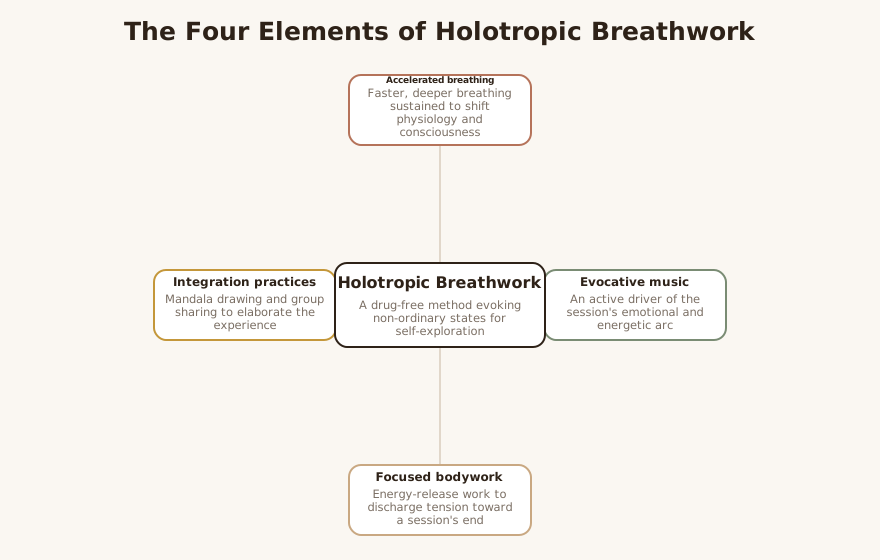
Four elements define the method. LLM First, accelerated breathing — faster and deeper than normal — sustained over an extended period to shift physiology and consciousness. 1 Second, evocative music, treated not as background but as an active driver of the emotional and energetic arc of the session. 1 Third, focused energy-release bodywork, offered toward the end of a session to help discharge tension or complete an emerging physical or emotional pattern. 1 Fourth, integration practices, classically including mandala drawing and group sharing, where the facilitator’s stance is one of elaboration rather than interpretation. 4
Sessions are typically conducted in pairs, with participants alternating roles as breather and sitter. 1 The breather lies down with eyes closed and engages the breathing and music; the sitter remains a supportive, available, but non-interfering presence. 1 This dyadic structure distributes holding and witnessing across the group rather than concentrating it in a single therapist. LLM
Interventions & Techniques
A session begins with preparation and intention-setting, then moves into a sustained period of accelerated breathing paired with a carefully sequenced musical program that typically builds in intensity before resolving. 1 Sessions can run from under an hour to several hours, with most lasting roughly one hour or more depending on the setting. 7 The breather is encouraged to surrender to whatever arises — emotional, physical, or imaginal — without analyzing it in the moment. 2
Toward the close of the experience, the facilitator may offer focused bodywork at points of unresolved tension, applying pressure or encouraging movement and sound to help the breather complete and release the pattern. 1 This is consent-based and follows the breather’s lead. LLM Afterward, mandala drawing provides a non-verbal channel for capturing the experience, and group sharing allows verbal integration with the facilitator drawing out the breather’s own meaning rather than imposing an interpretation. 4
LLM-generated illustrative example (not a guideline): A clinician trained in the method works with a client carrying long-standing grief that feels “stuck in the chest.” During a facilitated session, accelerated breathing and music evoke a wave of sobbing and a spontaneous arching of the back; with consent, focused bodywork at the sternum helps the client complete the movement, and afterward the client draws a closed door slowly opening. In the verbal integration, the clinician asks what the door means to the client rather than offering an interpretation. LLM
Within an ongoing course of therapy, the breathwork session is not the endpoint; the subsequent psychotherapeutic processing of what surfaced is where much of the clinical work occurs. 3 LLM
Evidence Base
The honest summary is that the evidence base is emerging and methodologically thin. 3 The most-cited mechanistic paper, by Rhinewine and Williams (2007), is explicitly hypothesis-generating: it proposes that prolonged voluntary hyperventilation alters central nervous system activity and might, as an adjunct to psychotherapy, facilitate a generalized extinction of avoidance behaviors — while stressing that more sophisticated research is required to confirm or refute the idea. 3 The authors speculate that clients high in trait absorption who have not responded to conventional psychotherapy may be most likely to benefit, but this remains conjecture rather than a tested finding. 3
The largest descriptive data point is a clinical report by Holmes and colleagues describing the use of Holotropic Breathwork across roughly 11,000 psychiatric inpatients over more than a decade, which noted benefits related to emotional catharsis and reported no adverse reactions. 4 5 This is an important safety signal but is uncontrolled, non-randomized, and not blinded, so it cannot establish efficacy. LLM Earlier small studies have reported reductions in death anxiety, gains in self-esteem, and higher self-awareness, but these too are limited in size and rigor. 4
Zooming out to breathwork generally, a 2023 meta-analysis of randomized controlled trials by Fincham and colleagues found small-to-medium benefits for stress (Hedges’ g ≈ −0.35), anxiety (g ≈ −0.32), and depression (g ≈ −0.40). 6 However, the relevance to Holotropic Breathwork specifically is weak: the great majority of those trials studied slow-paced breathing, only two examined fast-paced techniques, and holotropic-style circular breathing was not specifically represented. 6 The authors flagged moderate risk of bias, significant heterogeneity for anxiety and depression, and a real risk of “miscalibration between hype and evidence,” urging caution until lower-bias designs are available. 6 Reassuringly, that review found no reported lasting adverse effects directly attributable to breathwork. 6 Critics, meanwhile, note the limited rigorous research underlying the method’s transpersonal claims. 7 Bottom line: a coherent rationale and encouraging safety reports, but no robust efficacy evidence specific to this technique. LLM
Populations & Indications
Holotropic Breathwork is offered to adults engaged in experiential or transpersonal therapy who are seeking emotional processing, self-exploration, or spiritual and existential growth. 1 2 It has been described as a potential adjunct for trauma survivors, people with substance use disorders, and clients pursuing psychedelic-adjacent experiential work, as well as for individuals with treatment-resistant distress who have not responded to conventional talk therapy. 3 4 The Rhinewine and Williams hypothesis specifically targets clients high in trait absorption who have failed to respond adequately to standard psychotherapy. 3
Practically, the best candidates are stable, well-resourced adults with adequate affect tolerance and a capacity to integrate intense material afterward. LLM Because the method deliberately intensifies affect and can surface painful memories, it is best suited to clients who already have a therapeutic relationship and integration support in place. 4 LLM
Problems-for-Work
In experiential and transpersonal settings, Holotropic Breathwork is applied to several presenting problems. 2
- Emotional repression and numbing. The method’s non-ordinary state and catharsis-oriented arc are intended to loosen chronic affective constriction and restore access to feeling. 4 LLM
- Grief. The combination of music, breath, and bodywork can provide a non-verbal channel for mourning that has not found expression in talk therapy. LLM
- Trauma and PTSD. It is promoted as an adjunct for trauma processing, though this must be weighed carefully against arousal and dissociation risks. 4 LLM
- Depression and anxiety. Breathwork broadly shows small-to-medium effects on these in RCTs, providing indirect rationale, but not specific evidence for the holotropic technique. 6
- Existential and spiritual distress. The transpersonal framework explicitly addresses meaning, mortality, and existential concerns. 2 4
- Substance use disorders. Both descriptive reports and the method’s transpersonal lineage position it as a complement in addiction-recovery contexts. 4 LLM
LLM-generated illustrative example (not a guideline): A client in recovery from alcohol use disorder describes feeling “flat and disconnected” in sobriety. Within an integrative treatment plan that includes relapse-prevention work, a facilitated breathwork session evokes vivid imagery and an emotional release the client later names as “grief for the years I lost.” The clinician uses subsequent sessions to connect that affect to relapse triggers and meaning-making. LLM
Contraindications, Cautions & Cultural Humility
Holotropic Breathwork carries real physiological and psychological contraindications that clinicians must screen for. 4 The accelerated breathing produces hyperventilation and hypocapnia, which can cause tetany, cramping in the hands and around the mouth, dizziness, and muscle spasms during a session. 4 7 More seriously, the technique is not recommended for people with cardiovascular disease, angina, or prior myocardial infarction; uncontrolled high blood pressure; glaucoma or retinal detachment; osteoporosis or recent surgery or injury; seizure disorders; a personal history of psychosis or panic disorder; severe mental illness; a family history of aneurysm; and during pregnancy or breastfeeding. 4 Clients on regular medications should consult a clinician beforehand. 4 There is specific concern that the hyperventilation could provoke a seizure or, in vulnerable individuals, precipitate psychosis. 7
Dissociation deserves particular caution. LLM For clients prone to dissociation, a deliberately induced non-ordinary state can deepen detachment rather than integrate it, so dissociative presentations sit at the contraindication end of the spectrum and warrant careful screening or exclusion. 4 LLM Because the method can surface intense emotion and painful memories, it should not be undertaken without concurrent professional therapeutic support. 4
On cultural humility: the method borrows heavily from Eastern spiritual practices, indigenous traditions, and mystical frameworks, and clinicians should hold these influences with respect rather than appropriation, and should not present its transpersonal and perinatal claims as established science to clients who may take them literally. 2 7 LLM Informed consent should be explicit that this is an experiential, evidence-emerging method, not a proven treatment. LLM
Treatment-Plan Suggestions & SMART Objectives
| Goal | SMART objective (example) | Mechanism |
|---|---|---|
| Reduce emotional numbing | Over 8 weeks, client will identify and name at least two previously avoided emotions in session, rated weekly | Non-ordinary state loosens affective constriction and restores access to feeling 4 |
| Improve affect tolerance | Within 6 sessions, client will use a paced-breathing grounding skill to down-regulate arousal in 3 of 4 instances | Conscious breath regulation as a self-soothing anchor 6 |
| Process unresolved grief | Over 10 weeks, client will complete one focused integration (e.g., mandala plus verbal processing) per breathwork session | Non-verbal expression channels mourning into integrated meaning 4 |
| Lower self-reported stress | Across 8 weeks, client will reduce weekly stress-scale score by a clinically meaningful margin | Breathwork shows small-to-medium effects on stress in RCTs 6 |
| Strengthen existential meaning | Within 12 weeks, client will articulate two personally held sources of meaning in their own words | Transpersonal framework addresses meaning and mortality 2 |
| Support substance-use recovery | Over treatment, client will link each surfaced emotional theme to a relapse trigger in the following session | Catharsis plus integration connects affect to recovery work 4 |
| Increase self-awareness | Within 6 weeks, client will record one new self-observation after each session in a journal | Non-ordinary states surface previously out-of-awareness material 4 |
Common Misconceptions
A frequent misconception is that Holotropic Breathwork is an evidence-based treatment on par with established therapies; in reality the supportive research is preliminary and largely uncontrolled, and the most-cited mechanistic paper is explicitly hypothesis-generating. 3 6 Another is that it is simply “deep relaxation breathing” — it is the opposite, deliberately inducing hyperventilation and a non-ordinary state, with physiological effects clinicians must screen for. 4 7
A third misconception is that the facilitator guides or interprets the experience; the stance is deliberately non-directive, trusting an inner healing intelligence and elaborating the client’s own meaning rather than imposing one. 1 4 Finally, some assume perinatal “birth memories” reflect literal recall; the broader scientific literature treats such recovered memories with skepticism, and clinicians should frame perinatal and transpersonal material as subjective experience rather than verified history. 7 LLM
Training & Certification
Holotropic Breathwork is a trademarked method, and only practitioners certified through Grof Transpersonal Training are authorized to facilitate it under that name. 1 Certification involves completing the training program established by the Grofs, including its principles and ethical agreements. 1 For clinicians, the practical implication is that offering Holotropic Breathwork specifically requires this formal certification, not merely general breathwork familiarity. LLM Therapists who wish to incorporate the approach should pursue the lineage training, work within their scope of competence, and ensure adequate medical screening and integration support are in place. 4 LLM
Key Terms
- Holotropic — “moving toward wholeness,” the conceptual goal of the method. 1
- Non-ordinary state of consciousness — the altered state induced by breath and music in which the work occurs. 1
- Inner healing intelligence — the principle that the psyche spontaneously surfaces material relevant to healing. 1
- Breather and sitter — the alternating dyadic roles; the breather undergoes the process, the sitter offers non-directive support. 1
- Focused bodywork / energy release — consent-based physical work to help complete and discharge emerging patterns. 1
- Mandala drawing — a non-verbal integration practice following a session. 4
- Perinatal and transpersonal domains — Grof’s categories of birth-related and archetypal/collective experience. 2
- Hypocapnia — the reduced carbon dioxide from hyperventilation that drives the technique’s physiological effects. 7
Resources & Further Reading
▶ Watch — a video introduction to this concept:
- About Holotropic Breathwork — The Institute for Holotropics / Grof Transpersonal Training
- Grof S, Grof C. Holotropic Breathwork: A New Approach to Self-Exploration and Therapy, 2nd ed. (SUNY Press)
- Rhinewine JP, Williams OJ (2007). Holotropic Breathwork as an adjunct to psychotherapy — PubMed
- Holotropic Breathwork: Usage, Safety, and More — Healthline
- Holmes et al. A Clinical Report of Holotropic Breathwork in 11,000 Psychiatric Inpatients — MAPS Bulletin
- Fincham et al. (2023). Effect of breathwork on stress and mental health: a meta-analysis of RCTs — Scientific Reports / PMC
- Holotropic Breathwork — Wikipedia
Reflective / Supervision Questions
- How would I screen a given client for the cardiovascular, neurological, psychiatric, and dissociative contraindications before considering this method, and what would disqualify them? LLM
- Given that the efficacy evidence specific to Holotropic Breathwork is emerging rather than established, how do I frame informed consent so the client understands what is and is not known? 6 LLM
- Where does this technique fit relative to my scope of competence and certification, and would offering it require the lineage-specific training? 1 LLM
- When intense or perinatal/transpersonal material surfaces, how do I hold it as meaningful subjective experience without reinforcing literal-memory claims? 7 LLM
- How will I structure the integration work after a session, recognizing that the breathwork itself is only part of the therapeutic process? 3 LLM
- For a client with a trauma history, how do I weigh the potential for catharsis against the risk of overwhelming arousal or dissociation? 4 LLM