
Type & Discipline
The framing effect is a construct — a documented cognitive bias rather than a therapy, technique, or treatment program. LLM It belongs to the disciplines of behavioral economics and cognitive psychology, and sits within the larger theoretical family of prospect theory. 1 In plain terms, the framing effect names the reliable observation that logically equivalent options elicit different choices depending on whether they are described in terms of gains or losses. 1 A decision presented as “you will keep 80% of your savings” is preferred over the same decision presented as “you will lose 20% of your savings,” even though the two statements are mathematically identical. 3
For clinicians, the useful framing (so to speak) is this: the framing effect is a mechanism, not a modality. LLM It explains a predictable way that human judgment bends under linguistic presentation, and that mechanism can be borrowed as a lens for understanding — and intervening on — the distorted appraisals that drive anxiety, avoidance, and indecision. LLM
Creators & Lineage
The framing effect was formalized by Amos Tversky and Daniel Kahneman in their 1981 Science paper, “The Framing of Decisions and the Psychology of Choice.” 1 That paper introduced the now-canonical demonstrations of how the decision frame — the decision-maker’s conception of the acts, outcomes, and contingencies attached to a choice — can be shifted by wording alone. 1 The framing effect is one expression of the broader prospect theory Kahneman and Tversky had developed, which describes how people evaluate outcomes relative to a reference point rather than in terms of absolute final states. 2
Its intellectual lineage runs through behavioral economics, where it helped overturn the assumption of the rational utility-maximizing decision-maker. 5 For psychotherapists, there is a natural confluence with Aaron Beck’s cognitive model: the framing effect is, in effect, an experimentally validated cousin of the cognitive distortions that cognitive therapy targets — both describe systematic, predictable departures from balanced appraisal. LLM Cognitive Behavioral Therapy’s cognitive restructuring is the clinical home where the framing effect is most readily applied. LLM
Core Principles
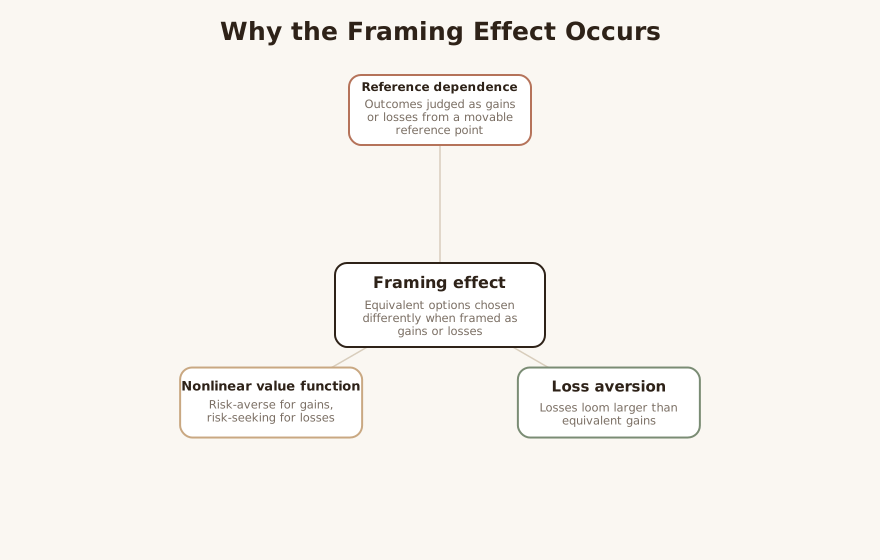
Three interlocking principles explain why the framing effect occurs. LLM
Reference dependence. People evaluate outcomes not in absolute terms but as gains or losses relative to a neutral reference point tied to their current situation. 2 The reference point is movable — and where it sits determines whether a given outcome registers as a win or a loss. 2
Loss aversion. Losses loom larger than equivalent gains. 5 The subjective sting of losing a given amount is roughly twice the pleasure of gaining the same amount; for some individuals the pain of losing $1,000 is only offset by the prospect of gaining $2,000. 2 This asymmetry is the engine of the framing effect. LLM
A nonlinear value function. In prospect theory the value function is concave for gains and convex for losses, and steeper for losses than for gains. 2 Practically, this means people are risk-averse when choosing among gains but risk-seeking when choosing among losses — they will gamble to avoid a certain loss. 1 Prospect theory also holds that people overweight small probabilities and underweight large ones, which compounds framing-driven distortions. 2
The classic demonstration is the Asian disease problem. 1 Respondents imagine an outbreak expected to kill 600 people and choose between two programs. In the gain frame, Program A saves 200 people for certain, while Program B offers a one-third probability that all 600 are saved and a two-thirds probability that none are. 1 In the loss frame, Program C results in 400 deaths for certain, while Program D offers a one-third probability that nobody dies and a two-thirds probability that all 600 die. 1 The two pairs are numerically identical — yet when the choice is framed as lives saved, roughly 72% of respondents prefer the certain option, whereas when it is framed as lives lost, only about 22% choose the certain option, with the large majority now gambling on the risky one. 3 Wording alone reverses the dominant preference. 1
Interventions & Techniques
There is no “framing-effect therapy.” LLM Instead, awareness of the framing effect supplies a set of techniques that live inside established cognitive work. LLM
- Reframing as cognitive restructuring. Helping a client deliberately re-describe a feared outcome in gain terms (what is preserved, what remains possible) rather than loss terms is a direct application of the principle, and it overlaps cleanly with standard CBT cognitive restructuring. LLM
- Reference-point shifting. Because appraisal depends on the reference point, therapy can make the implicit reference explicit and ask whether it is fair (e.g., comparing oneself to a flawless ideal versus to one’s own prior baseline). LLM
- Decentering from the wording. Encouraging analytic, slow processing rather than fast intuitive reaction reduces framing susceptibility. 4 Clinically, this maps onto Socratic questioning and “examining the evidence.” LLM
- Generating the counter-frame. A practical debiasing move is to deliberately rephrase a negative statement positively (and vice versa) before deciding, so the client sees both frames side by side. 3
- Seeking outside perspective. Inviting a trusted, credible outside view can dilute the pull of a single frame. 3
LLM-generated illustrative example (not a guideline): A client facing a recommended medical procedure is paralyzed by the phrase “10% risk of complication.” The clinician guides her to also write the equivalent “90% of patients have no complication,” then notices aloud that both are the same fact. The conversation shifts from the wording to her actual values, and she is able to decide. LLM
Evidence Base
Honesty about maturity matters here, and it cuts two ways. LLM
The framing effect as a phenomenon is established: it was demonstrated in the foundational 1981 study, has been replicated extensively across domains, and is one of the most reliable findings in decision science. 1 Its theoretical scaffolding, prospect theory, is among the most influential frameworks in behavioral economics and contributed to a Nobel Prize in Economics. 2 The medical-decision literature in particular shows framing reliably moves patient preferences — for example, survival framing versus mortality framing of the same treatment outcomes. 4
The framing effect as a clinical intervention is a different matter. LLM There is no distinct evidence base for “treating” the framing effect; its therapeutic use is an extrapolation from established cognitive restructuring, which itself has strong support within CBT for anxiety and depression. LLM Clinicians should therefore present framing-awareness as a technique borrowed into an evidence-based modality, not as an independent treatment with its own trials. LLM Stated plainly: the science of the bias is mature; the clinical translation is sound but inferential. LLM
Populations & Indications
The framing effect is universal — it operates in essentially everyone — but it becomes clinically relevant when it amplifies a presenting problem. LLM Among adults, it is most actionable with patients facing medical choices and other people making health decisions, where loss-framed information can drive avoidance or risk-seeking that does not serve the person. 4
It is particularly pertinent for individuals with anxiety disorders, whose threat-biased appraisal tends to lock onto the loss frame, and for people with depression, whose negative cognitive set similarly privileges loss-and-failure framings. LLM Adolescents, still developing deliberate (analytic) override of intuitive responses, may be especially swayed by how choices are worded, making explicit dual-framing a useful teaching tool. LLM
Problems-for-Work
The framing effect offers leverage on several common targets. LLM
- Cognitive distortions and catastrophizing: a catastrophic appraisal is often a loss frame in disguise; surfacing the equivalent gain frame is a restructuring move. LLM
- Anxiety and risk aversion: anxiety amplifies loss aversion, so naming the asymmetry (“the dreaded loss feels twice as heavy as the equivalent gain”) can normalize and loosen it. 2
- Decision-making difficulties and indecisiveness: presenting a stuck choice in both frames can break a deadlock created by one-sided wording. 3
- Health-related decision avoidance: re-describing a feared procedure in survival/preservation terms can reduce avoidance. 4
- Pessimism: chronic pessimism frequently reflects a default loss frame applied to ambiguous events, which reference-point work can address. LLM
LLM-generated illustrative example (not a guideline): A client with generalized anxiety describes a job offer entirely in terms of “everything that could go wrong if I take it.” The clinician helps him list the same situation as “what I stand to gain and keep,” and his indecision eases enough to weigh the offer on its merits. LLM
Contraindications, Cautions & Cultural Humility
The chief ethical caution is that framing is a double-edged tool. LLM The same mechanism that helps a client see a fairer appraisal can be used to manipulate — marketers and persuaders exploit framing precisely because it reliably moves choices. 4 The clinician’s job is to reveal both frames so the client decides from their own values, never to covertly steer them toward the clinician’s preferred outcome. LLM Presenting only the “better” frame is subtle coercion, not therapy. LLM
A second caution: framing-awareness is not a substitute for addressing real, well-grounded fears. LLM If a loss frame is accurate — the risk genuinely is serious — reframing should not be used to talk a client out of legitimate concern. LLM
On cultural humility: reference points, what counts as a “gain,” and acceptable levels of risk are culturally and individually shaped. LLM A frame that feels reassuring to the clinician may not map onto the client’s values, family obligations, or lived risk history. LLM The work is to make the client’s own reference point explicit and to honor it, not to impose a normative one. LLM
Treatment-Plan Suggestions & SMART Objectives
| Goal | SMART objective (example) | Mechanism |
|---|---|---|
| Reduce loss-biased appraisal | Within 6 weeks, client will independently generate a balanced gain-frame for 4 of 5 catastrophic thoughts logged that week | Reframing / cognitive restructuring 3 |
| Loosen anxiety-driven risk aversion | In 4 sessions, client will name the loss-aversion asymmetry and rate its pull (0-10) for two avoided decisions | Loss aversion awareness 2 |
| Break decisional deadlock | Within 3 weeks, client will complete a dual-frame worksheet (gain frame + loss frame) for one stuck choice and reach a decision | Counter-frame generation 3 |
| Reduce health-decision avoidance | By session 8, client will re-describe one feared medical option in survival terms and discuss it with their provider | Survival vs. mortality reframing 4 |
| Make reference points explicit | Within 5 sessions, client will identify the implicit comparison underlying two self-critical appraisals | Reference-point shifting 2 |
| Strengthen analytic override | Over 4 weeks, client will pause and apply a 3-question Socratic check before 3 reactive decisions | Slowing fast/intuitive processing 4 |
| Recruit outside perspective | Within 2 weeks, client will seek one trusted second opinion before finalizing an anxiety-laden choice | Outside-view debiasing 3 |
Common Misconceptions
“The framing effect is just for marketers and economists.” It is a general feature of human appraisal and shows up in clinical material — catastrophizing, pessimism, and avoidance often are loss frames. LLM
“Reframing means thinking positively.” It does not mean denying the negative; it means recognizing that the negative and positive descriptions can be equivalent, and choosing not to be ruled by the wording. 3
“Smart, informed people are immune.” Framing effects persist even when people know about them and even among experts; awareness reduces but does not eliminate the pull. 1
“Framing changes the facts.” It does not — the options remain logically identical; only the appraisal shifts. 1
Training & Certification
There is no certification in the framing effect, because it is a construct rather than a credentialed modality. LLM The relevant clinical competency is cognitive restructuring within Cognitive Behavioral Therapy, which is taught in standard CBT training, supervision, and continuing education. LLM Clinicians wanting to use framing well are best served by grounding in the primary source (Tversky & Kahneman, 1981) and prospect theory, paired with supervised practice in CBT reframing techniques. 1
Key Terms
- Decision frame — the decision-maker’s conception of the acts, outcomes, and contingencies attached to a choice, which wording can shift. 1
- Reference point — the neutral baseline against which outcomes are coded as gains or losses. 2
- Loss aversion — the tendency for losses to loom larger than equivalent gains, roughly two-to-one. 2
- Value function — prospect theory’s S-shaped curve: concave for gains, convex for losses, steeper for losses. 2
- Risk-seeking in losses / risk-aversion in gains — the preference reversal that produces framing effects. 1
- Probability weighting — the tendency to overweight small probabilities and underweight large ones. 2
Resources & Further Reading
▶ Watch — a video introduction to this concept:
- Tversky, A., & Kahneman, D. (1981). The framing of decisions and the psychology of choice. Science.
- Prospect theory — Wikipedia
- Framing Effect In Psychology — Simply Psychology
- Framing effect — The Decision Lab
- Prospect Theory’s Focus on Gains, Losses, and Framing — SpringerLink chapter
Reflective / Supervision Questions
- When I help a client “reframe,” am I revealing both frames so they can choose, or am I steering them toward the frame I prefer? LLM
- Where in my own caseload am I most likely to mistake an accurate loss frame for a distortion that needs reframing? LLM
- How do I make a client’s reference point explicit without imposing my own cultural assumptions about what counts as a gain or an acceptable risk? LLM
- With anxious or depressed clients, how can I name the loss-aversion asymmetry in a way that normalizes rather than pathologizes their appraisal? LLM
- For adolescents, what teaching tools (e.g., dual-framing worksheets) best build the deliberate override that resists wording effects? LLM