
Type & Discipline
Ritual is a construct from anthropology, not a treatment, a diagnosis, or a stand-alone modality LLM. In the lineage that matters most for clinicians it names structured, symbolic action that moves a person or group from one social state to another, contains the anxiety such transitions provoke, and generates shared meaning that no purely instrumental act supplies LLM. Victor Turner, whose work anchors this strand, treated ritual as a social process with its own internal structure rather than as inert custom, and analyzed how the form itself does work on the people who pass through it 1.
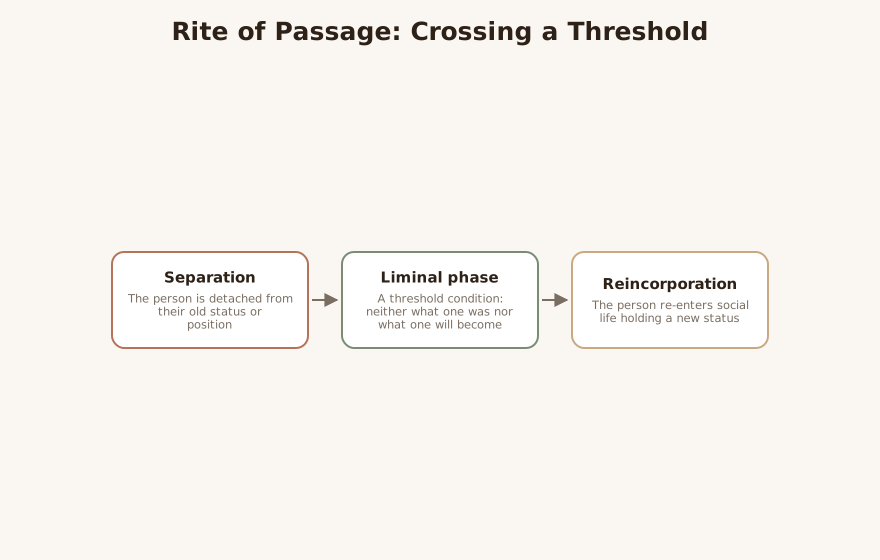
Because it is a descriptive theory of how human groups mark change, ritual informs case formulation, the reading of a client’s relationship to transitions and mourning, and the deliberate design of symbolic action within a recognized therapy — rather than being delivered as a therapy in its own right LLM. Its discipline is at once anthropological and processual: Turner located the meaning of a rite not in a single belief but in the staged movement of participants through separation, an ambiguous threshold, and reincorporation 2. That same processual frame is what lets family therapists and trauma clinicians borrow ritual as a structured intervention rather than a vague gesture 4.
Creators & Lineage
The modern clinical reading of ritual descends most directly from Victor Witold Turner (1920-1983), the British cultural anthropologist whose 1969 book The Ritual Process: Structure and Anti-Structure reframed ritual as a dynamic social process 1. Turner conducted his foundational fieldwork among the Ndembu of Zambia and built his theory of ritual symbolism and social drama from that ethnography before later extending it to industrial and urban societies 3. His enduring contribution was to take Arnold van Gennep’s earlier tripartite scheme of rites of passage and develop its middle, transitional phase into a full theory of liminality and communitas 2.
Turner’s debt to van Gennep is explicit: van Gennep had identified that rites of passage move through separation, transition (the liminal or marginal phase), and reincorporation, and Turner seized on the transition phase as the analytically richest 2. In the liminal state, the ritual subject is “betwixt and between” — stripped of the attributes of their former status and not yet endowed with those of the next — a condition Turner described as structurally ambiguous and socially invisible 2. From this he derived communitas, the intense, leveling bond that forms among people who undergo liminality together, which he set against the differentiated hierarchy of ordinary “structure” 2.
The clinical translation of this anthropology runs through family therapy 4. Evan Imber-Black, Janine Roberts, and Richard Whiting’s Rituals in Families and Family Therapy brought ritual deliberately into the consulting room, treating it as a designable therapeutic tool for families navigating change, loss, and impasse 4. The same family-therapy tradition includes the Milan team’s systemic prescriptions of ritual to interrupt entrenched family patterns, and the lineage runs onward into narrative therapy’s definitional ceremony, in which a person’s preferred identity is witnessed and acknowledged by an audience LLM. In trauma work, clinicians have adapted ritual and ceremony directly, drawing on the rite-of-passage structure to mark and metabolize what ordinary processing could not reach 5.
Core Principles
The first principle is that ritual marks a change of state rather than merely expressing feeling 2. Following van Gennep and Turner, a rite carries a person across a threshold: it separates them from an old status, holds them in a transitional phase, and reincorporates them with a new one, so that the change becomes socially real and not only privately felt 2. This is why a ritual can accomplish what insight alone cannot — it performs the transition into being rather than describing it LLM.
The second principle is liminality: the transitional phase is an ambiguous, threshold condition in which the subject is neither what they were nor what they will become 2. Turner argued that liminal beings are necessarily ambiguous, “neither here nor there,” occupying a position betwixt and between the positions assigned by law, custom, and ceremony 2. Clinically, this names the disorientation of being mid-transition — divorcing but not divorced, bereaved but not reorganized, ill but not yet recovered — as an expectable structural position rather than a deficit LLM.
The third principle is that ritual generates communitas and shared meaning 2. Out of the leveling of liminality arises an unmediated bond among co-participants and a renewed sense of belonging to a moral community, which Turner contrasted with the role-bound relations of everyday social structure 2. A related clinical principle, drawn from family therapy and trauma work, is that ritual contains anxiety by giving formless distress a bounded shape, a beginning and an end, and a frame of meaning within which it can be borne 4. In family-therapy practice, rituals are understood to hold contradiction, mark membership and transition, and stabilize a system in flux 4.
Interventions & Techniques
Because ritual is a construct rather than a manualized therapy, its techniques are ways of designing and deploying symbolic action inside a host modality LLM. The first move is assessing the client’s ritual life: noticing which transitions in a family or individual history were marked and which passed unmarked, and where a person currently sits in the arc of separation, liminal transition, and reincorporation 2. Family therapists treat under-ritualized, rigidly over-ritualized, interrupted, and hollow rituals as distinct clinical patterns, each calling for a different intervention 4.
The second move is the deliberate design of a therapeutic ritual with the client 4. In the family-therapy tradition this is a collaborative act: clinician and family co-create a symbolic action — using objects, time, repetition, and witnesses — tailored to the family’s own meaning system to mark a transition, honor a loss, redefine a relationship, or interrupt a stuck pattern 4. The Milan systemic approach contributes the prescribed ritual, a structured task assigned to a family to disrupt the rules sustaining a symptom, while narrative therapy contributes the definitional ceremony, in which outsider witnesses re-tell and authenticate a person’s preferred story of who they are LLM.
In trauma treatment, clinicians have built explicit healing ceremonies that use the rite-of-passage frame to address what conventional methods left untouched 5. The approach reported in the trauma literature placed a structured ritual and ceremony within a broader treatment program for post-traumatic stress disorder, using the ceremonial form to mark, witness, and reincorporate the survivor 5. A parallel finding in therapeutic-community settings is that recurring interaction rituals — the small, patterned, emotionally charged exchanges of communal life — themselves carry transformative power, building the shared emotional energy and group membership that support change 6.
LLM-generated illustrative example (not a guideline): A blended family that has never marked the merging of two households presents with constant low-grade conflict over “whose way” things are done. Formulated through ritual, the clinician hears an unmarked transition with no reincorporation rite — two former family structures with no ceremony making them one. Within family systems therapy, clinician and family co-design a simple recurring practice that deliberately blends both households’ traditions, performing the new family into being rather than only talking about getting along LLM.
Evidence Base
The honest appraisal is that ritual is an established, foundational construct within anthropology — durably influential, widely taught, and central to the theory of rites of passage — but it is a theory of how groups mark change rather than a discrete intervention with its own large body of randomized outcome trials 1. Turner’s work is a classic of social anthropology, and its empirical base is ethnographic: he reasoned from sustained fieldwork among the Ndembu and comparative analysis to a general model of liminality and communitas 3. Its standing rests on conceptual fertility and explanatory reach, not on efficacy data for any “ritual technique” 2.
The clinical applications carry their own, more modest evidence LLM. The family-therapy literature presents ritual as a well-developed and clinically articulated method, but as practice wisdom and case-based theory rather than as a heavily trialed protocol 4. In trauma treatment, the therapeutic use of ritual and ceremony for post-traumatic stress disorder has been described in the peer-reviewed literature as part of an inpatient program, which establishes feasibility and clinical rationale more than definitive comparative efficacy 5. Research in therapeutic communities likewise documents the transformative role of interaction rituals through qualitative and theoretical analysis of communal processes 6.
A defensible stance is therefore to treat ritual as a generative, established heuristic for understanding why marking transitions matters and how to structure symbolic action, while locating outcome evidence in the host modalities through which it is delivered LLM. Where a clinician uses ritual inside grief therapy, family systems therapy, or a trauma protocol, the relevant efficacy data belong to those treatments, and the construct should be presented as the formulation lens rather than as the proven active ingredient LLM.
Populations & Indications
The construct’s most natural population is families navigating change, since the clinical literature on therapeutic ritual grew up within family therapy and addresses membership, transition, healing, and the marking of identity within family systems 4. Families facing reorganization — through divorce, remarriage, a new member, a departure, or a death — are a direct indication, because ritual gives the system a way to make a structural change real and shared rather than contested 4. Bereaved individuals are an equally central focus: the rite-of-passage structure offers a map for grief, and the deliberate construction of mourning ritual is a long-standing application 5.
People in life transitions of every kind fit the model, because liminality names precisely the disorienting in-between of any major passage — leaving a role, entering parenthood, recovering from illness, ageing out of a community 2. Couples can use ritual to mark commitment, repair, or the redefinition of their bond, drawing on the same family-therapy toolkit 4. People with anxiety disorders are an apt population insofar as ritual’s containing function gives bounded, predictable form to free-floating distress, though this must be distinguished sharply from compulsive ritualization LLM. Finally, communities after collective trauma are addressed by the construct’s communitas dimension and by ceremonial approaches that gather survivors to witness and reincorporate one another 5.
Problems-for-Work
The construct maps onto a cluster of problems centered on transition, loss, meaning, and connection LLM. Grief and bereavement are illuminated by the rite-of-passage frame, which casts mourning as a passage with a separation, a liminal middle, and a needed reincorporation — and which justifies the deliberate building of a completing ritual when ordinary rites were absent or insufficient 5. Adjustment disorder and transition distress are reframed through liminality as the expectable disorientation of being mid-passage, which lets a clinician normalize the in-between rather than pathologize it 2.
Family conflict often tracks to unmarked or contested transitions, and ritual offers a way to make a structural change collectively real and to interrupt entrenched patterns through a co-designed or prescribed rite 4. Loss of meaning and relationship disconnection are addressed by ritual’s generation of communitas and shared significance — the renewed sense of belonging to a moral community that participation produces 2. Traumatic loss and disenfranchised grief — losses a community fails to recognize or ritualize — are sharp applications, since the construct explains why an unwitnessed, unmarked loss stays raw, and points toward ceremonial acknowledgment as repair 5. Anxiety and uncertainty intolerance can be eased by the containing, ordering function of a bounded ritual form, provided it is adaptive rather than compulsive 4.
LLM-generated illustrative example (not a guideline): A client whose long-term partnership ended without any acknowledgment — no funeral-equivalent for a relationship friends never fully recognized — describes feeling “stuck in a doorway,” unable to either grieve or move on. Through this lens the clinician recognizes disenfranchised grief held in liminality, with no reincorporation rite available. Within grief and bereavement therapy, the work supports the client in designing a private, freely chosen ceremony of acknowledgment that names the loss as real, so the passage can complete on the client’s own terms LLM.
Contraindications, Cautions & Cultural Humility
The foremost caution is conceptual restraint: ritual is an anthropological construct, not a validated clinical law, and its three-phase arc must not be presented to clients as a fixed schedule a person is obligated to follow LLM. Lived transitions loop, stall, and skip; imposing a tidy separation-liminality-reincorporation timeline can pathologize someone moving through change in their own order or their own community’s idiom LLM. The model is a lens for understanding, not a timetable for compliance LLM.
A second caution is the sharp distinction between adaptive ritual and compulsive ritualization LLM. The containing function that makes ritual helpful for anxiety can shade into the rigid, anxiety-driven rituals of obsessive-compulsive disorder, which are maintained by avoidance and require evidence-based treatment in their own right; a clinician must never frame a compulsion as a healthy “ritual” LLM. Relatedly, stalled grief or transition distress can co-occur with major depression, suicidality, or trauma, and the ritual frame must never displace risk assessment and indicated care LLM. Where distress is acute or dangerous, stabilization and safety planning take priority LLM.
A third caution concerns cultural humility, which this construct makes especially pressing because it deals directly with the sacred, mourning, and rites of passage LLM. Turner’s theory was built from specific Ndembu practices and then generalized, and a clinician must not flatten a client’s particular tradition into the abstract template or assume the dominant culture’s expectations about marking transitions are normative 1. Communities differ profoundly in which passages are ritualized, how long they last, and who must participate — and these differences are not deviations to be corrected 4. Designing or suggesting a ritual carries real power; it should be done collaboratively, anchored in the client’s own meaning system, and never imposed 4.
Treatment-Plan Suggestions & SMART Objectives
| Goal | SMART objective (example) | Mechanism |
|---|---|---|
| Locate the client within a transition | Within 3 sessions, client will describe in their own words where they are in a current life passage (separation, the unsettled middle, or nearing completion) | Uses the rite-of-passage arc to pace the work to the client’s actual position 2 |
| Normalize the disorienting in-between | Over 6 weeks, client will reframe the disorientation of being mid-transition as an expectable liminal phase rather than as breakdown | Reframes transition distress as a structured, finite passage 2 |
| Mark an unmarked or unrecognized loss | Within 8 sessions, client will identify a loss that was never ritually acknowledged and what an acknowledgment might mark | Names the absent rite as a source of arrested, disenfranchised grief 5 |
| Co-design a therapeutic ritual | Over 8 sessions, family and clinician will design and enact one collaborative ritual marking a transition, then process it in session | Provides a symbolic act that performs a change of state talk alone cannot accomplish 4 |
| Interrupt an entrenched family pattern | Over 10 sessions, family will carry out one prescribed recurring task and review its effect on the stuck pattern | Operationalizes ritual as a structured interruption of the rules sustaining a symptom 4 |
| Rebuild connection and shared meaning | Within 8 sessions, client will identify and participate in one freely chosen community ritual three times | Targets disconnection by restoring shared, performed belonging and communitas 2 |
| Contain anxiety through a bounded practice | Over 6 weeks, client will sustain one daily formal practice and rate felt groundedness weekly, distinguishing it from compulsion | Gives free-floating distress a bounded, ordered form with a clear beginning and end 4 |
| Witness and reincorporate after trauma | Within 10 sessions, client will participate in one structured ceremony of acknowledgment and process its meaning | Uses the ceremonial rite-of-passage form to mark and reincorporate the survivor 5 |
Common Misconceptions
A frequent error is reducing ritual to empty, rote ceremony, when in this tradition it is a structured social process that actively moves participants across a threshold and does work no instrumental act accomplishes 2. A second misconception is that ritual is inherently religious; the construct is general, encompassing secular family rites, life-cycle markings, and therapeutic ceremonies as readily as sacred ones 4. A third is hearing “liminality” as mere waiting, when Turner described it as an active, ambiguous, and transformative threshold state, the very engine of the passage 2.
A fourth misconception is that ritual is a therapy one “does,” when it is a descriptive construct that informs interventions delivered through other modalities LLM. A fifth is conflating helpful ritual with the compulsive ritualization of obsessive-compulsive disorder; the two are mechanistically opposite — one contains and integrates, the other is maintained by avoidance — and must never be treated as the same LLM. A sixth is romanticizing ritual as uniformly benign; communitas and the leveling of liminality can bind, but ritual can also be coercive or exclusionary, so more ritual is not automatically healthier 2.
Training & Certification
There is no certification in “ritual”; it is foundational scholarship studied within anthropology, religious studies, and the comparative study of rites of passage rather than a credentialed clinical technique LLM. Clinicians most often meet the ideas by reading Turner’s The Ritual Process directly, alongside van Gennep’s rites of passage, which remains the standard route to the construct in its original frame 1. Turner’s analysis of liminality and communitas, and the betwixt-and-between condition of the ritual subject, are the conceptual core a clinician would study 2.
For applied competence, the relevant training lives in the recognized modalities that operationalize ritual LLM. Family systems therapy supplies the most developed clinical method, articulated in the family-ritual literature, where supervised practice teaches clinicians to assess a family’s ritual life and to co-design therapeutic rituals within the family’s own meaning system 4. Grief and bereavement therapy, trauma protocols that incorporate ceremony, and narrative therapy’s definitional ceremony provide further applied frameworks 5. Generalist therapists can legitimately draw on the construct for formulation provided they represent its evidentiary status honestly, distinguish it from each host modality’s own evidence, and seek consultation for religious, spiritual, or cross-cultural ritual material outside their competence LLM.
Key Terms
Ritual — structured, symbolic action understood as a social process that moves participants across a change of state, rather than inert custom 1. Rite of passage — van Gennep’s tripartite structure of separation, transition, and reincorporation that marks a movement between social statuses 2. Liminality — Turner’s term for the ambiguous threshold phase in which the ritual subject is “betwixt and between,” stripped of the old status and not yet given the new 2. Communitas — the intense, leveling, unmediated bond and sense of shared community that arises among people undergoing liminality together 2. Structure vs. anti-structure — Turner’s contrast between the differentiated hierarchy of ordinary social life and the leveled, liminal condition that ritual opens 1. Therapeutic ritual — a deliberately designed symbolic action used in family therapy to mark transition, healing, membership, or identity within the client’s meaning system 4. Prescribed ritual — a structured task assigned to a family, in the systemic tradition, to interrupt the rules sustaining a symptom LLM. Healing ceremony — a structured ritual used in trauma treatment to mark, witness, and reincorporate a survivor 5. Interaction ritual — the small, recurring, emotionally charged exchanges of communal life through which therapeutic communities build membership and change 6.
Resources & Further Reading
▶ Watch — a video introduction to this concept:
- Turner, V. W. (1969). The Ritual Process: Structure and Anti-Structure (Routledge edition)
- Rite of passage - Victor Turner and anti-structure (Encyclopaedia Britannica)
- Victor Turner (Wikipedia)
- Imber-Black, E., Roberts, J., & Whiting, R. A. — Rituals in Families and Family Therapy (Google Books)
- The therapeutic use of ritual and ceremony in the treatment of post-traumatic stress disorder (Journal of Traumatic Stress)
- The transformative role of interaction rituals within therapeutic communities (PMC)
- The Ritual Process: Structure and Anti-Structure (Google Books edition)
Reflective / Supervision Questions
- When a client reports being “stuck,” have I asked which transition is unmarked or incomplete, and located them within the arc of separation, liminality, and reincorporation rather than expecting closure on a fixed schedule 2?
- Is this family’s conflict partly a structural change that was never ritually made real, and might a co-designed ritual mark it more effectively than further problem-talk 4?
- When I propose a therapeutic ritual, am I co-creating it within the client’s own meaning system, or imposing my own template onto their tradition 4?
- Can I clearly distinguish adaptive, containing ritual from compulsive ritualization, and am I treating an obsessive-compulsive ritual as a symptom to be addressed rather than a healthy practice to be encouraged LLM?
- With a disenfranchised or unwitnessed loss, am I offering a means of acknowledgment, or implicitly asking the client to grieve a loss no one ever validated 5?
- Am I presenting ritual as a generative heuristic for formulation, with efficacy located in the host modality, or am I overstating it as a proven stand-alone intervention LLM?