
Type & Discipline
Analytical psychology is a theory of mind and a method of depth psychotherapy founded by Carl Jung in the early twentieth century 2. It is housed within depth psychology, the family of traditions that take the unconscious as the central organizing concept of psychic life LLM. The International Association for Analytical Psychology (Jungian) (IAAP) describes it as an approach grounded in Jung’s theories of archetypes and the collective unconscious, with a distinctive focus on the role of symbolic and spiritual experiences in human life 1. Clinically, it sits alongside psychoanalysis and contemporary psychodynamic psychotherapy as an insight-oriented, relationship-centered modality rather than a symptom-targeted protocol LLM. Practitioners are typically called Jungian analysts, and the formal practice is often termed Jungian analysis LLM.
Creators & Lineage
Carl Gustav Jung (1875-1961) was a Swiss psychiatrist who earned his medical degree from the University of Zurich in 1902 and trained at the Burgholzli asylum under Eugen Bleuler 3. Between roughly 1907 and 1912 he collaborated closely with Sigmund Freud, held leadership roles in the psychoanalytic movement, and was widely regarded as Freud’s likely successor 3. The relationship fractured over both temperamental and theoretical differences, most notably Jung’s rejection of Freud’s emphasis on sexuality as the root of neurosis 3. The 1912 publication of Jung’s work on the unconscious crystallized the divergence, and he resigned from the International Psychoanalytic Society in 1914 3. Following the break, Jung explored his own dreams and fantasies, work that gave rise to his model of the collective unconscious 3.
Analytical psychology therefore descends directly from Freudian psychoanalysis while marking a decisive departure from it LLM. Jung attached less importance than Freud to sexuality in the neuroses and emphasized patients’ immediate conflicts over the uncovering of childhood conflicts 2. The tradition has since branched into archetypal and transpersonal psychology and has informed the broader psychodynamic psychotherapy field, with which it shares core assumptions about transference, defense, and unconscious motivation LLM.
Core Principles
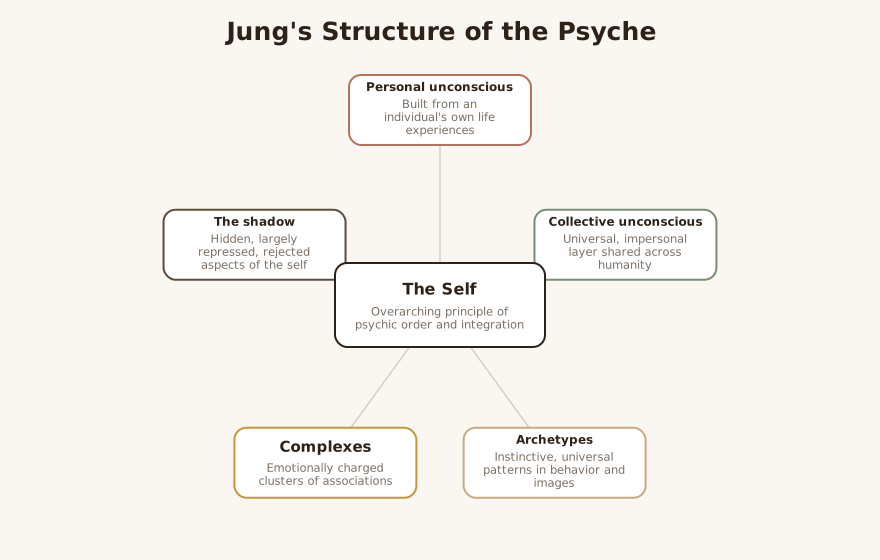
The central premise is that the psyche is structured in layers, including a personal unconscious built from an individual’s own life experiences and a collective unconscious of a universal and impersonal nature, shared across humanity 4. The collective unconscious is populated by archetypes, which Jung described as instinctive, universal patterns expressed in behavior and images 3. Common archetypes include the persona (public presentation), the shadow (rejected aspects of the self), the anima and animus (contrasexual or gender-balancing dimensions), and the Self as the overarching principle of psychic order 1. Collected Works Volume 9.1 develops these in detail, treating the mother, child, anima, wise old man, trickster, and rebirth motifs as primordial images that surface in dreams, mythology, religion, and art 4.
Complexes are emotionally charged clusters of associations that, in Jung’s usage, function as disturbances stored in the personal unconscious and shape how a person experiences the world 1. The shadow is the hidden, largely repressed, inferior and guilt-laden part of personality, though it also holds positive material such as normal instincts and creative impulses 5. The overarching aim of the work is individuation, defined by the IAAP as achieving greater awareness of the factors influencing how a person relates to the totality of their psychological, interpersonal, and cultural experience 1. Jung also classified people by attitude (introverted versus extraverted) and by four functions of mind: thinking, feeling, sensation, and intuition 2.
Interventions & Techniques
Jungian method emphasizes symbolic processes, principally dream interpretation, active imagination, and sand tray work 1. Unlike Freudian analysis, Jungian dreamwork treats the manifest form of the dream not as a disguise to be decoded but as a commentary by the unconscious on the present moment 1. The dream is therefore read for its imagery and movement rather than reduced to a hidden wish LLM. Active imagination invites the client to engage consciously with spontaneously generated images, dialoguing with figures or following a fantasy while remaining awake and reflective 6.
Shadow work is a recurring clinical task in which disowned material, often first encountered through projection onto others, is gradually recognized and assimilated 5. The therapeutic relationship provides the safe conditions for this assimilation; consistent positive regard and non-judgmental acceptance let the client contact repressed material without shame, releasing energy and shifting grievance and blame toward responsibility 5. The analyst-analysand relationship uses transference concepts alongside distinctly Jungian symbolic techniques to support the individuation journey 1. Word association, which Jung pioneered early in his career, historically served to detect complexes through delayed or disturbed responses, though contemporary practice leans more on dream and imaginal work LLM.
LLM-generated illustrative example (not a guideline): A client repeatedly describes a colleague as arrogant and controlling, with disproportionate affect. Rather than litigating the colleague’s behavior, the clinician gently explores what disowned ambition or authority the client may be projecting, treating the strong reaction as a doorway to shadow material LLM.
Evidence Base
Analytical psychology is best described as an established tradition rather than an empirically validated treatment protocol LLM. It is institutionalized through the IAAP, accredited training institutes, and Jung’s Collected Works, and it has been practiced continuously for over a century 1. None of the principal descriptive sources for the model present controlled outcome research; overviews of the approach typically present its concepts descriptively without addressing empirical validation or critiques 6. The honest clinical position is that controlled outcome research specific to Jungian analysis is limited relative to manualized therapies such as CBT, and that what empirical support exists generally rides on the broader psychodynamic and depth-psychotherapy literature rather than on Jungian-branded trials LLM. Several theoretical constructs, including archetypes and the collective unconscious, are not readily operationalized or falsifiable, which is a long-standing scientific criticism of the framework LLM. Clinicians should present the modality to clients as a meaning-oriented, exploratory approach with a deep theoretical and clinical heritage, not as a first-line evidence-based treatment for an acute disorder LLM.
Populations & Indications
The approach is most often indicated for adults in midlife transition, for whom questions of meaning, identity, and the unlived life become pressing LLM. It suits clients explicitly exploring meaning and identity, and those facing existential concerns about mortality, purpose, or value LLM. Because the method works fluently with image, symbol, and metaphor, it tends to engage creative and spiritually oriented clients well 1. Older adults reviewing a life and integrating its phases are a natural fit for individuation work LLM. Trauma survivors may benefit from the symbolic and imaginal aspects, particularly sand tray and active imagination, though this should be paced carefully and is best layered with stabilization and trauma-specific methods LLM.
Problems-for-Work
The framework is commonly applied to identity disturbance and self-concept difficulties, where archetypal and persona-versus-Self language helps a client articulate a more coherent sense of who they are LLM. It is frequently used with existential distress and the so-called midlife crisis, reframing disruption as a summons toward individuation rather than mere pathology 1.
LLM-generated illustrative example (not a guideline): A high-achieving client in their late forties reports emptiness despite external success. The work reframes the symptom as the psyche’s protest against an over-identified persona, opening exploration of neglected functions and values LLM.
Depression, grief, and complicated grief are worked through attention to symbolic material, mourning, and the energy that integration can release 5. Recurrent relationship patterns are understood partly through projection and complex activation, and recurrent dreams or nightmares are treated as direct commentary from the unconscious worth sustained attention 1. Meaning and spiritual concerns are central rather than peripheral to this tradition, which explicitly foregrounds symbolic and spiritual experience 1.
Contraindications, Cautions & Cultural Humility
Open-ended, insight-oriented, symbolically intensive work is poorly matched to acute crisis, active psychosis, or significant instability, where containment, safety, and evidence-based stabilization take priority LLM. Clients seeking brief, structured, symptom-focused relief may find the pace and ambiguity frustrating, and informed consent should make the exploratory nature explicit LLM. Active imagination and deep unconscious work can be destabilizing for clients with fragile reality testing or unprocessed trauma and should be titrated LLM. Several archetypal constructs, including the anima and animus, were articulated through an early twentieth-century European lens, and their gendered assumptions require critical, culturally humble adaptation rather than literal application to contemporary and diverse clients LLM. The strong emphasis on spiritual and symbolic experience should be calibrated to each client’s own worldview, neither imposed nor dismissed, and the clinician must guard against universalizing one cultural mythology as if it were truly collective LLM.
Treatment-Plan Suggestions & SMART Objectives
| Goal | SMART objective (example) | Mechanism |
|---|---|---|
| Increase self-awareness of disowned traits | Within 10 sessions, client will identify and journal 3 recurring projections and name the underlying disowned quality for each | Shadow recognition and integration 5 |
| Reduce over-identification with the persona | Over 8 weeks, client will distinguish role-based “shoulds” from personally held values in 2 written reflections | Persona-versus-Self differentiation 1 |
| Use dream material for insight | For 6 weeks, client will record and bring 1 dream per session and collaboratively explore its present-moment commentary | Symbolic dreamwork 1 |
| Clarify identity and life direction | Within 12 sessions, client will articulate a revised statement of meaning and 2 concrete value-aligned actions | Individuation process 1 |
| Process grief through symbolic work | Over 8 sessions, client will create and reflect on 2 sand tray or imaginal scenes representing the loss | Imaginal mourning and integration 1 |
| Reduce reactivity in relationships | Within 10 sessions, client will track 3 complex-driven conflicts and identify the activated emotional pattern in each | Complex awareness 1 |
| Build tolerance for ambiguity and inner conflict | Over 6 weeks, client will practice active imagination twice weekly and report shifts in affect | Conscious engagement with the unconscious 6 |
Common Misconceptions
A frequent error is conflating Jung’s introversion/extraversion typology with the Myers-Briggs Type Indicator; the MBTI was built on Jung’s functions but is a separate, commercial instrument with its own validity questions 6. Another is treating dreams as coded messages to be decrypted, when Jungian practice reads the manifest dream as present-moment commentary by the unconscious 1. Many assume the shadow is purely negative, but it also contains positive, creative, and instinctive material that has been disowned 5. The collective unconscious is sometimes misread as inherited memories or content, whereas Jung described it as universal, impersonal patterning (archetypes) rather than specific recollections 4. Finally, individuation is not the same as individualism or self-improvement; it is a movement toward integration of conscious and unconscious elements into a more whole relationship with oneself and one’s context 1.
Training & Certification
Becoming a credentialed Jungian analyst requires post-graduate training through an institute accredited by or affiliated with the International Association for Analytical Psychology (Jungian), the field’s official governing body 1. Training is intensive and typically includes a substantial personal analysis, supervised clinical work, seminars, and a qualifying examination, distinguishing certified analysts from clinicians who merely apply Jungian concepts LLM. Many general psychotherapists integrate Jungian ideas (dreamwork, shadow exploration, individuation framing) into psychodynamic practice without holding the analyst credential, which is legitimate provided scope and competence are represented honestly LLM. National professional bodies such as the Society of Analytical Psychology (Jungian) in the United Kingdom publish accessible clinical material and support continuing education in the tradition 5.
Key Terms
Collective unconscious — a universal, impersonal psychic layer shared across humanity, distinct from the personal unconscious, and consisting of archetypal patterning 4. Archetype — an instinctive, universal pattern expressed in behavior and images across dreams, myth, and art 3. Complex — an emotionally charged cluster of associations in the personal unconscious that disturbs and shapes a person’s experience 1. Persona — the public self, what one and others take oneself to be 5. Shadow — the hidden, largely repressed, inferior part of personality, which also holds disowned positive qualities 5. Anima/animus — the contrasexual or gender-balancing archetypal dimensions within the psyche 1. The Self — the overarching principle of psychic order and wholeness toward which development tends 1. Individuation — the process of greater awareness of how one relates to the totality of psychological, interpersonal, and cultural experience 1. Active imagination — a technique of consciously engaging spontaneously generated inner images 6.
Resources & Further Reading
▶ Watch — a video introduction to this concept:
- Analytical Psychology (Jungian) — International Association for Analytical Psychology (Jungian) (IAAP, official)
- Analytic psychology — Britannica
- Carl Jung — Britannica
- Volume 9.1: The Archetypes and the Collective Unconscious (Collected Works) — IAAP abstracts
- The Jungian Shadow — Society of Analytical Psychology (Jungian) (SAP)
- Jungian Psychology: Unraveling the Unconscious Mind — PositivePsychology.com
Reflective / Supervision Questions
- When a client’s symbolic or spiritual material differs from my own worldview, am I exploring it on their terms or subtly imposing my framework LLM?
- How do I distinguish a client who is ready for open-ended individuation work from one who first needs stabilization and structure LLM?
- Where might my own shadow or complexes be activated in the transference, and how would I notice LLM?
- Am I representing the evidence status of this approach honestly to clients, neither overselling nor dismissing it LLM?
- How do I adapt early twentieth-century archetypal constructs, especially gendered ones, for contemporary and diverse clients without distorting either the theory or the person in front of me LLM?