
Type & Discipline
Karuna (Pali and Sanskrit; Tibetan snying rje; Chinese bei) is a contemplative construct rather than a freestanding psychotherapy. 2 It names a specific quality of heart and mind: being moved by the suffering of beings, coupled with the wish that they be free from that suffering. 2 It belongs to Buddhist contemplative practice and, more precisely, to the family of the four brahmaviharas — the “divine abodes” or “sublime states.” 3 For clinicians it is best understood as a mental factor that can be deliberately cultivated, measured indirectly through its behavioral and affective expressions, and translated into structured intervention rather than as a diagnosis or a manualized treatment in itself. LLM
The distinction matters at the outset. Karuna is a target state and a practice object, not a billable modality. LLM What makes it relevant to a therapy room is that contemporary clinical models — most explicitly Compassion-Focused Therapy (CFT) — have operationalized compassion into trainable skills and embedded those skills inside recognized therapeutic frameworks. 6 So this article treats karuna on two levels at once: the contemplative source concept, and its clinical descendants. LLM
Creators & Lineage
The brahmaviharas predate Buddhism. The concept is described as a pre-Buddhist Brahminical one that the Buddhist tradition reinterpreted and integrated into the path to liberation, with antecedents in Upanishadic and Jain literature. 3 The term combines Brahma (divine) with vihara (abode), rendered as “sublime” or “divine abodes,” and the four are also called the four immeasurables (appamañña). 3
The canonical sources locate karuna within a structured set of four. The Tevijja Sutta of the Digha Nikaya presents these meditations as methods for “communion with Brahma,” and the Metta Suttas of the Anguttara Nikaya discuss them as immeasurable states with rebirth consequences. 3 The most influential systematization is Buddhaghosa’s fifth-century Visuddhimagga (“Path of Purification”), which lays out how a practitioner develops each immeasurable in turn — applied first to oneself, then to those nearby, and finally to all beings everywhere. 3
In the modern era, two strands of lineage converge on the clinician. The contemplative strand reaches Western practitioners through twentieth-century expositors such as Nyanaponika Thera, whose essay on the four sublime states remains a standard reference. 1 The clinical strand runs through Paul Gilbert, who developed Compassion-Focused Therapy by integrating cognitive behavioral techniques with evolutionary psychology, developmental and social psychology, neuroscience, and Buddhist psychology. 6 Gilbert’s foundational account argues that compassion can be analyzed and trained, and his work is the principal bridge from karuna as a meditative ideal to compassion as a clinical mechanism. 5 The proximate practice lineage for compassion cultivation also includes loving-kindness (metta) meditation and mindfulness meditation, which are frequently practiced alongside compassion training. 4
Core Principles
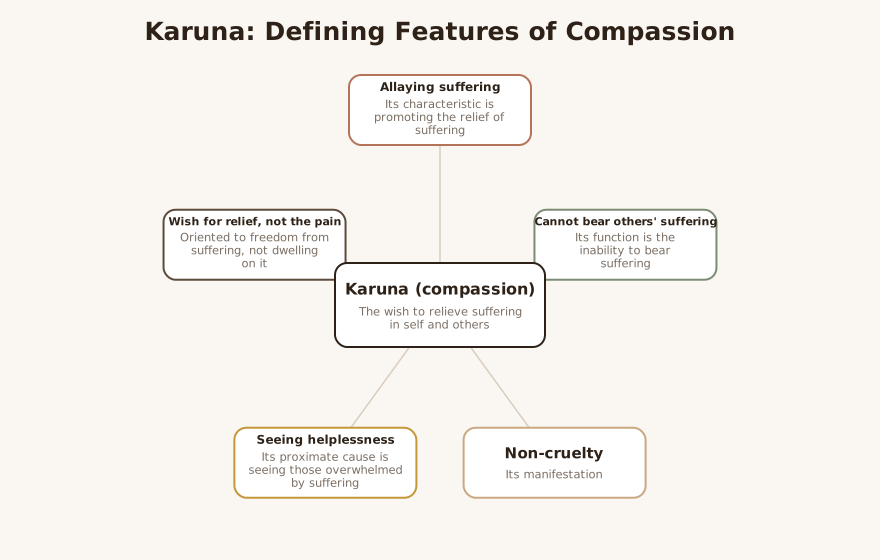
The defining characteristic of karuna is “promoting the aspect of allaying suffering”; its function is the inability to bear the suffering of others; its manifestation is non-cruelty; and its proximate cause is seeing the helplessness of those overwhelmed by suffering. 2 In Nyanaponika Thera’s image, compassion “removes the heavy bar, opens the door to freedom, makes the narrow heart as wide as the world.” 1 It is the response that refuses to look away.
A principle clinicians often miss is that karuna is oriented toward the wish for relief, not toward dwelling on pain. True compassion focuses on the wish that beings be free from suffering rather than on the suffering itself, because immersion in the pain alone produces sadness rather than the stable, resourced state from which help can flow. 2 This is the contemplative analogue of the clinical observation that fusing with a client’s distress degrades, rather than improves, one’s capacity to be useful. LLM
Karuna is also explicitly differentiated from loving-kindness. Metta is the wish that all beings be happy; karuna specifically addresses suffering. 2 Unlike loving-kindness and equanimity, which the tradition describes as manifesting through other mental factors, compassion functions as its own distinct mental factor. 2 The four states are designed to balance and correct one another: compassion keeps loving-kindness from becoming narrow or self-satisfied and urges it to widen its sphere, while sympathetic joy (mudita) keeps compassion from being consumed by suffering alone, and equanimity (upekkha) supplies the “calm and firm hand led by wisdom” that compassionate action requires. 1
The contemporary clinical reframing rests on a structural model of emotion. CFT proposes three evolved affect-regulation systems: a threat system (anger, anxiety, fight/flight), a drive system (resource- and pleasure-seeking), and a soothing system (contentment and safeness when threats recede). 6 Compassion is understood to engage the soothing/affiliative system, which is why deliberately cultivating it can down-regulate threat-based states such as shame and self-attack. 6 Gilbert’s account further specifies compassion as having two psychologies — the sensitivity that engages with suffering, and the motivation and skill to act to alleviate it — which maps cleanly onto karuna’s twofold structure of being moved by suffering and wishing its end. 5
Interventions & Techniques
Because karuna itself is a state, the techniques are methods for cultivating it. The classical method is the graduated extension practiced in the Visuddhimagga tradition: the practitioner takes the immeasurable and applies it to oneself, then to others nearby, then outward to everyone in the world. 3 In compassion practice this typically means beginning where the wish for relief is easiest to access and progressively including more difficult objects — neutral persons, then those toward whom one feels aversion. 4
The traditional texts also pair these practices. Compassion meditation is recommended alongside mindfulness meditation, with each able to serve as an antidote when the other becomes frustrating. 4 This is practical guidance the clinician can use directly: when a client cannot generate warmth, returning to breath-anchored attention can stabilize them, and vice versa. LLM
In the clinical lineage, the central technique is Compassionate Mind Training (CMT), which teaches the skills and attributes of compassion, having clients first understand compassion conceptually before applying it to themselves. 6 CFT also works with the “flows” of compassion — compassion received from others, compassion extended to others, and compassion directed toward oneself — recognizing that clients with high shame often block the self-directed flow most strongly. LLM Common CMT exercises include soothing-rhythm breathing, building a “compassionate self” or “compassionate image,” and compassionate letter-writing, all aimed at activating the affiliative soothing system. 6
LLM-generated illustrative example (not a guideline): A nurse presenting with burnout can name acute compassion for her patients yet meet her own exhaustion with contempt (“I should be coping”). Practice begins by having her notice that the warmth she readily offers patients is the same faculty she withholds from herself, then deliberately extends the graduated practice inward — first to a recent, concrete moment of her own struggle — before generalizing. LLM
Evidence Base
Honesty about maturity requires two separate verdicts. As a contemplative construct, karuna is established — it is a stable, well-documented element of a centuries-old, internally consistent system of practice, attested across canonical and commentarial sources. 3 Its clinical operationalization is younger and still maturing. LLM
CFT and CMT have accumulated supportive but not definitive evidence. The literature reports a 2012 trial indicating effectiveness in psychosis, a 2015 review showing promise for mood disorders, and applications across eating disorders (the CFT-E variant), acquired brain injury, and cancer populations. 6 A 2024 meta-analysis of 7,875 participants across 17 countries concluded that CFT was effective in reducing overall negative mental-health outcomes. 6 Importantly, the same source notes that researchers recommend larger-scale randomized controlled trials for independent validation. 6 The fair clinician’s summary is that compassion-cultivation produces reliable signals of benefit, especially for shame- and self-criticism-laden presentations, while the highest-tier confirmatory evidence is still being built. LLM Gilbert’s own foundational paper frames the rationale and mechanisms rather than serving as an outcome trial. 5
Populations & Indications
Compassion cultivation is most indicated where the soothing/affiliative system is under-developed or actively blocked. CFT explicitly targets populations characterized by high shame and self-criticism. 6 Among adults, this includes clients with chronic shame, those with pervasive self-criticism, and those reporting low self-compassion who can extend care outward but not inward. 6 LLM
Caregivers and healthcare workers are a natural population: compassion fatigue and burnout often reflect not an absence of compassion but a depleted soothing system and an absent self-directed flow. LLM Trauma survivors frequently carry shame and threat-system dominance, making graduated, carefully paced compassion work relevant — with cautions noted below. LLM The construct is also delivered in group formats and to the general public through guided audios, apps, and group programs. 6
Problems-for-Work
- Excessive self-criticism and low self-compassion. The core clinical use case: training the self-directed flow of compassion to compete with an entrenched self-attacking inner voice. 6 Application: a client who berates himself after any mistake practices generating a compassionate-self perspective and addressing that perspective to the failure. LLM
- Shame. Compassion engages the affiliative system that counter-regulates shame’s threat physiology. 6 Application: compassionate letter-writing to oneself about a shame memory. LLM
- Major depressive disorder. Mood disorders are among the presentations where compassion approaches have shown promise. 6 Application: compassion practice paired with behavioral activation to soften the self-blame that maintains low mood. LLM
- Compassion fatigue and burnout. Reframed as a deficit in the self-directed flow and a depleted soothing system rather than moral failure. LLM Application: structured self-compassion breaks for clinicians during the workday. LLM
- Emotional dysregulation. Activating the soothing system gives clients a physiological “down-shift” to pair with distress tolerance. 6 Application: soothing-rhythm breathing rehearsed before exposure to a dysregulating cue. LLM
- Interpersonal disconnection. The graduated extension practice rebuilds the felt sense of connection to others. 3 Application: metta/karuna sequencing toward a neutral colleague to loosen withdrawal. LLM
- Anxiety disorders. Compassion can down-regulate the threat system that drives anxious avoidance. 6 Application: compassionate-image work used as a safety-cultivating (not safety-behavior) resource alongside exposure. LLM
Contraindications, Cautions & Cultural Humility
The tradition itself names the central caution. Karuna’s “near enemy” is sentimental grief — being overwhelmed by the sight of the world’s suffering, falling into “melancholic brooding without purpose” and a “futile sentimentality that merely weakens and consumes the strength of mind and heart.” 1 The corrective is that the practitioner’s heart should remain serene and calm rather than victimized by others’ pain. 1 The Encyclopedia of Buddhism likewise identifies the near enemy as personal distress or grief rooted in worldly attachment, and the far enemy as cruelty and violence. 2 Clinically, this is a precise warning against the practice collapsing into rumination or vicarious distress. LLM
A documented phenomenon in compassion work is “backdraft” — for high-shame and trauma clients, self-directed warmth can paradoxically activate threat, grief, or memories of unmet need; pacing, titration, and grounding are therefore essential rather than optional. LLM The traditional pairing of compassion with mindfulness, and the use of either as an antidote when the other falters, offers a built-in stabilization strategy. 4 Equanimity is the indispensable counterweight: without it, engaged compassion has no “even, unwavering courage” and risks tipping into the near enemy. 1
Cultural humility is non-negotiable here. These are sacred practices within living religious traditions, and they are explicitly pre-Buddhist in origin and reinterpreted across Hindu, Jain, and Buddhist lineages. 3 Secular clinical adaptations such as CFT are deliberately framed in evolutionary and psychological terms rather than religious ones; clinicians should be transparent about which they are offering, avoid presenting decontextualized fragments as the whole tradition, and respect clients whose own faith framework may differ. 6 LLM
Treatment-Plan Suggestions & SMART Objectives
| Goal | SMART objective (example) | Mechanism |
|---|---|---|
| Reduce self-criticism | Within 8 weeks, client reduces frequency of self-critical episodes (self-monitored) by 50% and can articulate a compassionate-self response on demand in session | Trains self-directed flow of compassion; competes with self-attack 6 |
| Build self-compassion | Within 6 weeks, client completes one compassionate-letter-writing exercise weekly and reports increased ease addressing the self with warmth | Activates affiliative soothing system 6 |
| Down-regulate threat/anxiety | Within 4 weeks, client uses soothing-rhythm breathing to lower self-rated distress by 2 points (0-10) before an anxiety cue, 4 of 5 attempts | Soothing system counter-regulates threat system 6 |
| Address shame | Within 10 weeks, client describes one shame memory to a “compassionate image” and reports reduced shame intensity | Engages soothing system against shame physiology 6 |
| Mitigate burnout (caregivers) | For 4 weeks, client takes two brief self-compassion pauses per shift, logged, and reports recovered self-directed warmth | Restores depleted self-directed flow LLM |
| Increase connection | Within 6 weeks, client completes graduated extension practice (self → near → neutral) and identifies one re-engaged relationship | Visuddhimagga-style progressive widening of care 3 |
| Stabilize dysregulation | Within 5 weeks, client pairs compassion practice with a grounding skill and recovers baseline within 10 minutes after a trigger, twice weekly | Affiliative down-shift plus mindfulness anchoring 4 |
Common Misconceptions
- “Compassion means absorbing the client’s pain.” The tradition is explicit that true compassion focuses on the wish for relief, not on dwelling in the suffering, which only produces sadness. 2 Absorption is the near enemy, not the practice. 1
- “Compassion is the same as loving-kindness.” Metta wishes happiness; karuna specifically addresses suffering, and compassion is treated as its own distinct mental factor. 2
- “Compassion is soft or weak.” Equanimity supplies compassion with “unwavering courage and fearlessness” and a wisdom-led firm hand; engaged compassion is action-oriented, with cruelty as its far enemy. 1 2
- “Self-compassion is self-indulgence.” In CFT, self-directed compassion activates the soothing system to counter shame and self-attack; it is a regulatory skill, not permission-giving. 6 LLM
- “CFT is just Buddhism rebranded.” CFT integrates Buddhist psychology with evolutionary psychology, neuroscience, and CBT; it is a secular clinical synthesis, not a religious practice. 6
- “There’s no evidence.” A 2024 multinational meta-analysis found CFT effective for negative mental-health outcomes, though larger RCTs are still recommended. 6
Training & Certification
There is no certification in karuna as a construct; competence is built on two tracks. LLM The contemplative track involves grounding in primary and reputable secondary sources — Nyanaponika Thera’s exposition of the four sublime states is a standard entry point 1 — ideally with personal practice under qualified instruction, since the Visuddhimagga model is fundamentally an experiential, graduated training. 3 The clinical track is Compassion-Focused Therapy and Compassionate Mind Training, developed by Paul Gilbert and disseminated through dedicated CFT training pathways; clinicians intending to deliver CFT formally should pursue structured CFT/CMT training and supervision rather than improvising from this article. 6 5 Reading Gilbert’s foundational account of the origins and nature of CFT is recommended for the theoretical rationale. 5
Key Terms
- Karuna — Compassion; being moved by suffering and wishing for its relief; characterized by “allaying suffering.” 2
- Brahmaviharas — The four “divine abodes” or “sublime states”; also the four immeasurables (appamañña). 3
- Metta — Loving-kindness; the wish that beings be happy. 2
- Mudita — Sympathetic/empathetic joy; gladness at others’ happiness; keeps compassion from being consumed by suffering. 1 3
- Upekkha — Equanimity; even-mindedness that supplies compassion its steady, wisdom-led courage. 1 3
- Near enemy (of karuna) — Sentimental grief / personal distress that mimics compassion but weakens the mind. 1 2
- Far enemy (of karuna) — Cruelty and violence. 2
- Three affect-regulation systems — CFT’s threat, drive, and soothing systems. 6
- Compassionate Mind Training (CMT) — The skills-training core of CFT. 6
Resources & Further Reading
▶ Watch — a video introduction to this concept:
- Nyanaponika Thera — The Four Sublime States (Access to Insight) 1
- Karuṇā — Encyclopedia of Buddhism 2
- Brahmavihara — Wikipedia 3
- The Four Sublime States — Buddhistdoor Global 4
- Gilbert, P. (2014). The origins and nature of compassion focused therapy. British Journal of Clinical Psychology 5
- Compassion-Focused Therapy — Wikipedia 6
Reflective / Supervision Questions
- When I sit with a suffering client, am I cultivating the wish to relieve their suffering, or am I absorbing it — and how would I know the difference in my own body? LLM
- Where in my caseload am I confusing the near enemy (sentimental grief, over-identification) with genuine compassion, and what would equanimity add? 1
- Which of the three flows — receiving compassion, giving it, and directing it toward myself — is most blocked in me, and how might that shape what I model for clients? LLM
- For a high-shame or trauma client, how will I pace self-compassion work to anticipate backdraft, and what grounding skill will I have ready? LLM
- Am I being transparent with clients about whether I am offering a secular clinical adaptation (CFT) versus a practice rooted in a living religious tradition, and does that respect their own framework? 6 LLM
- What evidence threshold am I holding compassion interventions to, given that supportive findings exist but larger RCTs are still recommended? 6