
Type & Discipline
Existential psychotherapy is a depth-oriented, phenomenological modality within existential-humanistic psychology LLM. Rather than a manualized protocol, it is a way of thinking about distress: a framework that locates much human suffering in confrontation with the basic conditions of being alive LLM. Its most influential articulation organizes therapeutic attention around four “ultimate concerns” or givens of existence — death, freedom, isolation, and meaninglessness 5. These are described as an inescapable part of the human being’s existence in the world, not symptoms to be eliminated 5. The approach is best understood as a lens that can inform many forms of practice rather than a discrete technique set, and it shares conceptual ancestry with phenomenology, humanistic therapy, and Frankl’s logotherapy LLM.
Creators & Lineage
The framework most clinicians encounter is Irvin D. Yalom’s, set out in his 1980 textbook Existential Psychotherapy 5. The book is widely regarded as the definitive, comprehensive account of the field, giving a previously diffuse tradition coherent structure and clinical grounding 1. Yalom drew on clinical experience, empirical research, philosophy, and literature, building on the authority he had established with his earlier work on group psychotherapy 1. Contemporaries treated the text as foundational: endorsers predicted it would become a classic for all clinicians and recommended it for every psychiatry resident and clinical psychology intern 1. The publisher continues to present it as a standard reference in the discipline 2. The broader lineage runs through European existentialism, phenomenology, Frankl’s meaning-centered logotherapy, and the humanistic tradition associated with figures such as Rollo May LLM.
Core Principles
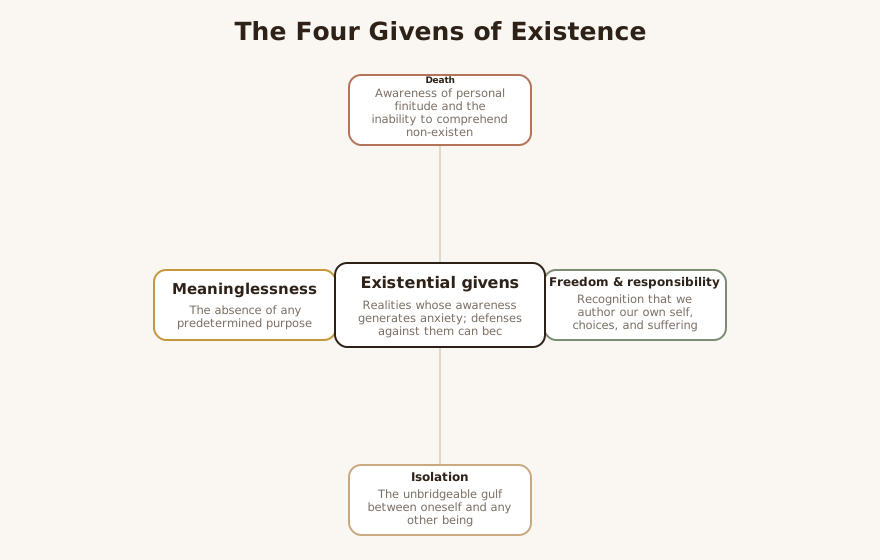
The organizing claim is that anxiety arises not only from learned cognitions or early relationships but from awareness of four existential realities, and that defenses against this awareness can themselves become pathological 5.
The first given is death: awareness of personal finitude and the inability to truly comprehend non-existence 4. Yalom describes two characteristic defenses — a belief in personal specialness and a belief in an ultimate rescuer — whose rigid forms can generate maladaptive patterns 5.
The second is freedom and responsibility: the recognition that we are authors of our own self, destiny, choices, and suffering 5. This awareness produces a sense of groundlessness, and people deploy strategies to shield themselves from the weight of freedom 5.
The third is isolation, operating at three levels — interpersonal loneliness, intrapersonal partitioning, and existential isolation, the unbridgeable gulf between oneself and any other being 5. No relationship can fully dissolve existential isolation, but accepting it can paradoxically enable more authentic connection 4.
The fourth is meaninglessness: the absence of any predetermined purpose in an indifferent universe 4. Yalom holds that meaning is found indirectly, through engagement, creativity, altruism, and self-transcendence, rather than pursued head-on 5.
A further principle cuts across all four: the treatment is an authentic encounter between two people, not a technician applying techniques to a patient 4. The relationship itself, and genuine presence within it, is the primary therapeutic instrument 4.
Interventions & Techniques
Existential work is deliberately light on protocol; there is typically no homework or rigid structure, and sessions respond organically to what the client brings 4. The central “technique” is the disciplined use of the therapeutic relationship and a here-and-now focus on what is happening between therapist and client in the present moment 4. The therapist engages as a fellow human facing the same existential realities, using judicious self-disclosure and authentic engagement rather than expert detachment 4.
Methodologically, the approach leans on the phenomenological stance — descriptive exploration of the client’s lived experience without premature explanation or problem-solving 3. A key clinical skill is recognizing when problem-solving is inappropriate, because existential issues lack technical solutions and call instead for accompaniment and meaning-making 3. Concrete moves include surfacing and examining the client’s defenses against death awareness, clarifying ownership of choices to counter avoidance of responsibility, and helping the client identify sources of engagement that generate meaning 5. Yalom’s notion of “rippling” — recognizing how one’s influence extends through others beyond one’s lifespan — is one such meaning-oriented intervention used with isolation and mortality concerns 4.
LLM-generated illustrative example (not a guideline): A clinician notices a midlife client repeatedly framing a stalled career as something that “just happened.” Rather than offering coping strategies, the therapist gently reflects the language of passivity and invites the client to consider where choice and authorship might lie — a freedom-and-responsibility intervention LLM.
Evidence Base
Honesty about maturity matters here. The framework is established in the sense of being foundational, influential, and widely taught; Yalom’s text is treated as a classic of the field 5 1. That status, however, reflects intellectual influence rather than a large body of randomized controlled trials of “existential therapy” as a standalone, manualized treatment LLM.
Where direct outcome evidence exists, it is concentrated in manualized derivatives developed for serious illness — meaning-centered group and individual psychotherapy, Managing Cancer and Living Meaningfully (CALM), Dignity Therapy, and Life-Review interventions 6. A review of nine evidence-based existential interventions for advanced cancer patients concluded that current evidence is still based on a very limited number of studies, with only about four interventions showing validated improvements in existential or spiritual well-being 6. Clinicians should therefore present existential therapy as a well-developed conceptual framework with promising but early outcome data, not as a treatment with robust efficacy trials across diagnoses LLM.
A common citation trap deserves flagging. A meta-analysis by Menzies and colleagues found large reductions in death anxiety, but that evidence is attributed to cognitive behavior therapy combining exposure with cognitive restructuring, not to existential therapy itself 3. It is best framed as adjacent and integration-relevant evidence — death-related concerns are clinically treatable — rather than proof of existential therapy’s efficacy 3.
Populations & Indications
The framework applies broadly because its concerns are universal, but it has gathered the most clinical traction among people for whom existential realities are acute and unavoidable LLM. The clearest indications are adults facing serious or terminal illness and cancer patients, where meaning-centered and dignity-based derivatives have been studied 6. People with chronic illness, older adults, the bereaved, those experiencing anticipatory grief, and adults navigating midlife transition are also natural candidates, as each confronts mortality, loss, or shifting meaning LLM. Healthcare professionals carrying repeated exposure to death and suffering can benefit from the framework’s attention to mortality awareness and meaning LLM. In palliative settings, target presentations include elevated psychological distress encompassing depression, anxiety, and a sense of spiritual hopelessness 6.
Problems-for-Work
Existential work is most apt when distress has a clear existential dimension that symptom-focused treatment alone does not reach LLM. Death anxiety, existential crisis, demoralization, and loss of meaning are the prototypical targets, mapping directly onto the four givens 5. Grief and anticipatory grief, adjustment disorder, identity disturbance, and loneliness and isolation also lend themselves to this lens LLM. Anxiety and major depressive disorder can be addressed existentially when the formulation implicates meaninglessness, avoidance of freedom, or unacknowledged mortality concern, though these often warrant evidence-based primary treatments alongside existential exploration LLM.
LLM-generated illustrative example (not a guideline): A client with advanced illness reports flat, pervasive demoralization rather than classic depression. Work centers on identifying remaining sources of engagement and on “rippling” — the influence she has had on her children — to address meaning and isolation LLM.
LLM-generated illustrative example (not a guideline): A recently bereaved older adult describes a sudden sense that “nothing matters.” The clinician treats this as meaninglessness rather than pathology, exploring small avenues of altruism and connection as indirect routes to renewed meaning LLM.
Contraindications, Cautions & Cultural Humility
Existential exploration is not a first-line substitute for acute stabilization; clients in crisis, acute psychosis, or untreated severe depression generally need symptom-focused and safety-oriented care before or alongside existential work LLM. The approach’s openness and lack of structure can feel destabilizing for clients who need containment, and confronting death or freedom prematurely may heighten rather than relieve distress LLM. Because the modality privileges first-person subjective experience and resists manualization, fidelity and outcomes are harder to standardize, which is a caution for accountability-driven settings 3.
Culturally, the four givens are framed as universal, but their meaning, the acceptability of discussing death, and beliefs about fate, freedom, and the afterlife vary widely across faith traditions and cultures LLM. Clinicians should hold the framework lightly, inquire into the client’s own meaning systems rather than imposing a secular existential reading, and remain alert to how individualistic notions of personal authorship may not fit collectivist worldviews LLM. The phenomenological stance — describing the client’s world without premature explanation — is itself a tool of cultural humility 3.
Treatment-Plan Suggestions & SMART Objectives
The objectives below illustrate how existential targets can be operationalized within ordinary clinical documentation LLM.
| Goal | SMART objective (example) | Mechanism |
|---|---|---|
| Reduce death anxiety | Client will identify and verbalize two personal defenses against mortality awareness within 4 sessions | Surfacing defenses against death 5 |
| Restore sense of meaning | Client will name three current sources of engagement (relationships, creativity, altruism) and act on one weekly for 6 weeks | Indirect meaning-making 5 |
| Increase ownership of choices | Client will reframe two “it just happened” narratives into language of authorship by session 8 | Freedom and responsibility 5 |
| Address existential isolation | Client will articulate one way their influence “ripples” to others within 5 sessions | Rippling intervention 4 |
| Reduce demoralization in serious illness | Client will complete a structured life-review or dignity exercise over 4 sessions | Manualized existential derivative 6 |
| Tolerate uncertainty | Client will practice describing one ambiguous situation without resolving it, weekly for 4 weeks | Phenomenological acceptance of ambiguity 3 |
| Process anticipatory grief | Client will express and contain anticipatory loss in 3 sessions using present-moment focus | Here-and-now relational work 4 |
| Clarify a difficult choice (e.g., contemplating making amends) | Client will weigh a pending decision by naming which option feels the easiest, which the hardest, which would make them feel the most proud, which would risk regret, and which would bring the most value, within 3 sessionsCommunity Member | Value-based decision-making within freedom and responsibilityCommunity Member |
Common Misconceptions
A frequent misconception is that existential therapy is purely philosophical conversation with no clinical method; in fact it has a defined stance, a here-and-now focus, and a clear theory of how avoidance of the givens produces symptoms 4 5. Another is that it is pessimistic or morbid because it foregrounds death; the actual aim is to use mortality awareness to intensify engagement with living 5. Some assume it is interchangeable with logotherapy, but meaning is only one of four concerns in Yalom’s scheme 5. Clinicians sometimes overclaim its evidence base, treating it as a proven standalone treatment, when robust outcome data are limited and concentrated in specific manualized derivatives 6. Finally, the absence of homework and protocol is mistaken for absence of skill, whereas disciplined presence and phenomenological listening are demanding competencies 4 3.
Training & Certification
There is no single mandatory credential for practicing existentially; the orientation is most often acquired through reading the foundational literature, supervised practice, and continuing education rather than a board certification LLM. Yalom’s textbook functions as a primary training text and is recommended reading across psychiatry and psychology training 1. Recommended developmental routes include didactic exposure to existential philosophy, experiential exercises in phenomenological listening, and supervision that emphasizes the clinician’s own existential awareness and personal development 3. Notably, trainees in cognitive behavioral programs consistently report existential training components as among the most valuable, despite initial discomfort 3. For clinicians working with serious illness, additional structured training exists in the manualized derivatives such as meaning-centered psychotherapy and dignity therapy 6.
Key Terms
Givens / ultimate concerns — the four inescapable conditions of existence: death, freedom, isolation, and meaninglessness 5. Death anxiety — distress arising from awareness of personal finitude, often managed by defenses such as belief in specialness or an ultimate rescuer 5. Groundlessness — the subjective experience that accompanies awareness of one’s own freedom and responsibility 5. Existential isolation — the unbridgeable gulf between oneself and any other being, distinct from ordinary loneliness 5. Rippling — recognizing how one’s influence spreads through others beyond one’s lifespan, offered as an antidote to isolation and mortality fears 4. Phenomenological method — descriptive exploration of lived experience without premature explanation 3. Demoralization — a loss of meaning, hope, and morale, a central target in palliative existential work 6.
Resources & Further Reading
▶ Watch — a video introduction to this concept:
- Existential Psychotherapy — Irvin D. Yalom, MD (author’s official page)
- Existential Psychotherapy by Irvin D. Yalom — Hachette Book Group
- Existential Approaches and Cognitive Behavior Therapy: Challenges and Potential — PMC
- Irvin Yalom’s Existential Psychotherapy: Core Ideas Explained — Reachlink
- Existential Psychotherapy (book) — Wikipedia
- Existential Psychotherapy within Palliative Care: Searching for Meaning — PMC
Reflective / Supervision Questions
- How comfortable am I sitting with a client’s confrontation with death or meaninglessness without reaching for problem-solving LLM?
- When does my use of structure and technique serve the client, and when might it be a defense against the discomfort of authentic encounter LLM?
- How do I distinguish a clinically appropriate existential focus from avoiding the client’s need for stabilization or evidence-based symptom treatment LLM?
- Whose meaning system is operating in the room — the client’s, or my own existential assumptions LLM?
- Where in my own life do the four givens go unexamined, and how might that shape my work LLM?