
Type & Discipline
Interpersonal Neurobiology (IPNB) is best understood as a meta-theoretical framework rather than a discrete, manualized therapy. LLM It is explicitly interdisciplinary, seeking the common patterns that arise when separate fields of knowledge — neuroscience, psychology, biology, anthropology, and systems theory — are examined side by side. 1 Daniel Siegel founded the framework precisely to surface these shared principles across disciplines that rarely speak to one another. 1 Wikipedia situates the field, also called relational neurobiology, as an interdisciplinary framework developed in the 1990s proposing that the mind, brain, and relationships integrate. 2
Because IPNB is a lens rather than a protocol, it sits “above” specific modalities and can inform how a clinician thinks within almost any treatment approach. LLM It is not a school of therapy in the way that cognitive behavioral therapy or psychodynamic therapy are; it is a way of understanding why those therapies work and what they are changing. LLM In this sense, clinicians do not typically “do IPNB” as a stand-alone treatment so much as practice through an IPNB-informed stance. LLM
Creators & Lineage
The framework’s primary developer is Daniel J. Siegel, a psychiatrist who convened academics from multiple disciplines to construct an integrative account of the mind. 2 Allan Schore is a central contributing theorist, particularly on the neurobiology of early affective development and right-brain-to-right-brain attunement between caregiver and infant. 2 Wikipedia additionally credits Louis Cozolino and Bonnie Badenoch as contributors who extended the framework into clinical and therapeutic territory. 2
IPNB draws directly on attachment theory, which supplies its account of how early caregiving relationships shape developing brains. 2 It is equally indebted to affective neuroscience, the study of the brain systems underlying emotion, which grounds its claims about regulation and arousal. LLM Mindfulness-based practice contributes the idea that focused attention can deliberately reshape neural structure and function. 1 Polyvagal-informed thinking about autonomic states and safety is a frequent companion to IPNB in trauma work, sharing its emphasis on the body and on co-regulation between people. LLM The through-line across this lineage is that the brain is a social organ shaped by relationships, not a closed computational box. LLM
Core Principles
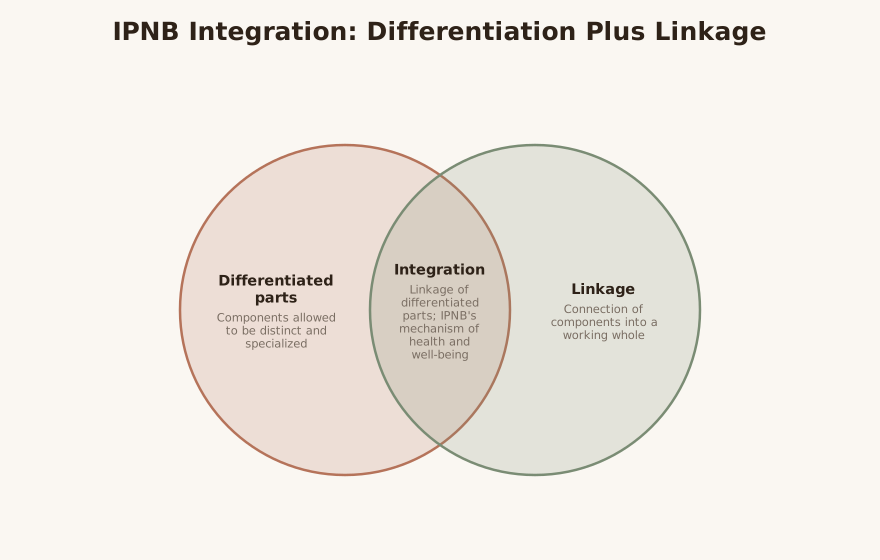
The cornerstone concept is integration, defined as “the linkage of differentiated components of a system.” 1 IPNB holds that integration is the essential mechanism of health, because it promotes a flexible and adaptive way of being filled with vitality and creativity. 1 When parts of a system are both differentiated (allowed to be distinct and specialized) and linked (connected into a working whole), the system functions at its best. 1
Integration is described as operating at several levels at once. 1 Within the individual mind, it means linking thought with feeling and bodily sensation with logic. 1 Within the brain, it means connecting separated areas with their unique functions through synaptic pathways, a linkage IPNB associates with the emergence of insight, empathy, intuition, and morality. 1 Within relationships, it means honoring the autonomy and differentiated self of each person while remaining linked to others in empathic communication. 1
A second principle concerns the mind itself. IPNB defines the mind expansively, decomposing it into facets that include subjective experience, consciousness, information processing, and self-organization. 2 The mind is conceived as a process that regulates the flow of energy and information, a process that is both embodied within the nervous system and relational between people. 2 This relational definition is what distinguishes IPNB from a purely brain-bound neuroscience: the mind is understood to be shared and shaped across the connections between people, not contained inside a single skull. 2
A third principle is the triangle of well-being, which depicts mind, brain, and relationships as three irreducible facets of one reality rather than three separate things. 2 Social interactions shape neural connections through continuous feedback loops mediated by neuroplasticity, so that experience in relationship literally reshapes the brain over time. 2 The framework leans heavily on neuroplasticity: that the focus of attention changes the structure and function of the brain, allowing people to “inspire each other to rewire” toward greater integration. 1
Health and its absence are framed in terms of integration. When integration is present, the system moves toward flexibility and adaptation; when it is impaired, the system tends toward chaos and rigidity. 6 These two poles — chaos on one side and rigidity on the other — are IPNB’s clinical signature for recognizing dysfunction. 6
Interventions & Techniques
Because IPNB is a framework rather than a protocol, its “interventions” are better described as a set of clinical aims and an organizing stance. LLM The overarching aim of any IPNB-informed intervention is to promote integration — to help differentiated parts of the mind, brain, or relational field become more linked. 1
Mindsight is the most clearly named applied practice associated with IPNB. Mindsight operates within interpersonal neurobiology and applies its emerging principles to promote compassion, kindness, resilience, and well-being. 1 In practical terms it refers to the trainable capacity to perceive the internal mental life of oneself and others — to “see” the mind — and to use that perception to integrate experience. LLM
Attention training and mindfulness follow directly from the claim that the focus of attention changes brain structure and function. 1 A clinician working in this frame may use focused-attention and awareness practices to strengthen the prefrontal circuitry IPNB links to regulation and empathy. LLM
Attuned, contingent relating is itself a core technique. Because secure caregiver relationships promote healthy neural integration, the therapeutic relationship is treated as a vehicle for the same integrative process. 2 Attunement, rupture-and-repair, and co-regulation are understood as integrating experiences delivered through the relationship. LLM
Naming and linking across domains — putting words to bodily sensation, connecting emotion to narrative, integrating left-hemisphere story with right-hemisphere affect — operationalizes integration at the level of the individual mind. LLM
LLM-generated illustrative example (not a guideline): A client who narrates a frightening event in a flat, over-controlled voice (rigidity) is gently invited to notice sensation in the body while staying connected to the clinician’s calm presence, so that bodily affect and verbal narrative can be linked rather than kept apart. LLM
Evidence Base
It is important to be honest about the maturity of the evidence. As a conceptual framework, IPNB is well established and widely cited; as an outcome-tested treatment, it is not, and direct empirical research is limited. 2 Wikipedia explicitly notes that limited empirical research exists for the framework itself. 2
The strongest empirical signal sits at the level of clinician development rather than client outcomes: studies suggest that IPNB training improves counselor empathy, self-awareness, and the capacity for attuned communication with clients. 2 This is meaningful but should not be overstated as proof that “IPNB cures” any disorder. LLM
Much of IPNB’s credibility is borrowed from its component sciences — attachment research and affective neuroscience — rather than from trials of IPNB as such. LLM Wikipedia also flags that the framework has attracted neutrality and balance concerns, and clinicians should be aware that some of its broader claims outrun the data. 2 The honest summary is that IPNB is a powerful organizing heuristic with strong face validity and modular empirical support, but it is not an evidence-based protocol in the sense that exposure therapy or cognitive processing therapy are. LLM
Populations & Indications
IPNB is presented as broadly applicable across the lifespan and across helping contexts, from clinical work to education and parenting. 6 It is frequently applied with children, whose developing brains are most plastic and most shaped by caregiving relationships. 2 It is equally applied with adults seeking greater self-understanding and regulation. LLM
Because the framework foregrounds relationships, it lends itself naturally to work with couples and with parents and caregivers, where the unit of change is the relational field rather than a single nervous system. LLM Trauma survivors are a central population, given IPNB’s emphasis on how disrupted attachment and overwhelming experience leave observable marks on neural structure. 2 In the broadest sense, any psychotherapy client can be conceptualized through an IPNB lens, because the framework claims to describe how all minds develop and heal. 6
Problems-for-Work
IPNB maps cleanly onto the problems clinicians actually treat, because most can be reframed as failures of integration tending toward chaos or rigidity. 6
- Emotion dysregulation and affect regulation difficulties are read as impaired integration between limbic arousal and prefrontal regulation; the work targets the linkage between feeling and the capacity to modulate it. LLM For example, a client who swings between flooding and numbing is helped to widen the band of tolerable arousal. LLM
- Posttraumatic stress disorder and developmental trauma are framed as unintegrated implicit memory and disrupted attachment; the work links fragmented sensory-emotional material into coherent narrative. 2 For example, intrusive somatic flashbacks are gradually connected to the autobiographical story they belong to. LLM
- Attachment disturbances are addressed through the corrective, attuned therapeutic relationship that secure caregiving was meant to provide. 2
- Dissociation is understood as a profound failure of integration across states of mind; the work fosters linkage across split-off self-states. LLM
- Relationship conflict is conceptualized as impaired interpersonal integration — too much fusion or too much distance — and treated by restoring differentiation-with-linkage between partners. 1
- Anxiety and depression, alongside other stress-related disorders, are approached as states of rigidity or chaos that integrative practices and relational repair can shift toward flexibility. 6
Contraindications, Cautions & Cultural Humility
The most important caution is one of scope: IPNB is a framework, not a complete treatment, and it should not displace structured, evidence-based protocols where those are indicated. LLM For acute posttraumatic stress disorder, for example, a clinician should not substitute IPNB language for a trauma-focused treatment with established outcome data. LLM
A second caution concerns over-claiming. The mechanistic, brain-based vocabulary of IPNB can lend an aura of neuroscientific certainty to claims that remain theoretical, and Wikipedia’s flagged neutrality concerns underscore that some assertions outpace the evidence. 2 Clinicians should use the language to illuminate experience, not to impress clients with neurobiology they cannot verify. LLM
On cultural humility, the framework’s emphasis on autonomy-and-linkage, attachment norms, and “healthy” relating carries implicit cultural assumptions. LLM What counts as appropriate differentiation, emotional expression, or interdependence varies across cultures and families, and an IPNB-informed clinician must hold its norms as provisional rather than universal. LLM Integration is best treated as a process the client defines in their own cultural terms, not a fixed endpoint the clinician imposes. LLM
Treatment-Plan Suggestions & SMART Objectives
The following objectives translate IPNB’s integrative aims into concrete, measurable targets. They are examples for adaptation, not a fixed protocol. LLM
| Goal | SMART objective (example) | Mechanism |
|---|---|---|
| Improve affect regulation | Client will identify and verbally label one bodily emotion cue in 4 of 5 sessions over 6 weeks. | Linking bodily sensation with conscious naming (integration of mind) 1 |
| Widen the window of tolerance | Client will use a self-selected grounding practice at the first sign of arousal in 3 logged instances per week for 8 weeks. | Strengthening prefrontal regulation of limbic arousal 2 |
| Build mindsight capacity | Client will complete a brief daily reflective attention practice 5 days per week for 4 weeks, logged in a journal. | Attention-driven neuroplastic change 1 |
| Integrate trauma narrative | Client will connect one intrusive sensory memory to its autobiographical context in session, twice over 10 weeks, with reduced distress rated on a 0-10 scale. | Linking implicit memory into coherent narrative 2 |
| Repair attachment patterns | Client will tolerate and verbally process one relational rupture-and-repair within the therapeutic relationship over the treatment course. | Corrective attuned relational experience 2 |
| Reduce relationship rigidity/chaos | Couple will practice one differentiation-with-connection exercise weekly and report it in session for 6 weeks. | Restoring interpersonal integration 1 |
| Decrease dissociative discontinuity | Client will report increased awareness of state shifts on a weekly self-rating, trending upward over 8 weeks. | Fostering linkage across self-states 1 |
Common Misconceptions
A frequent misconception is that IPNB is itself a therapy you can be certified to deliver as a stand-alone treatment. It is more accurately a framework that informs and integrates other treatments. LLM Relatedly, some assume IPNB has the trial-based evidence of a manualized protocol; in fact direct empirical research on the framework is limited, even though the underlying sciences are well developed. 2
Another misconception is that “integration” means making everything the same or merging parts together. Integration specifically requires differentiation as well as linkage — parts must remain distinct, not be dissolved into one another. 1 A third misconception treats IPNB’s brain talk as established mechanism for every claim; much of the neurobiological language is explanatory and theoretical, and should be held with appropriate humility. 2 Finally, mindsight is sometimes conflated with ordinary mindfulness; while related, mindsight specifically denotes perceiving the mind — one’s own and others’ — as a distinct, trainable capacity. 1
Training & Certification
There is no single licensing body that certifies one as an “IPNB therapist,” consistent with its status as a framework rather than a discrete modality. LLM Clinicians typically encounter IPNB through Daniel Siegel’s writing, including the Pocket Guide to Interpersonal Neurobiology, which is structured as an integrative handbook designed to be entered at any point and serving helping professionals, educators, and parents. 3 The Mindsight Institute and Siegel’s associated educational channels offer talks and courses that disseminate IPNB and mindsight concepts to a clinical and lay audience. 5
In practice, training is continuing-education and reading based: clinicians integrate IPNB into an existing license and modality rather than pursuing a separate credential. LLM The most defensible professional path is to learn IPNB as a conceptual organizer while maintaining competence in evidence-based treatments for the specific problems one treats. LLM
Key Terms
- Integration — “the linkage of differentiated components of a system”; in IPNB, the core mechanism of health. 1
- Differentiation — the distinctness and specialization of parts that must be preserved for integration to occur, not erased. 1
- Mind — a process that regulates the flow of energy and information, described as embodied and relational, encompassing subjective experience, consciousness, information processing, and self-organization. 2
- Triangle of well-being — the depiction of mind, brain, and relationships as three facets of one integrated reality linked by neuroplastic feedback loops. 2
- Mindsight — the applied capacity, operating within IPNB, to perceive the mind in oneself and others and to use it to promote compassion, resilience, and well-being. 1
- Chaos and rigidity — the two poles toward which a system moves when integration is impaired. 6
- Neuroplasticity — the brain’s capacity to be reshaped by experience and attention, the engine IPNB relies on for change. 6
Resources & Further Reading
- Interpersonal Neurobiology — Dr. Dan Siegel (official site) 1
- Pocket Guide to Interpersonal Neurobiology: An Integrative Handbook of the Mind — Daniel J. Siegel (Norton) 3
- The Mind in Psychotherapy: An Interpersonal Neurobiology Framework (Dartmouth DCAL PDF) 4
- Interpersonal neurobiology — Wikipedia 2
- Mindsight Institute / Dr. Dan Siegel — YouTube channel 5
- Interpersonal Neurobiology — Pathways of Mind (explainer) 6
Reflective / Supervision Questions
- In a current case, where do you see the client moving toward chaos versus rigidity, and what would greater integration look like in their own terms? 6
- How are you using the therapeutic relationship itself as an integrating, attuned experience rather than only as a delivery vehicle for technique? LLM
- Where might IPNB’s neurobiological language be lending false certainty to a claim you cannot actually verify with this client? 2
- What cultural assumptions about autonomy, attachment, and emotional expression are embedded in how you are defining “healthy integration” for this person? LLM
- How is IPNB complementing — rather than substituting for — the evidence-based protocol indicated for this client’s presenting problem? LLM
- What is your own capacity for mindsight and self-awareness in this case, given that the clearest evidence base for IPNB is its effect on clinician attunement? 2