
Type & Discipline
Resilience theory, in the form discussed here, is a theory of complex adaptive systems that originated in ecology and socio-ecological systems science, not in psychology or psychotherapy 1. Its two signature constructs are the adaptive cycle — the recurring pattern through which a system grows, accumulates, collapses, and reorganizes — and panarchy, the nested set of such cycles operating across scales of space and time 7. The framing belongs to the broader family of complex-adaptive-systems and systems theory, which treats living systems as dynamic, non-linear, and continually in transient states rather than resting at a single equilibrium 1.
For clinicians it is essential to be precise about what this article is and is not. The adaptive cycle and panarchy are an established lens in ecology; their use in individual, family, and community mental health work is an analogy that practitioners borrow to think about adversity, collapse, and renewal LLM. This article presents the ecological theory accurately, then translates it for clinical reasoning while keeping the two clearly separated LLM.
Creators & Lineage
The foundational figure is C.S. (Buzz) Holling, whose 1973 paper Resilience and Stability of Ecological Systems introduced resilience as a distinct property of ecological systems 1. Holling, working with Lance Gunderson and colleagues, later developed the adaptive cycle and panarchy as a way to describe how complex systems of people and nature are organized and reorganized across scales 75. The Resilience Alliance, a research network, has since served as a steward and disseminator of these constructs 34.
A parallel and largely independent lineage runs through developmental and clinical psychology, where Norman Garmezy, Emmy Werner, and Ann Masten studied why some children exposed to serious adversity nonetheless adapted well — what is usually called developmental resilience theory LLM. This tradition, together with family stress and coping theory, is the more direct ancestor of how the word “resilience” is used in clinical settings, and it converges conceptually with Holling’s systems work even though the two grew from different roots LLM. None of the provided sources document this developmental literature, so this article describes it only at a general, orienting level and does not attribute specific findings to it LLM.
Core Principles
1. Resilience is persistence under disturbance, not return to a fixed point. Holling’s central move was to separate two properties that earlier ecology had blurred. He defined resilience as the property that “determines the persistence of relationships within a system” and is “a measure of the ability of these systems to absorb changes of state variables, driving variables, and parameters, and still persist” 1. He contrasted this with stability, “the ability of a system to return to an equilibrium state after a temporary disturbance,” where faster, smaller fluctuation means more stability 1. A system can be highly resilient yet unstable — fluctuating wildly while never losing its essential identity 1.
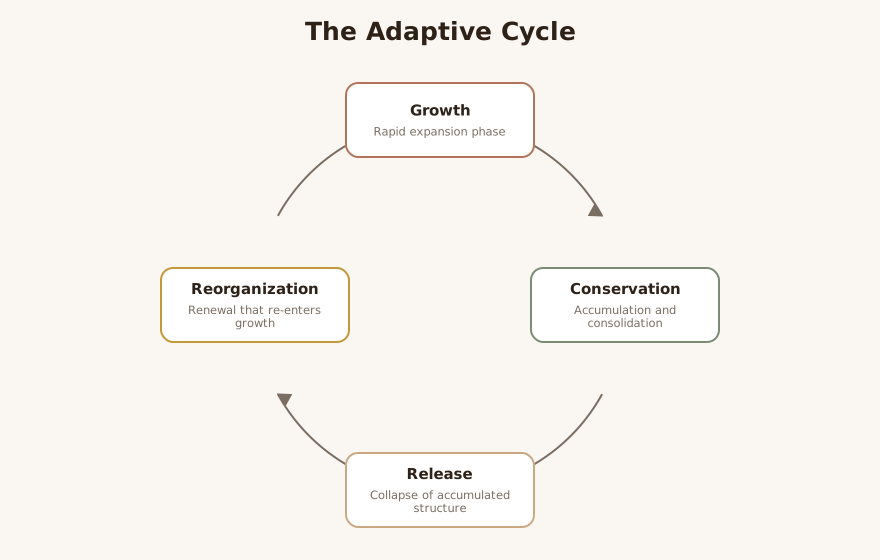
2. Systems move through an adaptive cycle. Rather than sitting at equilibrium, complex systems are typically in transient states 1. The adaptive cycle describes a recurring sequence of phases — rapid growth, accumulation and conservation, release or collapse, and reorganization — through which systems pass and re-pass 37.
3. Resilience varies across the cycle. Resilience is not constant. In the late conservation phase, a system that has become highly connected and rigid “may have little resilience,” so that a disturbance it can no longer absorb tips it into collapse 7.
4. Cycles are nested across scales (panarchy). A given adaptive cycle is embedded in larger, slower cycles above it and faster, smaller cycles below it; influence travels both downward and upward, because self-organized smaller scales also shape larger ones 74. Panarchy is the term for this cross-scale, dynamically organized structure 75.
Interventions & Techniques
Resilience theory is a conceptual framework, not a manualized treatment, so there are no “techniques” intrinsic to it; what follows describes how clinicians apply it as a lens inside established therapies LLM. First, it offers a mapping or formulation move: locating where a client, family, or community currently sits in the cycle — building, consolidated and rigid, in collapse, or reorganizing — to normalize the phase and clarify what kind of help fits it LLM. The systems insight that the late, over-connected phase carries little resilience can be translated into attention to rigidity, over-commitment, and brittle routines before collapse arrives 7.
Second, it reframes collapse as a phase rather than an endpoint, since in the ecological model release is followed by reorganization and renewal 3. Clinically this can support meaning-making after loss without minimizing pain LLM. Third, panarchy’s cross-scale view directs attention to resources at other levels — family, workplace, community, culture — that can either destabilize a person or scaffold their recovery 4LLM. These applications layer onto existing modalities; they do not replace them LLM.
LLM-generated illustrative example (not a guideline): With a client who has just lost a long-held job, a clinician might use the cycle as a shared map — naming the prior “conservation” phase (a stable but increasingly rigid role) and the current “release” phase (disorientation and grief) — to make space for the idea that reorganization, though not yet visible, is part of the pattern. The framework supplies the metaphor; the therapeutic work still happens through the host modality LLM.
Evidence Base
Honesty about maturity requires distinguishing two questions. As ecological theory, resilience, the adaptive cycle, and panarchy are well established: they are foundational concepts in socio-ecological systems science, anchored in Holling’s widely cited 1973 paper and developed over five decades 12. A 2022 review of how panarchy has been used across disciplines found that the adaptive cycle is the feature that has attracted the most attention, while also noting that challenges remain in empirically grounding the metaphor 6.
As a clinical or psychotherapeutic intervention, resilience theory in this specific systems form has no established evidence base LLM. There is no body of randomized trials testing “adaptive-cycle therapy,” because no such standardized treatment exists LLM. The robust clinical evidence concerns developmental and protective-factor resilience — a related but distinct literature — and even that supports resilience as a construct and target, not the panarchy framework as a manualized method LLM. Clinicians should therefore present the adaptive cycle to clients as a useful way of thinking, not as an evidence-based treatment LLM.
Populations & Indications
Because it is a systems lens, the framework is most naturally applied where dynamics span individuals and their wider contexts LLM. It maps readily onto communities recovering from disaster or trauma, where collapse-and-reorganization language fits collective experience, and the panarchy idea of nested scales matches the reality that neighborhood recovery is shaped by regional and national systems 4LLM. It suits work with families and family systems and with organizations and teams, both of which visibly move through growth, consolidation, crisis, and renewal LLM.
It can orient work with at-risk youth and populations facing chronic adversity, connecting to the developmental-resilience tradition’s focus on protective factors across levels LLM. With Indigenous and marginalized communities, the cross-scale framing can help name how larger structural forces bear on local adaptive capacity — though, as noted below, this must be done with care and in partnership rather than imposed LLM.
Problems-for-Work
The framework is a way of organizing work on familiar clinical problems, not a stand-alone treatment for any of them LLM.
- Crisis and instability / adjustment disorder: Locating a client in a “release” phase can normalize acute disruption and frame the task as supporting reorganization rather than forcing premature return to the prior state LLM.
- Loss and disruption / demoralization: The cycle’s renewal phase offers language for the possibility of restructuring after a collapse, which can counter hopelessness without denying grief 3LLM.
- Burnout: The systems observation that an over-connected, rigid late-conservation phase loses resilience can illuminate how sustained over-commitment precedes collapse, motivating earlier slack and flexibility 7LLM.
- Collective and community trauma: Panarchy’s nested scales help a clinician and community partners see how individual recovery depends on family, institutional, and cultural levels 4LLM.
- Stress and coping difficulties / post-traumatic stress disorder: The framework can complement trauma-focused, evidence-based treatment by situating symptoms within a phase and a wider system, but it does not substitute for that treatment LLM.
Contraindications, Cautions & Cultural Humility
The chief caution is category error: presenting an ecological metaphor as if it were a validated clinical method LLM. Because the systems version of resilience theory has no clinical evidence base, it should never displace established treatments for conditions such as post-traumatic stress disorder LLM. A second risk is toxic positivity — framing collapse as merely a prelude to growth in a way that minimizes suffering or implies the client should already be “reorganizing” LLM. Holling’s own distinction guards against this: resilience is about persistence through disturbance, which can be painful and prolonged, not about quick, tidy recovery 1.
A third risk is individualizing structural harm. Calling for more personal resilience can quietly blame people for systems failures around them; the panarchy view actually points the other way, toward cross-scale and structural forces 4LLM. This matters most with marginalized and Indigenous communities, where resilience language has sometimes been used to shift responsibility onto those least resourced LLM. Cultural humility means defining adaptive success collaboratively, honoring community and Indigenous knowledge about renewal, and not assuming a single healthy “equilibrium” exists LLM.
Treatment-Plan Suggestions & SMART Objectives
The framework supplies formulation language; the measurable objectives below are still delivered through established, evidence-based modalities LLM.
| Goal | SMART objective (example) | Mechanism |
|---|---|---|
| Make sense of an acute disruption | Within 4 sessions, client will describe their current situation using a shared phase map (growth / consolidation / collapse / renewal) and identify one current phase | Cognitive reframing and shared formulation reduce disorientation LLM |
| Reduce brittleness preceding burnout | Over 6 weeks, client will identify and modify two rigid, over-committed routines, building in measurable slack | Targets the low-resilience, over-connected late phase described in systems theory 7 |
| Counter demoralization after loss | Within 8 sessions, client will articulate two concrete signs of beginning reorganization in their life | Renewal framing mobilizes hope and behavioral activation 3LLM |
| Mobilize cross-scale supports | Within 30 days, client will map and contact two resources at family, work, or community level | Panarchy view surfaces protective factors at other scales 4LLM |
| Strengthen coping under chronic adversity | Over 8 weeks, client will practice and log one new coping skill weekly, rating perceived absorptive capacity | Builds capacity to absorb disturbance and still persist 1LLM |
| Support collective recovery | Within one quarter, family/team will hold three facilitated meetings to define shared markers of renewal | Aligns a system around a renewal phase rather than the lost prior state LLM |
| Reduce premature pressure to “bounce back” | By session 6, client will distinguish persistence-through-change from quick return-to-normal in their own goals | Corrects the resilience-as-instant-recovery misconception 1LLM |
Common Misconceptions
“Resilience means bouncing back unchanged.” This is the most common error and the one Holling’s work directly refutes: resilience is the persistence of essential relationships while absorbing change, not a rapid return to a prior equilibrium — that latter property he named stability, which is something different 1. In the adaptive cycle, what follows collapse is reorganization and renewal, which can mean genuine transformation rather than restoration of the old state 3LLM.
“Resilience is a fixed trait you either have or lack.” In the systems view resilience varies over time and phase; a system in late consolidation can become rigid and low in resilience even after a long stretch of apparent strength 7.
“More resilience is always better, at every level.” Panarchy emphasizes interactions across scales, so resilience at one level can come at the cost of another; the framework resists the idea of a single optimum 4LLM.
“The adaptive cycle is a proven clinical model.” It is a well-established ecological concept whose application to human systems remains, even within ecology, an incompletely grounded metaphor — and in therapy it is a borrowed lens, not a validated treatment 6LLM.
Training & Certification
There is no credentialing body, certification, or licensure pathway for resilience theory as a psychotherapy, because the systems version of the framework is a conceptual lens rather than a manualized modality LLM. Clinicians who want to use it well should instead learn it as theory: Holling’s 1973 paper for the original resilience-versus-stability distinction, and the Resilience Alliance and educational explainers for the adaptive cycle and panarchy 1347. Competence in actually helping clients still comes from training in established, evidence-based modalities into which this lens is integrated LLM. Clinicians seeking a clinically validated resilience framework should look to the developmental-resilience and protective-factors literature rather than to ecological panarchy LLM.
Key Terms
- Resilience: The property that determines persistence of a system’s relationships and its ability to absorb change and still persist 1.
- Stability: The ability to return to an equilibrium state after disturbance, measured by speed and smallness of fluctuation — distinct from resilience 1.
- Adaptive cycle: The recurring sequence of growth, conservation, release, and reorganization through which complex systems move 37.
- Release / collapse phase: The point at which a system meets a disturbance it cannot absorb 7.
- Reorganization / renewal phase: The post-collapse phase of restructuring and innovation 3.
- Panarchy: A model of nested adaptive cycles dynamically organized across scales of space and time, with influence flowing both up and down 745.
- Cross-scale interaction: The way smaller-faster and larger-slower cycles influence one another’s resilience 47.
Resources & Further Reading
▶ Watch — a video introduction to this concept:
- Holling, C.S. (1973). Resilience and Stability of Ecological Systems (PDF)
- Resilience and Stability of Ecological Systems — Annual Reviews landing page
- Resilience Alliance — The Adaptive Cycle
- Resilience Alliance — Panarchy
- Allen et al. — Panarchy: Theory and Application (preprint)
- Panarchy: ripples of a boundary concept — Ecology & Society (2022)
- What is Panarchy (and the Adaptive Cycle)? — University of Nebraska PASSEL
Reflective / Supervision Questions
- When I use “resilience” with a client, do I mean persistence-through-change or quick return-to-normal — and have I made that distinction explicit, as Holling did 1? LLM
- Where in the adaptive cycle does this client, family, or system seem to be, and does my treatment plan fit that phase rather than fight it 3? LLM
- Am I attending to cross-scale forces — family, workplace, community, structural — or am I quietly individualizing problems that live at larger scales 4? LLM
- Have I been clear with myself and the client that this is a thinking tool layered onto an evidence-based modality, not a validated treatment in its own right LLM?
- Could my use of resilience language be minimizing suffering or shifting responsibility onto an under-resourced client or community, and how would I know LLM?