
Type & Discipline
Polyvagal Theory is a theory in affective neuroscience and psychophysiology, not a manualized treatment — a proposed model of how the autonomic nervous system, and the vagus nerve in particular, organizes emotion, social connection, and defense.12 It is most usefully held by clinicians as a conceptual lens for trauma and dysregulation rather than as a validated mechanism of action, because several of its specific anatomical and evolutionary claims are genuinely contested in the scientific literature.28 LLM Its single most clinically generative idea is that human beings continuously and unconsciously scan for cues of safety and threat, and that physiological state — not just cognition — gates a person’s capacity to think, relate, and heal.14 LLM
Creators & Lineage
The theory was introduced by Stephen Porges in 1994 and elaborated across decades, most fully in his 2011 book The Polyvagal Theory.7 It grew out of affective neuroscience, stress and trauma physiology, and attachment theory, and is frequently paired with the trauma-treatment tradition (it has shaped how clinicians describe what happens in EMDR, somatic therapies, and attachment-based work).26 LLM Its translation into everyday clinical practice owes much to Deb Dana, whose “polyvagal-informed therapy” turned Porges’s neurophysiology into accessible tools — the autonomic “ladder,” state-mapping, and glimmers of safety.4 LLM Porges also developed the Safe and Sound Protocol (SSP), a listening intervention marketed as an “acoustic vagal nerve stimulator”; clinicians should note he holds patent rights and receives royalties from its commercialization, a relevant disclosure when weighing the evidence.1 LLM
Core Principles
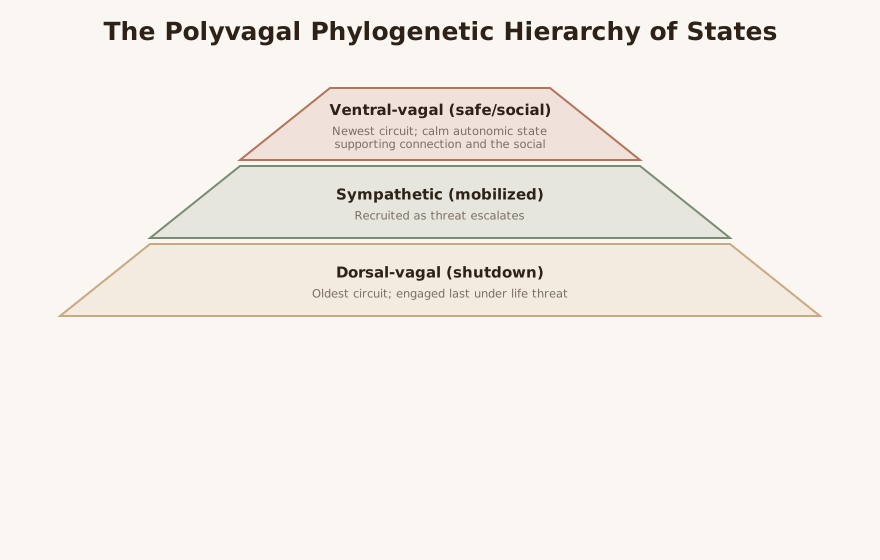
- A phylogenetic hierarchy of three autonomic states. The theory proposes three neural circuits that emerged in evolutionary sequence and are recruited in reverse order under threat.14
- Neuroception. A “neural process, distinct from perception, capable of distinguishing environmental and visceral features that are safe, dangerous, or life-threatening” — below conscious awareness.1
- Co-regulation. Nervous systems regulate one another; another person’s calm face, prosodic voice, and presence can shift our own state toward safety.14
- The Social Engagement System. A linked set of pathways (heart, face, voice, middle-ear muscles) that broadcasts and reads “cues of safety,” anchored in the brainstem nucleus ambiguus.1
- Safety as the precondition for connection and healing. A “calm autonomic state regulated by the ventral vagal pathway” is framed as the platform for higher cognition, trust, and recovery.1 LLM
The three states
The model’s clinical workhorse is its description of three autonomic states, organized as an evolutionary hierarchy and engaged in order from newest to oldest as threat escalates.14
| State | Circuit | Subjective experience | Function |
|---|---|---|---|
| Ventral vagal (safe/social) | Myelinated vagus, nucleus ambiguus | Calm, present, connected, curious | Social engagement, “health, growth, and restoration”1 |
| Sympathetic (mobilized) | Sympathetic nervous system | Anxious, activated, fight-or-flight | Mobilization to meet danger14 |
| Dorsal vagal (shutdown) | Unmyelinated vagus, dorsal motor nucleus | Numb, collapsed, dissociated, hopeless | Immobilization, “metabolic conservation”14 |
The newest circuit (ventral vagal) supports the “vagal brake” that constrains defensive arousal when we feel safe; when neuroception detects danger, the brake releases and the system steps down the hierarchy — first to sympathetic mobilization, and, under overwhelming life-threat, to dorsal-vagal shutdown.14 LLM This “step-down under threat” framing gives clinicians a shared vocabulary for the difference between a hyperaroused, panicky client and a collapsed, dissociated one — and for why the two need different in-session responses.26 LLM
Neuroception and co-regulation
Neuroception is the theory’s most clinically useful single construct: the idea that the nervous system continuously evaluates safety and threat “often outside of conscious awareness,” using both top-down (cortical) and bottom-up (interoceptive) information.14 It explains why a trauma survivor can know intellectually that they are safe and still feel, in the body, that they are not.6 LLM Co-regulation is the corollary: one person’s Social Engagement System — facial expression, vocal prosody — can transmit cues that trigger a neuroception of safety in another, producing “reciprocal calming.”1 For clinicians, this reframes the therapeutic relationship itself as a physiological intervention, not merely a delivery vehicle for technique.4 LLM
Interventions & Techniques
Polyvagal Theory is not a therapy with its own protocol; it is a framework that informs how clinicians work, and a cluster of derived practices.24 LLM In session, “polyvagal-informed” practice typically includes:
- Psychoeducation and state-mapping. Teaching the three states and helping a client build a personal “map” of their own ventral/sympathetic/dorsal triggers and “glimmers” (micro-cues of safety).4 LLM
- Cuing safety / bottom-up regulation. Deliberately using a regulated therapist presence, prosodic voice, soft eye contact, pacing, and a predictable frame to shift neuroception toward safety before doing harder processing work.12 LLM
- Breath and rhythm practices. Slow, extended-exhale breathing and rhythmic activities are framed as stimulating vagal afferents and supporting parasympathetic tone.2
- HRV biofeedback. Training awareness of respiratory–cardiac coupling (respiratory sinus arrhythmia, RSA) as an index of regulation.2
- The Safe and Sound Protocol (SSP) and acoustic interventions. Prosodic, filtered-music listening protocols proposed to engage middle-ear muscles and ventral-vagal pathways.12
- Polyvagal-informed trauma work. Sequencing — establishing felt safety and ventral-vagal access before trauma memory processing — is the most common way the theory is layered onto EMDR, somatic, and attachment-based therapies.26 LLM
LLM-generated illustrative example (not a guideline): A clinician notices a client’s voice flatten and gaze drop mid-session (a likely dorsal-vagal slide), pauses the trauma narrative, lowers and warms their own voice, invites the client to feel their feet on the floor and look around the room, and only resumes processing once the client reports feeling “back in the room.” LLM
Evidence Base
This is where honesty matters most. Polyvagal Theory is clinically influential but scientifically contested, and clinicians should not present it to clients as settled neuroscience.28 LLM Proponents argue the theory has generated “explicit, falsifiable predictions” tested in trauma studies, developmental psychobiology, and behavioral neuroscience, and point to associations between vagal tone (RSA) and emotion regulation.2 But several of its load-bearing claims have drawn sustained, substantive critique from psychophysiologists and neuroanatomists.8
Key disputes a clinician should know:8
- Evolutionary/anatomical claims. Critics including Paul Grossman and Edwin Taylor argue there is no good evidence that the dorsal motor nucleus is evolutionarily “more primitive” than the nucleus ambiguus, and comparative work (e.g., myelinated vagal fibers found in lungfish) challenges the claim that a myelinated cardioinhibitory vagus is uniquely mammalian.8
- RSA as a vagal-tone measure. Grossman concludes that RSA is not a clean, direct index of cardiac vagal tone, undercutting a key empirical pillar.8
- Falsifiability and consensus. Grossman’s 2023 review states there is “broad consensus among experts” that “each basic physiological assumption of the polyvagal theory is untenable,” and the Wikipedia overview classifies the theory under “popular psychology” and even “pseudoscience.”8
- Porges’s rebuttal. Porges (2022–2025) characterizes the critiques as misrepresentations, distinguishes myelinated from unmyelinated pathways, and maintains the core constructs are “empirically grounded hypotheses,” not metaphors.12
The pragmatic clinical reading: the broad clinical heuristics — that physiological state shapes behavior, that safety cues and co-regulation matter, that hyperarousal and shutdown are different and need different responses — are useful and largely uncontroversial as clinical framing.24 LLM The specific evolutionary and neuroanatomical mechanisms are disputed and should be held loosely. Treat the maturity level as emerging and contested, and let outcomes — not the theory’s elegance — drive your practice.28 LLM
Populations & Indications
The framework is applied most where autonomic dysregulation is central to the presentation.2 LLM It is widely used with survivors of trauma and people with PTSD, where the model reframes symptoms as a “retuned autonomic nervous system locked into states of defense” rather than as character pathology.16 It is invoked for anxiety and panic disorder (sympathetic mobilization), dissociation (dorsal-vagal shutdown), and emotional dysregulation and hypervigilance more broadly.26 LLM Developmentally, it is applied to children with early adversity and attachment disruption, and it is extended to people with chronic illness and functional conditions (e.g., chronic pain, IBS, fibromyalgia) where the review literature links symptoms to “loss of vagal inhibition.”2 Finally, it speaks directly to clinicians: their own regulated nervous system is treated as part of the intervention.14 LLM
Problems-for-Work
- PTSD / complex trauma. Map the client’s defensive states and prioritize felt safety and co-regulation before and during memory processing.16 LLM
- Dissociation. Recognize the dorsal-vagal “collapse” pattern and respond with orienting, grounding, and gentle re-engagement rather than more cognitive demand.46 LLM
- Panic & anxiety disorders. Frame sympathetic mobilization as a protective state and use breath, rhythm, and safety cues to support the vagal brake.24 LLM
- Hypervigilance. Name the neuroception of threat that persists despite objective safety, and work to recalibrate it through repeated experiences of safety.6 LLM
- Emotional dysregulation / chronic stress. Use state-mapping and HRV-informed practices to widen the window in which the client can stay socially engaged.2 LLM
LLM-generated illustrative example (not a guideline): A client with panic disorder learns to label early sympathetic cues (“my chest is bracing — this is mobilization, my body trying to protect me”), which reduces the secondary fear-of-fear, paired with a slow extended-exhale practice to support down-regulation. LLM
Contraindications, Cautions & Cultural Humility
The first caution is epistemic honesty: do not overstate the science.28 LLM Presenting polyvagal mechanisms as established fact risks misleading clients and colleagues, given the active expert dispute over its core assumptions.8 LLM A second risk is physiological determinism — reducing a person to their “state” in a way that bypasses meaning, context, relationship, and structural realities (poverty, racism, ongoing danger); a client may be in a “defensive state” because their environment is genuinely unsafe, and the work is then advocacy and safety, not down-regulation.2 LLM Third, the language of “safety” and a calm, prosodic therapist presence is culturally shaped: cues that read as safe in one cultural or neurodivergent context (eye contact, vocal warmth, touch) may not in another, so calibrate rather than assume.1 LLM Finally, weigh the commercial conflict of interest around SSP and similar products when recommending them, and avoid implying that any acoustic device is a proven treatment.1 LLM
Treatment-Plan Suggestions & SMART Objectives
| Goal | SMART objective (example) | Mechanism |
|---|---|---|
| Build interoceptive awareness of state | Over 6 weeks, client identifies and logs their ventral/sympathetic/dorsal state ≥1×/day, reviewed weekly | Neuroception made conscious; state-mapping4 |
| Expand access to ventral-vagal (felt safety) | Within 8 weeks, client names 3 reliable personal “glimmers” and uses one daily, rating felt safety 0–10 | Cuing safety; vagal brake4 |
| Reduce panic via down-regulation skills | For 4 weeks, client practices a slow extended-exhale breath ≥5 days/week and applies it at first sympathetic cue, logged | Vagal/parasympathetic support2 |
| Interrupt dissociative shutdown | Over 8 weeks, client uses an orienting/grounding sequence within 2 min of noticing dorsal-vagal cues, ≥3×/week | Re-engaging ventral vagal from immobilization46 |
| Strengthen co-regulation in relationships | Within 10 weeks, client initiates 1 co-regulating contact (call, in-person) when dysregulated, ≥2×/week | Co-regulation via Social Engagement System1 |
| Improve regulation index (optional, if HRV available) | Over 8 weeks, client completes HRV-biofeedback practice 3×/week and tracks change | RSA / respiratory–cardiac coupling2 |
| Reframe trauma symptoms adaptively | By session 6, client can describe ≥2 symptoms as protective autonomic states rather than personal failings | Reappraisal of “states of defense”16 |
Illustrative; integrate with an evidence-based modality and validated measures (e.g., PCL-5, GAD-7). LLM
Common Misconceptions
- “Polyvagal Theory is established neuroscience.” Its broad clinical heuristics are useful, but several core anatomical and evolutionary claims are actively disputed by experts.28 LLM
- “The dorsal-vagal state is the ‘reptilian’ brain shutting down.” This evolutionary framing is exactly what critics challenge; use the clinical description (shutdown/collapse) without asserting the contested phylogeny.8 LLM
- “You can just choose to be in ventral vagal.” State is shaped by neuroception below conscious control; “intentional self-regulation efforts originating in the cortex are frequently ineffective” against survival-driven reactions, which is why bottom-up safety cues matter.1 LLM
- “It replaces evidence-based trauma treatment.” It is best used to inform and sequence established treatments, not to substitute for them.26 LLM
- “The Safe and Sound Protocol is a proven cure.” It is a commercial intervention with a disclosed conflict of interest and a still-emerging evidence base.1 LLM
Training & Certification
There is no licensure in “polyvagal therapy”; it is applied within whatever evidence-based modality the clinician already practices.4 LLM The Polyvagal Institute offers courses and resources, and Deb Dana’s trainings and books are the most widely used route into clinical application (state-mapping, the autonomic ladder).4 LLM Delivery of the Safe and Sound Protocol requires provider registration through its commercial distributor.1 LLM Clinicians should pair any polyvagal training with solid grounding in a recognized trauma treatment and with critical literacy about the theory’s contested status.28 LLM
Key Terms
- Neuroception — the nervous system’s automatic, below-awareness detection of safety, danger, or life-threat.1
- Ventral vagal state — the calm, socially engaged state supported by the myelinated vagus and the “vagal brake.”14
- Dorsal vagal state — immobilization/shutdown, “a strategy of metabolic conservation.”4
- Co-regulation — physiological calming transmitted between nervous systems via social cues.1
- Social Engagement System — the linked face–voice–heart–ear pathways that send and read cues of safety.1
- Vagal brake — ventral-vagal restraint of defensive arousal during safety.1
- Vagal efficiency / RSA — proposed indices of autonomic regulation, themselves methodologically contested.28
Resources & Further Reading
▶ Watch — a video introduction to this concept:
Primary & academic - Polyvagal Theory: A Science of Safety — Porges (2022, Frontiers) - Polyvagal Theory: Current Status, Clinical Applications, and Future Directions (2025, PMC) - Polyvagal theory: from physiological observation to neural innervation and clinical insight (2025, Frontiers) - The Polyvagal Theory — Porges (2011, book)
Clinical & explainer - What is Polyvagal Theory? — Polyvagal Institute - Polyvagal Theory: An Approach to Understanding Trauma — Psychology Today - Polyvagal Theory Explained — Simply Psychology
Critical perspective - Polyvagal theory — Wikipedia (includes scientific criticism)
Video - Dr. Stephen Porges: What is the Polyvagal Theory
Related wiki articles: EMDR · Cognitive Processing Therapy · Attachment-Based Family Therapy. Explore in the graph: attachment · or filter by PTSD and Dissociation.
Reflective / Supervision Questions
- When I use polyvagal language with a client, am I being honest about what is established science versus a useful metaphor — and would I say the same thing to a skeptical colleague?
- Is this client’s “defensive state” a dysregulation to soothe, or an accurate read of an environment that is genuinely unsafe and needs to change?
- How does my own nervous system state in the room shape the client’s — and what helps me stay regulated enough to co-regulate?
- Where might my assumptions about what feels “safe” (eye contact, tone, pacing) not fit this client’s cultural or neurodivergent reality?