
Type & Discipline
Mindsight is best classified as a construct — a named human capacity — rather than a discrete therapy or a single technique LLM. Daniel Siegel coined the word to describe “our human capacity to perceive the mind of the self and others,” and, crucially, to monitor and modify the flow of energy and information within the mind 1. It sits at the intersection of clinical neuroscience and contemplative practice, and is the operational skill at the heart of interpersonal neurobiology (IPNB), Siegel’s interdisciplinary framework that synthesizes findings across psychology, attachment research, and the brain sciences 6. For practicing clinicians, the most useful framing is functional: mindsight is the trainable perceptual skill that mindfulness, mentalization, and attachment-focused work all rely on, named and articulated as a single target LLM.
A point worth flagging up front for those searching the literature: the term “mindsight” also appears in an unrelated neurology context — diagnostics for awareness in disorders of consciousness (coma, vegetative, and minimally conscious states) 7. That usage has nothing to do with Siegel’s construct, and the two literatures should not be conflated LLM.
Creators & Lineage
Mindsight is associated almost entirely with one figure: Daniel J. Siegel, a clinical professor of psychiatry at UCLA and the executive director of the Mindsight Institute 6. He developed the concept across his clinical and academic work and gave it its fullest popular articulation in his 2010 book Mindsight: The New Science of Personal Transformation 2. Siegel reports having coined the term in the 1990s to capture something his patients seemed to lack or to be developing — the ability to see and shape the mind itself 3.
The construct’s lineage is explicitly integrative LLM. It draws on attachment theory, in that secure attachment relationships are understood to cultivate the reflective capacities mindsight names 6. It overlaps heavily with mentalization (the ability to understand behavior in terms of underlying mental states) as developed in mentalization-based treatment, and with mindfulness-based interventions, from which it borrows the disciplined, nonjudgmental attention to present-moment internal experience LLM. Siegel’s broader contribution, interpersonal neurobiology, is the umbrella under which these threads are woven, with mindsight as the practical, teachable skill the whole framework aims to strengthen 6.
Core Principles
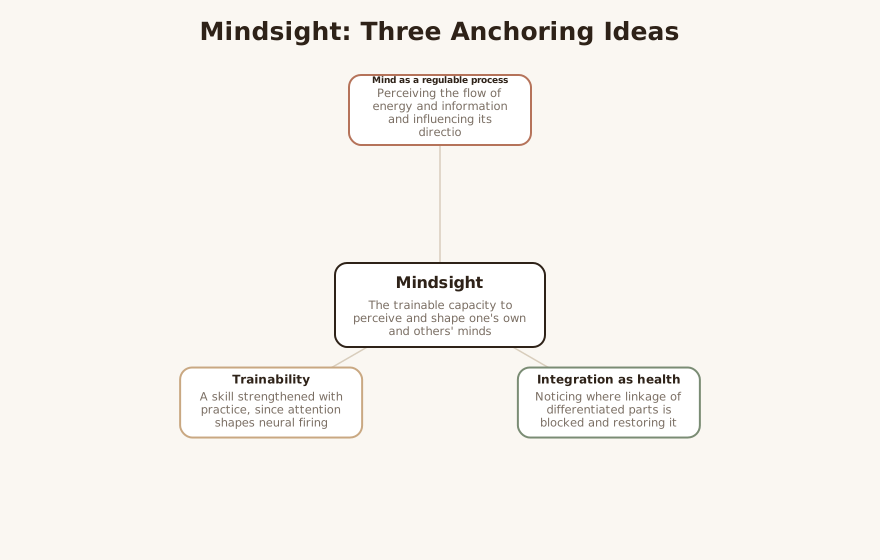
Three ideas anchor the construct LLM.
Mind as a regulable process. Siegel defines the mind, in part, as an embodied and relational process that regulates the flow of energy and information 6. Mindsight is the capacity to perceive that flow and to influence its direction — not merely to observe thoughts and feelings but to shift them 1.
Integration as the goal of health. In IPNB, well-being arises from integration: the linkage of differentiated parts of a system 6. Mindsight is the means by which a person notices where integration is impaired (e.g., a hijacked emotional state cut off from reflective thought) and works to restore it LLM. Siegel frames many forms of distress as states of chaos or rigidity that signal blocked integration 6.
Trainability and neuroplasticity. Mindsight is not a fixed trait; it is a skill that can be strengthened with practice, on the premise that focused attention shapes neural firing and, over time, neural structure 3. This is the principle that makes the construct clinically actionable — it implies that therapy can deliberately build the capacity rather than merely describe its absence LLM.
The capacity is often summarized as having three facets: insight (perceiving one’s own mind), empathy (perceiving the minds of others), and integration (linking and harmonizing those perceptions into regulated, coherent functioning) 3.
Interventions & Techniques
Because mindsight is a capacity rather than a manualized protocol, its “interventions” are the practices Siegel and others use to cultivate it LLM. Several have become widely taught.
Name it to tame it. Putting feelings into words — labeling an emotional state — helps soothe and regulate it, drawing the reflective, language-based circuitry of the brain into contact with raw affect 5. Siegel offers this as a simple, portable regulation tool, particularly with children and parents 5.
The hand model of the brain. Siegel’s well-known psychoeducational gesture — the fist as a brain, with the thumb tucked as the limbic regions and the fingers as the cortex — illustrates how, under stress, a person can “flip their lid,” losing top-down regulation LLM. It gives clients a concrete, shareable image of dysregulation and recovery LLM.
Reflective attention practices. Mindsight is trained through focused-attention and open-awareness exercises that have clients observe sensations, images, feelings, and thoughts without being swept away by them — practices closely related to mindfulness meditation 3. The aim is to widen the gap between experiencing a state and being able to describe it LLM.
Attuned therapeutic presence. The clinician’s own attuned, present, regulated stance is itself an intervention: secure, contingent relating is understood to grow the client’s reflective capacity, mirroring how caregiving builds it in development 6.
LLM-generated illustrative example (not a guideline): A client who “goes blank” during conflict practices, in session, narrating the bodily build-up before the shutdown — “tight chest, then heat, then nothing.” Over weeks, naming the sequence (name it to tame it) restores a sliver of reflective space before the freeze, which the dyad then uses to try a different response. LLM
Evidence Base
Honesty matters here. Although the maturity label is established — meaning the construct is mature, widely disseminated, and clinically influential — its evidence profile is uneven and should be represented carefully to clients and colleagues LLM.
The construct itself is a synthesis: Siegel integrates existing science rather than reporting a novel randomized trial of “mindsight” as a discrete, measurable variable 6. The provided source base for the construct is composed almost entirely of Siegel’s own teaching materials, a trade book, and secondary explainers, not independent controlled trials 123. There is, in this source set, no randomized controlled evidence that “mindsight” as a unitary capacity produces specific outcomes LLM.
What is better supported is the family of component skills the construct names and assembles — mindfulness-based attention training and mentalization-focused work each carry their own independent literatures developed outside Siegel’s framework LLM. The defensible clinical claim is therefore that mindsight is a clinically generative organizing idea grounded in interpersonal neurobiology, whose constituent practices have stronger empirical footing than the umbrella term does LLM. The unrelated “mindsight” of consciousness diagnostics should not be cited as support for the psychotherapeutic construct, despite sharing the word 7.
Populations & Indications
Mindsight is presented as broadly applicable across the lifespan, which is both its appeal and a reason for caution about overclaiming LLM. It has been applied with adults in psychotherapy seeking greater self-awareness and regulation 2, and extensively with children and adolescents and the parents and caregivers who support them, where concrete tools like name-it-to-tame-it and the hand model translate well 5.
It is frequently framed for couples and relational work, since the empathy facet directly targets perceiving a partner’s mind, and for individuals with attachment difficulties, given the construct’s roots in attachment research 6. Trauma survivors are a named population, with the integration framing offering a way to understand dissociation and dysregulation as blocked linkage between bodily, emotional, and reflective systems LLM. Across these groups, the through-line is the same: people whose difficulties involve perceiving and steering internal states LLM.
Problems-for-Work
Mindsight maps cleanly onto several recurring problems-for-work, used as a lens within a broader treatment plan LLM.
- Emotional dysregulation and impulsivity — building the capacity to notice an arousal state before acting on it; name-it-to-tame-it is the prototypical application 5.
- Low self-awareness — the insight facet is, almost by definition, the direct target 3.
- Difficulty with empathy and relationship conflict — the empathy facet supports perceiving a partner’s or child’s internal state rather than reacting only to behavior 6.
- Insecure attachment and interpersonal difficulties — strengthening reflective function within a secure therapeutic relationship 6.
- PTSD, anxiety, and chronic stress — reframing symptoms as states of chaos or rigidity reflecting impaired integration, then using attention practices to restore regulated, flexible functioning 6.
LLM-generated illustrative example (not a guideline): For a parent presenting with reactive anger toward a defiant child, the hand-model metaphor reframes their outbursts as “flipping the lid,” and brief reflective pauses are rehearsed so the parent can re-engage the cortex before responding — targeting both impulsivity and relationship conflict. LLM
Contraindications, Cautions & Cultural Humility
There are no formal “contraindications” to a capacity, but there are real cautions about how it is taught LLM. Intensive interoceptive and reflective attention can be destabilizing for some trauma survivors and for people with acute psychosis or severe dissociation; pacing, titration, and grounding should precede deep internal monitoring LLM. The “trainability” message must not curdle into the implication that a struggling client simply isn’t trying hard enough to regulate — a subtle form of blame the warm, optimistic framing can inadvertently invite LLM.
Clinicians should also hold the brain-based language lightly. The neuroscience framing is genuinely engaging, but much of the popular presentation is metaphorical and aspirational rather than a literal account of validated mechanisms, and it should not be presented to clients as settled fact LLM. Culturally, the construct’s individualistic, interiorized model of “seeing your own mind” reflects particular assumptions about selfhood; concepts of mind, emotion expression, and the appropriateness of introspection vary across cultures, and the practices should be adapted, not imposed LLM. Finally, because most accessible material originates from a single author and his institute, practitioners should seek the independent evidence behind the component skills rather than treating the framework as self-validating LLM.
Treatment-Plan Suggestions & SMART Objectives
| Goal | SMART objective (example) | Mechanism |
|---|---|---|
| Increase self-awareness | Client will name a specific emotion and its bodily signal in 4 of 5 sessions over 8 weeks | Insight facet; reflective attention to internal states 3 |
| Improve emotion regulation | Client will use a “name it to tame it” labeling step before responding in 3 logged conflict moments per week within 6 weeks | Linking affect to language-based regulation 5 |
| Reduce impulsive reactivity | Client will report inserting a deliberate pause before reacting in 60% of identified triggers by week 10 | Restoring top-down cortical regulation (“flipping the lid” recovery) LLM |
| Strengthen empathy in relationships | Client will articulate a partner’s likely internal state, distinct from their behavior, in 2 examples per week for 8 weeks | Empathy facet; perceiving another’s mind 6 |
| Build reflective attention | Client will complete a 5-minute focused-awareness practice 4 days/week and log noticed states for 6 weeks | Attention training shaping regulation capacity 3 |
| Increase integration under stress | Client will identify when functioning is “chaotic” or “rigid” and apply one grounding step in 3 of 4 stress episodes by week 12 | Integration framing; differentiation then linkage 6 |
| Support secure relating | Client will identify and describe one experience of attuned connection per week across 8 weeks | Attachment-based growth of reflective function 6 |
Common Misconceptions
“Mindsight is just mindfulness.” It overlaps with and uses mindfulness, but it explicitly extends attention to perceiving others’ minds (empathy) and to deliberately modifying states toward integration, not only observing them 13.
“It’s a brand-name therapy you can be certified to deliver as a protocol.” Mindsight is a capacity and an organizing construct; the clinical work happens through established practices that cultivate it, not through a single manualized procedure LLM.
“The neuroscience proves it works.” The construct is a synthesis of science used to motivate practice; the strongest evidence sits with the component skills, and much of the popular brain language is metaphor LLM.
“This ‘mindsight’ is the same as the medical-imaging term.” No — the consciousness-diagnostics literature uses the same word for an unrelated purpose 7.
Training & Certification
Training in mindsight is offered primarily through Daniel Siegel’s Mindsight Institute, alongside his books, lectures, and online courses for clinicians and the public 6. Mindsight (2010) functions as the foundational text, with accessible introductions available through Siegel’s talks and secondary explainers 24. There is no licensure or independent credentialing body that gates the use of the construct; clinicians integrate it within their existing scope and modality training LLM. Practitioners wanting rigor should pair Siegel’s materials with formal training in the better-validated component approaches — mindfulness-based interventions and mentalization-based treatment among them LLM.
Key Terms
- Mindsight — the capacity to perceive one’s own and others’ minds and to monitor and modify internal mental states 1.
- Integration — the linkage of differentiated parts of a system; the proposed basis of well-being in IPNB 6.
- Insight / empathy — the two perceptual facets of mindsight: seeing one’s own mind, and seeing others’ minds 3.
- Chaos and rigidity — the two poles of impaired integration that signal dysregulation 6.
- Name it to tame it — labeling an emotion to help regulate it 5.
- Flipping the lid — losing top-down cortical regulation under stress, illustrated by the hand model of the brain LLM.
- Interpersonal neurobiology (IPNB) — Siegel’s integrative framework within which mindsight is the central trainable skill 6.
Resources & Further Reading
▶ Watch — a video introduction to this concept:
- Mindsight — Dr. Dan Siegel (official site)
- Siegel, D. J. (2010). Mindsight: The New Science of Personal Transformation
- What is Mindsight? by Dr. Daniel Siegel — PsychAlive
- An Introduction to Mindsight by Daniel J. Siegel, M.D. (video)
- Dan Siegel: Name It to Tame It (video)
- Dan Siegel: Life, Mindsight, and Interpersonal Neurobiology — The Balance
- Mindsight: diagnostics in disorders of consciousness (PubMed — unrelated homonym)
Reflective / Supervision Questions
- Where in my caseload am I treating a deficit in perceiving internal states versus a deficit in regulating them — and does the distinction change my plan? LLM
- When I use the optimistic, “trainable capacity” framing, am I inadvertently implying that a struggling client just isn’t trying hard enough? LLM
- Which of the component skills (mindfulness, mentalization) am I actually delivering, and do I know their independent evidence rather than relying on the umbrella construct? LLM
- For this particular client, is intensive internal monitoring stabilizing or destabilizing, and have I sequenced grounding before reflection? LLM
- How well does an individualistic “see your own mind” model fit this client’s cultural framing of self, emotion, and introspection? LLM