
Type & Discipline
Cognitive Processing Therapy (CPT) is a structured, manualized, trauma-focused cognitive therapy for post-traumatic stress disorder, developed within clinical psychology and the broader cognitive-behavioral tradition.57 It is most commonly delivered as a fixed-length protocol of roughly 12 weekly sessions, individually or in groups, and can be conducted with or without a written trauma account.7 Within the family of evidence-based PTSD treatments, CPT sits alongside Prolonged Exposure as one of the two most widely disseminated individual trauma-focused therapies endorsed by major guideline bodies.56 Its defining feature is a cognitive emphasis: rather than treating the trauma memory primarily through repeated exposure, CPT targets the meanings a person has made of the event — the distorted beliefs that keep recovery from happening on its own.78
Creators & Lineage
CPT was developed by Patricia A. Resick in the late 1980s and first published in a 1992 study with Monica Schnicke, who applied it to female sexual assault survivors.3 The treatment was subsequently elaborated and disseminated with Candice M. Monson and Kathleen M. Chard, and the three authored the definitive second-edition therapist manual, Cognitive Processing Therapy for PTSD: A Comprehensive Manual.2 CPT draws its intellectual lineage from Beckian cognitive therapy and the wider cognitive-behavioral family, integrating that with a social-cognitive (information-processing) theory of PTSD: the idea that recovery stalls when trauma cannot be integrated with prior beliefs, producing distorted, over-generalized conclusions about oneself and the world.78 It emerged from the same trauma-treatment research program as Prolonged Exposure, with which it was directly compared in landmark trials, but it deliberately foregrounds cognition over exposure as the primary change mechanism.47 The original 1992 design was a quasi-experimental waitlist comparison, not a randomized trial; rigorous randomized evidence came later.34 LLM
Core Principles
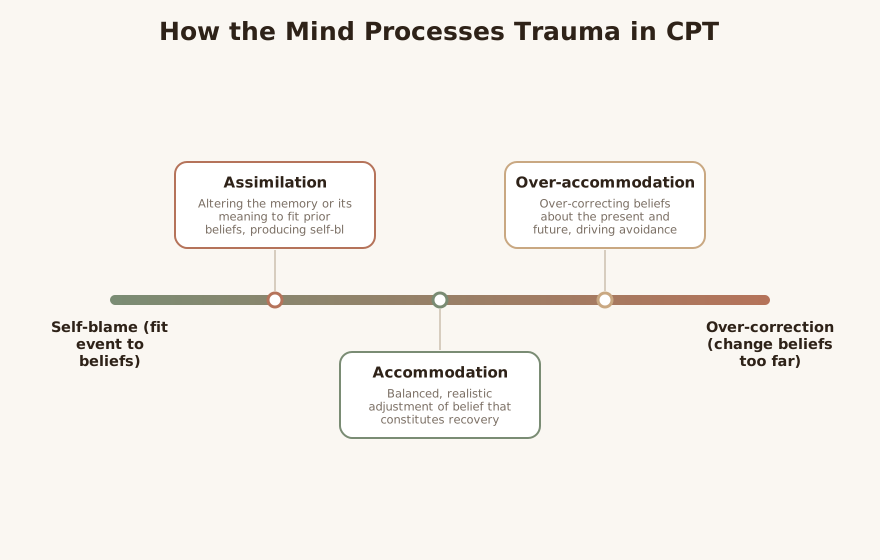
CPT rests on the premise that PTSD is maintained less by the trauma memory itself than by the stuck points — distorted, conflict-laden beliefs that block the natural processing of the event.78 When something terrible happens, the mind must reconcile it with prior assumptions about how the world works, and CPT describes three ways this can go wrong.7 LLM
- Assimilation — altering the memory or its meaning to fit prior beliefs, often producing self-blame and guilt (“If I had fought harder, it wouldn’t have happened”).7 LLM
- Over-accommodation — over-correcting one’s beliefs about the present and future (“No one can ever be trusted”; “The world is completely dangerous”), which drives avoidance and hypervigilance.7 LLM
- Accommodation — the balanced, realistic adjustment of belief that constitutes recovery (“Some people can be trusted; this was not my fault”).7 LLM
Stuck points cluster across five thematic domains that trauma commonly disrupts: safety, trust, power/control, esteem, and intimacy — applied both to the self and to others.17 CPT’s central therapeutic move is to help patients notice these beliefs, examine the evidence for and against them through guided questioning, and move from assimilated and over-accommodated conclusions toward balanced ones — a shift that, in turn, allows the natural emotions of the trauma to be felt and resolved rather than blocked by “manufactured” emotions like guilt and shame.78
Interventions & Techniques
CPT is delivered through a structured sequence of Socratic dialogue and standardized worksheets, completed both in session and as between-session practice assignments.27 The core toolkit includes the following.7
- Impact Statement — an early written account of why the patient believes the trauma happened and how it has changed their views of self, others, and the world; this surfaces the initial stuck points.7
- Socratic questioning — the therapist’s primary tool: gently asking questions that help the patient examine, rather than be told, where a belief is distorted.27
- ABC Sheets — connecting Activating events to Beliefs to Consequences (emotions and behaviors), teaching the cognitive model.7 LLM
- Challenging Questions Worksheet — a set of prompts (evidence, all-or-nothing thinking, source of the belief, etc.) applied to a single stuck point.7 LLM
- Patterns of Problematic Thinking — identifying habitual cognitive distortions across stuck points.7 LLM
- Challenging Beliefs Worksheets — the integrative worksheet combining the prior skills, used repeatedly across the five themes.7 LLM
- Trauma account (optional) — in the original “CPT+A” version, a written narrative of the index trauma; the now-common CPT without account (the protocol’s default in many settings) omits this and relies wholly on cognitive work.78
A typical course progresses from psychoeducation and the impact statement, through identifying and challenging assimilated stuck points (especially self-blame and guilt), to working through the five over-accommodated themes one by one, ending with a revised impact statement that documents the patient’s changed beliefs.27 LLM
Evidence Base
CPT’s evidence base is established and strong.56 It is a first-line, strongly recommended treatment in the major guidelines — the APA Clinical Practice Guideline for PTSD, the ISTSS treatment guidelines, and the VA/DoD clinical practice guideline — across a range of trauma populations.567 The pivotal randomized trial, Resick et al. (2002), compared CPT with Prolonged Exposure and a waiting condition in female rape survivors and found both active treatments markedly superior to waitlist, with CPT and PE broadly comparable in efficacy.4 Subsequent randomized trials have extended support to veterans, military service members, and other interpersonal-violence and trauma-exposed populations, including international and refugee samples.67
Honest read: CPT is one of the best-validated psychotherapies in all of mental health, with consistent guideline endorsement and decades of randomized data.56 The realistic caveats are practical, not foundational: dropout in trauma-focused work is non-trivial, a meaningful minority of patients retain residual symptoms, and head-to-head trials generally show CPT roughly equivalent to Prolonged Exposure rather than superior.47 LLM
Populations & Indications
CPT was first developed and tested with sexual assault survivors and has since become a workhorse treatment for PTSD in veterans and active-duty military service members, survivors of interpersonal and intimate-partner violence, and adults with PTSD from a wide range of index traumas.347 It has been studied and implemented internationally, including with refugees and other trauma-exposed populations, and is delivered in individual, group, and combined formats.67 Because its mechanism is cognitive, CPT is especially indicated when a patient’s distress is organized around distorted meanings — pervasive self-blame, guilt, shame, or sweeping conclusions about danger, trust, and worth — rather than around a circumscribed phobic avoidance of trauma reminders alone.78 LLM
Problems-for-Work
CPT’s natural targets are the trauma-related beliefs and symptoms it was built to dismantle.7 Representative problems, and how the model is applied to each, follow below.7
- PTSD — the primary indication; full-protocol CPT targeting stuck points across all five themes.45
- Trauma-related guilt and self-blame — challenged as assimilated stuck points early in treatment, using Socratic questioning to separate responsibility from hindsight.7 LLM
- Trauma-related shame — addressed through esteem-domain work, distinguishing the act done to the person from their worth.7 LLM
- Maladaptive beliefs about safety and trust — examined as over-accommodated conclusions (“nowhere is safe”; “no one can be trusted”) and rebalanced.7 LLM
- Moral injury — guilt and esteem stuck points arising from acts of commission, omission, or betrayal, common in military trauma, worked through the same evidence-examining process.7 LLM
- Complex PTSD — CPT is frequently used, with pacing and stabilization adjustments, though the evidence base is stronger for classic PTSD than for the full complex presentation.67 LLM
- Co-occurring depression and survivor guilt — often improve as trauma cognitions are rebalanced, though severe depression may need parallel attention.7 LLM
LLM-generated illustrative example (not a guideline): A combat veteran holds the stuck point “I should have saved my friend; his death is my fault.” On a Challenging Questions Worksheet the therapist helps him examine the evidence — the ambush conditions, the information he actually had, the difference between cause and blame — and over several sessions the assimilated belief shifts toward “I did what I could with what I knew; I am grieving, not guilty,” loosening the guilt that fueled his avoidance and insomnia. LLM
Contraindications, Cautions & Cultural Humility
CPT is broadly safe and well-tolerated, but several cautions apply.7 As a trauma-focused therapy, it asks patients to engage directly with painful material, and acute suicidality, active substance dependence requiring stabilization, current ongoing trauma (e.g., active domestic violence), or significant dissociation may call for stabilization or sequencing before or alongside the protocol.7 LLM Trauma-focused work carries a real dropout rate, and a brief, expected uptick in distress early in treatment should be normalized rather than treated as deterioration.7 LLM The cognitive emphasis assumes a patient can engage in abstract examination of beliefs; cognitive impairment or low literacy may require adaptation of the worksheets.7 LLM Cultural humility is essential when challenging beliefs: what looks like an “over-accommodated” conviction that “the world is dangerous” or “authorities cannot be trusted” may, for patients from marginalized or historically targeted communities, reflect accurate appraisal of real, ongoing risk rather than distortion — the therapist’s task is to help the patient calibrate belief to their reality, not to argue them out of justified vigilance.7 LLM Stuck points around honor, shame, family, and gender are also culturally shaped and must be explored from the patient’s frame.8 LLM
Treatment-Plan Suggestions & SMART Objectives
Goals center on identifying and rebalancing the distorted trauma cognitions that maintain PTSD, with symptom reduction following from belief change.7 LLM
| Goal | SMART objective (example) | Mechanism |
|---|---|---|
| Establish the cognitive model | Within 2 sessions, client completes an Impact Statement and identifies ≥3 stuck points | Socratic insight; assimilation/over-accommodation framework |
| Reduce trauma-related guilt | Over 4 weeks, client uses Challenging Questions on ≥1 self-blame stuck point/week, rating belief 0–100 | Cognitive restructuring of assimilated beliefs |
| Rebalance safety beliefs | Within 6 weeks, client completes Challenging Beliefs Worksheets on the safety theme and reports ≥1 re-entered avoided situation | Accommodation of over-accommodated beliefs |
| Address shame / esteem | Over 4 weeks, client distinguishes act-done-to-self from self-worth on ≥2 esteem worksheets | Esteem-domain restructuring |
| Reduce avoidance | Within 8 weeks, client logs daily practice assignments ≥5 days/week and reduces a PCL-5 avoidance item by ≥1 point | Habituation to trauma meaning; behavioral re-engagement |
| Lower overall PTSD severity | Over the 12-session course, client achieves a ≥10–15-point reduction on the PCL-5 | Cumulative belief change across five themes |
| Consolidate accommodated beliefs | In the final 2 sessions, client completes a revised Impact Statement reflecting balanced beliefs about self/others | Integration; relapse prevention |
These are illustrative; tailor to the client and track with a validated instrument. LLM
Common Misconceptions
- “CPT is just exposure therapy.” CPT is a cognitive therapy; the optional written account is not its engine, and the widely used “without account” version omits it entirely while remaining fully effective.78 LLM
- “You have to retell the trauma in detail.” Many patients complete CPT without a detailed narrative; the work is on the meanings, not on repeated recounting.7 LLM
- “It’s too rigid / one-size-fits-all.” CPT is manualized but flexible in pacing, format (individual or group), and the specific stuck points worked, which are drawn from the individual’s own impact statement.17 LLM
- “Challenging beliefs means telling the patient they’re wrong.” CPT uses Socratic questioning so the patient examines the evidence and reaches balanced conclusions themselves, not therapist persuasion.27 LLM
- “Twelve sessions can’t fix serious PTSD.” A time-limited course produces large, durable gains for many patients in randomized trials; brevity is a feature, not a limitation.45 LLM
Training & Certification
CPT has a formal provider-training and certification pathway maintained by the treatment developers, distinguishing it from many psychotherapies that lack one.1 Standard training involves a workshop with subsequent consultation on supervised cases, leading to recognition as a CPT provider, with additional pathways for becoming a CPT trainer.1 The VA and DoD have run large-scale CPT dissemination and training programs as part of national PTSD-care initiatives.7 LLM The authoritative source for training, certification status, and clinician materials is the official CPT site maintained by Resick, Monson, and Chard.1
Key Terms
- Stuck point — a distorted, conflicting belief that blocks natural recovery from trauma; the central target of CPT.7
- Assimilation — altering the memory or its meaning to fit prior beliefs, often producing self-blame.7
- Over-accommodation — over-correcting beliefs about the present/future (e.g., extreme distrust or danger appraisals).7
- Accommodation — balanced, realistic belief adjustment that constitutes recovery.7
- Five themes — safety, trust, power/control, esteem, and intimacy: the belief domains trauma disrupts.17
- Impact Statement — the written account of why the trauma happened and how it changed the patient’s beliefs.7
- CPT vs. CPT+A — the cognitive-only protocol versus the version that adds a written trauma account.78
Resources & Further Reading
▶ Watch — a video introduction to this concept:
Official site, manual & training - Cognitive Processing Therapy — official site (Resick, Monson, Chard) — training, certification, and clinician resources. - Resick, Monson & Chard (2016) — CPT for PTSD: A Comprehensive Manual (Guilford Press) — the definitive therapist manual.
Guidelines & clinical bodies - APA Clinical Practice Guideline for PTSD — Cognitive Processing Therapy - ISTSS — Cognitive Processing Therapy - VA National Center for PTSD — CPT for PTSD (clinician overview)
Foundational research - Resick & Schnicke (1992) — CPT for sexual assault victims (PubMed) - Resick et al. (2002) — CPT vs. Prolonged Exposure vs. waitlist (PMC)
General reference - Wikipedia — Cognitive processing therapy
Reflective / Supervision Questions
- When a patient’s “over-accommodated” belief about danger or distrust reflects real, ongoing risk in their environment, how do I help them calibrate without invalidating accurate appraisal?
- Am I using genuine Socratic questioning, or am I quietly arguing the patient toward the conclusion I want?
- How do I distinguish a normal early-treatment rise in distress from a signal that stabilization is needed before continuing?
- With patients who carry heavy guilt or moral injury, how do I separate responsibility from blame without minimizing what happened?
- When do I choose CPT over Prolonged Exposure, and is that choice driven by the evidence and the patient’s presentation or by my own comfort?