
Type & Discipline
The Window of Tolerance is a framework or conceptual model rather than a treatment, a diagnosis, or a manualized technique LLM. It names the optimal zone of autonomic nervous-system arousal within which a person can take in information, feel emotion, think clearly, and stay connected to themselves and others without becoming overwhelmed 4. Its home discipline is interpersonal neurobiology, the integrative field developed by Daniel Siegel that reads psychological development and mental health through the lens of how relationships shape the brain and nervous system 3. For the practicing clinician, its value is not a procedure to deliver but a lens that organizes what is happening in a dysregulated client moment to moment and that guides the pacing of any trauma-informed work 6.
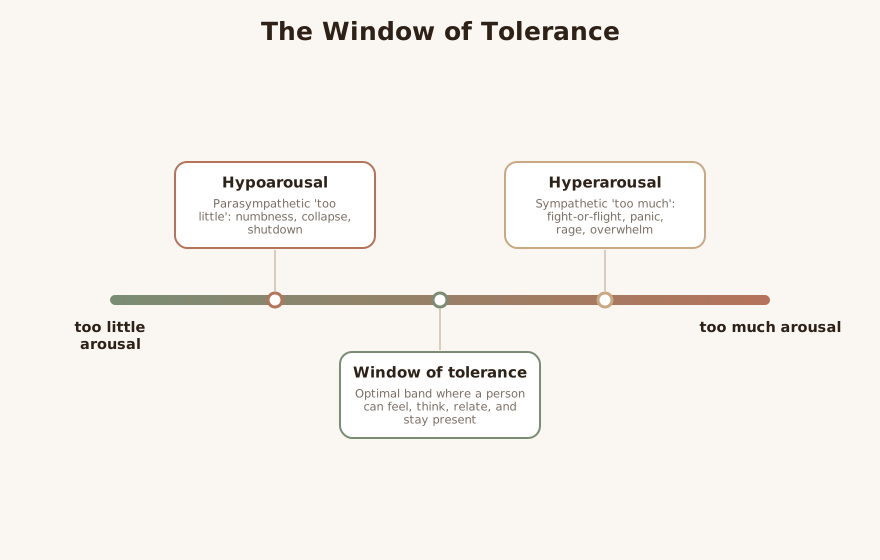
The model is fundamentally about arousal regulation. Above the window lies hyperarousal — a state of too much activation marked by anxiety, panic, anger, hypervigilance, racing thoughts, and a body braced for fight or flight; below it lies hypoarousal — a state of too little activation marked by numbing, emptiness, disconnection, flat affect, and shutdown 4. Inside the window, by contrast, arousal is tolerable: the person can experience emotion and sensation while remaining present and able to use their thinking brain 6. The boundaries of the window are not fixed; they can widen or narrow with state, history, support, and skill, which is precisely what makes the concept clinically useful 5.
Creators & Lineage
The term “window of tolerance” was coined by Daniel J. Siegel, a clinical professor of psychiatry at the UCLA School of Medicine and a founder of the field of interpersonal neurobiology, and was introduced in his 1999 book The Developing Mind 3. Siegel used it to describe the band of arousal within which emotional and physiological states can be integrated and tolerated, and within which the mind functions at its best 3. The concept grew out of his broader project of integrating attachment research, affective neuroscience, and developmental psychology into a single account of how the mind emerges from relationships and the brain 3.
The model’s most influential clinical elaboration came through the somatic trauma tradition, particularly the work of Pat Ogden, founder of Sensorimotor Psychotherapy, who placed arousal regulation and the body at the center of trauma processing 2. Ogden’s approach treats the regulation of arousal within a tolerable range as a precondition for working with traumatic memory, rather than something that can be assumed 2. A further strand of lineage runs through Stephen Porges’s polyvagal theory, which supplies a physiological vocabulary — sympathetic mobilization for hyperarousal, dorsal-vagal parasympathetic shutdown for hypoarousal — that maps closely onto the window’s upper and lower borders 1. The Window of Tolerance also sits within affect-regulation and attachment theory, sharing the premise that the capacity to stay regulated under stress is built through early relationships and can be rebuilt in later ones 3. A clinically focused articulation of the autonomic mechanics underlying the model was offered by Corrigan, Fisher, and Nutt, who examined how complex emotional trauma produces autonomic dysregulation that narrows and destabilizes the window 1.
Core Principles
The first principle is that there is an optimal zone of arousal for functioning 4. Within this band a person can simultaneously feel and think — emotion is present but does not hijack cognition, and the prefrontal, meaning-making capacities of the brain stay online 6. This is the state in which learning, relating, reflecting, and therapeutic processing are possible 5.
The second principle is that dysregulation takes two opposite forms. Hyperarousal is the sympathetically driven “too much” state — fight-or-flight activation, panic, rage, intrusive imagery, and a racing, overwhelmed system 4. Hypoarousal is the parasympathetically driven “too little” state — a collapse into numbness, helplessness, disconnection, and shutdown, which the autonomic literature ties to a dorsal-vagal response to inescapable threat 1. Both are out-of-window states in which integrated functioning breaks down, and clients can swing between them 4.
The third principle is that the width of the window is variable and trainable 5. Trauma, chronic stress, sleep deprivation, and illness can narrow the window so that even small stressors tip a person into hyper- or hypoarousal, while regulation skills, secure relationships, rest, and successful processing can widen it 56. Complex emotional trauma in particular is understood to produce a chronically narrowed and unstable window through lasting autonomic dysregulation 1.
The fourth principle is relational and developmental: the capacity to stay within the window is built through co-regulation 3. In Siegel’s framing the developing mind learns to regulate arousal through attuned interaction with caregivers, and that interpersonal scaffolding is internalized over time into self-regulation 3. This is what licenses the therapeutic move of using the clinician’s own regulated presence to help a dysregulated client return to their window LLM.
Interventions & Techniques
There is no “window-of-tolerance technique” a clinician performs; the model is a map that tells you where the client is and what the work needs to do next, and it is operationalized inside other modalities LLM. Its first clinical use is psychoeducation: many clients find immediate relief in learning that their panic or their numbness is an understandable nervous-system state rather than a personal failing, and visual versions of the three-zone model are widely used to teach it 7. Naming the state — “you’ve dropped below your window” — externalizes the experience and creates a shared language for the work 6.
The second use is tracking: the clinician monitors, moment to moment, the signs that a client is approaching or crossing the edges of their window — speech speeding up or going flat, breath shifting, eyes glazing, posture collapsing — and titrates the intensity of the session accordingly 2. In the somatic tradition this tracking of arousal is continuous and bodily, and it governs how far and how fast traumatic material is approached 2.
The third use is expanding and restoring the window through regulation skills 5. Down-regulating skills for hyperarousal include slowed breathing, orienting to the present environment, grounding, and other strategies that lower sympathetic activation; up-regulating skills for hypoarousal include movement, sensory stimulation, and re-engagement that lift a person out of shutdown 5. Resources collected for clinicians frame the overall aim as expanding the window so that more of life can be met from inside it 5. Beyond skills, the relational channel is itself an intervention: a clinician’s calm, attuned presence offers the co-regulation that helps a client’s nervous system find its way back to baseline 6.
LLM-generated illustrative example (not a guideline): A client recounting an assault begins to speak faster, grips the chair, and reports their heart pounding. Reading this as the upper edge of the window, the clinician pauses the narrative, slows their own voice, and invites the client to feel their feet on the floor and name three sounds in the room — bringing arousal back inside the window before any further processing is attempted LLM.
Evidence Base
The honest appraisal is that the Window of Tolerance is an established and widely taught clinical heuristic rather than an independently validated treatment, and its maturity lies in its pedagogical and organizing power, not in a body of outcome trials testing the construct itself LLM. It is taught across trauma trainings, embedded in somatic and trauma-focused modalities, and supported by a large ecosystem of clinical resources and worksheets, which speaks to its clinical generativity and face validity 56. The underlying observation it captures — that there is a band of arousal in which people function well, flanked by states of overwhelm and shutdown in which they do not — is consistent with broad findings on stress, arousal, and dysregulation 1.
Intellectual honesty requires separating the robust core from the more contested specifics LLM. The autonomic framing the model leans on, especially as articulated through polyvagal theory, has drawn substantive scientific criticism, and the neat mapping of hyperarousal to sympathetic activation and hypoarousal to a dorsal-vagal shutdown is better treated as a clinically useful organizing metaphor than as settled neurophysiology LLM. The provided literature here is largely descriptive and explanatory rather than experimental, and it does not include controlled trials isolating the window-of-tolerance construct as an active ingredient, so the clinician should present it to clients as a helpful frame rather than as proven brain science LLM. The defensible stance mirrors how seasoned clinicians treat other neuro-informed heuristics: use the model fully to guide pacing and psychoeducation, while holding the underlying physiology loosely LLM.
Populations & Indications
The model is most directly relevant to trauma survivors, for whom a narrowed and unstable window is a hallmark feature, and to people with post-traumatic stress disorder and complex trauma, whose intrusive hyperarousal and dissociative hypoarousal map onto the two out-of-window states 1. The clinical autonomic literature situates the model specifically within the effects of complex emotional trauma, making it especially apt for survivors of chronic, relational, or developmental trauma 1.
People with dissociative disorders are a core indication, since dissociation is one of the clearest expressions of dropping below the window into hypoarousal, and the model gives clinicians a way to recognize and name that shift 4. Clients whose presentations center on emotion dysregulation — rapid swings, flooding, or shutdown — also fit the model well, as do those with anxiety and panic, which sit at the hyperaroused edge 45. Children and adolescents are a natural audience because the three-zone picture is concrete and easy to teach, and animated explanations of the window were developed precisely for that kind of accessible psychoeducation 7. Veterans and others with combat- or service-related trauma fall squarely within the trauma populations the model was elaborated to serve LLM.
Problems-for-Work
The model reframes a recognizable cluster of clinical problems as states relative to the window LLM. Hyperarousal and hypervigilance are worked by recognizing the upper-edge state and applying down-regulating skills to return arousal to a tolerable range 5. Hypoarousal, numbing, and shutdown are worked at the lower edge by recognizing the collapse and using up-regulating, re-engaging strategies to lift the client back into the window 5. Dissociation becomes a specific, nameable target rather than an unexplained “checking out,” which both de-shames it for the client and tells the clinician to slow down and re-ground rather than push forward 4.
Emotional dysregulation and affect regulation difficulties are addressed by building the client’s repertoire of regulation skills and by widening the window so that ordinary stressors no longer tip them out of it 5. Post-traumatic stress disorder and complex trauma are worked by keeping processing within the window — approaching traumatic material only at an arousal level the client can integrate, which the somatic tradition treats as essential to processing rather than re-traumatizing 2. Panic attacks and anxiety are framed as hyperarousal to be down-regulated, while self-harm can be formulated, in many cases, as a desperate attempt to shift an unbearable out-of-window state — either to discharge hyperarousal or to break out of numb hypoarousal — which redirects treatment toward safer regulation strategies LLM.
LLM-generated illustrative example (not a guideline): A teenage client says they cut themselves when they feel “nothing at all” and “need to feel something.” Formulating this as an attempt to escape hypoarousal, the clinician and client build a menu of safer up-regulating strategies — cold water, intense movement, strong flavors — to interrupt the shutdown state before self-harm becomes the only available exit LLM.
Contraindications, Cautions & Cultural Humility
A framework has no contraindications of its own; the cautions concern how clinicians use it LLM. The first is presenting the neurophysiology as settled fact: telling a client that their numbness “is” a dorsal-vagal shutdown states contested science as certainty, when the autonomic mapping is best held as a useful metaphor LLM. The model can be taught fully as a way of understanding arousal without overclaiming the brain mechanics behind it LLM.
A second caution is that the window concept should guide pacing, not become a rationale for endlessly avoiding difficult material; the somatic tradition’s point is to work at the edges of tolerance, expanding the window, not to keep the client so comfortable that nothing changes 2. A third is over-pathologizing: not every strong emotion is “out of window,” and labeling all intensity as dysregulation can invalidate appropriate, healthy affect LLM. The clinician must also recognize that what counts as being “in” or “out” of the window cannot be read from arousal alone — context and meaning matter LLM.
Cultural humility is essential because the expression and display of arousal vary widely. Norms for emotional expressiveness, eye contact, stillness, and bodily animation differ across cultures, so a clinician must avoid reading culturally normative expressiveness as hyperarousal or culturally normative reserve as hypoarousal or shutdown LLM. Experiences of structural threat, discrimination, and ongoing danger can also keep a nervous system legitimately mobilized, and treating that vigilance as pathology rather than as an adaptive response to real conditions would be a serious misuse of the model LLM.
Treatment-Plan Suggestions & SMART Objectives
The model does not generate goals about changing a client’s brain; the appropriate goals concern recognizing arousal states, widening the window, and building the skills and relationships that keep a client within it, pursued inside an existing modality LLM.
| Goal | SMART objective (example) | Mechanism |
|---|---|---|
| Build awareness of arousal states | Over 4 weeks, client correctly identifies whether they are hyper-, hypo-, or in-window in ≥80% of logged daily check-ins | Self-monitoring makes out-of-window states recognizable and nameable 6 |
| Reduce hyperarousal in session | Within 8 weeks, client uses a down-regulating skill to return to baseline within 5 minutes during 3 in-session activations | Lowering sympathetic activation restores access to the regulated window 5 |
| Interrupt hypoarousal and shutdown | Within 8 weeks, client recognizes early numbing and applies an up-regulating strategy on ≥3 occasions before fully shutting down | Re-engaging activation lifts the client out of the lower edge of the window 5 |
| Widen the window of tolerance | Over 12 weeks, client tolerates a previously overwhelming reminder while staying present and reporting arousal in the manageable range | Graded exposure within tolerance expands the band of bearable arousal 2 |
| Reduce dissociation in session | Within 10 weeks, client signals the clinician at the first signs of “checking out” on ≥3 occasions before full dissociation | Early recognition allows grounding before hypoarousal deepens 4 |
| Strengthen self-regulation repertoire | Over 8 weeks, client identifies and applies 3 personalized regulation skills across logged out-of-session arousal spikes | A flexible skill set supports staying within or returning to the window 5 |
| Use relationship for co-regulation | Within 12 sessions, client uses the therapeutic relationship to settle from an activated state on ≥3 occasions | Attuned relational presence provides co-regulation that the client internalizes 3 |
Common Misconceptions
The most consequential misconception is that the Window of Tolerance is a treatment a clinician can be certified to deliver; it is a conceptual model that informs how recognized modalities are practiced, not a manualized protocol LLM. A second is that the underlying neurophysiology is settled — that hyperarousal simply “is” sympathetic activation and hypoarousal “is” a dorsal-vagal shutdown — when the autonomic framing it borrows is contested and best held as an organizing metaphor LLM.
A third misconception is that the goal of therapy is to keep the client permanently inside the window; the actual aim is to expand it and to build the capacity to return to it, which often requires deliberately working near its edges 25. A fourth is that the window is fixed — a stable trait of a person — when its central clinical value is that its width changes with state, support, skill, and the success of processing 5. Finally, the model is sometimes flattened into “calm equals in-window, intense equals out,” which loses the crucial distinction that a person can feel strong emotion and still be within their window, and can look outwardly calm while in a numb, hypoaroused shutdown 4.
Training & Certification
There is no license or certificate in “the Window of Tolerance”; it is a piece of conceptual knowledge applied by clinicians within their existing scope and modalities LLM. The most direct route to the concept itself runs through Siegel’s foundational account in The Developing Mind and the broader interpersonal-neurobiology literature, which build the conceptual literacy needed to formulate cases and explain the model accurately 3. Accessible explainers, handouts, and animated teaching resources are widely available and are useful both for the clinician’s own grounding and for client psychoeducation 467.
For clinical application, the relevant competencies live in the trauma-focused and somatic modalities that operationalize the model — Sensorimotor Psychotherapy and related body-oriented trauma approaches chief among them — each of which has its own established training and certification pathways 2. The realistic goal for a practicing clinician is twofold: enough fluency with arousal states, tracking, and regulation skills to pace trauma work safely, paired with honesty about which parts of the underlying physiology are robust and which remain a useful but unproven frame LLM.
Key Terms
Window of tolerance: the optimal band of autonomic arousal within which a person can think, feel, and stay present, with integrated functioning intact 4. Hyperarousal: the “too much” state above the window — fight-or-flight activation, anxiety, panic, anger, hypervigilance, and intrusive imagery 4. Hypoarousal: the “too little” state below the window — numbing, emptiness, disconnection, flat affect, and shutdown, linked to a parasympathetic dorsal-vagal response 14. Autonomic dysregulation: the destabilization and narrowing of the window produced by complex emotional trauma, leaving a person prone to swinging out of the tolerable range 1. Co-regulation: the relational process, first developmental and later therapeutic, by which an attuned other helps regulate a person’s arousal, which is internalized over time into self-regulation 3. Tracking: the clinician’s continuous, often bodily, monitoring of where a client sits relative to their window so that intensity can be titrated 2. Expanding the window: the therapeutic aim of widening the band of arousal a person can tolerate, typically by working at its edges and building regulation skills 5.
Resources & Further Reading
▶ Watch — a video introduction to this concept:
- Autonomic dysregulation and the Window of Tolerance model of the effects of complex emotional trauma (Corrigan, Fisher & Nutt)
- Trauma and the Body / Sensorimotor Psychotherapy trauma treatment (Pat Ogden)
- The Developing Mind (Daniel J. Siegel, 1999) — origin of the concept
- Window of Tolerance — Psychology Tools
- Expanding the Window of Tolerance: PDFs & Worksheets — PositivePsychology.com
- How to Help Your Clients Understand Their Window of Tolerance — NICABM
- The Window of Tolerance (Beacon House) — animation/video
Reflective / Supervision Questions
- For this client, am I tracking the bodily and autonomic signs of approaching the edges of their window as carefully as I track the content of what they say? 2
- When I explain the window to a client, am I respecting the difference between the well-supported observation about arousal and the more contested autonomic neuroscience, or am I presenting the physiology as settled fact? LLM
- Am I using the model to expand this client’s window by working thoughtfully at its edges, or am I keeping them so comfortable that processing never happens? 2
- When this client looks calm, am I checking whether they are genuinely within their window or quietly in a numb, hypoaroused shutdown? 4
- How am I interpreting this client’s expressiveness or reserve against their cultural frame rather than against a single standard for what “in-window” looks like? LLM
- Where a client’s vigilance reflects real, ongoing threat or discrimination, am I honoring it as an adaptive response rather than labeling it as dysregulation to be fixed? LLM