
Type & Discipline
Interbeing, also rendered as interdependence, is a contemplative philosophical teaching rather than a standalone, manualized psychotherapy LLM. Its native home is Engaged Buddhism in the Zen lineage, where it names a particular way of perceiving reality: nothing exists in isolation, and every person and thing “inter-is” with everything else through mutual dependence 1. The term was coined by the Vietnamese Zen teacher Thich Nhat Hanh, who created the English word “interbeing” (Vietnamese Tiep Hien, French Interêtre) to render classical Buddhist interconnectedness in accessible, modern language 1. The teaching is captured in his compressed formula “to be is to inter-be,” meaning that no entity can exist by itself alone 1. For the clinician it is most useful to treat interbeing as a perceptual and existential frame that can be cultivated within recognized mindfulness- and acceptance-based therapies, not as a billable modality in its own right LLM.
Interbeing is not a vague sentiment of connectedness; it is a precise restatement of three traditional Buddhist doctrines 1. It draws on dependent co-arising (pratityasamutpada), the principle that all phenomena arise through conditions and none stands alone; emptiness (sunyata), the absence of independent, permanent essence; and non-self (anatta), the insight that the self is composed of non-self elements 1. Thich Nhat Hanh expressed this innovatively as the formula “‘A’ is made of non-A elements,” reframing ancient wisdom in language that sounds almost scientific 2. The clinical value lies precisely in this shift of perception, from seeing oneself as a separate, encapsulated entity to seeing oneself as a node in a web of mutual dependence LLM.
Creators & Lineage
Interbeing has a single modern author, even though the underlying doctrine is ancient LLM. Thich Nhat Hanh, a Vietnamese Zen Buddhist monk, teacher, and peace activist, coined the word and built a practice tradition around it 1. He did so in a specific historical crucible: in 1966, in Saigon, amid the escalating Vietnam War, he founded the Order of Interbeing (Tiep Hien) because “the teachings of the Buddha were desperately needed to combat the hatred, violence, and divisiveness” tearing the nation apart 4. Six people were ordained as the founding members, three men and three women aged twenty-two to thirty-two, all of whom served on the board of the School of Youth for Social Service, an organization that brought practical aid to war victims 4.
This origin matters clinically because it locates interbeing inside Engaged Buddhism, a movement that refuses to separate contemplative insight from action in the world LLM. From the beginning, members of the Order “continued to stay busy helping war victims, organizing demonstrations, printing books and leaflets” while sustaining their practice through weekly days of mindfulness 4. The applied literature describes the Order as dedicated to alleviating suffering, fostering peace, and raising awareness of non-duality and “the interpenetration of all beings,” exemplified in its emphasis on engagement in the world and social transformation 6.
The word itself has a textual lineage LLM. Thich Nhat Hanh translated Tiep Hien as “Interbeing,” a word “based on a Chinese term in the Avatamsaka Sutra,” and the name points to “the absence of a separate self identity and thus to the interconnectedness, interdependence, and interpenetration of all beings” 6. The Order is guided by four principles, the first of which is “non-attachment to views, which Thich Nhat Hanh has called the most important teaching of Buddhism,” alongside direct experimentation, appropriateness, and skillful means 6. The practice tradition Thich Nhat Hanh later built, the Plum Village community established in France in 1982, became the global vehicle through which interbeing and its sister teachings are transmitted 1.
Core Principles
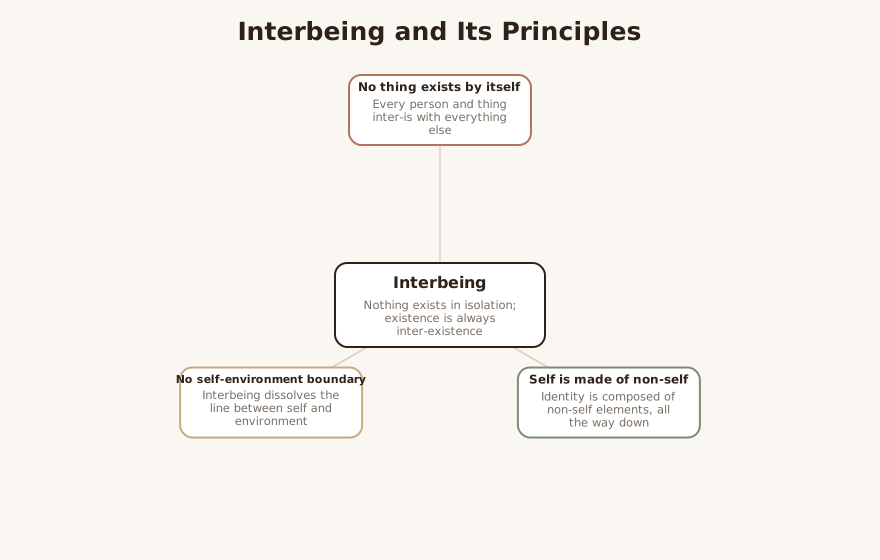
The first principle is that no thing exists by itself; existence is always inter-existence 1. As Thich Nhat Hanh puts it, “You cannot be by yourself alone. You have to ‘interbe’ with everybody and everything else” 2. The clinical correlate is that the felt sense of being a wholly separate, self-made individual is, in this view, a kind of perceptual error, and much suffering grows in the gap between that felt separateness and the reality of interdependence LLM.
The second principle is that the self is made of non-self elements 2. The classic illustration is a sheet of paper, which contains “non-paper elements like sunshine, clouds, rain and soil” without which it could not exist; in the same way “humans are made of non-human elements—animal, vegetable and mineral” 2. Extended fully, “everything—time, space, the earth, the rain, the minerals in the soil, the sunshine, the cloud, the river, the heat, and even consciousness—is in that sheet of paper” 2. The point is not metaphor but ontology: identity is relational all the way down 1.
The third principle is that interbeing dissolves the boundary between self and environment, which gives it an inherently ecological dimension 5. Thich Nhat Hanh teaches that “we cannot separate human beings from the environment. The environment is in human beings and human beings are part of the environment” 5. This is why interbeing functions, in the applied ecology literature, as a foundation for environmental care and for working with the alienation that comes from experiencing oneself as cut off from the living world 6.
The fourth principle is that interbeing must be experienced, not merely understood 2. There is a crucial difference between knowing about interbeing intellectually and directly realizing it through mindfulness practice; only the latter “transforms perception and action” 2. This maps onto the Order’s guiding principle of “direct experimentation or direct realization, through practice that brings about insight,” and it is what makes interbeing a practice target rather than a belief to be adopted 6.
A fifth principle, drawn from Thich Nhat Hanh’s broader teaching, is that mindfulness is the medium through which interbeing is realized, and that mindfulness is inseparable from ethics: “Mindfulness is not a tool or instrument to get something else,” but an integrated path toward genuine freedom 5.
Interventions & Techniques
Because interbeing is a perceptual frame rather than a protocol, it is cultivated through contemplative practices that can be embedded in standard therapy LLM. The foundational practice is mindful breathing, walking, and eating, which Thich Nhat Hanh treats not as relaxation but as ways to “live deeply every moment that is given you to live” and to perceive the conditions one is woven from 5. Present-moment awareness is itself a technique here, because, in this teaching, the conditions that constitute us are only ever available in the present, and grasping after future achievement pulls a person out of contact with them 5.
A second technique is the deliberate contemplation of interdependence, sometimes called “looking deeply”: guiding a client to trace any ordinary object, meal, or even their own body back to the web of non-self elements that produced it 2. The paper-and-cloud contemplation is the canonical example and is easily adapted to a client’s own life and supports 2.
LLM-generated illustrative example (not a guideline): A client who feels she is “completely alone” is invited, within a mindfulness-based session, to trace the bread she ate that morning back to the farmer, the rain, the sun, the truck driver, and the baker. The clinician is not arguing her out of loneliness; she is widening the client’s field of perception so that the felt fact of total isolation can be examined against the many hands and conditions her day actually depends on LLM.
A third technique is contemplative engagement with impermanence and the natural world, which the applied ecology literature treats as a direct teacher: time spent in the natural world reveals “the whole dance of impermanence” and reifies the basic tenets of the tradition 6. A fourth is the cultivation of non-attachment to views, the Order’s first principle, which Thich Nhat Hanh calls the most important teaching of Buddhism, and which fosters “open-mindedness and compassion, both in the realm of the perception of reality and in the realm of human relationships” 6.
In routine practice these techniques are delivered through the surrounding evidence-based modality, for example as looking-deeply and present-moment exercises within Mindfulness-Based Cognitive Therapy or Mindfulness-Based Stress Reduction, as a values-and-perspective exercise within Acceptance and Commitment Therapy, or as meaning-and-connection work within existential or group therapy LLM.
Evidence Base
Interbeing should be described honestly as an established teaching within its contemplative lineage, not as a clinically validated intervention LLM. The word “established” here refers to its standing in Engaged Buddhism and the Plum Village tradition, where it is a central, widely taught, and textually grounded doctrine, not to any body of efficacy research 1. There is no manualized interbeing therapy, no validated interbeing measure, and no randomized controlled trial of interbeing as a discrete treatment LLM.
What carries the clinical weight is the family of mindfulness- and acceptance-based therapies into which interbeing’s practices are embedded, and it is those modalities, not interbeing as such, that hold the more robust outcome literature LLM. The defensible clinical stance is therefore to use interbeing as an explanatory and experiential frame, a way of reorganizing a client’s perception of self, others, and world, delivered inside an evidence-based modality, while never presenting it to clients or supervisees as a freestanding proven treatment LLM. Even its source tradition insists that the teaching only does its work when it is directly experienced through sustained practice rather than intellectually endorsed, which means any clinical use depends on the quality of the practice it is paired with 2.
Populations & Indications
Interbeing as a clinical frame is well suited to adults whose distress is organized around a felt sense of separateness, isolation, or disconnection from others and the world LLM. People experiencing loneliness and isolation are a natural fit, because the teaching directly addresses the perception of being a wholly separate self and the alienation that follows from it 6. Mindfulness practitioners who already have a contemplative practice can deepen it with interbeing as a perspective, since it is taught as the fruit of mindfulness rather than a doctrine bolted on from outside 2.
People in existential distress and those searching for meaning are addressed by interbeing’s reframing of the self as inseparable from a larger web, which can restore a sense of belonging and significance LLM. People with chronic illness can use the frame to relocate themselves within a network of care and conditions rather than as an isolated sufferer, and caregivers may find in interbeing both a rationale for compassion and a guard against the burnout that comes from seeing care as a one-way transaction 5. People in grief may, with great care, find some comfort in the teaching that what they loved continues to inter-be in altered forms, though this must never be used to short-circuit mourning 2. People in ecological distress are directly served, since interbeing was developed in part as an applied ecology that dissolves the human-environment boundary 6.
Problems-for-Work
Interbeing speaks most directly to suffering rooted in perceived separateness LLM. For loneliness and isolation, the clinician uses looking-deeply practices to widen the client’s perception of the relationships and conditions their life is actually embedded in, working against the felt fact of total aloneness 6.
LLM-generated illustrative example (not a guideline): A recently retired man reports that he is “useless and connected to no one.” Within an existential or mindfulness-based frame, the clinician helps him map the people who still depend on small things he does, and the people and conditions he in turn depends on daily, not to dispute his grief over lost role and routine, but to make the web he is part of perceptible again LLM.
For disconnection and alienation, the work draws on the applied ecology arc from “behaviors of alienation” toward “reacquaintance,” helping a client move from experiencing themselves as a stranger to life back toward felt kinship with other beings 6. For self-focused rumination, interbeing offers a deliberate decentering: turning attention from a sealed, self-referential loop toward the field of conditions and others one is part of LLM. For existential distress and meaninglessness, the reframing of the self as inter-being can restore a sense of participation and belonging LLM. For anxiety, present-moment practices counter the future-grasping that pulls a person out of contact with the supports actually available now 5. For ecological distress, interbeing provides a framework that joins personal contemplative practice to engaged, compassionate action rather than paralysis 6. For grief, a non-clinging contemplation of how a loved one continues to inter-be may ease suffering, but only when paced sensitively and never imposed 2.
Contraindications, Cautions & Cultural Humility
The central caution is the risk of spiritual bypass: using “we inter-are” to override a client’s real and legitimate needs LLM. Telling a lonely client that they are “connected to everything” can invalidate a genuine, unmet need for actual human contact, and telling a grieving client that what they lost “continues to inter-be” can pressure premature letting-go of grief that the tradition itself does not demand LLM. Because the teaching insists it must be directly experienced rather than intellectually asserted, any clinician who deploys it as a reassuring slogan is misusing it, and the source material is explicit that intellectual understanding is not the same as realization 2.
Interbeing language is also poorly matched to acute crisis, active psychosis, acute suicidality, and severe instability, where structure, safety planning, and stabilization take priority over contemplative reframing LLM. Boundary-dissolving contemplations, in which the line between self and world thins, require careful screening and grounding for clients with histories of trauma, dissociation, or fragile self-structure, for whom such practices can shade into derealization rather than insight LLM.
Cultural humility is essential because interbeing is rooted in a specific Vietnamese Zen Buddhist and Engaged Buddhist tradition, born from the suffering of a particular war, and clinicians should neither strip it of those origins nor impose it as a universal spiritual prescription 4. The teaching emerged from Thich Nhat Hanh’s direct experience of mass death and ecological devastation, and presenting it as a generic wellness concept erases that lineage 6. For some clients interbeing will resonate with their own faith or worldview; for others it may conflict with religious commitments to a bounded, eternal self or to a creator distinct from creation LLM. The respectful stance is to offer the psychological mechanism, a more relational and less encapsulated sense of self, while honoring each client’s own tradition and language LLM.
Treatment-Plan Suggestions & SMART Objectives
| Goal | SMART objective (example) | Mechanism |
|---|---|---|
| Reduce felt loneliness and isolation | Within 8 sessions, client will complete a weekly “looking-deeply” log tracing 3 daily supports back to the people and conditions that produced them | Widening perception of interdependence 2 |
| Decrease self-focused rumination | Over 6 weeks, client will practice present-moment attention to breath or walking 5 times weekly, redirecting from self-referential loops to the present field | Decentering via mindful, present awareness 5 |
| Reduce existential disconnection | Within 10 sessions, client will articulate 3 specific ways their life participates in and depends on a larger web of others and conditions | Reframing self as inter-being 1 |
| Ease alienation and restore kinship | Over 8 weeks, client will spend 20 minutes weekly in the natural world and record one observed instance of interdependence or impermanence | Reacquaintance with the living world 6 |
| Support sustainable caregiving | Within 6 sessions, client will identify where their care is reciprocated by others and conditions, reframing care as mutual rather than one-directional | Interbeing as antidote to depleting separateness 5 |
| Address ecological distress | Over the episode of care, client will pair one contemplative practice with one small engaged action aligned with their values | Joining insight to compassionate engagement 6 |
| Loosen rigid, distressing views | Within 8 sessions, client will practice holding one strongly held self-judgment more lightly, noticing it as one perspective among many | Non-attachment to views 6 |
| Work gently with grief | Across the episode of care, at the client’s pace, client will explore how a lost person or role continues to influence and inter-be in their present life | Non-clinging contemplation of continuation 2 |
Common Misconceptions
The most consequential misconception is that interbeing is a feel-good slogan about everyone being connected; in the source teaching it is a precise restatement of dependent origination, emptiness, and non-self, asserting that the self is literally composed of non-self elements 1. A second is that it can be installed by explanation, when the tradition insists it must be directly experienced through mindfulness practice and that intellectual understanding is not realization 2. A third is that interbeing implies the self does not exist or does not matter; rather, it relocates the self as a real but thoroughly relational node, not an isolated essence 1. A fourth is that it is a purely abstract metaphysics with no practical edge, when it was forged as Engaged Buddhism in the midst of war and functions as an applied ecology and ethic of compassionate action 6. A fifth, especially relevant to grief and loneliness, is hearing it as a command to stop needing people or to “let go” quickly, which contradicts both the teaching’s emphasis on compassion and the clinical need to follow the client’s pace LLM.
Training & Certification
There is no license or certification in “interbeing”; it is a teaching practiced by licensed mental health professionals who incorporate it within their existing scope and modalities LLM. The most direct routes to clinical competence are training in the mindfulness- and acceptance-based therapies that operationalize present-moment awareness and decentering, namely Mindfulness-Based Stress Reduction, Mindfulness-Based Cognitive Therapy, and Acceptance and Commitment Therapy, each with its own established training pathway LLM. Clinicians who wish to engage the teaching seriously benefit from grounding in its source tradition, including its origins in Vietnamese Zen and Engaged Buddhism and its formal home in the Order of Interbeing and the Plum Village community, so that they represent it accurately rather than as a decontextualized wellness concept 4. Familiarity with how interbeing rests on dependent origination, emptiness, and non-self helps clinicians avoid distorting it in transmission 1. As with any contemplative integration, clinicians should represent their competence and scope honestly and avoid implying religious or spiritual authority they do not hold LLM.
Key Terms
Interbeing / interdependence – Thich Nhat Hanh’s teaching that nothing exists by itself alone and that all phenomena “inter-are” through mutual dependence; “to be is to inter-be” 1. To inter-be – the verb Thich Nhat Hanh coined to express that one can only exist in relationship with everything else 2. Dependent origination (pratityasamutpada) – the classical doctrine that all phenomena arise through conditions and none stands alone, which interbeing restates 1. Emptiness (sunyata) – the absence of independent, permanent essence in any phenomenon 1. Non-self (anatta) – the insight that the self is made of non-self elements 1. Interpenetration – the principle that everything contains and exists within everything else, so that separation is, in this view, illusory 2. Order of Interbeing (Tiep Hien) – the community founded by Thich Nhat Hanh in Saigon in 1966 to apply Buddhism to modern social crises 4. Non-attachment to views – the Order’s first guiding principle, which Thich Nhat Hanh calls the most important teaching of Buddhism, fostering open-mindedness and compassion 6. Engaged Buddhism – the movement, central to Thich Nhat Hanh, that joins contemplative insight to action in the world 6.
Resources & Further Reading
- Interbeing — Wikipedia
- Thich Nhat Hanh’s Teaching of Interbeing — Buddhistdoor Global
- Interbeing: A Buddhist Teaching on the Interconnection of All Things — Learn Religions
- Our History — Order of Interbeing (Tiep Hien)
- Key Teachings — Plum Village (Thich Nhat Hanh)
- Interbeing: Precepts and Practices of an Applied Ecology (Joan Halifax & Marty Peale, Upaya — PDF)
- There’s a Cloud in that Piece of Paper — Thich Nhat Hanh (YouTube)
Reflective / Supervision Questions
- When I introduce interbeing to a client, am I offering an experiential practice, or am I deploying “we’re all connected” as a reassuring slogan that bypasses their actual distress LLM?
- With a lonely or grieving client, am I honoring their real need for human contact and their right to mourn, rather than using interconnection to invalidate or rush them LLM?
- Am I screening for trauma, dissociation, and fragile self-structure before offering boundary-dissolving contemplations that could shade into derealization LLM?
- Am I honoring the Vietnamese Zen and Engaged Buddhist origins of this teaching and my client’s own worldview, rather than presenting a decontextualized wellness version LLM?
- Am I representing the evidence honestly, as a teaching that is established within its contemplative lineage but lacks a freestanding clinical trial base, used as a frame within evidence-based modalities LLM?
- Where do I, as the clinician, experience myself as separate from this client, and how might attending to our interdependence change the work LLM?