
Type & Discipline
Neuroplasticity is a construct in neuroscience, not a treatment modality LLM. StatPearls defines it as “the ability of the nervous system to change its activity in response to intrinsic or extrinsic stimuli by reorganizing its structure, functions, or connections” 1. It is descriptive and explanatory rather than prescriptive: it names a property of the brain, not a protocol a clinician delivers LLM. For practicing therapists, neuroplasticity functions as a unifying rationale — the mechanistic claim that underwrites why repeated practice, learning, and experience can durably change a person — rather than as a therapy in its own right LLM. It belongs to the family of basic and clinical neuroscience and intersects directly with learning and memory theory, neurorehabilitation, and the psychology of habit and behavior change 26. Its clinical value is conceptual and motivational: it reframes change as biologically possible across the lifespan, which can reduce hopelessness and increase engagement, while leaving the actual work to be done inside an evidence-based modality LLM.
Creators & Lineage
Neuroplasticity has no single inventor; it emerged cumulatively from neuroscience over more than a century LLM. Its modern conceptual backbone is Hebbian learning theory — the principle, often summarized as “neurons that fire together wire together,” that synapses repeatedly active together tend to strengthen 2. This idea grounds the synaptic mechanisms (long-term potentiation and long-term depression) through which experience-dependent change is now understood 2. The construct sits within the broader lineage of learning and memory theory, which supplies the behavioral and cellular accounts of how repeated experience is encoded 6. A distinct clinical lineage runs through neurorehabilitation, where the recognition that undamaged tissue can take over lost functions reshaped recovery practice after stroke and brain injury 1. The construct was popularized for general and clinical audiences by Norman Doidge’s The Brain That Changes Itself (2007), which gathered case stories of recovery and reorganization and helped move “neuroplasticity” into mainstream therapeutic vocabulary 4. Public-facing talks and explainers have since amplified the message that experience continually rewires the brain 7.
Core Principles
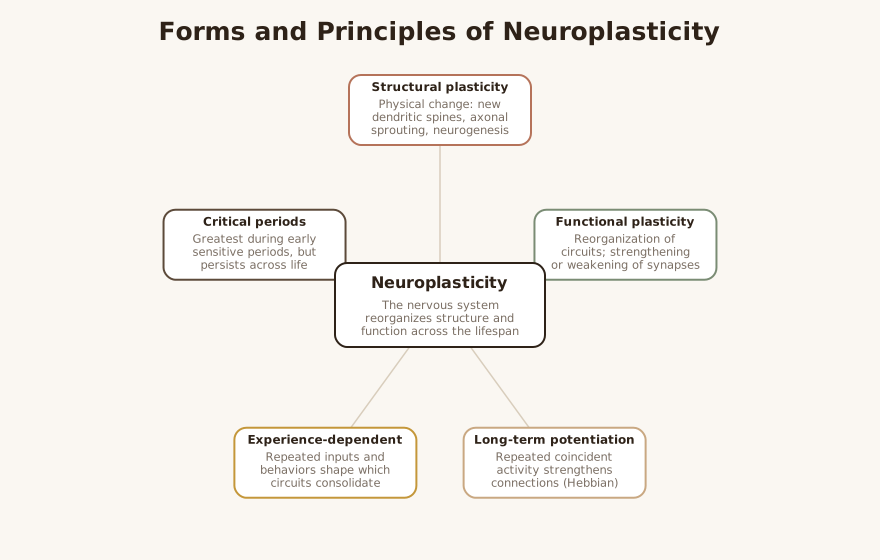
The foundational claim is that the brain is not fixed: it reorganizes structure and function across the lifespan in response to experience, learning, and injury 1. Two broad forms are distinguished LLM. Structural plasticity involves physical change — the growth of new dendritic spines, axonal sprouting, and, in restricted regions, neurogenesis 2. Functional plasticity involves changes in the functional organization of circuits, including the strengthening or weakening of synapses that underlies memory formation, skill acquisition, and recovery from injury 2. At the synaptic level, long-term potentiation strengthens connections following repeated, coincident activity, consistent with Hebbian plasticity in which synapses that are repeatedly active at the same time tend to strengthen 2.
Plasticity is experience-dependent and use-driven: the inputs and behaviors a person repeats shape which circuits consolidate 3. It is greatest during early developmental “critical” or “sensitive” periods — by age two the brain has roughly twice the number of synapses of the adult brain, and skills such as language are acquired with far less effort early than later — but it persists, more regulated and context-dependent, throughout life 2. Plasticity is also bidirectional and not inherently benign: the same mechanisms that support recovery can produce maladaptive reorganization, as in phantom limb pain 1. After focal injury, undamaged regions can assume lost functions (equipotentiality and vicariation), while damage in one area can disrupt function elsewhere through connected pathways (diaschisis) 1.
Interventions & Techniques
There is no “neuroplasticity therapy”; the construct informs how clinicians design, frame, and sequence existing interventions LLM. In neurorehabilitation, plasticity is harnessed through targeted approaches such as constraint-induced movement therapy and mirror therapy, alongside repetition, intensity, and salience of practice 1. Recovery after injury is described in phases — initial damage, recruitment of supporting cells, and axonal reorganization over weeks to months — which justifies sustained, graded practice rather than one-off effort 1. Across settings, plasticity is optimized by conditions the clinician can influence: physical exercise, environmental enrichment, task repetition, motivation, adequate sleep, and stress reduction 1.
For psychotherapists, the practical translation is mostly about parameters of practice and about rationale LLM. Cleveland Clinic’s patient-facing principles emphasize practice and repetition, intensity and focus, and sleep as the period when the day’s learning is consolidated, with earlier intervention generally yielding better results 3. Experience is the active ingredient — “it’s the experience that counts” — so novelty and effortful challenge (a new route, the non-dominant hand, a new language or instrument) are framed as plasticity-promoting 3. In clinical practice this maps onto the spaced, repeated, emotionally salient practice already built into evidence-based modalities: graded exposure, behavioral rehearsal, skills practice, and homework LLM. The construct is delivered inside recognized modalities as psychoeducation and as a design heuristic, not as a freestanding technique LLM.
LLM-generated illustrative example (not a guideline): A clinician helping a client unlearn a chronic avoidance habit explains that each rehearsal of the new approach behavior is, in effect, strengthening a competing pathway, while the old route weakens from disuse. Reframing “willpower” as “wiring through repetition” makes the homework feel mechanistic and achievable rather than a test of character LLM.
Evidence Base
The maturity label applies to the construct, not to a treatment LLM. Neuroplasticity as a description of how the nervous system reorganizes is established and central to modern neuroscience, with a large mechanistic literature spanning synaptic plasticity, structural remodeling, and circuit reorganization 12. Its application in neurorehabilitation is mature: plasticity-based approaches such as constraint-induced movement therapy and mirror therapy have a real evidence base for recovery of function after stroke and brain injury 1. Adult neurogenesis is established in restricted regions in animal models and, while supported by some human evidence, remains a more qualified and debated claim in humans 12.
What is not established is “neuroplasticity-informed therapy” as a standalone, validated intervention LLM. The clinically actionable behaviors the construct points toward — repeated practice, exercise, cognitive stimulation, social engagement, and sleep — have their own independent evidence bases, but that evidence supports those behaviors, not the neuroplasticity frame itself 2. The popular literature, including widely read books and talks, has at times overstated or oversimplified the construct into the implication that the brain can rewire itself to overcome almost anything 47. Clinicians should present neuroplasticity as a well-grounded mechanistic rationale that motivates evidence-based practice, not as proof that any particular outcome is achievable in any particular client LLM.
Populations & Indications
The construct is most directly useful where reorganization and relearning are central to the work LLM. Stroke and brain injury survivors are the paradigm population: neurorehabilitation explicitly exploits plasticity to recover lost function, and the phased model of recovery sets realistic expectations for sustained practice 1. People in psychotherapy benefit from the construct chiefly as rationale — change is biologically possible, and repetition is how it consolidates — which can lift hopelessness and improve adherence LLM. Children and adolescents are in a period of heightened, critical-period plasticity, which is why early intervention and enriched environments matter and why early adversity leaves durable marks 2. Older adults retain meaningful plasticity, and exercise, cognitive stimulation, social engagement, and good sleep are associated with preserved cognition and reduced dementia risk, supporting active aging rather than therapeutic nihilism 2. Trauma survivors and people with chronic pain are populations where plasticity cuts both ways: maladaptive learning helped create the problem, and corrective, repeated experience is part of the path out 1. The construct is an adjunct lens across these groups, not a diagnosis-specific protocol LLM.
Problems-for-Work
In stroke and brain injury recovery, the work is structured, intensive, repeated task practice that drives functional reorganization — for example, constraint-induced movement therapy to recruit an affected limb back into daily use 1. In habit and behavior change, the work is repeated rehearsal of a new response so the competing pathway strengthens while the old one weakens from disuse, the mechanism behind exposure and behavioral-activation homework 3. In PTSD, the work is corrective, repeated learning experiences that update fear associations, with the construct supplying the rationale for why repetition and salience matter; the construct does not replace trauma-focused, evidence-based protocols LLM. In chronic pain and phantom limb pain, the work targets maladaptive plastic reorganization — mirror therapy is a plasticity-based example used for phantom limb pain 1. In cognitive decline, the work is lifestyle and cognitive engagement — exercise, mentally stimulating activity, social connection, sleep, diet — to support cognitive reserve and slow decline 2. In learning and memory deficits, the work is spaced, repeated, emotionally salient practice consistent with how synaptic strengthening encodes learning 2.
LLM-generated illustrative example (not a guideline): A client recovering from a mild brain injury sets a daily relearning routine for a lost skill. The clinician frames inconsistent early progress as expected during the reorganization phase, normalizing plateaus so the client keeps practicing rather than quitting at the first setback 1.
Contraindications, Cautions & Cultural Humility
Because neuroplasticity is a construct rather than a procedure, the cautions concern misapplication, not patient selection LLM. The most serious error is using “your brain can rewire itself” to imply that any deficit, disability, or trauma can be willed away with enough effort; this can shade into blaming clients for incomplete recovery and ignoring the real limits set by lesion size, age, comorbidity, and resources LLM. The popular framing that the brain can change itself to overcome nearly anything overstates the science and should not be imported uncritically into clinical talk 4. Plasticity is also not uniformly good — it produces maladaptive as well as adaptive change — so promising clients that “more plasticity” is always better is inaccurate 1. Clinicians should not present adult neurogenesis or specific “brain-training” claims as more settled than the evidence supports 2. Cultural and structural humility matters: the lifestyle levers the construct points to (exercise, enrichment, cognitive stimulation, restorative sleep, social connection) are unevenly available, and recommendations that assume time, safety, and material latitude can be tone-deaf to clients facing precarity, caregiving load, or systemic stress 2. The construct should never substitute for appropriate medical and rehabilitative assessment LLM.
Treatment-Plan Suggestions & SMART Objectives
| Goal | SMART objective (example) | Mechanism |
|---|---|---|
| Drive functional recovery through repetition | Client completes a structured task-practice routine for an affected skill 5 days/week for 8 weeks, logged daily | Use-dependent, repeated practice promotes functional reorganization and synaptic strengthening 1 |
| Consolidate new behaviors | Client rehearses one target replacement behavior at least once daily for 6 weeks, tracked weekly | Repeated coincident activation strengthens the competing pathway (Hebbian plasticity) while disuse weakens the old one 2 |
| Protect sleep to consolidate learning | Client maintains a consistent 7-hour sleep window on 6 of 7 nights for 4 weeks | Sleep supports consolidation of the day’s learning, optimizing plasticity 3 |
| Increase plasticity-supporting activity | Client completes 3 sessions of moderate exercise per week for 6 weeks | Physical exercise raises growth factors (e.g., BDNF) that support neuronal survival and plasticity 2 |
| Build cognitive engagement in aging | Client adds 3 mentally stimulating activities per week for 8 weeks, logged | Cognitive stimulation is associated with lower risk of cognitive decline and supports reserve 2 |
| Reduce maladaptive pain-related reorganization | Client completes a clinician-guided mirror-therapy protocol per plan for 4 weeks | Targets maladaptive plastic reorganization implicated in phantom limb pain 1 |
| Reframe change as achievable | Client states and applies a plasticity-based rationale for homework in 80% of sessions over 6 weeks | Replaces character/willpower framing with a mechanistic, motivating “wiring through repetition” model 3 |
| Sustain practice across recovery phases | Client continues practice through a logged plateau without discontinuation over 8 weeks | Aligns expectations with the staged, weeks-to-months course of axonal reorganization 1 |
Common Misconceptions
The first misconception is that neuroplasticity is itself a therapy; it is a construct that informs and motivates therapy, not a treatment one can deliver or be certified in LLM. A second is that the brain becomes fixed after childhood — plasticity is greatest in early critical periods but persists, more regulated, throughout life 2. A third, popularized by accessible books and talks, is that the brain can rewire itself to overcome almost any deficit with enough effort; the science supports meaningful change, not unlimited recovery, and real limits remain 47. A fourth is that more plasticity is always good — the same mechanisms produce maladaptive reorganization, including phantom limb pain 1. A fifth is that adult neurogenesis is a settled, large-scale phenomenon in humans; it is established in restricted regions and animal models but remains qualified in humans 12. Finally, some assume the plasticity-promoting levers (exercise, enrichment, sleep, stimulation) are equally accessible to all clients, which ignores structural and economic constraints 2.
Training & Certification
There is no certification in neuroplasticity, because it is a scientific construct rather than a proprietary modality LLM. Clinicians encounter it through neuroscience and psychology coursework, through neurorehabilitation training where it is applied directly, and through accessible explainers and popular books 134. The practical path is to absorb neuroplasticity as background theory and then apply it inside whatever evidence-based modality the clinician is already trained and credentialed in — for psychotherapists, that means modalities such as Cognitive Behavioral Therapy, exposure-based and trauma-focused treatments, and behavioral activation; for rehabilitation, the recognized neurorehabilitation techniques LLM. Using the construct as a rationale creates no new scope of practice, and competence in the host modality and discipline remains the relevant qualification LLM. Where plasticity-based rehabilitation techniques (such as constraint-induced movement therapy or mirror therapy) are indicated, they should be delivered by appropriately trained rehabilitation professionals 1.
Key Terms
Neuroplasticity — the nervous system’s ability to change activity by reorganizing its structure, functions, or connections in response to intrinsic or extrinsic stimuli 1. Structural plasticity — physical change in the brain, including new dendritic spines, axonal sprouting, and neurogenesis 2. Functional plasticity — change in the functional organization of circuits, including synaptic strengthening or weakening that underlies learning and recovery 2. Long-term potentiation (LTP) — durable strengthening of synapses following repeated, coincident activity, a core mechanism of learning 2. Hebbian plasticity — the principle that synapses repeatedly active together tend to strengthen (“neurons that fire together wire together”) 2. Critical/sensitive period — a developmental window of heightened plasticity during which skills such as language are acquired most readily 2. Neurogenesis — generation of new neurons, occurring in restricted regions and modulated by exercise, stress, and enrichment 2. Maladaptive plasticity — reorganization that produces dysfunction, such as phantom limb pain 1. Diaschisis — functional loss in one region caused by damage to a connected region 1.
Resources & Further Reading
▶ Watch — a video introduction to this concept:
- Neuroplasticity (StatPearls, NCBI Bookshelf)
- Exploring the Role of Neuroplasticity in Development, Aging, and Neurodegeneration (PMC)
- Brainwork: The Power of Neuroplasticity (Cleveland Clinic Health Essentials)
- The Brain That Changes Itself (Norman Doidge, 2007) — author’s page
- Neuroplasticity (Wikipedia)
- Neuroplasticity (Journal of Communication Disorders)
- Brain-plasticity talk (TED, referencing Lara Boyd, “After watching this, your brain will not be the same”)
Reflective / Supervision Questions
- When you invoke “your brain can change” with a client, how do you confirm it lands as realistic hope rather than as a promise of unlimited recovery that may later breed self-blame? LLM
- Are you using neuroplasticity as a rationale that motivates an evidence-based modality, or have you let it drift into being the treatment itself? LLM
- How do you set expectations for the staged, weeks-to-months course of reorganization so a client does not quit at the first plateau? 1
- For which of your clients are the plasticity-promoting levers — exercise, sleep, enrichment, social engagement — genuinely accessible, and how do you adapt when they are not? 2
- How do you talk about maladaptive plasticity (for example in chronic or phantom pain) without implying the client’s suffering is imaginary? 1
- What would tell you the neuroplasticity frame is not helping this particular client, and what would you do instead? LLM