
Type & Discipline
Cognitive Behavioral Therapy (CBT) is a structured, time-sensitive, present-oriented psychotherapy within clinical psychology that targets the reciprocal relationships among cognition, emotion, and behavior.3 It is best understood as the second wave of the cognitive-behavioral tradition: the first wave was behavior therapy grounded in learning theory and conditioning, and the second wave added a cognitive dimension, working to change the content and accuracy of thoughts.7 In contemporary usage “CBT” is less a single manual than a family of related, empirically validated protocols that share a common cognitive model and a common toolkit of cognitive and behavioral techniques.37 The Beck Institute defines it plainly as “a time-sensitive, structured, present-oriented psychotherapy” whose central premise is that “the way individuals perceive a situation is more closely connected to their reaction than the situation itself.”5
Creators & Lineage
CBT has two principal founding lineages that converged over time.7 Aaron T. Beck, a psychiatrist, developed cognitive therapy in the 1960s after observing that depressed patients reported automatic, invalid thoughts marked by characteristic “cognitive distortions,” leading him to conceptualize depression as fundamentally a cognitive disorder.3 Beck’s 1979 Cognitive Therapy of Depression, paired with outcome research, was an innovation that helped establish the approach as an empirically validated treatment rather than a clinical theory alone.3 In parallel, Albert Ellis developed Rational Emotive Behavior Therapy (REBT), an earlier cognitively oriented approach that similarly located emotional distress in irrational beliefs about events rather than in the events themselves.7 These cognitive approaches were then integrated with the behavior therapy tradition — exposure, conditioning, and reinforcement drawn from learning theory — to produce the combined cognitive-behavioral model dominant today.7 Judith S. Beck has carried the model forward through teaching, treatment-principle articulation, and the Beck Institute.56 CBT in turn seeded the third wave of contextual and acceptance-based therapies, including Acceptance and Commitment Therapy, which retain behavioral roots while shifting emphasis from the content of thoughts to one’s relationship with them.LLM
Core Principles
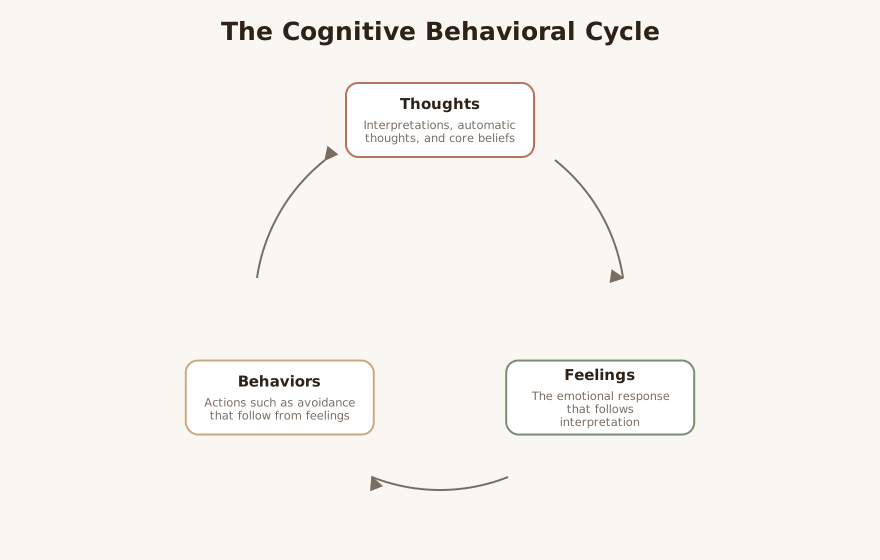
The core CBT model is, in the words of the StatPearls clinical reference, “a straightforward, common-sense model of the relationships among cognition, emotion, and behavior.”3 Events do not directly cause feelings; rather, the interpretation of an event drives the emotional and behavioral response — interpreting a friend’s silence as “he hates me” produces hurt and avoidance, whereas “he is in a hurry” does not.3 Distress is therefore understood to be maintained, in part, by habitual automatic thoughts and deeper core beliefs that are distorted, unhelpful, or untested against reality.3 Treatment helps clients identify these distressing thoughts and evaluate how realistic they are, so that more accurate appraisals can loosen the emotional and behavioral patterns that follow.5
Several structural principles distinguish CBT in practice.5 It is collaborative, emphasizing active participation and a shared, empirical stance toward the client’s beliefs.5 It is structured and time-sensitive, with each session organized around an agenda and the overall course typically time-limited.53 It is goal-oriented and present-focused, prioritizing current maintaining factors over extensive historical reconstruction.5 And it is fundamentally skills-based, aiming to teach the client to become their own therapist through techniques that generalize beyond the therapy hour.LLM
Interventions & Techniques
CBT delivers change through a recognizable set of cognitive and behavioral techniques, usually combined and sequenced to the presenting problem.37 On the cognitive side, cognitive restructuring — identifying, examining, and modifying distorted automatic thoughts and beliefs — is the signature method, often pursued through Socratic questioning, thought records, and behavioral experiments that test a belief against evidence.37 On the behavioral side, the toolkit includes behavioral activation (re-initiating positive, rewarding activities, central to depression treatment), exposure and desensitization to feared triggers (central to anxiety and panic), relaxation and arousal-reduction strategies, and contingency or skills training.3
A typical session follows a consistent architecture: a brief mood check, a bridge from the previous session, collaborative agenda-setting, review of homework (between-session practice that is integral, not optional), focused work on agenda items punctuated by feedback and summaries, assignment of new homework, and a closing summary.3 A standard course often runs roughly weekly for about 8 to 12 sessions of about 60 minutes, though length is tailored to the problem and severity.3
LLM-generated illustrative example (not a guideline): A client with social anxiety records the automatic thought “everyone will see I’m incompetent” before a meeting, rates its believability at 90/100, designs a behavioral experiment (ask one question aloud and observe reactions), and afterward re-rates the belief at 40/100 — pairing cognitive restructuring with graded exposure. LLM
Evidence Base
CBT has the most extensive empirical literature of any psychotherapy, and its overall maturity is best described as established.27 A widely cited review by Hofmann and colleagues examined 106 meta-analyses (selected from 269 identified) covering CBT across a broad range of problems and concluded that “the evidence-base of CBT is very strong.”2 That review found the strongest support for CBT of anxiety disorders, somatoform disorders, bulimia, anger control problems, and general stress.2 Where CBT was directly compared with other treatments, it showed higher response rates than the comparison condition in 7 of the relevant reviews, with only one review reporting lower response rates.2 The Beck Institute likewise notes that more than 2,000 studies have examined CBT’s efficacy across psychiatric, psychological, and medical problems with a psychiatric component.5
Honesty about the evidence is warranted alongside this strength.LLM The same review concluded that additional, rigorous randomized-controlled research is still needed in several areas, and crucially noted that — except for children and elderly populations — no meta-analytic studies of CBT had been reported for specific subgroups such as ethnic minorities and low-income samples, a meaningful generalizability gap.2 The picture is also uneven across conditions: support is robust for anxiety and several mood and stress-related presentations, while CBT for problems such as schizophrenia is typically adjunctive rather than standalone.3 CBT being well-supported does not mean it is invariably superior to every active comparator for every condition, and clinicians should match protocol to the disorder rather than assume uniform effects.LLM
Populations & Indications
CBT has been applied and studied across the lifespan — children, adolescents, adults, and older adults — and across a wide diagnostic span.32 It is a leading treatment for anxiety disorders and mood disorders specifically, and is also used for eating disorders, substance use, personality disorders, bipolar disorder, ADHD (including parent training and behavioral classroom management for children), insomnia, and medically related conditions such as irritable bowel syndrome, chronic fatigue, fibromyalgia, and chronic pain.3 Because its model is transdiagnostic and its techniques modular, CBT is often a sensible first-line consideration when a problem is maintained by identifiable thinking patterns and avoidance or activity deficits, and when a client is open to a structured, active, homework-based approach.4LLM
Problems-for-Work
CBT’s techniques map onto specific maintaining mechanisms, which is what makes problem selection straightforward.3 Representative targets and how the methods are applied:
- Major depressive disorder — behavioral activation to re-engage rewarding activity, plus restructuring of negative automatic thoughts about self, world, and future.3
- Generalized anxiety disorder — examining and modifying catastrophic and worry-driven cognitions and reducing avoidance.23
- Panic disorder — interoceptive exposure and desensitization to feared bodily sensations and triggers.3
- Social anxiety disorder — graded exposure to social situations paired with testing predictions about judgment and performance.2LLM
- Obsessive-compulsive disorder — exposure with response prevention combined with cognitive work on the meaning of intrusive thoughts.3LLM
- PTSD — restructuring trauma-related appraisals and reducing avoidance of trauma reminders.3LLM
- Insomnia — stimulus control, sleep restriction, and restructuring of sleep-related beliefs.3
- Eating disorders / bulimia — normalizing eating, addressing shape-and-weight cognitions, and interrupting binge-purge cycles.23
- Substance use disorders — identifying triggers, building coping skills, and modifying use-supporting beliefs.3
- Chronic pain — shifting catastrophic pain appraisals and increasing valued activity.3
- Phobias — graded in-vivo exposure with cognitive challenge of feared outcomes.3LLM
- Anger and irritability — recognizing provocation-related cognitions and rehearsing arousal-management skills.2
LLM-generated illustrative example (not a guideline): For a client with panic disorder, the therapist designs an interoceptive exposure (intentional breath-holding to provoke a tolerable racing heart), elicits the catastrophic prediction “I’m having a heart attack,” and after repeated trials the client gathers disconfirming evidence and the predicted catastrophe loses its grip. LLM
Contraindications, Cautions & Cultural Humility
CBT is broadly applicable and well-tolerated, but several cautions apply.3 Its structured, cognitively demanding, homework-driven format presupposes a degree of reflective capacity, motivation, and stability, so it may need adaptation — slowing, more behavioral emphasis, or a different approach — in acute crisis, significant cognitive impairment, or active psychosis where it is generally adjunctive rather than primary.3LLM CBT alone is not a substitute for medication or higher levels of care when those are indicated by severity or risk.LLM On cultural humility, the evidence base itself carries a notable gap: the Hofmann review highlighted that, outside of child and elderly samples, meta-analytic CBT research has not adequately covered ethnic minority and low-income populations, so clinicians should not assume that effects or assumptions about “rational” or “distorted” thinking transfer uncritically across cultural contexts.2 What one culture treats as a distortion may be an adaptive appraisal of real adversity, discrimination, or material constraint, and restructuring such cognitions can be invalidating; the corrective is to test beliefs against the client’s actual lived reality rather than a normative standard.LLM
Treatment-Plan Suggestions & SMART Objectives
Goals center on identifying and modifying maintaining cognitions and behaviors and on building durable, generalizable coping skills.LLM
| Goal | SMART objective (example) | Mechanism |
|---|---|---|
| Increase awareness of automatic thoughts | Within 3 weeks, client completes a thought record for ≥4 distressing situations per week | Cognitive monitoring |
| Restructure a target distorted belief | Over 6 weeks, client reduces believability of a core negative belief from 90/100 to ≤50/100, rated weekly | Cognitive restructuring |
| Re-engage rewarding activity (depression) | Over 4 weeks, client schedules and completes ≥3 pleasant or mastery activities per week, logged | Behavioral activation |
| Reduce avoidance via graded exposure | Over 8 weeks, client completes one step up a fear hierarchy per week, tracking anxiety pre/post | Exposure / desensitization |
| Build a between-session practice habit | For 6 weeks, client completes assigned homework ≥80% of weeks | Skills consolidation / generalization |
| Improve in-session collaboration and goal clarity | By session 3, client co-sets the session agenda and names ≥2 measurable treatment goals | Collaborative empiricism |
| Develop relapse-prevention plan | By the final phase, client produces a written plan of early-warning signs and coping responses | Maintenance / self-as-therapist |
These objectives are illustrative; tailor each to the individual client and track with a validated outcome measure. LLM
Common Misconceptions
- “CBT is just thinking positive.” CBT does not replace negative thoughts with positive ones; it tests thoughts against evidence for accuracy and helpfulness, which sometimes confirms a realistic appraisal.3LLM
- “CBT ignores emotions and the past.” Emotions are a central target of the model, and while CBT is present-focused, history is used to understand how core beliefs formed.3LLM
- “CBT is purely cognitive.” The behavioral half — activation, exposure, skills — is equally essential and often the most powerful component.3LLM
- “CBT is a single fixed manual.” CBT is a family of protocols sharing a common model, adapted by disorder and population.7LLM
- “Homework is optional.” Between-session practice is integral to the model and a key mechanism of generalization.3LLM
- “More CBT is always better.” It is typically time-limited, and many courses run roughly 8 to 12 sessions rather than open-endedly.3LLM
Training & Certification
CBT is taught within accredited graduate clinical and counseling programs and through specialized postgraduate training, supervision, and continuing education.LLM Competence is built through workshops, supervised practice, and consultation, and the Beck Institute is a primary source of structured CBT training, treatment-principle frameworks, and clinician resources, including demonstration material featuring Aaron and Judith Beck.56 There is no single mandatory license unique to CBT — it is practiced by licensed psychologists, social workers, counselors, and psychiatrists — though formal certification routes and beginner-to-advanced training pathways exist for clinicians seeking documented proficiency.5LLM
Key Terms
- Cognitive model — the framework that interpretation of an event, more than the event itself, drives emotional and behavioral response.5
- Automatic thoughts — rapid, often unexamined cognitions that arise in specific situations and shape feelings.3
- Cognitive distortions — characteristic patterns of invalid or biased thinking that maintain distress.3
- Core beliefs — deeper, generalized beliefs about self, others, and the world that underlie automatic thoughts.3
- Cognitive restructuring — identifying, examining, and modifying distorted thoughts and beliefs.7
- Behavioral activation — systematically re-engaging rewarding activity to interrupt the withdrawal cycle of depression.3
- Exposure / desensitization — structured, graded contact with feared stimuli to reduce avoidance and disconfirm catastrophic predictions.3
- Collaborative empiricism — the client and therapist jointly treating beliefs as hypotheses to be tested.LLM
Resources & Further Reading
▶ Watch — a video introduction to this concept:
- Hofmann, Asnaani, Vonk, Sawyer & Fang (2012). The Efficacy of CBT: A Review of Meta-analyses (PDF)
- Hofmann et al. (2012) — PubMed record
- Cognitive Behavior Therapy — StatPearls (NCBI Bookshelf)
- Cognitive-Behavioral Therapy — Oxford Bibliographies (Psychology)
- Beck Institute — Understanding CBT
- Cognitive and Behavioral Techniques in the Treatment of Depression — Beck Institute (YouTube)
- Cognitive Behavioral Therapy — Psychology Today
Related wiki articles: Acceptance & Commitment Therapy. Explore in the graph: Rational Emotive Behavior Therapy · Dialectical Behavior Therapy · or filter by Major depressive disorder and Generalized anxiety disorder.
Reflective / Supervision Questions
- When I label a client’s thought a “distortion,” am I testing it against their actual lived reality, or against my own cultural assumptions about what is rational?
- How do I tell the difference between genuine collaborative empiricism and subtly arguing a client into the appraisal I prefer?
- Am I delivering the behavioral half of CBT — activation and exposure — with the same rigor as the cognitive half, or defaulting to talk?
- When homework is repeatedly incomplete, am I treating it as resistance, or as data about fit, motivation, or the workability of the assignment?
- For this client, is CBT the right primary treatment, or should it be adjunctive to medication, higher-level care, or another modality?