
Type & Discipline
Flow is a psychological construct studied within positive psychology and the broader science of motivation and optimal experience, not a treatment modality 6. It names the state of being so fully absorbed in an activity that engagement becomes effortless and intrinsically rewarding, with heightened focus, a sense of control and mastery, and enjoyment for its own sake 6. The defining condition is a match between the difficulty of a task and the person’s skill: flow arises in the narrow band where challenge stretches capability without overwhelming it 6. The construct belongs to the family of optimal-experience and intrinsic-motivation theories and sits alongside self-determination theory and the humanistic tradition’s interest in growth and self-actualization LLM. For the clinician, flow functions as a target state and an explanatory lens — a name for the engaged, absorbed, intrinsically motivated experience that recovery from anhedonia, boredom, and demoralization often requires — rather than a technique billed in isolation LLM. Its clinical value is that it reframes “getting engaged” from a vague aspiration into a designable condition with specifiable inputs: clear goals, immediate feedback, and a tuned challenge-skill ratio 6.
Creators & Lineage
Flow was named and developed by the Hungarian-American psychologist Mihaly Csikszentmihalyi, who proposed the theory in the 1970s and consolidated it for a wide audience in his 1990 book Flow: The Psychology of Optimal Experience 61. His work began with a simple question — what makes life worth living and when do people feel most alive — pursued by studying artists, athletes, surgeons, and chess players who would lose themselves for hours in demanding activity with no external reward 4. To capture these moments as they happened rather than in retrospect, he pioneered the Experience Sampling Method, paging participants at random intervals to report what they were doing and how absorbed and happy they felt 4. The recurring report of effortless, self-forgetting absorption became the empirical basis of the construct 4. Csikszentmihalyi is widely regarded as a co-founder of the positive psychology movement alongside Martin Seligman, the field that turned psychology’s attention toward flourishing and engagement rather than pathology alone 4. He brought the idea to a general public through his book and a widely viewed TED talk on flow as a route to happiness 3. The lineage runs through humanistic psychology’s concern with growth and through theories of intrinsic motivation, and it is conceptually adjacent to self-determination theory, which independently models the conditions under which activity becomes self-sustaining LLM.
Core Principles
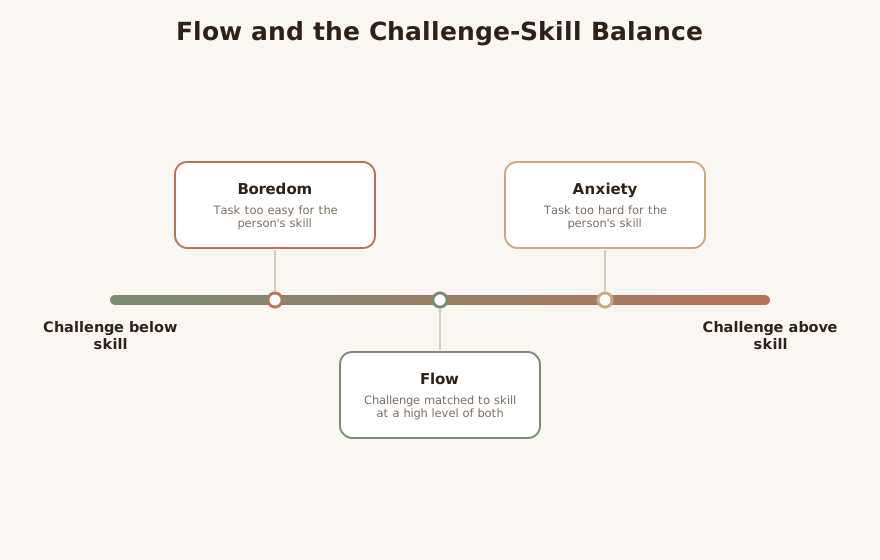
The first principle is the challenge-skill balance 6. Flow occupies the channel between two failure modes: when a task is too easy for a person’s skill they become bored and disengaged, and when it is too hard they become anxious and stressed 6. Optimal experience lives in the matched middle, where the demand of the activity meets capability closely enough that attention is fully recruited 6. Csikszentmihalyi’s later refinement adds that the match must occur at a relatively high level of both challenge and skill — being equally low on both yields apathy, not flow — so the richest flow tends to arise when a stretching challenge meets a well-developed skill 2.
The second cluster of principles concerns the phenomenology of the state itself, its recognizable signature 2. Flow typically involves clear proximal goals and immediate feedback so the person always knows what to do next and whether it is working; intense, undistracted concentration on the present task; a merging of action and awareness, where doing and noticing fuse; a loss of self-consciousness, the quieting of the inner monitor that evaluates performance; a sense of control over the activity; and a distortion of time, which commonly seems to pass faster than it is 2. The culminating principle is that the experience is autotelic — from the Greek for self-goal — meaning it is worth doing for its own sake, with the activity functioning as its own reward regardless of any outcome 2. Csikszentmihalyi further proposed an autotelic personality, a disposition toward finding intrinsic reward and entering flow more readily, though the trait is less firmly established than the state LLM.
Interventions & Techniques
There is no “flow therapy”; the construct informs how a clinician structures activity and frames engagement within an existing approach LLM. The most direct application is deliberate challenge-skill tuning: choosing or adjusting tasks so the difficulty sits just above the client’s current capability — hard enough to demand attention, not so hard as to provoke anxiety or avoidance 6. Because clear goals and immediate feedback are conditions of flow, a second technique is engineering them into otherwise vague or overwhelming activities: breaking a task into concrete next steps, defining what “done” looks like, and building in a way to see progress as it happens 6. This maps naturally onto graded-task and activity-scheduling work, where the clinician helps a client select activities likely to produce absorption rather than only distraction or duty LLM.
A third application is using the model diagnostically with the client: when an activity reliably bores them, the response is to raise the challenge or add complexity; when it reliably triggers anxiety or shutdown, the response is to build skill or lower the demand until it is workable 6. A fourth is identifying a client’s existing or past flow activities — the things in which they have lost track of time — and treating these as resources to protect, expand, and reintroduce, since they already supply intrinsic motivation that effortful “shoulds” do not 4. Across all of these, the clinician’s framing matters: the aim is not relentless productivity but restoring access to absorbed, self-rewarding engagement as a source of vitality and meaning LLM.
LLM-generated illustrative example (not a guideline): A clinician working with a client whose depression has flattened all interest helps them resurrect guitar, abandoned for years. Rather than “practice more,” they tune the challenge: the client picks one short song slightly above their rusty skill, sets a clear goal (play it through cleanly), and uses the recording as immediate feedback. The framing is explicit — the point is not achievement but re-entering a state of absorption the client once knew, to begin reversing anhedonia from the engagement side rather than the mood side. LLM
Evidence Base
The honest maturity label is established — but established as a research construct with a large descriptive literature, which is not the same as established as a treatment LLM. Flow is a well-defined, widely adopted, and heavily cited account of optimal experience, with a coherent theoretical model and decades of data gathered largely through the Experience Sampling Method across education, sport, work, and the arts 64. The core claim — that engagement and enjoyment peak when challenge matches skill, with boredom below the band and anxiety above it — is the model’s most reproduced finding, and the relationship between skill-challenge interaction and the flow state remains an active object of empirical study 56. The construct’s phenomenological dimensions (concentration, merging of action and awareness, time distortion, autotelic reward) are consistently reported across these diverse domains 2.
Honesty requires naming the construct’s limitations, which the academic literature states plainly LLM. First, flow research relies heavily on self-report, which is subject to recall and reporting biases and inaccuracies 6. Second, the basic theory does not adequately account for individual differences such as personality and motivation that shape who enters flow and how readily 6. Third, there are no clear, validated guidelines for inducing flow across different contexts — the model describes the conditions of the state far better than it prescribes a reliable procedure to produce it 6. There is also genuine scientific debate about the precise form of the challenge-skill relationship — whether a strict moment-to-moment balance is what matters or whether high challenge paired with high skill is the stronger predictor — which contemporary work continues to examine rather than settle 5. Finally, the great majority of flow evidence comes from non-clinical samples — students, athletes, workers, the general public — so applying flow as an intervention for clinical populations outruns the strongest data and should be done as an adjunct, tentatively, and never as a substitute for established treatment LLM. The defensible clinical claim is the mechanism — matched challenge plus clear goals and feedback tends to produce absorbed, intrinsically rewarding engagement — not a dose-response promise of symptom remission LLM.
Populations & Indications
Flow is most clinically useful where a deficit of engagement, motivation, or intrinsic reward is central to the presentation, rather than where acute symptom control or safety is the priority LLM. The construct was built largely from non-clinical high-functioning groups — athletes, artists and performers, and high achievers — for whom it explains peak performance and the sustaining of effortful practice 4. Students are a well-studied group, since matched challenge, clear goals, and feedback describe the conditions of deep, self-motivated learning and counter both boredom and performance anxiety 6. Workplace populations use flow to understand engagement, meaningful work, and the difference between draining and energizing tasks 6. Among clinical and subclinical presentations, adults with depression — especially where anhedonia, low motivation, and demoralization dominate — are a primary indication, because flow targets the diminished-engagement side of the disorder that symptom reduction alone can leave untouched LLM. People experiencing burnout and chronic disengagement may use the model to rebuild access to absorbing, restorative activity and to distinguish genuine engagement from mere busyness LLM. Across these groups flow is an adjunct lens and a target state, not a diagnosis-specific protocol LLM.
Problems-for-Work
In anhedonia and low motivation, the work is reintroducing tuned, absorbing activity — challenge matched just above current skill, with clear goals and visible feedback — to rebuild the capacity for intrinsic reward from the engagement side rather than waiting for mood to lift first 6. In boredom and lack of engagement, the model points directly to a remedy: the activity is under-challenging for the person’s skill, so the move is to raise complexity or add a meaningful goal until attention is fully recruited 6. In burnout, flow helps distinguish depleting overload (chronic challenge exceeding skill or capacity, producing anxiety and exhaustion) from genuinely restorative absorbed activity, and guides a client back toward the latter alongside the structural rest that burnout actually requires LLM. In low intrinsic motivation, identifying and protecting the client’s existing flow activities supplies self-sustaining reward that externally imposed effort does not, which can then scaffold harder work 4. In procrastination, the avoided task is often poorly structured — vague goals, no feedback, a daunting challenge-skill gap — and redesigning it toward flow conditions can lower the activation barrier LLM. In low life satisfaction, increasing the frequency of flow experiences is framed as a route to a more engaged and meaningful life, consistent with the construct’s positive-psychology roots, used as an adjunct to the primary treatment 3.
LLM-generated illustrative example (not a guideline): A clinician treating a client whose chronic procrastination centers on a stalled thesis reframes the avoidance through the flow lens. The task as it stands has no clear next step, no feedback, and a challenge that feels impossibly large — the opposite of flow conditions. Together they carve out a single concrete subtask sized just above the client’s current footing, with a defined endpoint and a way to see progress, aiming to convert a dreaded, formless task into one absorbing enough to actually enter. LLM
Contraindications, Cautions & Cultural Humility
Because flow is a construct rather than a procedure, most cautions concern misapplication and timing, not patient selection LLM. The most common error is conflating flow with productivity or perpetual busyness; chasing flow as relentless high performance can feed the very overwork and self-pressure that drive burnout, which is the opposite of the construct’s intent LLM. Flow’s quieting of self-consciousness and altered sense of time can be used to avoid rather than engage — absorbing activities (gaming, scrolling, compulsive work) can serve experiential avoidance and even tip into behavioral addiction — so the clinician should track what a given absorption is in service of 2. Flow work is poorly timed in acute crisis, fresh trauma, or active suicidality, where it can read as distraction and should yield to stabilization and safety-focused care LLM. It must not displace evidence-based treatment for moderate-to-severe disorders, where it is at most an adjunct LLM. Cultural humility matters: the construct carries an individualistic, achievement-oriented, and Western emphasis on personal optimal experience, and what counts as a worthy, absorbing, or appropriately challenging activity is shaped by culture, class, and access — so the clinician should let the client define their own meaningful activities rather than impose a default of solitary mastery pursuits LLM. Structural realities also constrain flow: people working multiple jobs, caregiving without respite, or living with material insecurity may have little discretionary attention or time, and no challenge-tuning exercise substitutes for changing those conditions LLM.
Treatment-Plan Suggestions & SMART Objectives
| Goal | SMART objective (example) | Mechanism |
|---|---|---|
| Reintroduce absorbing activity for anhedonia | Client identifies and engages in one past or potential flow activity for 30 minutes, 3 times weekly for 4 weeks, logging absorption | Restores intrinsically rewarding engagement to counter diminished reward 4 |
| Tune challenge to reduce boredom | Client raises the difficulty or adds a goal to one routinely boring activity weekly for 4 weeks and rates engagement | Closes the challenge-skill gap that produces boredom 6 |
| Build skill to reduce task anxiety | Client breaks one anxiety-provoking task into graded sub-steps and completes the easiest tier on 5 of 7 days for 3 weeks | Lowers excess challenge below the anxiety threshold toward the flow band 6 |
| Engineer clear goals and feedback | Client defines a concrete “done” point and a progress marker for one avoided task and starts it within each of 4 weeks | Supplies the goal-and-feedback conditions flow requires 6 |
| Increase frequency of flow experiences | Client schedules one immersive, challenge-matched activity weekly for 6 weeks and journals on absorption and enjoyment | Raises optimal-experience frequency to support engagement and life satisfaction 3 |
| Protect existing intrinsic motivation | Client safeguards one current flow activity from disruption on 5 of 7 days for 4 weeks | Preserves self-sustaining reward that scaffolds harder effort 4 |
| Reduce procrastination via task redesign | Client redesigns one chronically avoided task toward clear goals, feedback, and matched difficulty, then begins it weekly for 4 weeks | Lowers the activation barrier by approximating flow conditions LLM |
Common Misconceptions
The first misconception is that flow is just enjoyment, fun, or relaxation; it is a specific state of absorbed engagement requiring concentration and a tuned challenge, and it is more often described as effortful immersion than as ease 6. A second is that flow comes only from grand creative or athletic feats; the same conditions can arise in ordinary work, conversation, cooking, or study whenever challenge meets skill with clear goals and feedback, which is what makes it clinically practical 2. A third is that easier is always better; below the matched band, too-easy tasks produce boredom, not flow, so removing all difficulty defeats the purpose 6. A fourth is treating flow as synonymous with productivity or hustle; it is about the quality of engagement and intrinsic reward, not output, and weaponizing it for relentless performance can drive burnout LLM. A fifth is assuming flow is an unalloyed good in every instance; absorbing activities can serve avoidance or shade into compulsive use, so what the absorption is for matters 2. Finally, some treat flow as a proven clinical treatment, when the strong evidence concerns the state and its conditions, largely in non-clinical samples, making it a promising adjunct rather than an established therapy LLM.
Training & Certification
There is no certification in flow, because it is a scientific construct rather than a proprietary modality LLM. Clinicians typically encounter it through positive-psychology coursework, through Csikszentmihalyi’s primary book and his widely available TED talk, and through accessible explainers and academic overviews 136. Practitioners who want to apply flow-based ideas formally usually do so within an approach they are already trained in — cognitive behavioral therapy and behavioral activation, acceptance- and values-based work, well-being and resilience programs, performance and coaching frameworks, or occupational and educational settings — and use flow as the underlying rationale and engagement target LLM. No new scope of practice is created by using the construct; competence in the host modality the clinician is credentialed in remains the relevant qualification LLM. The practical path is to understand the challenge-skill model, the conditions and phenomenology of the state, and the construct’s evidentiary limits well enough to design for engagement honestly within existing competencies 6.
Key Terms
Flow — the state of fully absorbed, intrinsically rewarding engagement that arises when task challenge matches the person’s skill, marked by heightened focus, control, and enjoyment 6. Challenge-skill balance — the central condition of flow, the match between task difficulty and capability, with boredom below the match and anxiety above it 6. Autotelic experience — an activity worth doing for its own sake, where the doing is its own reward independent of outcome 2. Autotelic personality — a proposed disposition toward intrinsic reward and readier entry into flow, less firmly established than the state LLM. Merging of action and awareness — the fusion of doing and noticing in which the person and the activity become one process 2. Loss of self-consciousness — the quieting of the self-monitoring, self-evaluating inner voice during deep engagement 2. Time distortion — the altered sense of time, typically of its passing faster, that accompanies flow 2. Experience Sampling Method — Csikszentmihalyi’s technique of prompting people at random moments to report activity and experience, used to capture flow as it happens 4.
Resources & Further Reading
▶ Watch — a video introduction to this concept:
- Csikszentmihalyi, M. (1990). Flow: The Psychology of Optimal Experience — book notes
- Flow (psychology) — Wikipedia
- Mihaly Csikszentmihalyi: Flow, the secret to happiness — TED Talk
- Mihaly Csikszentmihalyi: The Father of Flow — PositivePsychology.com
- Analyzing Skill-Challenge Interaction and Flow State — Journal of Happiness Studies (2024)
- Flow Theory — TheoryHub, Newcastle University
Reflective / Supervision Questions
- When you introduce flow-based work, how do you confirm a client experiences absorbed engagement as restorative vitality rather than as one more performance demand to meet? LLM
- How do you judge whether a client is stable enough for engagement-focused work, versus still needing acute, safety-focused, or symptom-focused care? LLM
- When an activity reliably bores or reliably panics a client, are you reading that as data about the challenge-skill gap, and adjusting which lever you pull? LLM
- How do you tell the difference between flow that builds a client’s life and absorption that serves avoidance or compulsion, and what would alert you to the latter? LLM
- Whose definition of a worthy, meaningful activity is operating in the room — yours or the client’s — and have you accounted for the time, attention, and access their circumstances actually allow? LLM
- Are you presenting flow honestly, including that the strongest evidence is for the state and its conditions in non-clinical samples rather than for flow as a treatment? LLM
- What would tell you this lens is not helping a particular client, and what would you switch to? LLM