
Type & Discipline
Exposure therapy is a technique within clinical psychology, rooted in the learning-theory tradition of behavior therapy 8. It is defined as a psychological treatment developed to help people confront their fears by repeatedly and deliberately facing avoided objects, situations, memories, or bodily sensations in a structured way 3. Rather than a single branded protocol, it is a family of procedures and a core mechanism embedded across many evidence-based treatments, including cognitive behavioral therapy (CBT), Prolonged Exposure for PTSD, and Exposure and Response Prevention for OCD 8. Its theoretical foundation is respondent (Pavlovian) conditioning and its corollary, extinction 8. For the practicing clinician, exposure is best understood as a component technique delivered within a recognized psychotherapy modality rather than a stand-alone billable therapy LLM.
Creators & Lineage
The lineage runs from classical conditioning and behaviorism through several generations of clinical innovation 8. Joseph Wolpe (1915-1997) was among the first to frame psychiatric problems as behavioral issues and developed systematic desensitization in the late 1950s and early 1960s while working with traumatized World War II veterans 7. Wolpe built on Pavlovian principles, proposing counter-conditioning via reciprocal inhibition: anxiety and relaxation cannot fully coexist, so pairing relaxation with graded feared stimuli displaces the fear response 7. Edna Foa later operationalized exposure for trauma through Prolonged Exposure (PE) therapy, a behavioral and cognitive-behavioral treatment for PTSD combining imaginal and in vivo exposure with processing of the trauma memory, which the APA strongly recommends as a first-line PTSD psychotherapy 8. Michelle Craske and colleagues advanced the field’s mechanistic understanding by reframing exposure around inhibitory learning theory, now the most common conjecture for why exposure works 18.
Core Principles
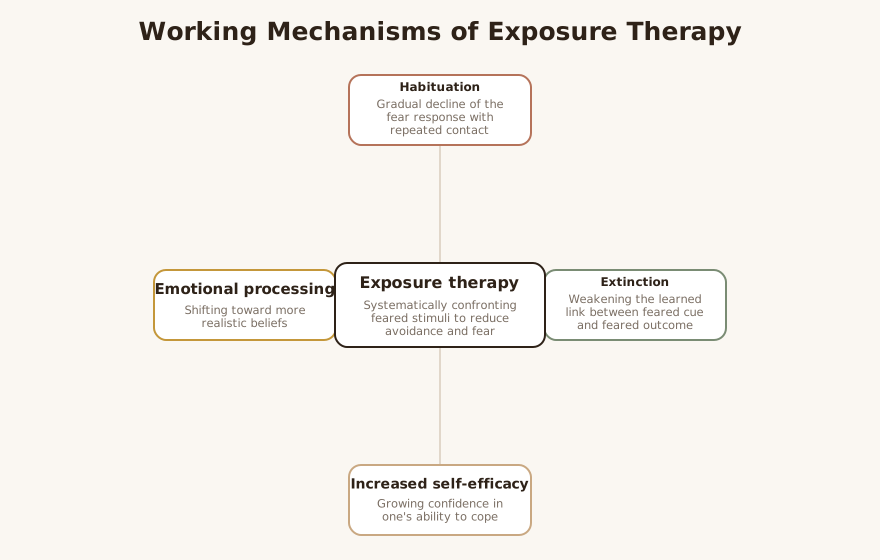
Classical accounts attributed exposure’s benefit to habituation, the gradual decline of the fear response with sustained or repeated contact 3. The APA still names four working mechanisms: habituation, extinction (weakening the learned link between the feared cue and a feared outcome), increased self-efficacy, and emotional processing toward more realistic beliefs 3. However, contemporary theory has shifted: habituation is now viewed more as a description of the therapeutic process than its causal mechanism 8. Inhibitory learning theory holds that the original fear association is not erased but is overlaid by new learning that the conditioned stimulus no longer predicts the feared outcome 18. This dual-association account explains why fears return through spontaneous recovery, renewal in new contexts, reinstatement after adverse events, and rapid reacquisition 1. Crucially, the degree of within-session fear reduction does not predict long-term outcome; new safety learning, not fear decline, is the target 14.
Interventions & Techniques
Exposure is delivered through several modalities, often combined: in vivo (real-world contact with the feared object or situation), imaginal (vividly recalling or imagining a feared scenario, central to trauma work), interoceptive (deliberately provoking harmless feared bodily sensations such as a racing heart), and virtual reality when real-world exposure is impractical 35. Written exposure, in which clients narrate a traumatic event, is also used 8. Pacing varies: graded (graduated) exposure ascends a hierarchy from milder to stronger stimuli, while flooding begins with the most feared item first 58. Systematic desensitization adds explicit relaxation pairing to graded exposure 5. The inhibitory-learning approach reframes each trial as a hypothesis test, structured around a specific behavioral goal, the client’s concrete prediction of a feared outcome, an exposure that continues until the expectancy is violated rather than until fear drops, and a post-exposure consolidation discussion asking what was feared, what happened, and what was learned 1.
LLM-generated illustrative example (not a guideline): A client with panic disorder predicts “If my heart races past 130, I will faint.” During interoceptive exposure (e.g., brief stair sprints), the clinician frames the trial to test that prediction, not to make anxiety subside, and afterward asks what the client learned about whether racing heart actually causes fainting LLM.
To strengthen and generalize new learning, Craske and colleagues describe optimization strategies: maximizing expectancy violation, deepened extinction (combining separately extinguished cues), occasional reinforced extinction to inoculate against relapse, removing safety signals and behaviors (reassurance, companions, medications), varying stimuli and intensity, using retrieval cues, conducting exposures across multiple contexts, and affect labeling (describing the emotion rather than reappraising it) 1.
Evidence Base
The maturity of exposure therapy is established, with strong and broad empirical support 2. APA Division 12 (Society of Clinical Psychology) lists exposure therapies for specific phobias among treatments with strong research support 2. Wikipedia summarizes exposure as the most successful known treatment for phobias, with meta-analytic data indicating that roughly 90% of people retained a considerable reduction in fear at four-year follow-up 8. Exposure-based protocols are recommended first-line treatments across PTSD, OCD (where Exposure and Response Prevention has the richest empirical support), social anxiety, agoraphobia, panic disorder, and generalized anxiety disorder 38. The mechanistic literature is itself well-developed: controlled studies show that neither the degree of fear reduction nor the ending fear level during exposure predicts therapeutic outcome, which has reshaped how the technique is taught and delivered 4. Honest framing for clinicians: efficacy is robust, but durability depends on consolidation and generalization, and relapse mechanisms are real and well-characterized 1.
Populations & Indications
Exposure therapy is indicated across the anxiety, trauma, and obsessive-compulsive spectrums and is appropriate for both adults and youth 38. Core populations include people with anxiety disorders, trauma survivors, veterans (a population central to the technique’s origins in both Wolpe’s and Foa’s work), children and adolescents with phobias, adults with panic disorder, and people with social anxiety 78. The APA names phobias, panic disorder, social anxiety disorder, OCD, PTSD, and generalized anxiety disorder as primary indications 3. Cleveland Clinic additionally lists agoraphobia, complex PTSD, acute stress disorder, and certain eating disorders 5. For PTSD specifically, imaginal exposure—having the client recall and describe the traumatic experience—is highlighted, and a 2024 systematic review found Exposure and Response Prevention highly effective for pediatric OCD 38.
Problems-for-Work
Exposure targets the avoidance-maintained fear that sits at the heart of many presentations 3. For specific phobia, a graded in vivo hierarchy disconfirms catastrophic predictions about the feared object 8. For panic disorder and fear of bodily sensations, interoceptive exposure repeatedly provokes the feared symptom to test beliefs that it signals catastrophe 35. For agoraphobia, in vivo exposure to avoided settings reduces situational avoidance 5. For social anxiety disorder, exposures (and occasional reinforced exposures such as deliberate minor social risks) target fears of judgment and rejection 1. For PTSD, imaginal exposure to the trauma memory plus in vivo work on trauma reminders reduces fear and avoidance 3. For OCD, Exposure and Response Prevention has the clinician guide the client to confront triggers while discontinuing the escape/ritual response 8. For generalized anxiety disorder, anticipatory anxiety, and avoidance behavior, exposure reduces the chronic over-prediction of threat that drives worry and withdrawal 8.
Contraindications, Cautions & Cultural Humility
Exposure can be distressing, especially early, and the clinician should monitor for worsening and maintain a safe, collaborative frame 5. Flooding carries a greater risk of overwhelming the client than graded approaches and is used selectively 7. A practical caution from inhibitory learning theory: reducing the client’s threat expectancy before exposure through reassurance or probability-correction can backfire by shrinking the mismatch between prediction and experience, weakening the learning 1. Likewise, distraction and safety behaviors (therapist presence, carried benzodiazepines) divert attention from the disconfirming contingency and undermine new learning 1. Cultural humility matters in calibrating what counts as a “feared outcome”: some avoidance is realistically protective, and the meaning of a feared situation is shaped by a client’s identity, history, and lived context, so hierarchies and expectancy tests must be co-constructed rather than imposed LLM. Adequate stabilization, informed consent about transient distress, and attention to genuine safety concerns should precede intensive exposure LLM.
Treatment-Plan Suggestions & SMART Objectives
| Goal | SMART objective (example) | Mechanism |
|---|---|---|
| Reduce phobic avoidance | Client completes top 3 hierarchy items for the feared object across 2 settings within 8 sessions | In vivo extinction across multiple contexts to offset renewal 1 |
| Disconfirm catastrophic panic belief | Client conducts interoceptive exposure 4x/week and rates change in belief that racing heart causes collapse by week 6 | Expectancy violation via interoceptive cues 13 |
| Decrease trauma-related avoidance | Client completes weekly imaginal exposure plus 1 in vivo reminder task for 8-15 sessions | Emotional processing and extinction of trauma cues 3 |
| Eliminate compulsive ritual | Client confronts a defined trigger daily and withholds the ritual, logging response prevention for 4 weeks | Response prevention with extinction (ERP) 8 |
| Tolerate uncertainty in worry | Client engages a feared “what-if” scenario without reassurance-seeking 3x/week for 6 weeks | Removal of safety/reassurance behaviors 1 |
| Generalize gains | Client repeats mastered exposures in 3 novel contexts and times before discharge | Multiple-context learning to reduce relapse 1 |
| Inoculate against setback | Client rehearses a brief planned exposure that may include a mild aversive outcome | Occasional reinforced extinction 1 |
Common Misconceptions
A persistent misconception is that exposure works by “calming down” within the session and that the clinician must keep going until anxiety subsides; in fact, neither the amount of fear reduction nor the ending fear level predicts outcome 14. A related error is treating habituation as the active ingredient—current theory views habituation as a feature of the process, not the mechanism of lasting change 8. Another myth is that exposure must be intense or flooding-based; graded, hierarchy-driven exposure is standard and safer 57. Clinicians sometimes assume exposure means simply enduring distress, when the optimized version is a deliberate hypothesis test built around violating a specific prediction 1. Finally, exposure is not retraumatizing when conducted properly; it is considered a safe and effective treatment, though distress early in treatment is expected 5.
Training & Certification
Exposure techniques are taught within graduate clinical training and CBT supervision, and historically were disseminated through influential behavior-therapy programs such as the Maudsley Hospital 8. For trauma, structured competence is commonly built through Prolonged Exposure training, given its strong APA recommendation as a first-line PTSD treatment 8. For OCD, clinician competence centers on Exposure and Response Prevention, the first-line psychotherapy with the richest empirical support 8. The contemporary standard of care increasingly incorporates the inhibitory-learning framework, so clinicians should seek supervision in designing expectancy-violation exposures, removing safety signals, and consolidating learning rather than relying on within-session fear monitoring 1. There is no single universal certification; competence is established through supervised practice in the relevant manualized protocol LLM.
Key Terms
Extinction: Pavlovian learning in which a conditioned stimulus stops predicting an aversive outcome; the associative basis of exposure 18. Inhibitory learning: New learning that overlays, rather than erases, the original fear association, inhibiting the fear response 18. Expectancy violation: Designing exposures so the feared outcome the client predicts fails to occur, maximizing learning 1. Habituation: Decline of the fear response with sustained or repeated exposure; historically considered the mechanism, now seen as process 38. SUDS (Subjective Units of Distress Scale): A 0-10 (or 1-10) self-rating used to build and track fear hierarchies 7. Safety signals/behaviors: Cues or actions (reassurance, companions, medication) that reduce engagement with the disconfirming contingency and impair learning 1. Reciprocal inhibition: Wolpe’s principle that relaxation and anxiety cannot fully coexist, underlying systematic desensitization 7. Interoceptive exposure: Deliberate provocation of feared, harmless bodily sensations 35.
Resources & Further Reading
▶ Watch — a video introduction to this concept:
- Maximizing exposure therapy: An inhibitory learning approach (Craske et al., 2014)
- Optimizing inhibitory learning during exposure therapy (Craske et al., 2008)
- What Is Exposure Therapy? (APA)
- Exposure Therapies for Specific Phobias — Society of Clinical Psychology (APA Division 12)
- Exposure Therapy: What It Is, What It Treats & Types (Cleveland Clinic)
- Systematic Desensitization Steps: 13 Techniques & Worksheets (Positive Psychology)
- Exposure therapy (Wikipedia)
Reflective / Supervision Questions
- When planning an exposure, can I state the client’s specific, measurable feared prediction, and is the exposure designed to violate it rather than to wait out the anxiety? 1
- Am I inadvertently introducing safety signals or pre-exposure reassurance that shrink the mismatch between prediction and outcome? 1
- How am I generalizing gains across contexts, times, and stimuli to guard against renewal and relapse? 1
- Am I conflating within-session fear reduction with treatment progress, when outcome is better predicted by new learning? 4
- How do I co-construct the hierarchy with cultural humility, distinguishing maladaptive avoidance from realistically protective caution? LLM
- When have I chosen graded exposure versus flooding, and is that choice justified by safety and client readiness? 7