
Type & Discipline
Mindfulness-Based Interventions (MBIs) are not a single therapy but an umbrella class of structured, secularized programs that adapt contemplative meditation practices for use in health care and clinical psychology 3. They sit within behavioral medicine and clinical psychology, and belong to the broader family of acceptance, mindfulness, and process-based therapies that emphasize changing one’s relationship to internal experience rather than directly disputing its content LLM. The prototypical members of this class are Mindfulness-Based Stress Reduction (MBSR) and Mindfulness-Based Cognitive Therapy (MBCT), from which a large number of “Mindfulness-Based X” adaptations have proliferated 5.
As a clinician, it is useful to hold MBIs as a format — typically an 8-week, group-based, manualized curriculum combining formal meditation training, psychoeducation, and home practice — rather than as a discrete diagnostic treatment 5. Most MBIs are delivered as a course or program; in routine practice their components are also woven into individual psychotherapy LLM.
Creators & Lineage
The clinical lineage of MBIs begins with Jon Kabat-Zinn, who in 1979 founded the Stress Reduction Clinic at the University of Massachusetts Medical Center and developed MBSR as a way to bring meditation into mainstream medicine for patients with chronic pain and stress-related conditions 37. Kabat-Zinn explicitly framed mindfulness in secular, operational terms — most famously as “the awareness that arises through paying attention, on purpose, in the present moment, and non-judgmentally” — while being candid that the practices derive from Buddhist meditation and contemplative traditions 36.
MBCT was the next major branch, developed by Zindel Segal, Mark Williams, and John Teasdale, who married the MBSR format to cognitive-behavioral theory specifically to prevent relapse in recurrent depression 2. This places MBIs at the confluence of two streams: Buddhist contemplative practice on one side and cognitive behavioral therapy on the other LLM. Acceptance and Commitment Therapy (ACT) is a parallel development in the same acceptance-and-mindfulness family, sharing the emphasis on present-moment awareness and acceptance, though it arose from relational frame theory rather than from the MBSR curriculum LLM.
Core Principles
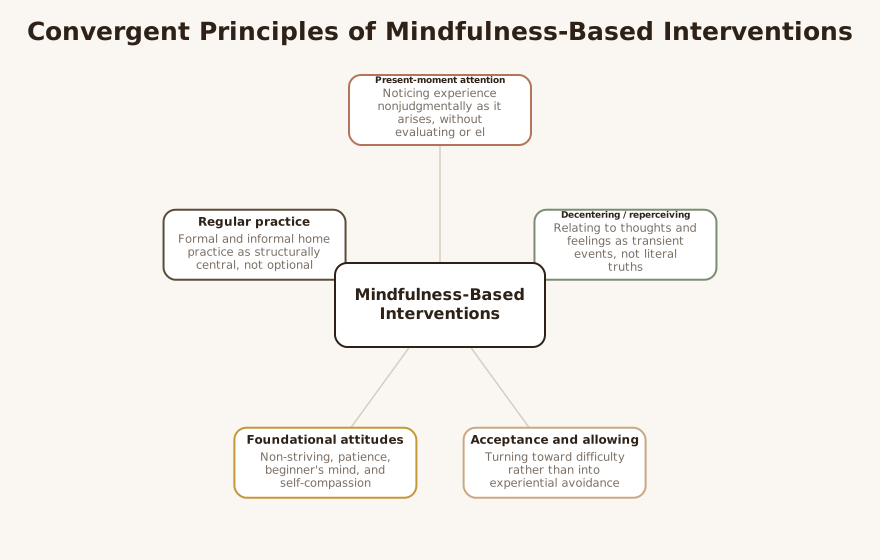
Several convergent principles run through the MBI family. The first is present-moment, nonjudgmental attention — deliberately noticing experience as it arises without immediately evaluating, suppressing, or elaborating it 3. The second is decentering or reperceiving: learning to relate to thoughts and feelings as transient mental events rather than as literal truths or commands to act, which is hypothesized to be the central change mechanism in MBCT’s prevention of depressive relapse 2LLM.
A third principle is acceptance and a stance of allowing, in deliberate contrast to experiential avoidance — turning toward difficulty rather than away from it 3. A fourth is the cultivation of attitudes Kabat-Zinn describes as foundational to practice — non-striving, patience, beginner’s mind, and self-compassion — which distinguish mindfulness practice from a results-oriented mental exercise 7. Finally, MBIs treat regular formal and informal practice as essential; the program is a training in a skill, and home practice between sessions is structurally central rather than optional 5LLM.
Interventions & Techniques
Standard MBI curricula draw on a recognizable set of formal practices. The body scan systematically moves attention through regions of the body, training sustained attention and interoceptive awareness 5. Sitting meditation anchors attention on the breath and then progressively widens to sounds, thoughts, and emotions 5. Mindful movement, often gentle Hatha yoga in MBSR, brings the same attentional stance to the moving body 5. Informal practice extends mindfulness to daily activities — eating, walking, washing dishes — so that the skill generalizes beyond the cushion 7.
MBCT layers cognitive-behavioral elements onto this scaffold: psychoeducation about the relapse signature of depression, identification of personal warning signs, and the construction of an individualized relapse-prevention “action plan,” together with the three-minute breathing space as a brief practice to interrupt ruminative spirals 2LLM. Across programs, the work is delivered over roughly eight weekly sessions in a group, supported by daily home practice and frequently an all-day silent retreat 5.
LLM-generated illustrative example (not a guideline): A clinician adapting MBI principles in individual therapy might guide a client who ruminates after work to label thoughts as “planning” or “worrying,” return attention to the breath, and notice the bodily pull to keep ruminating — practicing decentering rather than problem-solving the content LLM.
Evidence Base
The evidence base for MBIs is established but should be characterized with precision rather than enthusiasm. The most influential cautious appraisal is the Goyal et al. (2014) systematic review and meta-analysis in JAMA Internal Medicine, which found that mindfulness meditation programs produced moderate evidence of small-to-moderate reductions in anxiety, depression, and pain, but low or insufficient evidence for effects on positive mood, attention, substance use, eating, sleep, and weight 1. Crucially, that review found little evidence that meditation programs were superior to active comparators such as exercise or other behavioral therapies, underscoring that MBIs are effective but not uniquely or dramatically so 1.
Subsequent broad reviews echo this: MBIs show benefit across a range of physical and psychological conditions, while the literature remains limited by methodological heterogeneity, variable comparators, and inconsistent active controls 5. The strongest and most specific indication is relapse prevention in recurrent depression. APA Division 12 lists MBCT as having strong/modest research support for that indication 2, and a network meta-analysis of MBCT for preventing depressive relapse found it reduced relapse risk and increased time to relapse relative to usual care, with effects comparable to maintenance antidepressants in several comparisons 4. Benefit appears most pronounced for patients with a greater number of prior depressive episodes 4LLM.
The honest summary for clinicians: MBIs reliably produce modest improvements in stress, anxiety, depression, and pain, have a well-supported niche in depressive-relapse prevention, and are generally not demonstrably superior to other active treatments — making them a reasonable, evidence-supported option rather than a first-line cure-all 14LLM.
Populations & Indications
MBIs were originally developed for, and remain well-suited to, adults with stress-related and chronic medical conditions, including chronic pain and other chronic illness, the populations of Kabat-Zinn’s original Stress Reduction Clinic 37. They have moderate support for people with anxiety or depression, with the clearest indication being maintenance for individuals with recurrent major depressive disorder in remission 124.
The broader review literature describes application across additional groups, including people with chronic pain, where small-to-moderate effects are documented, and explorations in substance use disorders, though Goyal et al. judged the evidence for substance use to be insufficient 15. MBIs are also widely used with healthcare professionals and other high-stress occupational groups for burnout and stress management, an application area reflected in the program’s dissemination into workplaces 56.
Problems-for-Work
- Stress and burnout. The founding indication; MBSR was designed for stress reduction and has moderate evidence for reducing perceived stress, with widespread occupational use 15.
- Generalized anxiety disorder. Moderate-strength evidence supports small-to-moderate reductions in anxiety symptoms 1.
- Major depressive disorder (recurrent, in remission). The best-supported indication, via MBCT for relapse prevention 24.
- Chronic pain. Moderate evidence for small improvements; valuable for changing the relationship to pain rather than eliminating sensation 1.
- Rumination. Targeted directly by decentering and the breathing space, which interrupt ruminative cycles implicated in depressive relapse 2LLM.
- Emotional dysregulation. Cultivating nonjudgmental awareness of affect supports tolerating and observing emotion rather than reacting 3LLM.
- Insomnia and substance use disorders. Plausible and frequently attempted applications, but Goyal et al. rated sleep and substance-use evidence as low or insufficient — apply with appropriate caution 1.
LLM-generated illustrative example (not a guideline): A primary-care patient with recurrent depression in remission and two prior episodes might be referred to an 8-week MBCT group as relapse prevention, learning to recognize early warning signs (sleep change, withdrawal) and use a brief breathing space at those moments rather than waiting for a full relapse LLM.
Contraindications, Cautions & Cultural Humility
MBIs are generally low-risk, but they are not inert, and a few cautions matter clinically. Intensive meditation can occasionally precipitate distressing experiences, and patients with acute psychosis, severe dissociation, or acute trauma activation may find sustained interoceptive attention destabilizing; screening and clinical judgment are warranted before group enrollment LLM. MBCT was specifically validated for relapse prevention in remitted depression, not as an acute treatment for a current severe depressive episode — a distinction clinicians should preserve 2LLM.
The format also has demands that function as practical exclusions: MBIs require substantial home practice, group participation, and motivation, and patients unable or unwilling to commit to daily practice are unlikely to benefit 5LLM. On cultural humility, clinicians should remember that mindfulness practices are adapted from Buddhist and contemplative traditions; Kabat-Zinn deliberately secularized them, but practitioners should present them with respect for that origin, avoid implying a religious requirement, and remain attentive to whether a meditation framing fits a given patient’s worldview and values 36LLM.
Treatment-Plan Suggestions & SMART Objectives
| Goal | SMART objective (example) | Mechanism |
|---|---|---|
| Reduce perceived stress | Patient completes a daily 10-minute formal practice at least 5 days/week for 8 weeks, logged in a practice diary | Sustained attention training and arousal regulation 15 |
| Decrease depressive relapse risk | Patient attends ≥6 of 8 MBCT sessions and produces a written relapse-prevention action plan within 8 weeks | Decentering plus early-warning-sign recognition 24 |
| Reduce rumination | Patient applies a 3-minute breathing space at the onset of identified rumination ≥4 times/week, tracked for 4 weeks | Interruption of ruminative cycling via decentering 2LLM |
| Improve emotion regulation | Patient labels and observes one strong emotion without acting on it daily for 3 weeks, rated 0-10 for reactivity | Nonjudgmental awareness reduces automatic reactivity 3LLM |
| Change relationship to chronic pain | Patient completes a 20-minute body scan 4x/week and rates pain interference (not intensity) weekly for 6 weeks | Acceptance and altered appraisal of sensation 1LLM |
| Reduce burnout (clinician/caregiver) | Patient integrates 3 informal mindfulness practices into the workday daily for 1 month | Generalization of present-moment awareness to routine activity 5LLM |
| Increase present-moment awareness | Patient reports a measurable rise on a mindfulness self-report measure over an 8-week program | Repeated formal and informal practice 5LLM |
Common Misconceptions
A first misconception is that mindfulness means emptying the mind or achieving relaxation; the actual instruction is to notice whatever arises nonjudgmentally, with relaxation a frequent byproduct rather than the goal 37. A second is that MBIs are a uniformly powerful treatment — the strongest evidence shows modest effects that are generally not superior to other active treatments, so overselling them misrepresents the data 1.
A third is that mindfulness is inherently religious; while it derives from Buddhist contemplative practice, the clinical programs were intentionally secularized for medical settings 36. A fourth is conflating MBSR and MBCT: MBSR is a general stress-reduction program, whereas MBCT is a depression-specific relapse-prevention protocol with cognitive-behavioral content, and they are not interchangeable for a given indication 2LLM. Finally, mindfulness is not simply “thinking positively” or distraction — it is approach-oriented, asking patients to turn toward difficulty rather than away from it 3LLM.
Training & Certification
Competent MBI delivery is generally understood to require the teacher’s own established personal meditation practice, not merely knowledge of the curriculum — a point Kabat-Zinn has emphasized as central to teaching authentically 36. MBSR and MBCT have structured teacher-training pathways, typically involving foundational training, supervised teaching of the protocol, attendance at silent retreats, and ongoing supervision and continuing development 5LLM.
For clinicians who wish to deliver the full manualized programs, the appropriate route is recognized MBSR or MBCT teacher training rather than self-directed adoption; for those integrating mindfulness skills into existing psychotherapy, a sustained personal practice plus familiarity with the source protocols is the realistic minimum 7LLM. Kabat-Zinn’s own site and talks remain useful orienting resources to the spirit and standards of the work 67.
Key Terms
- Mindfulness — paying attention, on purpose, in the present moment, and nonjudgmentally 3.
- MBSR (Mindfulness-Based Stress Reduction) — the original 8-week program for stress and chronic illness developed by Kabat-Zinn 37.
- MBCT (Mindfulness-Based Cognitive Therapy) — an MBSR-derived program integrating CBT for prevention of depressive relapse 2.
- Decentering / reperceiving — relating to thoughts and feelings as passing mental events rather than facts; a proposed core mechanism 2LLM.
- Body scan — a formal practice of sequentially attending to regions of the body 5.
- Three-minute breathing space — a brief MBCT practice to interrupt automatic reactivity and rumination 2.
- Experiential avoidance — habitual attempts to escape internal experience, which mindfulness practice is intended to counter 3LLM.
Resources & Further Reading
▶ Watch — a video introduction to this concept:
- Goyal et al. (2014), Meditation Programs for Psychological Stress and Well-being — JAMA Internal Medicine
- APA Division 12 — Mindfulness-Based Cognitive Therapy for Depression
- Kabat-Zinn (2003), Mindfulness-Based Interventions in Context: Past, Present, and Future
- MBCT for prevention and time to depressive relapse — systematic review and network meta-analysis
- Mindfulness-based interventions: an overall review (PMC)
- Jon Kabat-Zinn — Mindfulness, Stress Reduction & Healing (Talks at Google)
- Jon Kabat-Zinn — official site / MBSR overview
Reflective / Supervision Questions
- For a given patient, am I recommending an MBI because the evidence supports it for their specific problem, or because mindfulness is broadly popular? How would I justify the choice from the data 1LLM?
- Do I distinguish clearly between MBSR for general stress and MBCT for depressive-relapse prevention when setting goals, or am I treating “mindfulness” as one undifferentiated tool 2LLM?
- Have I screened for situations — acute psychosis, severe trauma activation, current severe depression — where sustained meditation could destabilize a patient rather than help LLM?
- Do I have enough of my own practice and training to teach this credibly, or am I delivering a technique I have only read about 36LLM?
- How am I attending to cultural and spiritual fit — presenting mindfulness in a way that respects its contemplative origins without imposing a worldview the patient does not share 3LLM?
- Am I honest with patients and in my documentation about realistic, modest expected benefits rather than overpromising 1LLM?