
Type & Discipline
Co-regulation (also called dyadic regulation or mutual regulation) is a construct from developmental psychobiology rather than a treatment modality in its own right LLM. It names the interactive, bidirectional process by which two nervous systems shape one another’s physiological and affective states in real time LLM. The construct sits at the intersection of infant research, attachment science, and affective neuroscience, and it has become a connective concept that clinicians borrow across many modalities LLM. Its most famous empirical demonstration is the Still-Face Paradigm, in which a caregiver is asked to hold a neutral, unresponsive expression toward their infant for a brief period 3.
For practicing therapists, the practical upshot is that “regulation” is not solely an internal skill the client either has or lacks; it is something originally built between people and, in therapy, partly rebuilt between client and clinician LLM. Understanding co-regulation reframes a dysregulated client not as failing at a solo task but as lacking sufficient relational scaffolding to organize their state LLM.
Creators & Lineage
The construct is most closely associated with Edward Tronick, a developmental psychologist long affiliated with the University of Massachusetts Boston and its Infant-Parent Mental Health Program 2. Tronick designed and popularized the Still-Face Paradigm in the 1970s as a way to make the infant’s contribution to social interaction observable and measurable 3. His later “mutual regulation model” framed early development as an ongoing dyadic negotiation of states rather than a one-way transmission from caregiver to child LLM.
The lineage runs through several converging traditions LLM. Attachment theory (Bowlby and Ainsworth) supplied the idea that the caregiver functions as a secure base and that the quality of early interaction has lasting consequences LLM. Affect regulation theory, associated with Allan Schore, emphasized the right-brain-to-right-brain transmission of affect and the maturation of regulatory circuitry through repeated dyadic experience LLM. Polyvagal theory (Stephen Porges) later offered an autonomic-nervous-system account of why a calm, attuned other can down-regulate another person’s physiology through cues of safety LLM. Tronick’s work, with Claudia M. Gold, extended these ideas to a lifespan and clinical audience in The Power of Discord, arguing that the repair of inevitable mismatches — not flawless attunement — is what builds resilience and trust 6.
Core Principles
The first principle is bidirectionality: regulation is not something a caregiver does to an infant but something the pair does together, with the infant actively signaling, eliciting, and contributing 3. The Still-Face procedure exposes this by removing one partner’s responsiveness and showing how quickly the interaction destabilizes 3.
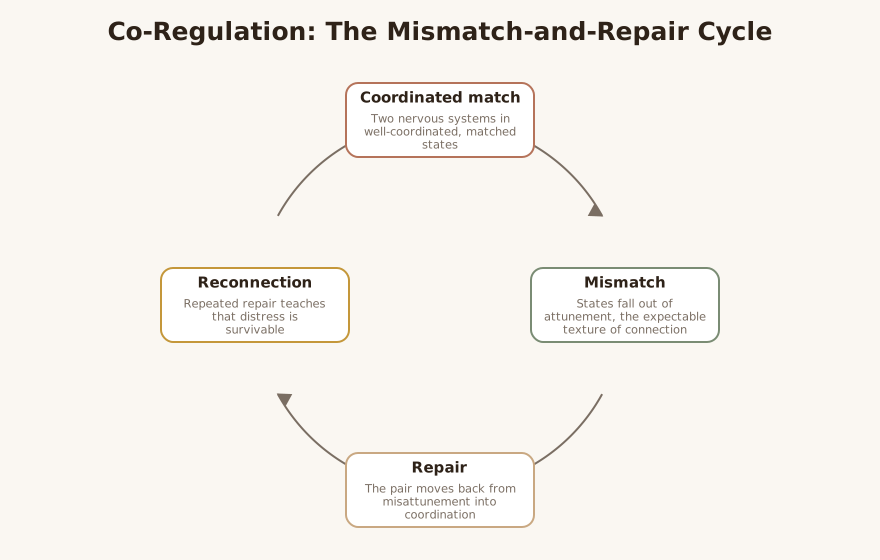
The second principle is mismatch and repair. Tronick’s signature claim, developed in his published work, is that well-coordinated, matched states occupy only a minority of ordinary interaction — on the order of roughly a third of the time — and that the normal flow of relationship is a cycle of mismatch followed by repair 6. Far from being a failure, mismatch is the expectable texture of connection, and the repeated experience of moving from misattunement back into coordination is what teaches the developing person that distress is survivable and reconnection is possible 6.
The third principle is that co-regulation precedes and scaffolds self-regulation LLM. The capacity to soothe oneself is understood as an internalization of many experiences of being soothed in relationship LLM. The fourth principle is that this process is physiological, not merely behavioral: the partners are influencing one another’s autonomic arousal, and the infant’s stress response in the Still-Face is detectable in bodily measures, not only in facial affect 4.
Interventions & Techniques
Because co-regulation is a construct rather than a manualized therapy, “techniques” means the concrete clinical moves that operationalize it LLM. In dyadic work, clinicians coach caregivers in attunement and contingent responsiveness — reading the child’s cues and responding in a timely, matched way — and explicitly normalize that perfect synchrony is neither possible nor the goal 6. Rupture-and-repair coaching teaches caregivers to notice breaks in connection and to actively repair them, treating repair as the therapeutic ingredient rather than the avoidance of all rupture 5.
With adolescents and adults, the same logic informs the clinician’s use of their own regulated presence — pacing, prosody, breathing, and nonverbal cues of safety — to help an activated client’s nervous system organize before cognitive work begins LLM. Tracking arousal in session (signs of hyperarousal or hypoarousal) and deliberately down- or up-regulating through the relationship is a direct application LLM. In couples work, partners can be coached to function as regulatory resources for one another and to recognize and repair the “still-face” moments of withdrawal and unresponsiveness that escalate conflict LLM.
LLM-generated illustrative example (not a guideline): A clinician notices a client’s speech speeding and shoulders rising as they describe a confrontation. Rather than pursuing content, the clinician slows their own cadence, lowers their voice, and says, “Let’s let your system catch up before we go further.” The pacing of the dyad shifts and the client’s breathing deepens — co-regulation enacted in the room before any reframe is offered LLM.
Evidence Base
The evidentiary maturity here is established for the underlying phenomenon and more variable for specific clinical applications LLM. The Still-Face effect itself is one of the most robustly replicated findings in developmental science: across a large body of studies summarized in meta-analysis, infants reliably show a characteristic shift during the still-face episode — a drop in positive affect and gaze toward the caregiver and a rise in negative affect and gaze aversion — that distinguishes it from ordinary play 1. The meta-analytic literature also examines how this response varies with caregiving context and risk, treating the paradigm as a window onto the quality of the dyad rather than a fixed infant trait 1.
Importantly, the response is not only behavioral. Physiological studies show that infants mount a measurable autonomic stress response to the still-face, and that the degree of physiological regulation is related to the caregiving relationship rather than being purely constitutional 4. This is what licenses the language of two nervous systems: the body, not just the face, registers the loss and recovery of contingent responsiveness 4.
Clinicians should be honest about the gap between this strong basic-science foundation and the looser evidence for any particular co-regulation-informed adult intervention LLM. The construct is well validated; the leap to a specific protocol for a specific adult population is often an inference, and should be presented to clients and supervisors as such LLM.
Populations & Indications
The paradigm’s home population is infants and young children and the parent-child dyads that surround them, where it directly informs assessment and dyadic intervention 3. By extension, work with caregivers — supporting their own regulation so they can serve as a regulatory resource — is a primary indication 6.
Beyond early childhood, the construct is applied with people with trauma histories and people with attachment disturbances, for whom solo emotion-regulation strategies often fail precisely because the original co-regulatory scaffolding was absent or frightening LLM. It also informs couples work, where each partner’s capacity to be a calming presence — and to repair withdrawal — is a treatment target LLM. In each case the indication is the same: distress that is hard to organize alone and more tractable in a safe, attuned relationship LLM.
Problems-for-Work
The construct maps onto a recognizable cluster of clinical problems LLM. For emotional dysregulation and affect regulation deficits, co-regulation reframes the goal as building, in relationship, the regulatory capacity that was under-developed — for example, a clinician using their regulated presence to help a client return to baseline after a flooding episode LLM. For hyperarousal/hypoarousal and distress tolerance, the dyad becomes the means by which the client’s nervous system practices moving back into a tolerable range LLM. For anxiety, attuned co-regulatory contact can interrupt escalation before exposure or cognitive work LLM.
In dyadic and family contexts it addresses attachment disturbances, developmental trauma, parent-child relational problems, and presentations consistent with reactive attachment disorder, where the repair of repeated relational ruptures is the active ingredient LLM. For instance, coaching a caregiver to notice and repair a “still-face” moment of distraction can be a concrete, observable target across sessions 5.
Contraindications, Cautions & Cultural Humility
Co-regulation is a frame, not a stand-alone treatment, and should not displace indicated trauma or psychiatric care LLM. The Still-Face Paradigm is a research and assessment procedure, not a home exercise; clinicians should never instruct distressed caregivers to deliberately go unresponsive with their child as a “lesson,” which risks unnecessary distress and misunderstanding of the procedure’s purpose LLM. The procedure is a brief, controlled demonstration precisely so that repair follows immediately 3.
A central caution concerns interpretation: the speed of infant recovery is meaningful only in context, and the paradigm is best read as information about the dyad and its environment, not as a verdict on a caregiver’s worth 1. Cultural humility is essential here, because norms for gaze, facial expressiveness, physical contact, soothing, and the very meaning of “responsiveness” vary widely across families and communities LLM. What reads as attuned or as withdrawn is culturally patterned, and clinicians must hold their own developmental templates lightly rather than pathologizing difference LLM. With adults, sustained therapist regulation should not become a substitute for the client developing their own capacities, and caregivers should never be shamed for the inevitable mismatches that the model itself frames as normal and necessary 6.
Treatment-Plan Suggestions & SMART Objectives
| Goal | SMART objective (example) | Mechanism |
|---|---|---|
| Build dyadic capacity to repair ruptures | Within 8 weeks, caregiver will identify and verbally repair at least 2 observed disconnection moments per session in 3 consecutive dyadic sessions LLM | Repeated mismatch-and-repair cycles consolidate the expectation that reconnection is possible 6 |
| Increase caregiver contingent responsiveness | Over 6 sessions, caregiver will demonstrate timely response to 3 of the child’s distress or bid cues per observed play interval LLM | Contingent responsiveness restores the matched states that scaffold the child’s regulation 3 |
| Improve client tolerance of arousal | Within 10 sessions, client will use a co-regulatory grounding sequence with the clinician to return to baseline within 5 minutes on 4 occasions LLM | Relationally-supported down-regulation widens the window of tolerable arousal 4 |
| Reduce conflict escalation in the couple | Within 12 weeks, each partner will name 1 “still-face” withdrawal moment and initiate repair in 3 sessions LLM | Recognizing and repairing unresponsiveness interrupts the disconnection cycle 5 |
| Strengthen caregiver self-regulation | Over 8 weeks, caregiver will report using 1 self-soothing strategy before responding to the child on 5 documented occasions LLM | A regulated caregiver can serve as a stable regulatory resource for the child 6 |
| Normalize imperfect attunement | By session 4, caregiver will articulate that mismatch is expectable and that repair, not perfection, is the goal, in their own words LLM | Reframing reduces caregiver shame that otherwise blocks repair 6 |
Common Misconceptions
A frequent misconception is that the Still-Face Experiment proves “ignoring your baby causes damage”; in fact the procedure is a brief, repaired demonstration of the infant’s active social expectations, not evidence that ordinary momentary inattention is harmful 3. A related error is treating flawless attunement as the standard; Tronick’s own model holds that mismatch is the majority of normal interaction and that repair, not perfection, builds resilience 6.
Another misconception is that co-regulation is “just being nice” or generic warmth; it specifically refers to the contingent, moment-to-moment shaping of physiological and affective states, which the body registers measurably 4. Finally, some assume co-regulation is only relevant to infancy; the construct is increasingly applied across the lifespan, including with adults and couples, precisely because the same relational mechanism continues to operate 5.
Training & Certification
There is no single certification in “co-regulation” because it is a construct woven through many trainings rather than a licensed modality LLM. Formal exposure typically comes through infant and early-childhood mental health programs, such as the Infant-Parent Mental Health work associated with Tronick at UMass Boston, and through dyadic intervention trainings that operationalize the concept 2. Clinicians also encounter it within attachment-based, trauma-informed, and affect-regulation-oriented trainings LLM. For self-study, Tronick’s filmed demonstrations and The Power of Discord are accessible entry points before pursuing supervised dyadic practice 3.
Key Terms
Still-Face Paradigm — an experimental procedure in which a caregiver holds a neutral, unresponsive face toward the infant for a brief interval, revealing the infant’s reaction to the loss of contingent responsiveness 3. Mutual regulation model — Tronick’s framework casting development as an ongoing dyadic negotiation of states 2. Mismatch and repair — the normal cycle in which coordination is repeatedly lost and re-established, with repair as the engine of resilience 6. Contingent responsiveness — caregiver responses that are timely and appropriately matched to the child’s signals 3. Autonomic stress response — the bodily, nervous-system level reaction to the still-face, indexed physiologically rather than only behaviorally 4. Window of tolerance — the arousal range within which a person can stay organized, which co-regulation helps widen LLM.
Resources & Further Reading
▶ Watch — a video introduction to this concept:
- The many faces of the Still-Face Paradigm: A review and meta-analysis (Mesman, van IJzendoorn & Bakermans-Kranenburg)
- Edward Tronick — UMass Boston / Infant-Parent Mental Health Program
- Still Face Experiment: Dr. Edward Tronick (video)
- Infant physiological response to the still-face paradigm (Conradt & Ablow)
- The Still-Face Experiment and what it teaches about co-regulation (Stay Rooted Counselling)
- The Power of Discord (Edward Tronick & Claudia M. Gold)
Reflective / Supervision Questions
- When a client becomes dysregulated in session, how aware am I of my own autonomic state, and am I offering co-regulation or unconsciously matching their escalation? LLM
- Do I hold “perfect attunement” as an implicit standard, and how might that lead me — or the caregivers I coach — toward shame rather than repair? LLM
- How do I distinguish a culturally different style of responsiveness from a genuine regulatory rupture, and whose norms am I using to judge? LLM
- In what ways might my use of sustained co-regulation be inadvertently keeping a client dependent rather than building their own capacity? LLM
- When a rupture occurs between me and a client, do I treat it as a failure to be avoided or as a repairable opportunity that can deepen the work? LLM