
Type & Discipline
Attachment theory is a developmental and clinical theory describing how early bonds between an infant and primary caregivers shape enduring patterns of relating across the lifespan 1. It originated within developmental psychology and ethology and now informs clinical work across psychodynamic, family, and couples modalities 1. The theory proposes that humans possess an innate, evolutionarily selected behavioral system that motivates proximity-seeking to a protective figure under conditions of threat, fatigue, or distress 4. It is a theory of normative human development and, separately, a framework for individual differences in how that system becomes organized 4. Attachment theory is not itself a standalone, billable psychotherapy; it is a conceptual lens that informs treatment delivered within recognized modalities LLM.
Creators & Lineage
The theory was formulated by British psychoanalyst and psychiatrist John Bowlby, who broke from classical drive theory to argue that the infant’s tie to the caregiver was a primary biological need rather than a derivative of feeding 2. Bowlby drew heavily on ethology, particularly Konrad Lorenz’s work on imprinting in precocial birds, which suggested that early proximity-maintaining behavior could be biologically prepared rather than learned through reinforcement 5. His thinking also incorporated evolutionary biology, control-systems theory, and observations of institutionalized and separated children in the post-war period 3. Mary Ainsworth, who collaborated with Bowlby beginning in the 1950s, supplied the empirical and observational backbone, including naturalistic studies in Uganda and Baltimore and the laboratory paradigm that operationalized individual differences 3. Bretherton’s history documents how this partnership fused Bowlby’s grand theoretical synthesis with Ainsworth’s methodological rigor 3. The theory’s intellectual lineage connects to object relations theory and psychodynamic thought, and it later seeded developmental psychopathology and Emotionally Focused Therapy LLM.
Core Principles
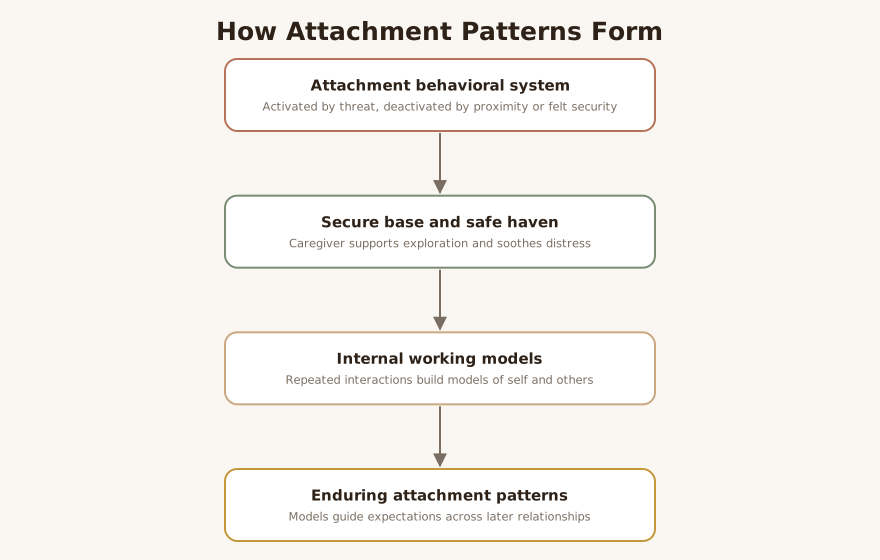
Attachment theory rests on the premise of a normative attachment behavioral system shared by all typically developing infants, activated by threat and deactivated by attained proximity or felt security 4. The caregiver functions as a secure base from which the child explores and a safe haven to which the child returns when distressed 6. Through repeated interactions, the child constructs internal working models — mental representations of the self as worthy or unworthy of care and of others as available or rejecting — that guide expectations in later relationships 6. Bowlby additionally proposed monotropy, a bias toward one principal attachment figure, and a sensitive period in roughly the first years of life during which attachment formation is most consequential 2. The Simpson and colleagues statement of principles distinguishes the species-typical system from the dimension of individual differences, where variations in caregiver sensitivity produce systematically different strategies for regulating proximity and affect 4. Importantly, the strength of an infant’s attachment behavior in a given moment does not index the strength of the underlying bond 8.
Interventions & Techniques
Because attachment theory is a framework rather than a manualized protocol, its techniques are expressed through host modalities LLM. Assessment is foundational: Ainsworth’s Strange Situation Procedure classifies infants aged roughly 12 to 18 months across eight episodes of separation and reunion, observing exploration, separation distress, and — most diagnostically — reunion behavior 6. In adult and clinical work, the therapist functions deliberately as a secure base, offering attuned, contingent responsiveness so that the client can explore painful material with felt safety LLM. Common attachment-informed techniques include identifying and revising internal working models, tracking activation and deactivation of the attachment system in session, and reframing presenting symptoms as protective strategies that once made sense LLM. In couples work, Emotionally Focused Therapy explicitly maps cycles of pursuit and withdrawal onto attachment needs and restructures bonding interactions LLM.
LLM-generated illustrative example (not a guideline): A client who reflexively minimizes distress and insists “I’m fine” after a rupture may be displaying a deactivating, avoidant-leaning strategy; the clinician names the pattern non-judgmentally, slows the moment, and invites the unspoken need for reassurance rather than challenging the defense head-on LLM.
Evidence Base
Attachment theory’s core constructs are well established, but its maturity comes with active, unresolved debates that clinicians should hold honestly 8. The Strange Situation reliably distinguishes secure, avoidant, and resistant patterns, and the constructs of the secure base and internal working models are broadly supported 6. However, long-term predictive power is more modest than popular accounts imply: in the Minnesota longitudinal study, infant attachment security accounted for only about 5% of the variance in social competence at age nineteen once background variables were controlled 8. Cross-cultural validity is genuinely contested — Japanese samples have shown resistant but essentially no avoidant classifications, while a northern German sample yielded roughly 52% avoidant, distributions that may reflect culturally specific rearing practices rather than universal pathology 8. There is also an ongoing debate about whether attachment is best modeled categorically or dimensionally 8. The disorganized category, identified later by Main and Solomon for infants who did not fit existing groups, is associated with unresolved caregiver trauma but remains comparatively understudied 6. The honest summary: a robust, foundational theory whose specific predictive and cross-cultural claims warrant humility 8.
Populations & Indications
Attachment-informed work spans the lifespan and is applied with children, adolescents, and adults 1. It is especially salient for couples, where relational distress maps readily onto attachment dynamics, and for parents and caregivers seeking to strengthen sensitive responsiveness 1. Adoptees and foster children represent a particularly relevant population given histories of disrupted or discontinuous caregiving LLM. The framework is indicated wherever relational history appears to organize present-day difficulties, from early childhood through later-life attachment to partners and children 1. It is best understood as a transdiagnostic lens applied alongside, not instead of, modality-specific assessment LLM.
Problems-for-Work
Attachment theory illuminates a wide range of clinical presentations LLM. Insecure attachment patterns themselves are a frequent focus, expressed as chronic relationship conflict, fear of abandonment, and intimacy difficulties 1. Anxious and avoidant strategies often underlie presentations of anxiety disorders and major depressive disorder, where the dysregulation of proximity-seeking maps onto mood and worry LLM. In children, reactive attachment disorder reflects grossly disrupted early caregiving and is a distinct psychiatric diagnosis 8. Disorganized attachment and unresolved loss are theorized contributors to emotional dysregulation, complex PTSD, and features of borderline personality disorder LLM. Attachment also frames grief and loss, since the disruption of an attachment bond is the prototypical loss, and low self-esteem, which reflects an internal working model of the self as unworthy of care 6.
LLM-generated illustrative example (not a guideline): An adult presenting with recurrent “self-sabotage” before relationships deepen may be enacting an internal working model that expects rejection; framing the behavior as a protective prediction rather than a flaw can reduce shame and open the model to revision LLM.
Contraindications, Cautions & Cultural Humility
Attachment theory has no contraindications as a lens, but its misapplication carries real risks LLM. Clinicians should resist deterministic readings that treat early classification as fixed destiny, since attachment patterns can change with later relational experience and predictive power across the lifespan is limited 8. The most important caution is cultural: the Strange Situation was normed primarily on white, middle-class North American dyads, and classification distributions differ markedly in Japanese, German, and Israeli kibbutz samples, reflecting divergent rearing philosophies rather than deficient attachment 8. Bowlby’s original concept of monotropy and his early maternal-deprivation claims overstated the singularity and irreplaceability of the mother and have been substantially revised by later research recognizing networks of caregivers 2. Applying Western sensitivity norms uncritically across cultures, family structures, and kinship systems can pathologize culturally normative practices LLM. Clinicians should treat attachment formulations as hypotheses to be tested with the client, not labels to be assigned LLM.
Treatment-Plan Suggestions & SMART Objectives
The following goals translate attachment concepts into measurable objectives suitable for documentation LLM.
| Goal | SMART objective (example) | Mechanism |
|---|---|---|
| Increase awareness of attachment patterns | Client will identify and describe two recurring relational patterns and their childhood antecedents in 4 sessions | Internal working models made explicit |
| Reduce fear of abandonment | Client will reduce self-reported abandonment-anxiety rating from 8/10 to 4/10 over 12 weeks | Corrective relational experience |
| Improve emotion regulation under relational stress | Client will use a named self-soothing strategy in 3 of 4 conflict episodes per week, logged in a diary, within 8 weeks | Attachment-system deactivation skills |
| Strengthen secure-base behavior in a couple | Partners will complete one structured bonding conversation weekly for 6 weeks | EFT restructuring of attachment cycle |
| Increase caregiver sensitivity | Parent will demonstrate 3 attuned responses per observed play session by week 10 | Sensitive responsiveness shaping |
| Revise negative self-model | Client will record one piece of disconfirming evidence against “I am unlovable” daily for 4 weeks | Internal working model revision |
| Process attachment-related loss | Client will articulate the meaning of a significant relational loss across 6 sessions without dissociative withdrawal | Mourning the disrupted bond |
Common Misconceptions
A persistent misconception is that infant attachment style rigidly determines adult outcomes; in fact stability is moderate and patterns can shift with experience 8. Another is that attachment “strength” can be read from how clingy or distressed a child appears, when in fact behavioral intensity does not index bond strength 8. Many assume there are only three styles, overlooking the later disorganized classification 6. Bowlby’s monotropy is often misread as meaning only the biological mother matters, whereas children form a hierarchy of attachments to multiple caregivers 2. Finally, clinicians sometimes treat the Strange Situation as a culture-free gold standard, despite well-documented cross-cultural variation in its distributions 8.
Training & Certification
There is no single licensing body for “attachment therapy,” and clinicians should be wary of unregulated practices marketed under that name LLM. Legitimate competence is typically acquired through graduate training in developmental and clinical psychology and through certification in attachment-grounded modalities LLM. Examples include externship and certification pathways in Emotionally Focused Therapy and structured training in the research-based coding systems such as the Strange Situation and the Adult Attachment Interview, which require supervised reliability training LLM. Foundational reading in the primary literature, including Bowlby’s and Ainsworth’s original work, is recommended for clinicians applying the framework seriously 3.
Key Terms
- Attachment behavioral system — the innate, evolutionarily selected system motivating proximity to a caregiver under threat 4.
- Secure base — the caregiver as a platform from which the child confidently explores 6.
- Safe haven — the caregiver as a source of comfort the child returns to when distressed 6.
- Internal working model — internalized representations of self-worth and others’ reliability that guide later relationships 6.
- Monotropy — Bowlby’s proposed bias toward one principal attachment figure 2.
- Sensitive period — the early developmental window in which attachment formation is most consequential 2.
- Strange Situation — Ainsworth’s laboratory procedure for classifying infant attachment patterns 6.
- Disorganized attachment — a later-identified pattern of contradictory, goal-less reunion behavior linked to frightening caregiving 6.
Resources & Further Reading
▶ Watch — a video introduction to this concept:
- Attachment theory | Definition, Features, & Types — Britannica
- John Bowlby’s Attachment Theory — Simply Psychology
- The origins of attachment theory: John Bowlby and Mary Ainsworth (Bretherton, 1992) — APA PsycNet
- Major Principles of Attachment Theory (Simpson et al., 2021) — University of Minnesota
- Back to basics: imprinting and the genesis of Bowlby’s attachment theory — PMC
- Attachment Theory In Psychology Explained — Simply Psychology
- Attachment theory — Wikipedia
Reflective / Supervision Questions
- When I formulate a client’s difficulties as “attachment-driven,” am I treating it as a testable hypothesis or as a fixed label? LLM
- How might my own attachment history shape my reactions to a client’s pursuit or withdrawal in session? LLM
- Am I imposing Western norms of caregiver sensitivity on a client whose cultural and family context defines care differently? LLM
- Where in my caseload am I overstating the predictive certainty of early attachment given its modest measured effect sizes? LLM
- How am I functioning as a secure base for this client, and where might I be failing to be attuned and contingent? LLM