
Type & Discipline
Flooding and implosive therapy are exposure-based techniques within behavior therapy, sitting in the same lineage as systematic desensitization and grounded in classical conditioning and extinction learning 4. They are not stand-alone schools of therapy but specific procedural variants of exposure: the defining feature is that the feared stimulus is presented immediately at full intensity, with no graded buildup, and the exposure is sustained until anxiety subsides 4. This places them squarely within clinical psychology’s behavioral tradition, where avoidance is understood as the engine that maintains anxiety and exposure as the mechanism that dismantles it 1.
The two terms are related but historically distinct. “Flooding” most often refers to prolonged, intense in vivo (real-world) exposure to the actual feared object or situation 4. “Implosion” (implosive therapy) refers to prolonged exposure through vivid, exaggerated imaginal scenes 3. In contemporary usage the two are frequently treated as near-synonyms for prolonged, high-intensity exposure to anxiety-eliciting stimuli, even though their original procedures differed 3. For working clinicians, the practical distinction worth holding onto is in vivo versus imaginal and full-intensity versus graded LLM.
Creators & Lineage
Implosive therapy was developed by Thomas G. Stampfl, who introduced the method in 1957 and later collaborated with Donald J. Levis on its foundational papers between 1966 and 1969 3. Stampfl reported that marked symptom change could occur within roughly one to fifteen one-hour sessions, an unusually rapid timeline that was part of the method’s early appeal 3. The implosion model was distinctive in that it combined Pavlovian conditioning principles with psychodynamic theory, so that the imaginal scenes incorporated not only the client’s reported fear cues but also therapist-hypothesized cues drawn from psychoanalytic theory 3.
Flooding shares the same behavioral roots but is more purely conditioning-based, dispensing with the psychodynamic scene construction LLM. Joseph Wolpe — better known as the originator of systematic desensitization — documented clinical cases of flooding that demonstrated both successes and risks, and his work is part of how the technique entered the behavioral literature 4. The broader exposure tradition these techniques belong to is the same one that produced systematic desensitization and, later, the graded and prolonged exposure protocols that dominate practice today 1. The foundational clinical literature on this approach was consolidated in volumes such as Flooding and Implosive Therapy: Direct Therapeutic Exposure in Clinical Practice, which gathered the Stampfl-tradition methods for practitioners 2.
Core Principles
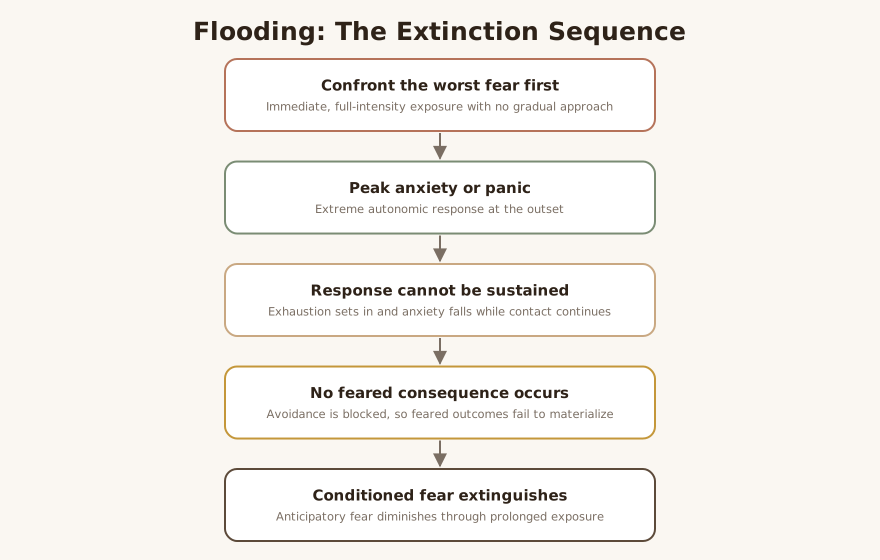
The central principle is extinction: when a person is exposed to a feared stimulus repeatedly and for a prolonged period without the feared negative consequence occurring, the conditioned fear response diminishes 4. Flooding pushes this to its limit by withholding any gradual approach — the client confronts the worst version of the fear first, not last 4.
A second principle is that fear is a time-limited physiological response. The client typically experiences extreme anxiety or panic at the outset, but the autonomic response cannot be sustained indefinitely; exhaustion eventually sets in and anxiety falls 4. The therapeutic window opens when panic subsides while the client remains in contact with the feared stimulus and no harm occurs, at which point anticipatory fear begins to extinguish 4.
A third principle, foregrounded by the behavioral model, is that avoidance is the maintaining mechanism. Phobias persist because avoidance prevents the person from learning three things: that fear can be tolerated, that fear decreases naturally over time, and that feared outcomes often do not occur or are less severe than imagined 1. Flooding is essentially a way of blocking avoidance completely LLM.
It is worth noting that the modern understanding of extinction has shifted. Contemporary research frames extinction as new learning layered over the original fear association rather than an erasure of it, and this new learning is context-dependent — which helps explain why fears can return in new settings or after time 3. This reframing matters clinically because it implies the goal is robust, generalizable inhibitory learning, not simply driving anxiety to zero within a single session LLM.
Interventions & Techniques
In an in vivo flooding procedure, the client is placed in direct, prolonged contact with the actual feared stimulus in a controlled setting and kept there until the anxiety response declines 4. The exposure is continuous rather than titrated, and the duration is whatever it takes for arousal to fall, which can mean sessions of several hours 4.
In implosive therapy, the therapist guides the client through imaginary scenes enriched with graphic, exaggerated imagery, deliberately amplifying the feared content rather than softening it 3. The scenes are dynamic: they evolve in real time based on the client’s verbal feedback and observable emotional reactions, and they fold in both client-reported cues and therapist-hypothesized cues 3. The clinician’s task is to sustain the affect, not to reassure it away LLM.
LLM-generated illustrative example (not a guideline): A clinician using implosive imagery with a client who has a contamination fear might guide a vivid, prolonged scene of touching a contaminated surface and being unable to wash, holding the image until the client’s distress crests and falls — rather than reassuring the client that the surface is probably clean LLM.
Across both forms, three procedural commitments recur: full intensity from the start, prolonged duration until habituation, and prevention of escape or avoidance during the exposure LLM. The contrast with systematic desensitization is sharp — desensitization pairs a graded fear hierarchy with relaxation and may use imaginal or virtual exposure, whereas flooding typically goes straight to real-world, maximum-intensity contact with no relaxation scaffolding 4.
Evidence Base
Honesty about maturity requires separating two questions. The exposure family is empirically established: the Society of Clinical Psychology (APA Division 12) lists exposure therapies for specific phobias as having Strong Research Support, with treatment gains tending to be well maintained up to a year following treatment, particularly for animal phobias 1. That designation, however, attaches to exposure-based treatment broadly — including the graded and one-session formats that now dominate — not specifically to maximal flooding or classical implosion 1.
Flooding and implosion as distinct techniques rest on a thinner and older evidence base. A 1973 critical review noted methodological weaknesses in the existing implosion research, and that critique has not been fully superseded by a modern trial literature dedicated to the technique 3. The exposure-based approaches in general have demonstrated success in treating PTSD, combat trauma, and assault-related anxiety, which is part of why the family is well regarded — but this is family-level evidence, not flooding-specific evidence 3. SimplyPsychology characterizes flooding bluntly as a method that is “rarely used and potentially dangerous” in contemporary practice 4.
A meaningful practical barrier comes from a study of therapists’ and patients’ stress responses during graduated versus flooding in vivo exposure for specific phobia 6. In that preliminary study of 25 patients and 25 psychotherapist trainees, therapists showed heightened salivary alpha-amylase release during flooding but not during graduated exposure, and reported more pronounced subjective stress during flooding 6. Patient cortisol was numerically elevated during flooding but did not reach statistical significance 6. The authors concluded that elevated stress should be addressed in clinical training to improve the application of exposure in routine practice — a finding that helps explain why flooding-intensity exposure is underused even when it works 6. The honest summary: exposure is established, flooding-specifically is supported but largely superseded by graded approaches LLM.
Populations & Indications
The technique was developed and studied primarily with adults experiencing anxiety disorders and phobias, where a circumscribed feared stimulus makes prolonged, full-intensity confrontation feasible 1. Specific phobia is the prototypical indication, and the exposure family’s strongest evidence is here 1. The exposure approach has also been applied to people with PTSD, including trauma survivors, veterans with combat trauma, and people with assault-related anxiety 3.
Adolescents have been treated with flooding-style exposure in documented cases — the classic illustration is driving a car-phobic adolescent continuously for four hours until the fear extinguished 4. Other anxiety presentations within scope of the exposure family include panic disorder, agoraphobia, social anxiety disorder, generalized anxiety disorder, and obsessive-compulsive disorder, where avoidance and ritualized escape maintain the problem LLM. The common thread across populations and indications is a fear that is being sustained by avoidance, which exposure is designed to interrupt 1.
Problems-for-Work
Specific phobia. A client with a circumscribed phobia (heights, flying, animals) avoids the feared object so completely that they never learn the fear is survivable; prolonged in vivo contact provides that corrective learning 1.
LLM-generated illustrative example (not a guideline): A client with claustrophobia agrees to remain in a small, enclosed room with the clinician for an extended, uninterrupted period, staying until the initial panic crests and recedes and the client directly experiences that nothing catastrophic happens LLM.
Avoidance behavior. Avoidance is itself the target — each avoided situation reinforces the phobia, so blocking escape during exposure is the mechanism of change 4.
Panic disorder and agoraphobia. The problem is fear of the fear response and the situations that might trigger it; sustained exposure lets the client learn the bodily sensations are time-limited and not dangerous LLM.
PTSD. Trauma-related avoidance of reminders maintains symptoms; prolonged exposure to trauma cues, a descendant of this tradition, has demonstrated benefit in combat and assault-related presentations 3.
OCD. Compulsions function as avoidance; sustained exposure to the feared cue while preventing the ritual targets the maintaining loop LLM.
Contraindications, Cautions & Cultural Humility
Flooding carries real risk and is not a default. SimplyPsychology notes that some patients experience intensified fear that has required hospitalization, and others abandon therapy prematurely — before anxiety has subsided — which can actually strengthen the phobia by reinforcing escape 4. This makes premature termination the single most important hazard to plan around: an exposure cut short at the peak of arousal teaches the wrong lesson 4.
A historical perspective tempers the alarm somewhat — a 1980 survey of implosion found serious negative effects in only 0.26% of cases — but the ethical concerns about extreme client discomfort and potential exacerbation of anxiety are long-standing and legitimate 3. Informed consent is therefore central: the client must understand and genuinely agree to confront the worst version of their fear at full intensity LLM.
The therapist-stress findings add a less obvious caution: flooding is demanding for the clinician too, and a stressed or under-trained therapist may apply the technique poorly 6. Clinicians should weigh medical stability (cardiac conditions, pregnancy, conditions where extreme autonomic arousal is unsafe), comorbid psychosis or dissociation, and the client’s capacity to give meaningful consent before considering maximal-intensity exposure LLM. Cultural humility matters in how fear, distress, and “appropriate” emotional expression are understood; a procedure that deliberately maximizes distress should be negotiated collaboratively, with attention to the client’s framing of acceptable risk and to power dynamics in pushing someone toward overwhelming affect LLM. In most contemporary settings, graded exposure is the more humane and equally defensible first choice, with flooding reserved for specific, well-considered situations 4.
Treatment-Plan Suggestions & SMART Objectives
| Goal | SMART objective (example) | Mechanism |
|---|---|---|
| Reduce phobic avoidance | Within 6 sessions, client completes one prolonged in vivo exposure to the feared stimulus, remaining until subjective distress drops by at least 50% from peak | Extinction through sustained contact without feared consequence 4 |
| Block escape/avoidance | Over 4 weeks, client refrains from leaving 3 planned exposure situations before distress declines, logging each | Prevents reinforcement of phobia via avoidance 4 |
| Build tolerance of arousal | Within 8 sessions, client rates ability to “stay with” panic sensations as 7/10 or higher across 3 consecutive exposures | New inhibitory learning that fear is time-limited 1 |
| Generalize gains across contexts | Over 8 weeks, client completes exposures in at least 3 distinct settings to reduce context-dependent return of fear | Context-varied extinction strengthens generalization 3 |
| Reduce anticipatory fear | Within 6 weeks, client reports a 40% drop on a standardized anxiety measure for the target situation | Anticipatory fear extinguishes after repeated harmless contact 4 |
| Restore valued functioning | Within 10 sessions, client resumes one avoided life activity (e.g., driving, flying) tied to the target fear | Avoidance reversal restores approach behavior 1 |
| Maintain gains | At 3-month follow-up, client sustains exposure gains on the target measure within 10% of post-treatment level | Durable extinction learning maintained up to a year for phobias 1 |
Common Misconceptions
“Flooding just wears the client down until they give up.” The mechanism is not surrender but extinction and habituation — the fear response is physiologically time-limited and falls of its own accord during sustained, harmless contact, and the therapeutic gain comes from staying until it falls 4.
“Flooding and implosion are the same thing.” They share intensity and duration but originated as distinct procedures — flooding emphasizes real-world (in vivo) contact, while implosion uses exaggerated imaginal scenes built partly from psychoanalytically derived cues 3. They are used near-synonymously now, but the procedural difference still shapes how a session is run 3.
“More intense is always more effective.” Flooding can be as effective as systematic desensitization, and sometimes more so, but it is also rarely used and potentially dangerous, and a botched flooding session can strengthen the phobia 4. Greater intensity buys speed at the cost of higher risk and dropout, not guaranteed superiority LLM.
“Driving anxiety to zero in the session is the goal.” Modern extinction theory frames the aim as new, context-robust inhibitory learning rather than momentary anxiety reduction, which is why generalization across settings matters 3.
Training & Certification
There is no stand-alone credential for flooding or implosive therapy; competence is acquired within broader training in behavior therapy and exposure-based cognitive behavioral therapy LLM. The stress study underscores why supervised training specifically matters here: trainees conducting flooding showed measurable physiological and subjective stress, and the authors recommended that elevated therapist stress be explicitly addressed in clinical training to improve real-world application of exposure 6. Practically, clinicians should build skill first in graded exposure, develop comfort tolerating client distress without prematurely reassuring or terminating, and pursue close supervision before attempting maximal-intensity exposure LLM. The foundational procedural literature — including dedicated volumes on direct therapeutic exposure in the Stampfl tradition — remains a reference point for those learning the method 2.
Key Terms
- Flooding: Prolonged, full-intensity, typically in vivo exposure to the feared stimulus without graded buildup, sustained until anxiety extinguishes 4.
- Implosive therapy (implosion): Stampfl’s imaginal variant using exaggerated, graphic fear scenes that blend reported and psychodynamically hypothesized cues 3.
- Extinction: The diminishing of a conditioned fear response after repeated, prolonged exposure without the feared consequence; now understood as new learning rather than erasure 43.
- Habituation: The natural decline of the autonomic fear response over the course of sustained exposure as the time-limited reaction exhausts itself 4.
- Avoidance: The escape behavior that maintains phobias by preventing corrective learning; the primary target of exposure 1.
- In vivo vs. imaginal exposure: Real-world contact with the feared stimulus versus confrontation through guided imagery 43.
Resources & Further Reading
▶ Watch — a video introduction to this concept:
- Exposure Therapies for Specific Phobias — Society of Clinical Psychology (APA Division 12)
- Flooding and Implosive Therapy: Direct Therapeutic Exposure in Clinical Practice — Springer
- Implosion (Behavior Therapy) — EBSCO Research Starters
- Flooding in Psychology: Implosion Therapy — Simply Psychology
- What Is Flooding Exposure Therapy? — Choosing Therapy
- Therapists’ and patients’ stress responses during graduated versus flooding in vivo exposure (specific phobia) — PubMed
Reflective / Supervision Questions
- For this specific client, what makes maximal-intensity flooding preferable to graded exposure — and can I articulate that rationale beyond “it’s faster”? LLM
- How will I plan for the most dangerous failure mode, a session terminated at peak arousal, and what is my concrete protocol if the client wants to stop? LLM
- Have I honestly assessed the client’s medical stability, consent capacity, and dissociation risk before proposing a procedure designed to maximize distress? LLM
- What is my own stress response to running intense exposure, and do I have the supervision and skill to stay regulated and present? 6
- Am I designing for generalization across contexts, or only for anxiety reduction within the session? 3
- How am I attending to the client’s cultural framing of distress, risk, and emotional expression in negotiating an inherently distressing procedure? LLM