
Self-organization is a borrowed idea. It comes from physics, chemistry, and biology, where researchers observed that ordered structures — convection cells, laser light, the rhythms of living tissue — can arise spontaneously from the interactions of a system’s parts, with no blueprint and no central controller LLM. Over the past three decades, a research program led primarily by Günter Schiepek and colleagues has asked whether psychotherapeutic change works the same way: not as the linear product of techniques applied to a passive client, but as a self-organizing process in which a person’s cognitive-emotional-behavioral system reorganizes itself under the right conditions 3. This article is written for clinicians who want to understand what that claim actually means, what evidence supports it, and — honestly — where it remains a metaphor reaching for clinical traction.
Type & Discipline
Self-organization is a theory and an organizing framework rather than a packaged treatment modality LLM. Its home discipline is complexity science and nonlinear dynamical systems theory, with its most developed psychotherapeutic expression in synergetics — the science of cooperation among the components of a system 3. In clinical terms, it sits one level of abstraction above any particular modality: it is a way of describing how change happens across therapies, not a competing brand of therapy LLM. Schiepek frames it explicitly as a reconceptualization of psychotherapy as “the dynamical realization of conditions for the possibility of human self-organization within a certain professional context” 3. The therapist, in this view, does not manufacture change so much as create and protect the conditions under which a client’s system can reorganize 3.
Creators & Lineage
The intellectual lineage runs through several twentieth-century complexity scientists. Hermann Haken, a physicist, founded synergetics, the framework most directly imported into psychotherapy research, describing how large numbers of interacting subsystems can spontaneously generate ordered, coordinated patterns LLM. Ilya Prigogine, a Nobel laureate in chemistry, studied dissipative structures — ordered states that arise in systems held far from equilibrium by a flow of energy — establishing that order can emerge from, rather than be destroyed by, fluctuation LLM. Francisco Varela, a biologist, contributed the concept of autopoiesis: living systems as self-producing, operationally closed networks, an idea that deeply shaped systemic and constructivist thinking in therapy LLM. These figures supply the conceptual scaffolding; their work was not about clinical practice, and the bridge to psychotherapy is interpretive LLM.
Within psychotherapy itself, the dominant contemporary figure is Günter Schiepek, who with collaborators translated synergetics into a testable model of therapeutic change and built tools to measure it 3. A second strand comes from the complex-systems and network-science community — researchers such as those behind the Network Destabilization and Transition model — who frame psychopathology and recovery in terms of attractors and tipping points 2. The framework also resonates with older clinical traditions it did not originate: family systems theory’s emphasis on circular causality, and the humanistic / Rogerian actualizing tendency, the assumption that organisms move toward growth when conditions permit LLM.
Core Principles
A handful of interlocking ideas carry most of the weight.
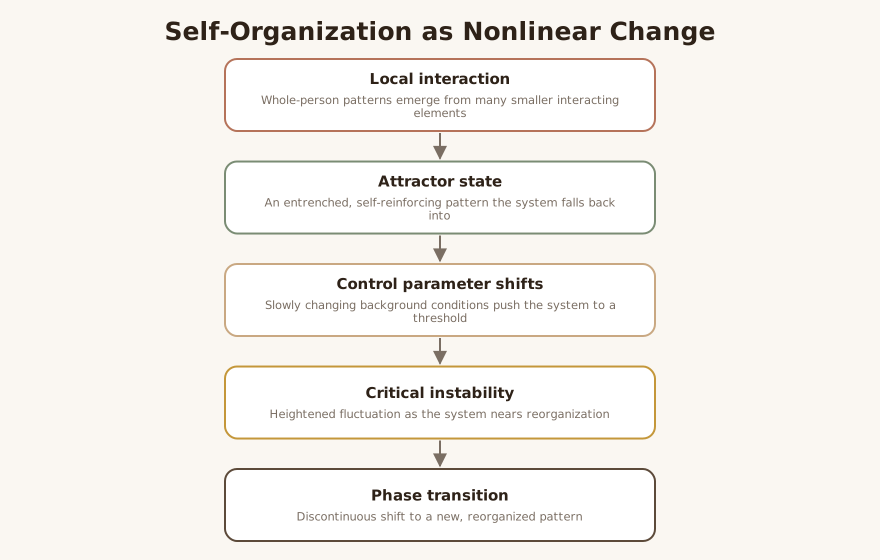
Order from local interaction. Coordinated patterns at the level of the whole person — a depressive style, a panic cycle, a relational stance — emerge from the interaction of many smaller elements (cognitions, emotions, behaviors, physiology) rather than from a single cause or a controlling center 2.
Attractors. Psychopathology can be understood as an attractor state: a self-reinforcing, entrenched pattern that the system tends to fall back into 2. Healthier patterns often already exist as weaker alternative attractors, waiting to be strengthened 2.
Control parameters and order parameters. In synergetics, slowly changing background conditions (control parameters) can push a system across a threshold, at which point a few collective variables (order parameters) come to dominate and organize the whole LLM. In Schiepek’s clinical model, candidate control parameters include client motivation and engagement 3.
Critical instability and phase transitions. Change is often discontinuous. As a system approaches reorganization, it passes through a period of heightened fluctuation — a critical instability — before snapping into a new, more stable pattern, much like a physical phase transition 1. Turbulence is not necessarily a sign of treatment failure; it may be the signature of a system nearing a tipping point 2.
Destabilization within stable boundary conditions. A central, almost paradoxical principle: productive reorganization requires both destabilization of the old pattern and a stable, supportive surround — the therapeutic relationship, a containing environment — that makes the instability survivable 1.
LLM-generated illustrative example (not a guideline): A client with long-standing avoidant coping is, for years, perfectly “stable” — and perfectly stuck. As therapy intensifies, weeks of unusual emotional volatility appear: tears one session, anger the next, a shaken sense of self. Under a self-organization lens, this is not deterioration but the system loosening its old attractor, held together by a reliable alliance, before settling into a new organization. LLM
Interventions & Techniques
Self-organization is not a manual of techniques, so its “interventions” are mostly stances and tools layered onto whatever modality a clinician already practices LLM.
The most concrete deliverable from this tradition is high-frequency process monitoring. The Synergetic Navigation System collects daily client self-ratings (for example via a Therapy Process Questionnaire spanning symptoms, affect, relationship quality, and progress) and analyzes them with nonlinear methods to estimate dynamic complexity — a measure of fluctuation that flags periods of critical instability 13. Therapist and client review this feedback together, supporting what Schiepek calls “eye-level therapy” and data-informed, adaptive timing of interventions 3.
Clinically, the framework suggests a posture more than a procedure LLM:
- Time interventions to the system’s state. The same intervention may do little in a rigid, stable phase and a great deal near a tipping point; “just-in-time adaptive interventions” aim to act when the system is most responsive 2.
- Tolerate and even protect destabilization. Rising variability is reframed as potential opportunity rather than automatic alarm, provided boundary conditions are secure 2.
- Strengthen alternative attractors. Because new learning competes with and gradually inhibits — rather than erases — old patterns, repetition across contexts matters for making a new pattern dominant 2.
Evidence Base
Honesty is essential here: the maturity of this framework is best described as metaphorical and emerging, not established LLM. Much of the psychotherapy work is explicitly proof-of-concept, built on small or heterogeneous samples — single-case analyses and modest inpatient cohorts across mixed diagnoses 3. The terminology is imported wholesale from physics and complexity science, and its clinical applicability still requires validation 3. Crucially, the core causal claim — that instability produces reorganization — remains largely correlational rather than demonstrated as cause 3.
That said, the empirical signal is real and consistent in direction. In a study of obsessive-compulsive disorder patients, higher peaks of local dynamic complexity predicted better outcomes, and — strikingly — in 13 of 18 patients undergoing exposure with response prevention, the steepest gradient of symptom change occurred before the formal exposure procedure began, with complexity peaks preceding maximum improvement by several days 1. Positive ward atmosphere (a stable boundary condition) correlated with symptom reduction, and the best outcomes appeared when high complexity and a supportive environment co-occurred — the predicted synergy of destabilization plus stability 1. Across the broader literature, increased variability in symptoms and process measures has been linked to “sudden gains” and to better long-term outcomes, and critical-slowing indicators have been documented preceding mood-episode onset 2.
Part of the framework’s appeal is that it explains well-known anomalies that trouble the standard “medical model” of therapy: specific techniques account for only a small fraction of outcome variance, bona fide therapies tend to perform comparably, and manualized treatments show no clear superiority — patterns that make more sense if common factors are conditions for self-organization rather than direct causal levers 3. This is an elegant reframe, but it is interpretive, and clinicians should hold it as a promising hypothesis rather than a settled finding LLM.
Populations & Indications
Because it describes a general mechanism of change, the framework is, in principle, modality- and population-agnostic LLM. The research base centers on individual clients in psychotherapy, including inpatient and day-treatment settings 13. The complex-systems reframing of pathology as attractor states applies naturally to a range of presentations where rigid, self-reinforcing patterns dominate 2.
By extension and clinical analogy, the model is invoked for couples, families, and groups or systems, where circular causality and emergent relational patterns are precisely the phenomena complexity science describes — though direct empirical work in these populations is thinner LLM. It is also a natural lens for people recovering from crisis or trauma, where instability is already present and the clinical question becomes how to make reorganization safe and constructive, and for individuals in personal growth seeking to move beyond a stable-but-limiting pattern LLM.
Problems-for-Work
The framework is most useful when the clinical problem is itself about patterns and change, not a discrete symptom to be subtracted LLM.
- Treatment stagnation. When a client is “stable” but stuck, the model reframes the goal as introducing controlled instability so a new pattern can emerge, rather than pushing harder on a technique that the system absorbs without changing 2.
- Rigidity and inflexibility. A strong, entrenched attractor — perfectionism, chronic avoidance — is the paradigm case; work targets loosening the old pattern while building a competing one 2.
- Symptom reorganization. Self-organization predicts that improvement may be discontinuous and that pre-change turbulence is expected, helping clinicians read volatility as signal rather than failure 1.
- Crisis and instability. Here the priority inverts: the system is already destabilized, so the clinical task is supplying stable boundary conditions so reorganization resolves toward health rather than collapse 1.
- Resistance to change. Reframed not as opposition but as a system defending a stable attractor; respecting that stability while creating conditions for transition is more coherent than overpowering it 2.
LLM-generated illustrative example (not a guideline): A clinician notices a client’s weekly mood ratings have grown jagged — wide swings where there used to be flat, low numbers. Rather than treating this as relapse, she names the pattern aloud, reinforces the alliance and between-session structure, and slows the pace, treating the volatility as a window in which a new organization might consolidate. LLM
Contraindications, Cautions & Cultural Humility
The chief caution is conceptual overreach. Because the language is evocative, it is easy to narrate any clinical event as a “phase transition” after the fact; the framework’s predictions are still largely correlational, and it should not be used to justify ignoring volatility that is, in fact, clinical deterioration 3. Destabilization is not a goal in itself LLM. The model is explicit that instability is only constructive within stable boundary conditions; deliberately destabilizing a client who lacks a secure alliance, adequate support, or safety risks harm rather than reorganization 1. With acutely suicidal, severely dysregulated, or unsupported clients, the clinical priority is stabilization, and the framework’s own logic supports that 1.
Process-monitoring tools raise practical and ethical considerations: daily self-ratings require client capacity, literacy, and consent, and data should be used collaboratively rather than as surveillance LLM. From a cultural-humility standpoint, what counts as a “stable” versus “rigid” pattern, and which new organization is “healthier,” are value-laden judgments; a pattern that looks like rigidity from one cultural frame may be coherent, adaptive, and protective within the client’s context LLM. The metaphor’s physics pedigree can also lend false authority — clinicians should resist presenting it to clients as harder science than it is LLM.
Treatment-Plan Suggestions & SMART Objectives
| Goal | SMART objective (example) | Mechanism |
|---|---|---|
| Make change processes visible | Client completes a brief daily process rating at least 5 of 7 days for 4 consecutive weeks | High-frequency monitoring surfaces dynamic complexity / instability windows 13 |
| Reduce pattern rigidity | Within 8 weeks, client identifies and behaviorally tests 2 alternatives to a habitual avoidant response per week | Strengthening competing attractors so a new pattern can dominate 2 |
| Stabilize boundary conditions | Client and clinician co-create and use a written safety/support plan reviewed weekly for 6 weeks | Stable boundary conditions make destabilization survivable 1 |
| Reframe volatility | Within 4 weeks, client verbalizes 3 instances of distinguishing “turbulence as signal” from “relapse” | Reattributes pre-transition fluctuation as potential opportunity 2 |
| Time effortful work to readiness | Over 6 weeks, client and clinician schedule 2 higher-intensity sessions during identified instability windows | Just-in-time, state-matched intervention timing 2 |
| Consolidate a new pattern | Client practices a new relational/behavioral response in 3 distinct contexts within 8 weeks | New learning inhibits rather than erases old patterns; cross-context repetition entrenches the new attractor 2 |
| Increase engagement (control parameter) | Client articulates 2 personally meaningful change goals and rates motivation weekly for 8 weeks | Motivation/engagement as a candidate control parameter driving reorganization 3 |
Common Misconceptions
“Self-organization is a type of therapy you can deliver.” It is not; it is a meta-level theory of how change occurs across therapies, operationalized mainly through monitoring and timing rather than a distinct set of techniques 3 LLM.
“More instability is always better.” The model is explicit that destabilization is only productive within stable boundary conditions; instability without support is risk, not progress 1.
“It proves techniques don’t matter.” The anomalies it explains (small technique-specific variance, comparable outcomes across therapies) are reinterpreted, not erased; the claim is that techniques work through enabling self-organization, not that they are irrelevant 3 LLM.
“The physics makes it rigorous science for clinical decisions.” The terminology is borrowed and the clinical evidence is proof-of-concept and largely correlational; treating it as established mechanism overstates the case 3.
“Change should be smooth, so volatility means we’re off track.” A core prediction is precisely the opposite — that meaningful change is often discontinuous and preceded by turbulence 12.
Training & Certification
There is no licensure or formal certification in “self-organization therapy,” because it is a framework rather than a credentialed modality LLM. Practitioners typically encounter it through academic and continuing-education routes — the synergetics and nonlinear-dynamics literature in psychotherapy research, and training associated with process-monitoring systems such as the Synergetic Navigation System used in Schiepek’s research program 13. Competent use draws on grounding in dynamical-systems concepts plus solid clinical skills in an established evidence-based modality into which the monitoring and timing stance is integrated LLM. Clinicians interested in applying the high-frequency feedback approach should seek the specific platform training and attend to data-handling, consent, and supervision considerations LLM.
Key Terms
- Self-organization — the spontaneous emergence of ordered, coordinated patterns from local interactions among a system’s components, without a central controller 23.
- Attractor — a stable, self-reinforcing pattern a system tends to settle into; psychopathology framed as an entrenched attractor 2.
- Order parameter — a small number of collective variables that come to organize the behavior of the whole system LLM.
- Control parameter — a slowly varying background condition (e.g., motivation) whose change can push a system across a transition threshold 3.
- Critical instability / critical fluctuations — a period of heightened variability preceding reorganization, often a marker of an impending transition 1.
- Phase transition / order transition — a discontinuous shift from one stable pattern to another 1.
- Dynamic complexity — a quantitative index of fluctuation in process data used to detect instability windows 13.
- Critical slowing down — slower recovery from perturbations as a system nears a tipping point; a documented early-warning signal 2.
- Stable boundary conditions — the supportive, containing surround (alliance, environment) that makes destabilization constructive rather than dangerous 1.
- Network Destabilization and Transition (NDT) — a complex-systems model proposing distinct change pathways, including destabilizing maladaptive networks while strengthening functional ones 2.
Resources & Further Reading
▶ Watch — a video introduction to this concept:
- Self-organization in psychotherapy: testing the synergetic model of change processes (PMC)
- A complex systems approach to the study of change in psychotherapy (PMC)
- Complexity and nonlinear dynamics in psychotherapy — Schiepek, European Review (Cambridge Core)
- Synergetics — Scholarpedia (Hermann Haken)
- Synergetics in Psychology — Springer (Haken & Schiepek tradition)
Reflective / Supervision Questions
- When a client’s process turns turbulent, how do I distinguish a productive critical instability from genuine deterioration — and what evidence am I using? LLM
- Are the “stable boundary conditions” in this case (alliance, support, safety) strong enough to make any destabilization survivable before I encourage deeper work? LLM
- Where might I be narrating ordinary clinical events as “phase transitions” after the fact, lending myself false confidence the framework hasn’t earned? LLM
- Whose values define which pattern counts as “rigid” and which new organization counts as “healthier” in this client’s cultural context? LLM
- If techniques work mainly by enabling self-organization, what conditions am I actually creating in the room — and which am I neglecting? LLM