
Type & Discipline
The Three Poisons (Sanskrit triviṣa) are a construct from Buddhist philosophy, not a treatment modality, an assessment instrument, or an evidence-based intervention LLM. They name the three root unwholesome mental states held to underlie human suffering: ignorance or delusion (moha), attachment or greed (rāga; Pāli lobha), and aversion or hatred (dveṣa; Pāli dosa) 5. Within Buddhist psychology these three function as the root kleshas — mental states that cloud the mind and manifest in unwholesome actions — from which all other afflictions are said to spring 4. For the practicing therapist, the construct is best understood as a transdiagnostic phenomenology of motivation: a compact map of the three pulls (toward, away, and asleep) that organize much of clinical distress LLM. It is a lens, adjunctive to a Western framework, rather than a stand-alone clinical method LLM.
Creators & Lineage
The construct is attributed to Gautama Buddha and the earliest Buddhist teachings, where the three poisons are framed as “the root causes of our suffering and the principal obstacles on the path to spiritual liberation” 2. They are catalogued across both major streams of Buddhism: Mahayana and Theravada traditions alike identify these three fundamental kleshas as “the root of all the other kleshas” 4. Doctrinally they connect to the Four Noble Truths and to dependent origination, where ignorance conditions craving and clinging in a self-perpetuating cycle 4. The contemporary clinical lineage runs through Buddhist psychology into mindfulness-based and acceptance-based therapies LLM. Mindfulness-Based Cognitive Therapy, Acceptance and Commitment Therapy, and Compassion-Focused Therapy each operationalize, in secular language, processes the three-poisons model names directly — craving, aversion, and the unawareness that lets both run unchecked LLM. The construct itself has also drawn explicit academic treatment within Buddhist psychology and mental health scholarship 7.
Core Principles
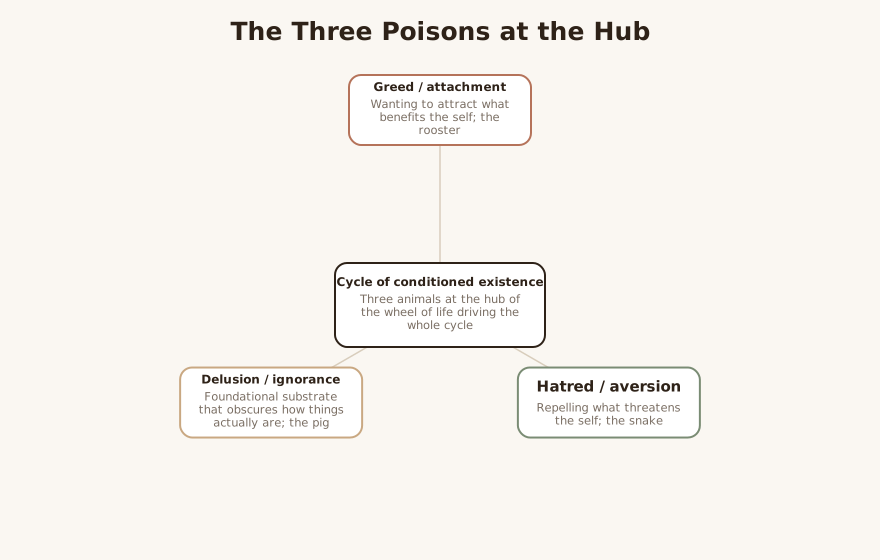
First, the three poisons reflect what one teaching calls “the three energies of ego’s focus on itself”: wanting to attract what benefits the self (greed), repelling what threatens it (aversion), and disregarding what does not seem to affect it personally (ignorance) 2. Second, delusion is foundational — moha, often glossed as confusion or bewilderment, is the substrate that makes craving and aversion possible by obscuring how things actually are 5. Third, the poisons are generative rather than static: in the dependent-origination framework they form a “round of defilements” in which ignorance conditions action, which produces results that generate further craving and clinging 4. Fourth, they are depicted vividly in the Bhavacakra, or wheel of life, as three animals at the hub — a rooster, a snake, and a pig — representing greed, ill-will, and delusion, driving the whole cycle of conditioned existence 1. Clinically, the principle most worth carrying is that reactivity has roots, and naming the root changes the relationship to the reaction LLM.
Interventions & Techniques
The traditional “antidotes” map cleanly onto contemplative techniques a clinician can recognize LLM. For greed, the canonical antidote is generosity (dāna): “sharing internal or external resources with others moves us away from the fear of not having what we need,” cultivating a felt sense of sufficiency that loosens craving 3. For hatred, the antidote is loving-kindness (mettā) — consciously cultivating goodwill toward oneself and even toward adversaries to neutralize aversion and open space for the underlying wound to heal 3. For delusion, antidotes emphasize wisdom from direct seeing rather than theory, alongside practices such as tonglen and the cultivation of equanimity — “the capacity to remain present without needing to control outcomes” 63. Underlying all three, mindfulness functions as the meta-skill: it helps a person recognize the poisons as they arise without identifying with them 3. Two complementary mechanisms are described across traditions — tranquility practice pacifies the afflictions while insight practice reveals their nature 4. In session, these translate into noticing-and-naming, values-based generosity behaviors, compassion practices, and decentering from thought LLM.
Evidence Base
Honesty about maturity matters here. As a doctrinal construct the three poisons are established — they have been articulated, transmitted, and elaborated across roughly two and a half millennia and both major Buddhist traditions, and they carry scholarly treatment within Buddhist psychology 47. But “established as canon” is not the same as “validated as a clinical target” LLM. None of the sources supplying this construct contain efficacy data, randomized trials, or effect sizes for treating any disorder by addressing the three poisons as such LLM. Its empirical footing is therefore indirect, arriving through the lineage modalities: the mindfulness, acceptance, and compassion processes that the model anticipates are themselves the subject of a substantial and growing controlled-trial literature in Western psychotherapy LLM. Clinicians should present the three poisons to clients as an organizing heuristic and a bridge to those evidence-based practices, not as an independently proven intervention LLM. Used that way, it earns its place; oversold, it overreaches the data LLM.
Populations & Indications
The construct fits clients already oriented toward, or curious about, contemplative and mindfulness-based care, where its vocabulary feels native rather than imposed LLM. It is particularly resonant for people in recovery from addiction, where craving (greed) is the central clinical phenomenon, and where the model’s framing of grasping as a source of suffering can normalize the experience without moralizing it 2. People with anger and hostility problems map naturally onto the aversion pole, and the loving-kindness antidote gives a concrete counter-practice 3. Adults with anxiety and depression often present a blend — anxious aversion to feared outcomes, depressive clinging to loss, and the rumination that delusion feeds LLM. Meditation practitioners and clients in explicitly contemplative therapy may already use this language and benefit from a clinician who can hold it competently LLM. As always, indication depends on fit between the client’s worldview and the frame, not on diagnosis alone LLM.
Problems-for-Work
Craving and addiction. The greed pole gives a non-shaming way to externalize urges: the client and clinician can track the “wanting mind,” notice the fear of insufficiency beneath it, and practice generosity or sufficiency as a counter-move 32.
Anger and hostility. The aversion pole reframes anger as a poison that “leads to harmful actions, conflicts, and the perpetuation of negative cycles,” with loving-kindness and the pause-and-breathe practice as antidotes 26.
Rumination and cognitive distortions. Delusion names the unexamined, distorted seeing that sustains rumination; the work is decentering and cultivating clearer, direct observation rather than arguing with content 53.
Experiential avoidance. Aversion-driven pushing-away of inner experience is precisely what the model predicts; mindful recognition without identification offers an alternative to avoidance 3.
LLM-generated illustrative example (not a guideline): A client in early sobriety learns to label a craving spike as “greed arising,” notices the underlying thought “I won’t be okay without it,” and chooses a brief generosity action — texting encouragement to a peer — to shift the felt sense of scarcity. LLM
Contraindications, Cautions & Cultural Humility
The language of “poisons” can land as harsh or pathologizing if introduced carelessly, and clients with strong self-criticism may hear it as one more verdict against themselves LLM. Frame the poisons as universal human pulls, not personal defects — the model is explicitly about ego’s habitual energies, common to all, not about a given client’s badness 2. Cultural humility is essential: these are sacred concepts within living religious traditions, and a secular therapist borrowing them owes accuracy, attribution, and restraint, never appropriation dressed as technique LLM. Do not impose the frame on clients whose own faith or worldview conflicts with it, and never present antidotes such as loving-kindness as a demand to forgive an abuser LLM. The construct is not a substitute for trauma-informed care, risk assessment, or indicated evidence-based treatment, and “just be less attached” is never an appropriate response to material deprivation, oppression, or acute crisis LLM. When in doubt, defer to the client’s meaning-making LLM.
Treatment-Plan Suggestions & SMART Objectives
| Goal | SMART objective (example) | Mechanism |
|---|---|---|
| Reduce craving-driven reactivity | Over 8 weeks, client will label urges as “greed/wanting” and apply a sufficiency practice in ≥4 of 5 logged episodes weekly | Mindful recognition of grasping plus generosity antidote 3 |
| De-escalate anger episodes | Within 6 weeks, client will use a pause-and-breathe response before reacting in ≥70% of recorded conflict moments | Loving-kindness and non-reactive awareness toward aversion 63 |
| Interrupt rumination | Over 8 weeks, client will practice decentering from ruminative thoughts daily, rating identification with thoughts ≤3/10 | Insight into delusion; observing thoughts without identifying 34 |
| Reduce experiential avoidance | Within 8 weeks, client will stay present with one avoided feeling for 5 minutes in 4 of 5 attempts weekly | Mindful tolerance replacing aversive pushing-away 3 |
| Cultivate self-compassion | Over 6 weeks, client will complete a loving-kindness practice 4 days weekly toward self and one difficult person | Mettā antidote softening hostility and self-aversion 3 |
| Strengthen present-moment awareness | Within 8 weeks, client will sustain a 10-minute daily mindfulness practice on ≥5 days weekly | Tranquility and insight pacifying and revealing afflictions 4 |
| Loosen attachment to fixed beliefs | Over 8 weeks, client will identify and test one rigid “must” belief per week | Releasing clinging that fuels the poisons 3 |
Common Misconceptions
A frequent misreading is that the three poisons condemn desire, anger, or thought wholesale; the construct targets the afflictive, ego-centered, grasping forms of these energies, not healthy wanting, protective anger, or ordinary cognition 2LLM. Another is that delusion means low intelligence — moha denotes confusion or bewilderment about the nature of experience, not a deficit of reasoning 5. A third is that the antidotes are about suppression: tranquility practice pacifies the afflictions but, per the tradition itself, does not eradicate them, and insight works by understanding rather than repression 4. Clinicians also sometimes assume the model is purely individual, when its frame extends to how ignorance lets injustice and diminished compassion persist socially 2. Finally, treating the poisons as a validated standalone treatment overstates the evidence — the construct earns clinical use as a bridge to tested practices, not as proof of outcome on its own LLM.
Training & Certification
There is no certification in “the three poisons”; it is doctrinal content, not a credentialed modality LLM. Therapists who wish to use it responsibly are better served by training in the lineage therapies that operationalize it — Mindfulness-Based Cognitive Therapy, Acceptance and Commitment Therapy, and Compassion-Focused Therapy — each of which has established training pathways and supervised practice requirements LLM. Equally important is the clinician’s own contemplative practice and grounding in the source tradition, so the concepts are used with fidelity rather than as decoration; the antidote practices of generosity, loving-kindness, and insight are themselves trainings to be undertaken, not just described 36. Consultation with practitioners or scholars from Buddhist traditions supports accurate, humble application LLM.
Key Terms
Three Poisons (triviṣa) — the three root unwholesome mental states underlying suffering 5. Greed / attachment (rāga, lobha) — desire, passion, grasping toward what is wanted 5. Hatred / aversion (dveṣa, dosa) — anger, hostility, pushing-away of what is unwanted 5. Delusion / ignorance (moha; cf. avidyā) — confusion or bewilderment about the nature of experience 5. Kleshas — mental afflictions that cloud the mind and drive unwholesome action; the three poisons are their root 4. Antidotes — generosity (dāna), loving-kindness (mettā), and wisdom/insight, the wholesome counters to each poison 36. Bhavacakra — the wheel of life depicting the poisons as rooster, snake, and pig at its hub 1.
Resources & Further Reading
▶ Watch — a video introduction to this concept:
- Three poisons — Wikipedia
- Three Poisons | Buddhism A–Z — Lion’s Roar
- Practices to Purify the Three Poisons of Buddhism — Lion’s Roar
- Kleshas (Buddhism) — Wikipedia
- Three poisons — Encyclopedia of Buddhism
- The Antidote to Greed, Hatred & Ignorance — Lion’s Roar
- Greed, Hatred, and Delusion (Springer chapter)
Reflective / Supervision Questions
- Which of the three poisons do I most readily recognize in my own reactivity, and how might that shape what I notice — or miss — in clients? LLM
- When I introduce contemplative language, am I doing so because it fits the client’s meaning-making, or because it fits mine? LLM
- How do I hold the difference between offering the three poisons as a heuristic and overstating it as a proven treatment? LLM
- Where might “non-attachment” or “loving-kindness” be misapplied as pressure to forgive harm or tolerate injustice, and how do I guard against that? LLM
- Am I borrowing from a living sacred tradition with accuracy, attribution, and humility, or am I flattening it into technique? LLM
- What in my own practice would I need to deepen for these antidotes to be lived rather than merely taught? LLM