
The Abhidhamma (Pali; Sanskrit Abhidharma) is one of the three “baskets” of the Buddhist canon and the tradition’s most systematic attempt to map the mind from the inside out. For the clinician, it is not a religion to adopt but a remarkably granular phenomenology of how moments of experience arise, combine, and drive behavior — a framework whose vocabulary now sits, often unnamed, inside the mindfulness-based therapies many of us already practice. LLM This article treats it as a conceptual resource for case formulation and psychoeducation, not as a faith commitment or a standalone billable treatment. LLM
Type & Discipline
The Abhidhamma is a theory — a classical contemplative psychology and philosophy of mind — rather than a manualized therapy. LLM It is best described as Buddhism’s systematic phenomenological psychology, analyzing experience into elementary factors and cataloguing how they interact. 7 The early Western scholar Caroline A. F. Rhys Davids made this recognition explicit as early as 1900, translating a core Abhidhamma text as a “Buddhist Manual of Psychological Ethics” and praising its account of the “complex continuum of subjective phenomena.” 7 Bhikkhu Bodhi characterizes the Abhidhamma as simultaneously a philosophy, a psychology, and an ethics, integrated into a path of practice and grounded in introspective meditation. 7 One contemporary teacher frames it bluntly as Buddhism’s comprehensive taxonomy of all the possible experiences a mind and body can have. 5
Creators & Lineage
The Abhidhamma developed over centuries as a scholastic elaboration of the Buddha’s discourses, but two figures anchor its transmission. LLM Acariya Buddhaghosa, a fifth-century commentator, compiled and systematized the canonical Abhidhamma material, producing authoritative commentaries that organized centuries of exegetical tradition. 2 Several centuries later, Acariya Anuruddha composed the Abhidhammattha Sangaha, the standard primer that condensed the vast system into nine compact chapters and remains the entry text for students today. 2 In the modern era, Bhikkhu Bodhi’s annotated edition of that primer brought the system to English-language readers, and clinically trained teachers such as Beth Jacobs have presented it explicitly as “the original Buddhist psychology” for Western audiences. 24
Its therapeutic lineage runs forward into the contemporary clinic. The Abhidhamma’s analysis of attention, perception, and reactivity is the conceptual ancestor of the mindfulness-based interventions developed over the last four decades, including mindfulness-based cognitive therapy (MBCT) and acceptance and commitment therapy (ACT). 17
Core Principles
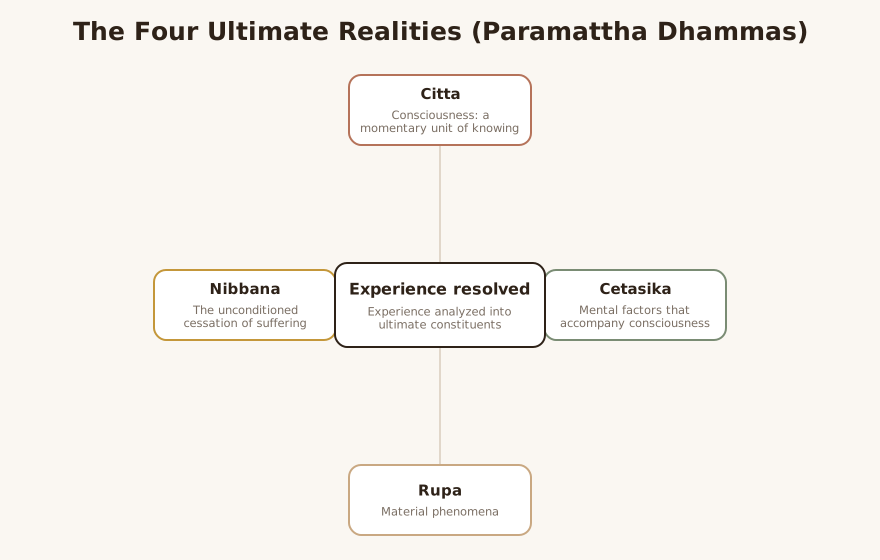
The system rests on the claim that what we call “experience” can be resolved into a small number of ultimate constituents. LLM The Theravada Abhidhamma names four such ultimate realities (paramattha dhammas): citta (consciousness or awareness), cetasika (the mental factors that accompany consciousness), rupa (material phenomena), and nibbana (the unconditioned cessation of suffering). 27 A citta is not a static “mind” but a discrete, evanescent cognitive event — a single momentary unit of knowing that arises, does its work, and passes. 2 One clinically minded teacher captures the shift this way: in the Abhidhamma view, consciousness is best understood as an action rather than a fixed entity or container. 4
Each moment of consciousness is colored by accompanying mental factors. The manual enumerates fifty-two cetasikas, divided into universals, occasionals, unwholesome factors, and beautiful (wholesome) factors. 2 These factors carry an ethical valence: states are classified as wholesome, unwholesome, or indeterminate. 2 At the root of all unwholesome states stand the three poisons — greed or craving (lobha), hatred or aversion (dosa), and delusion (moha) — while their wholesome counterparts are non-greed (generosity, alobha), non-hatred (loving-kindness, adosa), and non-delusion (wisdom, amoha). 3 A structurally important principle for the clinician is that wholesome and unwholesome factors can never arise together in the same mind-moment. 3
Two further ideas matter for case formulation. First, perception does not deliver reality directly: through the five aggregates and the six sense bases, raw contact becomes “entangled” with conceptual proliferation (papañca), so that we react to our constructions rather than to events. 7 Second, the framework dissolves any simple linear story of causation; as Jacobs puts it, there is no single point where you can say “this leads to this,” only the moment-by-moment, complex evolution of the activity of consciousness. 4
Interventions & Techniques
The Abhidhamma is descriptive rather than prescriptive, so its “interventions” are habits of observation that a therapist can translate into practice. LLM The core move is to bring the analytic map to direct experience on the meditation cushion: when a practitioner notices how mind, a sense faculty, and an object combine to produce a perception and a reactive pattern, the abstract categories become live and usable. 5 Rather than analyzing a distressing content directly, the Abhidhammic approach invites the person to recognize how a formation (say, guilt or craving) arises in context, and to notice the clinging that intensifies the difficulty — a stance that emphasizes letting go over control. 4
Clinically, this maps onto familiar techniques. LLM Practitioners learn to label arising states by their ethical “flavor” — is this moment rooted in craving, in aversion, or in clarity — which is a refined form of affect labeling and metacognitive monitoring. LLM They are trained to attend to the gap between contact and reaction, the same interval that decentering and cognitive defusion target. LLM
LLM-generated illustrative example (not a guideline): A client with rumination says, “I keep replaying the argument.” Using an Abhidhammic lens, the therapist coaches him to notice that each “replay” is a fresh mind-moment, not a continuous loop, and to name its root: “Is this moment pulling toward (craving to be right) or pushing away (aversion)?” Seeing the moments as discrete and passing loosens the felt solidity of the rumination. LLM
Evidence Base
Honesty matters here. As a classical contemplative system, the Abhidhamma is established in the sense of being a mature, internally coherent, two-and-a-half-millennia-old framework with an extensive textual and commentarial tradition — not in the sense of being a treatment validated by randomized controlled trials. LLM There is no body of efficacy research testing “Abhidhamma therapy” as a discrete, manualized intervention. LLM
What carries empirical weight is its derivatives. Buddhist psychology increasingly informs mainstream mental health care through cognitive behavioral therapy, dialectical behavior therapy, and explicitly mindfulness-based approaches, and the Abhidhamma is the canonical source articulating the structure of consciousness and the practice of meditation that these therapies draw on. 1 Mindfulness-based stress reduction (MBSR), developed by Jon Kabat-Zinn, and MBCT, developed by Segal, Williams, and Teasdale, are the best-evidenced of these lineages. 7 The defensible clinical claim is therefore modest: the Abhidhamma offers a conceptual map that some clinical authors argue reaches beyond standard mindfulness programs, but its therapeutic value reaches patients primarily through evidence-based modalities, not as a freestanding treatment. 1
Populations & Indications
The framework is pitched at adults capable of sustained introspection, and it is most natural with meditation practitioners and contemplatives who already have a vocabulary for observing the mind. LLM Its analysis of reactivity is readily applied with people experiencing chronic stress, anxiety disorders, and the broad category of suffering and distress that the tradition takes as its central problem. 15 Because the system foregrounds craving and aversion as universal mechanisms, it generalizes across presenting problems rather than targeting a single diagnosis. LLM
A caution specific to populations: with trauma survivors, intensive introspective or concentration practice can destabilize, and the Abhidhamma’s emphasis on dissolving the felt continuity of self may be disorienting rather than freeing. LLM It is best introduced through grounded, titrated, trauma-informed mindfulness rather than deep analytic meditation. LLM
Problems-for-Work
- Craving and addiction. The construct of lobha — the mind-moment that reaches toward and grasps — gives a precise target for urge surfing: the client learns to watch craving arise and pass as a momentary event rather than a command. 3
- Anger and aversion. Dosa names the push-away reactivity behind anger and contempt; recognizing it as one transient root, incompatible in that moment with loving-kindness, supports affect regulation. 3
- Rumination and chronic stress. Seeing thought as a sequence of discrete cittas, each conditioned and passing, undercuts the sense of an endless loop and supports decentering. 4
- Attachment and clinging. The framework’s account of clinging as what intensifies difficulty reframes letting go as a skill rather than a loss. 4
- Existential anxiety and suffering. Locating distress in misperception and reactive habit, rather than in a fixed defective self, can reduce the secondary suffering of self-condemnation. 5
LLM-generated illustrative example (not a guideline): A client with generalized anxiety describes “a constant background dread.” The therapist uses the aggregates model to separate bodily sensation (rupa), the feeling-tone, the labeling (“danger”), and the proliferating story (papañca), helping the client see that the “constant” dread is actually many separable, arising-and-passing moments — a first step toward interrupting the proliferation. LLM
Contraindications, Cautions & Cultural Humility
The Abhidhamma is a sacred tradition with its own soteriological aims, and lifting its vocabulary into the clinic risks decontextualization. LLM Clinicians should be transparent that they are borrowing a psychological model, not delivering Buddhist practice, and should respect clients for whom this is a living religion rather than a technique. LLM Imposing the language on clients from other faith backgrounds, or presenting “no-self” as a settled fact, can rupture the alliance. LLM
Clinical cautions include the destabilizing potential of intensive concentration practice for trauma survivors and for people with psychosis-spectrum or dissociative presentations, and the risk that “letting go” is heard as spiritual bypassing — a way to avoid grief, anger, or the legitimate need to take action. LLM The honest framing from the literature is that these are conceptual resources whose continued clinical relevance flows from their roots in therapies like mindfulness, not a validated protocol to apply uncritically. 1
Treatment-Plan Suggestions & SMART Objectives
| Goal | SMART objective (example) | Mechanism |
|---|---|---|
| Reduce reactivity to urges | Client will use a “notice-name-allow” routine on 3 cravings/week, logging onset and passing, for 4 weeks | Observing lobha as a discrete, impermanent mind-moment 3 |
| Interrupt rumination | Client will practice labeling thoughts as “just a passing moment” for 10 min daily, reducing self-reported loop-time by 50% in 6 weeks | Decentering from a continuous “loop” to discrete cittas 4 |
| De-fuse from self-criticism | Client will distinguish sensation, feeling-tone, and story (papañca) in 2 distressing episodes/week | Disentangling perception from proliferation 7 |
| Down-regulate anger | Client will name aversion (dosa) at onset and shift to one loving-kindness phrase in 4 of 5 flashpoints | Wholesome and unwholesome roots cannot co-arise 3 |
| Increase distress tolerance | Client will sit with one uncomfortable feeling-tone for 3 min without acting, 4x/week | Watching states arise and pass; reducing clinging 4 |
| Build metacognitive awareness | Client will complete a daily “mind-weather” log noting the dominant root (craving/aversion/clarity) for 3 weeks | Ethical-quality labeling of mind-moments 2 |
| Reduce existential self-condemnation | Client will reframe one “I am broken” narrative as “a conditioned, passing pattern” per session | Locating distress in misperception, not a fixed self 5 |
Common Misconceptions
A first misconception is that the Abhidhamma is mysticism or metaphysics; in fact it reads as a precise, almost clinical taxonomy of mind-body processes, which is why one teacher likens it to a “periodic table of experience.” 45 A second is that mindfulness equals Abhidhamma: mindfulness is one practice and the Abhidhamma is the larger map within which mindfulness operates, and at least one clinical author argues the system offers psychology that reaches beyond mindfulness alone. 1 A third is that “letting go” means passivity or suppression; the system distinguishes letting go of clinging from suppressing experience, and treats wholesome states like generosity and loving-kindness as active cultivations. 34 A fourth, important for evidence-minded clinicians, is that its long pedigree implies proven clinical efficacy — it does not; its empirical support is indirect, via its derivative therapies. 1
Training & Certification
There is no clinical credential in “Abhidhamma therapy,” and clinicians should be wary of any that claims to be one. LLM Foundational study typically begins with Anuruddha’s Abhidhammattha Sangaha in Bhikkhu Bodhi’s annotated edition, supplemented by introductory lecture series such as Ven. Dhammasami’s video introduction to the Abhidhamma. 26 For clinical application, the credentialed pathways are in the derivative modalities — MBCT and MBSR teacher training, and ACT training — which carry the evidence base and the supervision structures appropriate to patient care. 17 Accredited contemplative-psychology degrees exist (for example at Naropa University) for clinicians who want formal integration. 7
Key Terms
- Citta — a single, momentary unit of consciousness; a discrete cognitive event, not a standing “mind.” 2
- Cetasika — a mental factor that arises with and colors a citta; the manual lists fifty-two. 2
- Paramattha dhammas — the four ultimate realities: citta, cetasika, rupa (matter), nibbana. 27
- Lobha / Dosa / Moha — the three unwholesome roots: greed/craving, hatred/aversion, delusion. 3
- Alobha / Adosa / Amoha — the wholesome roots: generosity, loving-kindness, wisdom. 3
- Papañca — conceptual proliferation; the mind’s elaboration that entangles perception. 7
- Aggregates / sense bases — the five aggregates and six sense bases through which experience is constructed. 7
Resources & Further Reading
▶ Watch — a video introduction to this concept:
- Beyond mindfulness: Buddhist psychology and the Abhidharma (Kelly, Journal of Spirituality in Mental Health, 2022)
- A Comprehensive Manual of Abhidhamma: The Abhidhammattha Sangaha of Acariya Anuruddha (ed. Bhikkhu Bodhi)
- The Abhidhamma: A Field Guide to the Mind — Spirit Rock
- Mapping Your Mind: The Original Buddhist Psychology (Beth Jacobs, Tricycle)
- Understanding Abhidharma, a.k.a. Buddhist Psychology — Lion’s Roar
- Introducing Abhidhamma by Ven. Dhammasami — The Buddhist Society (video)
- Buddhism and psychology — Wikipedia
Reflective / Supervision Questions
- When I introduce “letting go” or “non-attachment,” am I supporting genuine acceptance, or inadvertently enabling spiritual bypassing of grief, anger, or needed action? LLM
- Am I transparent with clients that I am borrowing a psychological model from a living religious tradition, and am I attending to their own faith background? LLM
- For this client, would intensive introspective practice risk destabilization (trauma, dissociation, psychosis-spectrum), and have I titrated accordingly? LLM
- Am I documenting this work honestly within an evidence-based modality, rather than implying that the Abhidhamma itself is a validated treatment? LLM
- Where do I notice my own craving (to fix, to be the good therapist) or aversion (to a client’s distress) arising in the room? LLM