
Type & Discipline
Upekkha (Pali; Sanskrit upekṣā) is a construct from Buddhist contemplative psychology, usually translated “equanimity” or “even-mindedness.” 1 It names a balanced mental state that remains stable across pleasure and pain — not a technique, a diagnosis, or a therapy, but a quality of mind that practices aim to cultivate. 1 It is the fourth of the four brahmaviharas (“divine abodes” or “sublime states”), the others being loving-kindness (metta), compassion (karuna), and sympathetic joy (mudita). 4
For clinicians, the value of upekkha is conceptual precision. LLM Contemporary therapies repeatedly ask clients to stay present with difficult internal experience without being swept away by it, and upekkha is the contemplative tradition’s most developed name for that exact stance. LLM It is the quality “undisturbed by emotional upheavals” — “not picking and choosing, but rather being content with what presents itself.” 2 Understanding it well helps therapists describe, model, and scaffold non-reactivity rather than leaving it as a vague instruction to “just observe.” LLM
Creators & Lineage
Upekkha has no single author; it is a classical category of early Buddhist psychology systematized over centuries. 1 The most influential practice manual is the Visuddhimagga, written by the fifth-century Sri Lankan monk Buddhaghosa, which formalized how the brahmaviharas are cultivated through repeated phrases and a widening circle of beings. 4 Modern Theravada-derived teachers — including Bhikkhu Bodhi, whose distinction between equanimity and indifference is widely quoted, and insight-meditation teachers such as Gil Fronsdal — have shaped the English-language framing therapists are most likely to encounter. 1 3
The lineage into clinical work runs through the mindfulness movement. LLM The brahmaviharas underwrite the attitudinal foundations of mindfulness-based stress reduction (MBSR), the acceptance and defusion stance of acceptance and commitment therapy, and the distress-tolerance and radical-acceptance skills of dialectical behavior therapy — each of which operationalizes, in secular language, a posture the tradition would recognize as equanimity. LLM None of these therapies cite upekkha by name, but the family resemblance is close enough that the construct is a useful translational bridge. LLM
Core Principles
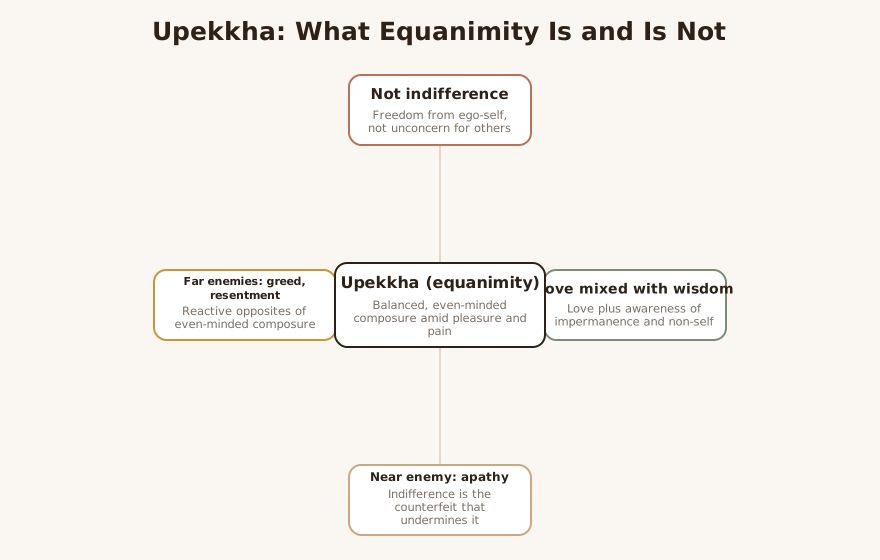
Equanimity is not indifference. This is the single most important clinical clarification. LLM Bhikkhu Bodhi writes that “the real meaning of [upekkha] is equanimity, not indifference in the sense of unconcern for others”; it is “freedom from all points of self-reference… indifference only to the demands of the ego-self,” not to others’ well-being. 1 Indifference and apathy are the near enemy — a counterfeit that superficially resembles equanimity but actually undermines it — while greed and resentment are the far enemies. 1 An emergency-room clinician can keep their equanimity and still “respond appropriately (and in a caring fashion)” to suffering. 6
It is love mixed with wisdom, not detachment. Spirit Rock describes upekkha as “a form of metta mixed with wisdom” that lets “the heart… stay open and kind regardless of circumstances.” 4 Wildmind frames it as “love accompanied by insight” — specifically “love plus an awareness of impermanence, or love plus an awareness of non-self.” 5 Fronsdal calls it “equanimous love,” a stance of “keeping our hearts open” while not becoming “elated or distressed” by another’s ups and downs. 3
It balances and grounds the other three abodes. Equanimity is “the culminating brahmavihara… which balances the other three by bringing impartiality and balance of heart to the foreground.” 4 Compassion without equanimity can tip into empathic distress and burnout; sympathetic joy without it can tip into craving. LLM Equanimity is what keeps care sustainable. 3
It is an awareness of conditions and limits. A recurring teaching is “equanimity is an awareness of karma” — a recognition that outcomes arise from many causes outside one’s control, which makes one “more resilient to unexpected events.” 6 The classical reflection holds that “all beings are the owners of their actions,” encouraging acceptance of what one cannot determine for another. 4 Wildmind distinguishes everyday equanimity (non-reactivity to the pleasant and unpleasant), jhanic equanimity (a factor in deep meditative absorption), the equanimity of awakening, and brahmavihara equanimity — only the last of which is necessarily loving. 5
It is steadiness against the “eight worldly conditions.” Practitioners aim to remain even across gain and loss, repute and ill-repute, praise and censure, happiness and sorrow. 1 Ajahn Kalyano’s image is ballast: equanimity is the heavy keel that keeps a vessel from being “blown around by the eight worldly winds.” 6
Interventions & Techniques
Equanimity is classically cultivated through brahmavihara (heart) practice rather than as a standalone drill. 4 The Spirit Rock / Mahasi method pairs silent well-wishing phrases with visualization of a series of beings, beginning with individuals and widening to categories. 4
- Equanimity phrases. The classical formula is a reflection on ownership of action: “All beings are the owners of their actions, heir to their actions, born of their actions… whatever action they do, for good or for ill, of that they will be the heir.” 4 A contemporary phrase is “I care about you, but your life and choices are your own.” 4
- Equanimity as a by-product of mindfulness. Lion’s Roar notes that equanimity “emerges as a by-product of mindfulness practice and especially from the awareness and insight that mindfulness brings, which allows us to see our habitual thought processes and undercut them.” 2 In other words, it is trained indirectly by repeatedly noticing reactivity rather than by forcing calm. LLM
- Reflection on impermanence and limits. Contemplating that experience is changing (impermanence) and not wholly self-owned (non-self) is the cognitive engine that converts mere non-reaction into loving non-reaction. 5
- Temperament-matched calming. Cultivation also includes “personalized calming strategies suited to individual temperaments” alongside formal meditation. 6
Clinically, these map onto familiar moves: phrase repetition resembles cognitive defusion and self-talk restructuring; the ownership-of-action reflection resembles distinguishing one’s “circle of control” from outcomes one cannot dictate; and the impermanence reflection resembles urge-surfing and the observation that affect rises and passes. LLM
LLM-generated illustrative example (not a guideline): A clinician working with a parent consumed by their adult child’s relapse might introduce the ownership-of-action reflection as a non-pathologizing reframe — “you can love and support without being able to author their choices” — to loosen fused over-responsibility while explicitly preserving care, not encouraging detachment. LLM
Evidence Base
As a contemplative construct, upekkha is well-established — it is a stable, centuries-old category with a detailed practice literature across Theravada traditions. 1 4 Its conceptual maturity is high. LLM
Its clinical evidence is indirect. LLM None of the sources here is a clinical trial; the construct’s therapeutic credibility rests on the broader, robust evidence base for mindfulness- and acceptance-based interventions that operationalize an equanimity-like stance, rather than on trials of “equanimity training” per se. LLM Therapists should present upekkha to clients as a useful organizing concept and a target of established practices, not as an independently validated treatment. LLM (Note: one academic item indexed under “equanimity” is a clinical-pathology editorial on thyroid biopsy that uses the word only figuratively and has no bearing on the psychological construct — a caution against literature searches that match on the term alone.) 1
Populations & Indications
Equanimity practices are most relevant where the clinical problem is reactivity to inescapable or uncontrollable experience. LLM Indicated populations include:
- Meditators and clients already engaged in contemplative practice, for whom upekkha is a native vocabulary. 4
- People with chronic pain and chronic illness, where the goal shifts from eliminating sensation to changing one’s relationship to it. LLM
- Caregivers, and hospice and palliative-care patients and families, where equanimity sustains compassion without collapse and supports presence amid loss. 3 6
- Adults under chronic stress, who benefit from the “ballast” against the eight worldly winds. 6
Problems-for-Work
- Emotion dysregulation and reactivity. Equanimity is the trained capacity not to be “disturbed by emotional upheavals,” developed by seeing and undercutting habitual reactive patterns. 2
- Application: pairing affect-labeling with the observation that the wave of emotion is impermanent and will pass. 5
- Distress intolerance. The stance of “being content with what presents itself” is a direct antidote to the demand that the present moment be otherwise. 2
- Anger. Reflecting that beings are “owners of their actions” can interrupt blame-driven rumination by reframing others’ behavior as conditioned. 4 6
- Chronic pain. Non-reactive awareness lets the person stop adding the “second arrow” of struggle to unavoidable sensation. 2 LLM
- Grief. Equanimity holds open-hearted love alongside acceptance of what cannot be changed, rather than numbing it. 3
- Burnout (especially in caregivers and clinicians). Equanimity is precisely what lets compassion remain sustainable instead of tipping into empathic exhaustion. 3 6
Contraindications, Cautions & Cultural Humility
The chief clinical risk is the near enemy: clients (and therapists) can mistake avoidance, dissociation, emotional blunting, or learned helplessness for equanimity. 1 Genuine upekkha stays engaged and caring; counterfeit “equanimity” withdraws. 1 6 Screen for this directly — true equanimity should coexist with appropriate, caring action, as the emergency-room example illustrates. 6
Equanimity language can also be misused to bypass legitimate distress or to rationalize tolerating harm. LLM Telling someone in an abusive or unjust situation to “accept what arises” can reinforce entrapment; the construct concerns one’s inner relationship to uncontrollable conditions, not passivity toward changeable ones. LLM The teaching that beings own their actions should never be deployed to minimize a client’s victimization or to discourage protective action. LLM
Cultural humility is essential. LLM Upekkha is a living religious concept embedded in Buddhist soteriology, not a free-floating wellness technique; extracting it for secular therapy should be done transparently and without claiming it is “just science.” LLM Match framing to the client: offer the Pali terms and tradition to those who welcome them, and a fully secular translation to those for whom religious language is alienating or inappropriate. LLM
Treatment-Plan Suggestions & SMART Objectives
| Goal | SMART objective (example) | Mechanism |
|---|---|---|
| Reduce emotional reactivity | Client will name the rising and passing of one strong emotion per day for 2 weeks using an impermanence reflection | Non-reactive awareness undercuts habitual reactive patterns 25 |
| Increase distress tolerance | Client will remain with an unpleasant sensation for 90 seconds without acting on the urge to escape, in 4 of 7 days | “Content with what presents itself” stance reduces struggle 2 |
| De-fuse over-responsibility | Client will apply the “ownership of action” reflection to one relationship stressor weekly and record the shift | Recognizing conditions/limits loosens fused control 46 |
| Sustain compassion without burnout | Caregiver will pair one daily compassion phrase with an equanimity phrase across 3 weeks | Equanimity grounds and balances the other heart-states 34 |
| Reduce anger rumination | Client will reframe one provoking event per week as conditioned rather than personal | “Awareness of karma” interrupts blame loops 6 |
| Steady mood amid stress | Client will practice 10 minutes of equanimity-oriented meditation 5 days/week for 4 weeks | “Ballast” against the eight worldly winds 6 |
| Improve pain coping | Client will rate reactivity (0–10) to pain before/after a brief non-reactive awareness practice daily | Changes relationship to sensation rather than sensation itself 2 |
Common Misconceptions
- “Equanimity means not caring.” The opposite: it is “indifference only to the demands of the ego-self,” not to others’ welfare, and is explicitly framed as a form of love. 1 3
- “It means feeling calm all the time.” It is non-reactivity to whatever arises, including agitation — a relationship to experience, not a guaranteed pleasant feeling. 5
- “It’s passive resignation.” It coexists with caring, appropriate action and is described as a “deep wisdom quality,” not withdrawal. 4 6
- “It can be willed directly.” It is largely “a by-product of mindfulness practice,” cultivated indirectly through repeated noticing rather than forced. 2
- “All equanimity is the same.” Wildmind distinguishes several forms; only the brahmavihara form is necessarily loving, so non-reactivity alone does not equal the therapeutic target. 5
Training & Certification
There is no certification in upekkha as such; it is cultivated within Buddhist practice traditions, typically transmitted by teachers and through retreat at centers such as Spirit Rock and Insight Meditation Center using methods derived from the Visuddhimagga and Burmese vipassana lineages. 3 4 For clinicians, the relevant professional pathway is training in the secular interventions that operationalize equanimity — MBSR teacher training, and ACT or DBT training — which provide supervised, manualized routes to delivering equanimity-adjacent skills within scope of practice. LLM Clinicians intending to teach contemplative practice rather than merely reference it should pursue their own sustained personal practice and, ideally, recognized teacher training. LLM
Key Terms
- Upekkha / upekṣā: equanimity, even-mindedness; the fourth brahmavihara. 1
- Brahmaviharas: the four “divine abodes” — metta, karuna, mudita, upekkha. 4
- Near enemy: a counterfeit that resembles the quality but undermines it; for upekkha, indifference/apathy. 1
- Far enemy: the obvious opposite; for upekkha, greed and resentment. 1
- Eight worldly conditions/winds: gain/loss, repute/ill-repute, praise/censure, happiness/sorrow. 1 6
- Equanimous love: equanimity understood as a face of love that stays open without being destabilized. 3
- Tatramajjhattata: the “neutrality” or balancing factor underlying equanimity in Buddhist psychology. 1
Resources & Further Reading
▶ Watch — a video introduction to this concept:
- Upekṣā — Wikipedia
- What is Equanimity, or Upekkha? — Lion’s Roar
- The Four Faces of Love: The Brahma Viharas — Gil Fronsdal, Insight Meditation Center
- The Four Divine Abodes — Spirit Rock Meditation Center
- Cultivating equanimity or even-mindedness (upekkha) — Bodhipaksa, Wildmind
- Upekkha / Equanimity — Chicago Buddhist Meditation Group
Reflective / Supervision Questions
- When I notice “equanimity” in a client, can I distinguish genuine non-reactive openness from avoidance, blunting, or resignation — and how would I screen for the near enemy? 1
- Am I introducing acceptance language in a way that loosens unproductive struggle, or in a way that risks counseling tolerance of a changeable harm? LLM
- Where in my own caseload is my compassion tipping toward empathic distress, and would equanimity practice protect my sustainability? 3
- How do I match the framing — Pali/Buddhist versus fully secular — to each client’s worldview and consent? LLM
- For this client, is equanimity better trained directly (phrases, reflection) or indirectly (as a by-product of mindfulness), and why? 2 5