
Type & Discipline
Phenomenology is a philosophical movement and method, not a psychotherapy, a manualized protocol, or a clinical diagnosis LLM. It is the rigorous descriptive study of structures of experience and consciousness as they are lived from the first-person point of view, attending to how phenomena present themselves to awareness rather than to causal explanations of why they occur 1. The discipline was founded by the German philosopher Edmund Husserl in the first decades of the twentieth century and grew into one of the defining traditions of twentieth-century continental philosophy 4. Its literal sense is captured in its name: a logos (study, account) of phenomena — things precisely as they appear 4.
For the clinician the value of phenomenology is not as a treatment but as a disciplined way of attending to a client’s experience LLM. It supplies a rigorous philosophical account of what skilled therapists already gesture toward when they speak of “meeting the client where they are,” “beginner’s mind,” or non-judgmental presence — and it names the structures (directedness, embodiment, lived time, the taken-for-granted world) that organize how any experience is lived LLM. Understood this way, phenomenology is best treated as a foundational stance and descriptive framework that informs recognized therapies — existential-phenomenological, humanistic, person-centered, and Gestalt work in particular — rather than as a standalone modality in its own right LLM.
Creators & Lineage
The founder is Edmund Husserl (1859–1938), a philosopher trained originally as a mathematician, who established phenomenology as a rigorous descriptive science of consciousness 2. His governing slogan was a return “to the things themselves” — to the phenomena of experience described exactly as they present themselves, before they are overlaid with theory, explanation, or metaphysical assumption 2. Husserl took the concept of intentionality — the thesis that consciousness is always consciousness of something — from his teacher Franz Brentano and made it the cornerstone of his analysis 2. He developed and refined the project across major works including the Logical Investigations, Ideas I, the Cartesian Meditations, and the late, unfinished Crisis of the European Sciences 2.
Phenomenology did not remain Husserl’s alone; his most influential students reshaped it 1. Martin Heidegger (1889–1976), Husserl’s pupil and successor, turned the method toward the question of being and the analysis of human existence as Dasein — being-in-the-world — in Being and Time, shifting phenomenology from a study of consciousness toward an existential and hermeneutic interpretation of lived existence 1. Maurice Merleau-Ponty (1908–1961) developed a phenomenology of perception and the lived body, arguing that we are not pure minds surveying a world but embodied subjects whose perception is the primary opening onto reality 1. Jean-Paul Sartre and others extended the tradition into existentialism, emphasizing freedom, choice, and the structures of self-experience 1.
The clinical descendants of phenomenology are several and direct LLM. Existential psychotherapy draws on Heidegger, Sartre, and Merleau-Ponty for its focus on lived existence, freedom, and the givens of being-in-the-world LLM. Gestalt therapy inherits the field-theoretical and perceptual insights of the tradition. Humanistic and person-centered psychology share its insistence on the primacy of the client’s own frame of reference and subjective meaning LLM. In research, Amedeo Giorgi adapted Husserl’s framework into descriptive phenomenological psychology, a structured method for describing the lived structure of a phenomenon from first-person accounts LLM.
Core Principles
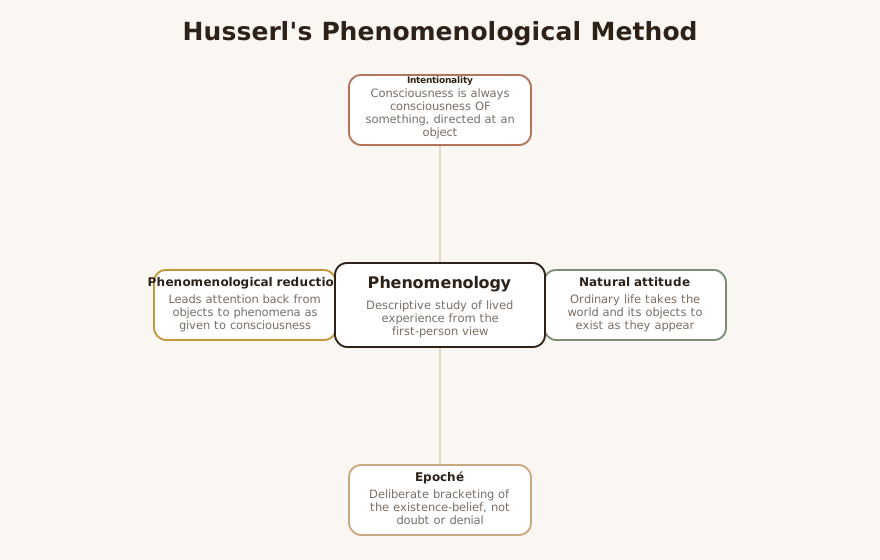
The first principle is intentionality: consciousness is always consciousness of something, never a sealed inner container 2. Every act of awareness — perceiving, remembering, imagining, fearing, judging — is directed toward an object, whether or not that object exists 2. This directedness dissolves the picture of mind as a private interior that must somehow “reach out” to a separate world, and it makes experience describable: a mood is about the world, an anxiety is of something even when its object is hard to name 1.
The second principle is the epoché and the phenomenological reduction. In ordinary life we live in what Husserl called the natural attitude, unreflectively taking the world and its objects to exist just as they appear 3. The epoché is the deliberate suspension — a methodical “switching off” — of this existence-belief, not doubting or denying the world as Descartes did, but bracketing our commitment to it so that the world’s appearing can be examined rather than its being assumed 3. The reduction then “leads attention back” from objects naively taken as existing to the phenomena as they are given in and to consciousness 3.
The third principle is description over explanation. Phenomenology aims to describe the structures of experience as faithfully as possible, not to explain experience causally in the manner of the natural sciences 1. The method seeks the invariant, essential features of a kind of experience — what makes a perception a perception, a grief a grief — through careful attention to examples and the imaginative variation of their features 1. The point is the how of appearing, not a theory of the why 2.
The fourth principle is the primacy of lived experience and the lifeworld 2. Husserl argued in the Crisis that the mathematized world of physics is not the real world but an achievement abstracted from the concrete lifeworld (Lebenswelt) of ordinary perception and practice — and that the crisis of the sciences is precisely their forgetting of this grounding 2. Later figures radicalized this: for Heidegger the human being is always already absorbed in a meaningful world, and for Merleau-Ponty the lived body is the standing ground of all experience 1. Across the tradition, the abstraction is never mistaken for the lived reality it stands on 2.
Interventions & Techniques
Because phenomenology is a method and a stance rather than a manual of clinical procedures, it does not prescribe techniques the way a treatment protocol does; instead it disciplines the clinician’s attention and shapes what a formulation is built from LLM. Its primary clinical use is to cultivate a way of listening: the therapist deliberately suspends diagnostic labels, theoretical commitments, and personal reactions in order to receive the client’s experience as it is lived and described, before interpreting or explaining it 3. Naming this as a practiced discipline, rather than an attitude one simply possesses, is itself the contribution, because it makes “non-judgment” something one actively does and can get better at LLM.
Ernesto Spinelli’s widely taught adaptation translates the method into three working rules that map onto recognizable clinical moves LLM. The rule of epoché asks the clinician to set aside initial biases and assumptions so the client’s account can be met freshly LLM. The rule of description asks the clinician to stay with the immediate and concrete — what is actually said, felt, and shown — rather than leaping to causal theory or interpretation LLM. The rule of horizontalization (or equalization) asks the clinician to resist ranking the elements of the client’s account by assumed importance, treating each as initially worthy of attention LLM.
These principles find natural homes across modalities LLM. In person-centered therapy, the phenomenological stance underwrites the empathic, non-judgmental reception of the client’s internal frame of reference LLM. In Gestalt therapy, field theory and the notion of contact are heirs of intentionality — the person is always in contact with a field, and disturbance is a disturbance of that contacting LLM. In existential-phenomenological therapy, the therapist describes the client’s mode of being-in-the-world rather than explaining it causally, mapping their lived relationship to world, others, body, and time LLM. In mindfulness-based work, the cultivation of non-reactive, present-moment observation parallels the phenomenological discipline of describing appraisals rather than acting on them LLM.
LLM-generated illustrative example (not a guideline): A client says, “I had a panic attack at my sister’s wedding.” The clinician notices an immediate internal story forming — social anxiety, fear of crowds, a tidy formulation — and deliberately brackets it. Instead of confirming the hypothesis, they invite the client to describe the moment exactly as it was lived: what was seen, the bodily sensations, the precise thought, the timing. The client describes not crowds but a sudden conviction, on seeing her sister, that “I’m the one who never gets chosen.” The bracketed formulation would have missed the phenomenon entirely LLM.
Evidence Base
Honesty about evidence requires distinguishing two senses of “established” LLM. As a philosophical movement and method, phenomenology is firmly established and mature: it is one of the foundational traditions of twentieth-century thought, anchored in Husserl’s major primary texts and the subsequent work of Heidegger, Merleau-Ponty, and Sartre, and the subject of a very large, rigorous scholarly literature treated in the authoritative philosophical encyclopedias 1. Several of its core concepts — intentionality above all — sit at the center of the philosophy of mind and have been debated continuously from Brentano to the present 2. In that sense the tradition is canonical 4.
What phenomenology is not is an empirically validated clinical intervention with controlled outcome data, because it is a philosophical and descriptive enterprise rather than a treatment that has been trialed against comparators LLM. The scrutiny it has received is itself largely philosophical and methodological rather than outcome-based: debates over whether intentionality can be naturalized, over the coherence of Husserl’s later “transcendental” turn, and over what exactly the reduction accomplishes — debates that motivated Heidegger and Merleau-Ponty to revise the method in different directions 1. Its main applied legacy in the human sciences runs through descriptive and interpretive phenomenological research methods, which ground qualitative studies of lived experience rather than supplying an outcome-measured therapy LLM.
The defensible clinical position is that phenomenology earns its place by sharpening the quality of attention and the object of therapeutic interest — the client’s directed, embodied, world-embedded experience — while disorder-specific change is pursued through therapies that carry their own evidence base LLM. The mechanisms it cultivates — accurate empathy, suspension of bias, careful description, attunement to lived meaning — are themselves associated with good practice, but phenomenology supplies their philosophical grammar, not their outcome trials LLM. Clinicians should therefore present it as a powerful descriptive stance, not as a scientifically validated technique for symptom change LLM.
Populations & Indications
Phenomenology is most directly useful with clients whose difficulty is itself a disturbance of lived meaning or of the felt reality of experience LLM. Adults in existential and humanistic therapy, and those exploring meaning or reflecting on a life, are working with the very structures phenomenology describes — what their world has been of and for 2. People with chronic illness live a disrupted relationship to the body and to time that a phenomenology of embodiment, in the lineage of Merleau-Ponty, helps a clinician hear without reducing the experience to a list of physical findings 1.
The tradition has a notable and growing role in understanding psychosis LLM. Phenomenological psychiatry approaches anomalous self-experience — disturbances in the basic sense of being a unified, present, self-owning subject — as describable structural alterations of consciousness rather than mere checklists of symptoms, giving clinicians a richer language for what a person with psychosis is actually undergoing 1. Trauma survivors can be understood as living a rupture of the taken-for-granted world, where basic trustworthiness has broken and recovery involves re-establishing an inhabitable world LLM. The method is also a core formation tool for clinicians in training, for whom learning to suspend the first formulation and describe before concluding is a fundamental — and frequently failed — skill 3.
Problems-for-Work
Phenomenology maps onto several presenting problems by restoring experience to its lived, directed form and by disciplining how clinician and client relate to interpretation LLM. For loss of meaning and demoralization, the lifeworld frame reorients work away from abstract questions about “the meaning of life” toward the concrete texture of the client’s own world — what once mattered, what has gone flat, and where significance might be recovered 2.
LLM-generated illustrative example (not a guideline): A retired client says “nothing means anything anymore.” Rather than debating meaning in the abstract, the clinician explores the lifeworld concretely: the workshop that was once a place of absorption now stands unused; the morning routine has lost its directedness. The work becomes re-inhabiting specific regions of a world rather than solving meaning as a philosophical problem LLM.
For depersonalization-derealization and anomalous self-experience in psychosis, naming the trouble as a disturbance of the basic structure of experience — perception intact but stripped of its usual meaning-saturation, or the sense of self thinned — gives a precise, validating description and a recovery target rather than a bare diagnosis 1. For existential distress and identity confusion, phenomenology frames the work as describing and clarifying how the client lives their world and themselves within it, restoring a sense of authorship over a situation that had felt foreign LLM. For anxiety driven by appraisal, distinguishing the phenomenon as lived from the catastrophic interpretation layered onto it can loosen the grip of the appraisal 3.
LLM-generated illustrative example (not a guideline): A client describes feeling “numb, like I’m watching my life through glass.” Rather than coding this immediately as a symptom, the clinician explores it as a thinning of the lived world: perceptions still occur, but the kitchen is recognized without being inhabited, the partner is seen without being met. Naming the loss as a change in how the world is given, not a defect of perception, gives the client language for what is missing and a direction for its recovery LLM.
For grief and alienation, the tradition locates the trouble in a rupture of a once-shared, taken-for-granted world, and frames the work as describing the loss precisely and re-entering a common world of meaning LLM.
Contraindications, Cautions & Cultural Humility
The central caution is conceptual: phenomenology is a descriptive frame and a stance, not an intervention, and it does not substitute for active treatment where one is indicated LLM. A client with severe depersonalization secondary to trauma, panic, or a medical condition needs assessment and evidence-based care for those causes; the phenomenological language is a way of understanding and validating the experience, not a stand-alone remedy LLM. A clinician who treats a risk disclosure “phenomenologically” without also responding to it as a risk has misapplied the method: the epoché suspends premature interpretation, never the clinician’s responsibility to assess safety LLM.
A second caution concerns acute states. In active psychosis, severe dissociation, or acute crisis, open-ended phenomenological exploration of a destabilized world can deepen disorganization rather than help; containment, grounding, structure, and reality-testing take priority LLM. The method is best suited to reflective work with a client who has enough stability to describe and inhabit their experience LLM. A third caution is that full presuppositionlessness is an asymptotic ideal, never perfectly achieved; treating it as attainable can breed a false confidence that one has “set aside” one’s biases when one has not 2.
Cultural humility is where the tradition shows its greatest clinical value and its sharpest demand LLM. Phenomenology’s core teaching is that every person lives within a taken-for-granted world of meaning — and that the clinician has one too, with its culturally embedded norms about emotion, family, distress, time, and the self, which are precisely what is most invisible to them and most easily mistaken for “reality” 2. The discipline is to attend to the client’s world without substituting one’s own LLM. Yet bracketing one’s assumptions does not license ignoring structural realities — racism, poverty, marginalization — that shape and constrain a client’s lived world; the lived world is always also a socially and materially conditioned world LLM.
Treatment-Plan Suggestions & SMART Objectives
| Goal | SMART objective (example) | Mechanism |
|---|---|---|
| Reduce premature closure in assessment | Over 4 sessions, clinician will defer the initial formulation and produce a purely descriptive account of the presenting concern before naming a hypothesis | Suspending the natural attitude to attend to the phenomenon as given 3 |
| Recover sources of meaning | Within 10 sessions, client will map which regions of their world once carried significance and identify one concrete region to re-engage | Reorienting from abstract meaning to the concrete lifeworld 2 |
| Give language to derealization | Within 4 sessions, client will describe their experience as a change in how the world is given, distinguishing intact perception from lost significance | Reframing the disturbance as one of experiential structure, not perceptual defect 1 |
| Increase non-judgmental observation | Over 8 weeks, client will, 3 times weekly, describe one distressing experience in concrete sensory terms before adding any interpretation | Bracketing appraisal to separate the lived event from the judgment about it 3 |
| Clarify the object of a symptom | Over 5 sessions, client will articulate what a recurring anxiety episode is about, naming its intentional object | Restoring the symptom’s world-relation rather than treating it as context-free 2 |
| Re-establish a trustworthy world after trauma | Over 12 sessions, client will identify 2 ordinary, predictable features of daily life that still feel reliable and build from them | Repairing the ruptured taken-for-granted basis of the lived world LLM |
| Strengthen clinician’s cultural attunement | Over 6 cross-cultural sessions, clinician will note in supervision one taken-for-granted assumption from their own world per session | Attending to the client’s world without substituting the clinician’s own 2 |
Common Misconceptions
The first and most consequential misconception is that “intentionality” means doing something on purpose or with intent LLM. In the phenomenological sense it is a technical term for the directedness of consciousness toward an object — its always being of or about something — and has nothing to do with deliberateness or will; an involuntary fear is just as intentional as a deliberate plan 2. A second misconception is that the epoché means doubting or denying the existence of the world; the method neither denies nor doubts but suspends our existence-belief, leaving the world untouched while changing how we attend to it 3.
A third misconception is that phenomenology is purely subjective or anti-scientific; Husserl conceived it as a rigorous descriptive science aimed at the invariant structures of experience, with method and discipline at its core, and his critique of natural science was that it forgets its grounding in the lifeworld, not that it is worthless 2. A fourth is that phenomenology is a single fixed doctrine; it is a tradition that splits and develops, from Husserl’s transcendental project through Heidegger’s existential and hermeneutic turn to Merleau-Ponty’s phenomenology of the body, with genuine disagreement among them 1. A fifth misconception is that phenomenology supplies a therapy; it supplies a way of seeing what experience is, which various therapies then put to work LLM.
Training & Certification
There is no certification in “phenomenology,” and there should not be; it is a philosophical tradition and method absorbed into clinical and research practice rather than a credentialed technique LLM. Clinicians most often encounter it through training in existential-phenomenological psychotherapy, Daseinsanalysis, and Gestalt therapy, where the foundational texts of Husserl, Heidegger, and Merleau-Ponty and their reputable commentaries are core reading 1. Familiarity with the authoritative encyclopedic treatments equips a clinician to use the concepts accurately rather than as loose slogans about “lived experience” 4.
Practitioners who wish to work explicitly in this tradition typically pursue post-qualification training in existential or Gestalt therapy and engage with applied formulations such as Ernesto Spinelli’s rules of epoché, description, and horizontalization, and, for those doing qualitative research, Amedeo Giorgi’s descriptive phenomenological method LLM. As with any borrowed construct, the ethical requirement is competence and honest scope: phenomenology should inform how one listens and formulates within one’s licensed practice, not be represented as a standalone evidence-based treatment LLM.
Key Terms
Phenomenology — the rigorous descriptive study of the structures of experience and consciousness from the first-person point of view, attending to how phenomena appear 1. Phenomenon — a thing precisely as it presents itself to and in experience, the proper object of phenomenological description 4. Intentionality — the thesis that consciousness is always consciousness of something, always directed toward an object, whether or not it exists 2. Epoché — the deliberate, methodical suspension of our ordinary belief in the existence of the world, “switching off” the natural attitude so phenomena can be described as they appear 3. Phenomenological reduction — the leading-back of attention from objects naively taken as existing to the phenomena as given in consciousness 3. Natural attitude — the everyday, unreflective stance in which we take the world and its objects to exist exactly as they appear 3. Lifeworld (Lebenswelt) — the pre-theoretical world of taken-for-granted, lived, and shared meaning in which we always already live, prior to scientific abstraction 2. Being-in-the-world (Dasein) — Heidegger’s reframing of the human being as inseparable from a meaningful, lived world 1. Lived body — Merleau-Ponty’s term for the body as the standing ground of perception and experience, not merely an object among objects 1.
Resources & Further Reading
▶ Watch — a video introduction to this concept:
- Phenomenology — Stanford Encyclopedia of Philosophy
- Edmund Husserl — Stanford Encyclopedia of Philosophy
- The Phenomenological Reduction — Internet Encyclopedia of Philosophy
- Phenomenology (philosophy) — Wikipedia
- Husserl & the Adventure of Phenomenology — In 12 Minutes (YouTube)
- Phenomenology Crash Course with Wayne Martin, University of Essex (YouTube)
Reflective / Supervision Questions
- When I form my first impression of a client, can I name the assumptions I am bringing, and what would it mean to bracket them long enough to hear the phenomenon as the client lives it LLM?
- When a client describes a symptom, do I ask what it is of or about — restoring its world-relation — or do I treat it as a context-free internal state LLM?
- Whose lifeworld am I attending to in this session, and where might I be substituting my own taken-for-granted world of meaning for the client’s LLM?
- For a client reporting derealization, numbness, or an altered sense of self, can I distinguish, with them, between intact perception and a loss of lived significance — and does that distinction change the direction of the work LLM?
- Where is the line, for this client, between the disciplined suspension of premature interpretation and the suspension of necessary clinical judgment about safety LLM?
- How do I hold the value of phenomenological attention while being honest, in supervision, that phenomenology is a way of seeing rather than a validated treatment for symptom change LLM?