
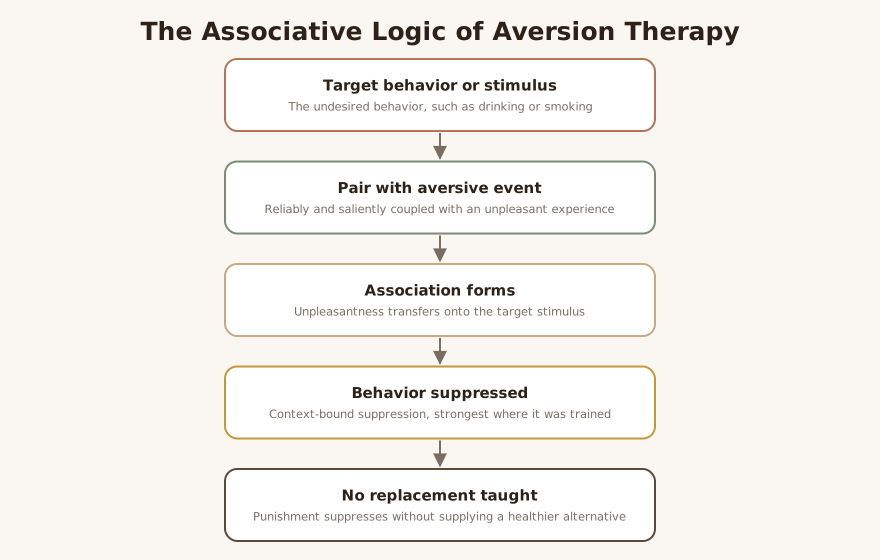
Aversion therapy is one of the oldest formalized behavioral techniques, and for the contemporary clinician it occupies an unusual position: historically influential, conceptually simple, and ethically fraught. It pairs an undesired behavior — drinking, smoking, a compulsive urge — with an unpleasant stimulus so that the behavior itself begins to evoke discomfort rather than reward 1. Understanding it well matters less because you are likely to deliver it in its classic form and more because its logic survives in tools you do use, and because clients sometimes arrive having been harmed by its past misuse 2. This article treats aversion therapy honestly: what it is, where its narrow evidence holds, and the substantial cautions that have moved most of it to the margins of practice 1.
Type & Discipline
Aversion therapy is a technique within clinical psychology and the behaviorist tradition rather than a free-standing therapeutic modality 6. It sits squarely in the family of classical-conditioning and behavior-therapy interventions, applying learned-association principles to clinical targets 1. Mechanistically it is usually described as counterconditioning — replacing a positively valenced response to a stimulus with a negative one — and is frequently framed in operant terms as positive punishment, in which an unpleasant consequence is added after a behavior to reduce its frequency 1. LLM The dual framing (classical and operant) is part of why the technique is conceptually slippery: depending on the procedure, it can look like Pavlovian pairing of a substance with nausea, or like operant punishment of a discrete act. LLM
Creators & Lineage
Aversion therapy descends directly from the foundational experiments of behaviorism. Ivan Pavlov’s early-1900s work demonstrating classical conditioning in dogs supplied the core associative mechanism 6. John B. Watson’s 1920 conditioning of fear in “Little Albert” extended the principle to acquired human aversions, and John Garcia’s later work on conditioned taste aversion — the “Garcia effect,” in which an aversion can form after a single pairing — showed how powerfully and rapidly such learning can occur 6. The first therapeutic applications appear in the 1930s, when clinicians began pairing emetics with alcohol to treat alcohol addiction 6. A landmark clinical site was the Seattle sanatorium opened by Charles Shadel in 1935, where gastroenterologist Walter Voegtlin and psychiatrist Fred Lemere applied Pavlovian conditioning to chronic alcoholism 5. Crude precursors are far older still — Pliny the Elder reportedly placed putrid spiders in the cups of Roman drinkers in the first century 5. The technique developed alongside, and in tension with, Joseph Wolpe’s systematic desensitization, a counter-tradition that used learning principles to reduce rather than manufacture aversive responses 6.
Core Principles
The governing principle is associative learning: a person “learns to respond to something based on repeated interactions with it,” so that repeated pairing of a target stimulus with an unpleasant one transfers the unpleasantness onto the target 2. When alcohol or cigarettes are paired reliably with an aversive event, “the two stimuli become associated, and the person develops an aversion towards the stimuli which initially caused the deviant behavior” 1. Several corollaries follow from this. First, the aversive pairing must be salient and reliable enough to form the association 1. Second, because the learning is tied to context, the suppression tends to be strongest where it was trained — a feature that becomes a central limitation 1. Third, in its operant framing the procedure suppresses a behavior without supplying a replacement: “punishment only teaches a person what not to do. It fails to guide them toward better, healthier alternatives” 1. LLM This last point is the conceptual seam where aversion therapy, used alone, tends to fail — suppression without substitution leaves the underlying need unaddressed. LLM
Interventions & Techniques
Several distinct delivery methods share the underlying logic. Chemical aversion pairs the target substance with a drug-induced unpleasant reaction; disulfiram (Antabuse) blocks alcohol metabolism so that drinking produces acetaldehyde buildup with “throbbing headaches, increased heart rate, palpitations, nausea, and vomiting,” while emetic agents induce vomiting in direct pairing with alcohol 1. Electrical aversion delivers mild-to-intense electric shock paired with a target behavior — for example, a person with a gambling problem self-administering shocks while reading gambling-related statements 1. Covert sensitization is entirely imaginal: the client vividly visualizes engaging in the behavior while imagining “a repulsive event, such as becoming violently nauseous or facing public ridicule,” which avoids physical harm but depends on imagery capacity 1. Rapid smoking has the client take frequent puffs to induce nausea and dizziness as a smoking-cessation strategy 1. Lighter physical aversion methods include rubber-band snaps or unpleasant tastes 2. Historically, pharmacological agents such as apomorphine and acoustic, photic, and electroshock stimulation were also documented across a range of targets 7.
LLM-generated illustrative example (not a guideline): A clinician and a client with an alcohol use disorder rehearse a covert-sensitization script in which the client imagines lifting a glass, then immediately imagines the smell turning, his stomach lurching, and vomiting across the bar before anyone can see. The pairing is rehearsed repeatedly so the imagined nausea begins to intrude when a real drink is offered LLM.
Evidence Base
The evidence base for aversion therapy is best described as historical and mixed, and the honest summary is that short-term signals exist while durability is weak 2. For alcohol use disorder, some studies are encouraging: one found roughly 69% of participants reporting sobriety one year after treatment, and Wikipedia summarizes a comparable figure of 69% continued abstinence at twelve months after four chemical-aversion sessions 25. Supervised disulfiram shows significantly lower relapse rates than unsupervised use — a finding more about adherence than about conditioning per se 5. But longer follow-up erodes these gains: historical abstinence rates fell from about 60% at one year to roughly 23% at ten years 2. Chesser (1976) reported 50% abstinence at twelve months, suggesting the technique can outperform no treatment 1. For smoking, the picture is poor: Hajek and Stead (2013) reviewed 25 studies and found 24 of them carried significant methodological flaws, concluding the evidence was insufficient to support long-term abstinence, and rapid smoking yields only mixed results 15. Aversion therapy proved largely ineffective for smoking cessation and for obesity 2. Across the literature, experts have repeatedly questioned its long-term efficacy 6. LLM Read together, the data suggest a technique that can perturb behavior in the short run but rarely produces durable change on its own, and whose better outcomes often reflect supervision and adjunctive support rather than the aversive pairing itself. LLM
Populations & Indications
The populations historically targeted are adults with substance use disorders, and especially adults with alcohol use disorder, where chemical aversion has been the primary application 25. People who smoke have been treated with rapid smoking and electrical methods, with limited success 12. The broader set of documented targets includes eating disorders, nail biting and other oral habits, self-injurious behaviors, and certain inappropriate sexual behaviors 2. Individuals with compulsive behaviors and behavioral addictions such as gambling have been treated with electrical pairing 1. Adults explicitly seeking reduction of a circumscribed, ego-dystonic habit represent the population in which a consensual, imaginal approach is most defensible 2. LLM In current practice the realistic indication is narrow: a motivated, fully informed adult with a specific habit who prefers an associative strategy and for whom safer, more durable first-line treatments have been offered. LLM
Problems-for-Work
- Alcohol use disorder. Chemical aversion with disulfiram or emetics has been the flagship application, with short-term abstinence signals that fade over years 25. LLM Application: used as a time-limited adjunct to relapse-prevention work, not a stand-alone cure. LLM
- Nicotine dependence. Rapid smoking pairs the act with nausea, but evidence for lasting cessation is weak 12. LLM
- Substance use disorders / polydrug use. Covert sensitization has been applied to polydrug dependence, with the caveat that some clients cannot generate vivid aversive imagery 3. LLM
- Compulsive and behavioral addictions (e.g., gambling). Electrical pairing while rehearsing the urge-eliciting cue has been used to attach discomfort to the trigger 1. LLM
- Nail biting and body-focused repetitive behaviors. Lighter physical aversion (an unpleasant taste, a rubber-band snap) has been paired with the behavior 2. LLM
- Problematic habits more broadly. The general logic of pairing the habit with discomfort has been extended to a range of unwanted routines 1. LLM
- Paraphilic disorders and compulsive sexual behavior. These appear in the historical record as targets, but this is also where the technique’s ethical history is most fraught and where extreme caution is required 75. LLM
Contraindications, Cautions & Cultural Humility
The cautions here are not peripheral; they are the reason the technique is largely abandoned 1. Aversive stimuli “can trigger disabling anxiety, aggression, or a desire to retaliate,” and in severe cases the literature documents risk of depression, fear, pain, and even post-traumatic stress disorder 15. Because learning is context-bound, suppression frequently fails to generalize: clients avoid the behavior in the clinical setting while relapsing outside it 12. Used punitively, the approach can foster “deep mistrust and may lead to the dehumanization of the client” 1. For covert sensitization specifically, Copemann (1977) identified a practical contraindication: clients who relax well but cannot generate vivid aversive imagery do not respond to the standard procedure, which led the author to augment it with hypnosis 3. The gravest cautions are historical and ethical. Before 1973, aversion therapy was used in attempts to “treat” homosexuality and was later judged both ineffective and harmful; the American Psychiatric Association removed homosexuality from its classification of mental illness in 1973, recognizing sexual orientation as non-pathological 26. In England during the 1960s and 1970s the technique was misapplied as conversion therapy against lesbian and bisexual women using electric shocks and vomiting-inducing injections, with over 250 documented cases and lasting psychological harm 5. Coercive use of electric-shock devices for behavior modification continued at the Judge Rotenberg Educational Center until 2020, drawing United Nations condemnation as torture 5. LLM These are not historical footnotes but live considerations: any clinician encountering a client with a conversion-therapy history should expect mistrust of behavioral framing, center informed consent and autonomy, and never pathologize identity. Aversion methods must never be applied to sexual orientation or gender identity. LLM
Treatment-Plan Suggestions & SMART Objectives
| Goal | SMART objective (example) | Mechanism |
|---|---|---|
| Reduce alcohol use | Within 8 weeks, client will report zero drinking days for 4 consecutive weeks, verified by self-monitoring log | Counterconditioning pairs alcohol cues with an aversive response 1 |
| Decrease cravings to a manageable level | Within 6 weeks, client will rate peak daily craving at or below 3/10 on 5 of 7 days | Conditioned negative association weakens the appetitive pull of the cue 1 |
| Build vivid aversive imagery (covert sensitization) | Within 3 sessions, client will independently generate a detailed aversive scene rated ≥7/10 in vividness | Imaginal pairing of behavior with a repulsive consequence 13 |
| Interrupt a body-focused repetitive behavior | Over 4 weeks, client will reduce nail-biting episodes from a baseline of 10/day to ≤2/day per tally | Lighter physical aversion paired with the behavior 2 |
| Improve generalization beyond sessions | By week 10, client will apply the rehearsed pairing in ≥3 real-world high-risk situations per week | Deliberate cross-context practice counters context-bound suppression 1 |
| Strengthen adherence to medication-supported plan | For 12 weeks, client will take supervised disulfiram on 95% of scheduled days, confirmed by support person | Supervision raises adherence and lowers relapse 5 |
| Replace the suppressed behavior with an alternative | Within 6 weeks, client will name and use ≥2 coping alternatives during 80% of logged urges | Suppression alone teaches only what not to do; substitution adds the missing skill 1 |
Common Misconceptions
A first misconception is that aversion therapy is simply “punishment” in the colloquial sense; clinically it is an associative-learning procedure, though in operant terms it does function as positive punishment, and conflating the two obscures the conditioning mechanism 1. A second is that the technique reliably works for any habit — the data show meaningful failure for smoking cessation and obesity and only fragile, short-term gains elsewhere 12. A third is that gains in the office translate to daily life; in fact suppression is often context-bound, with relapse common outside the therapeutic setting 12. A fourth, and the most important, is that the historical use of aversion methods against sexual orientation was a legitimate clinical application — it was neither, having been judged ineffective and harmful and predicated on a diagnosis the field formally retired in 1973 26. LLM A final, subtler error is treating the encouraging one-year alcohol figures as evidence of durable cure; the ten-year decline to roughly 23% abstinence corrects that impression. LLM2
Training & Certification
There is no recognized stand-alone certification in aversion therapy; it is taught, when at all, as one technique within behavior-therapy and learning-theory training 6. LLM Chemical aversion in particular is a medical procedure: disulfiram and emetic protocols require physician prescription and medical supervision because of the physiological reactions they provoke, so a non-medical clinician’s role is collaborative rather than independent 1. LLM Competent use of even the imaginal variants assumes grounding in classical and operant conditioning, informed-consent procedures, and risk assessment for the anxiety, fear, and trauma reactions the methods can precipitate 15. LLM Given the evidence and the ethical record, most contemporary training frames aversion therapy historically and directs clinicians toward better-supported alternatives as first-line care. LLM
Key Terms
- Counterconditioning — replacing an existing response to a stimulus with an incompatible one; the mechanism most often invoked for aversion therapy 1.
- Positive punishment — in operant terms, adding an unpleasant stimulus after a behavior to reduce its frequency 1.
- Chemical aversion — pairing a substance with a drug-induced unpleasant reaction, e.g., disulfiram or an emetic with alcohol 1.
- Covert sensitization — imaginal pairing of the target behavior with a vividly imagined repulsive consequence 1.
- Rapid smoking — frequent forced puffing to induce nausea as a cessation method 1.
- Garcia effect — conditioned taste aversion that can form after a single pairing 6.
- Context-bound suppression — reduction of a behavior that holds in the training setting but fails to generalize, leading to relapse elsewhere 12.
Resources & Further Reading
▶ Watch — a video introduction to this concept:
- Aversion Therapy & Examples of Aversive Conditioning (Simply Psychology)
- Aversion Therapy: What It Is, Efficacy, Controversy, and More (Healthline)
- Treatment of polydrug abuse and addiction by covert sensitization: some contraindications — Copemann, 1977 (PubMed)
- Aversion therapy (Wikipedia)
- Aversion therapy (EBSCO Research Starters)
- Aversion therapy — McConaghy, 1972 (PubMed)
Reflective / Supervision Questions
- Given that short-term alcohol-abstinence gains erode markedly over ten years, how would you decide whether an aversion-based approach is justified over a better-supported first-line treatment for a given client? 2 LLM
- Because suppression is often context-bound, what concrete steps would you build into a plan to promote generalization beyond the session? 1 LLM
- How would you screen for, and respond to, a client whose presentation suggests prior harm from conversion-style aversion practices? 5 LLM
- When covert sensitization stalls because a client cannot generate vivid aversive imagery, what alternative would you choose, and how would you weigh augmentation strategies? 3 LLM
- What does informed consent need to include for any aversive procedure, given the documented risks of anxiety, fear, and trauma reactions? 15 LLM
- If a technique “teaches a person what not to do” without supplying an alternative, how does that shape your decision to pair it with skills-building work? 1 LLM