
Type & Discipline
Dukkha (Pali; Sanskrit duḥkha) is a foundational concept in Buddhist philosophy and psychology, not a clinical intervention in its own right 1. It is one of the three marks of existence (alongside impermanence and non-self) and the subject of the first of the Four Noble Truths 18. The term is conventionally translated “suffering,” but that rendering is widely regarded as too narrow; the construct spans gross pain, ordinary stress, and a subtle background unsatisfactoriness that pervades even pleasant experience 15. For clinicians, dukkha functions less as a technique and more as a lens for case conceptualization — a model of why distress recurs and how the mind manufactures secondary suffering on top of unavoidable difficulty LLM. It belongs to the lineage that runs through Buddhist psychology into mindfulness-based stress reduction (MBSR), mindfulness-based cognitive therapy (MBCT), and acceptance and commitment therapy (ACT) 6LLM.
Creators & Lineage
The concept is attributed to the historical Buddha, who framed dukkha as the starting point of the Four Noble Truths: the truth of dukkha, its origin, its cessation, and the path leading to its cessation 24. In classical sources dukkha is parsed into three forms: the dukkha of ordinary pain (dukkha-dukkha), the dukkha of change or impermanence (viparinama-dukkha), and the pervasive dukkha of conditioned existence (sankhara-dukkha) 8. The scholar-monk Bhikkhu Bodhi emphasizes that the First Noble Truth is not pessimism but a diagnostic claim — a clear-eyed acknowledgment that conditioned experience is inherently unreliable as a source of lasting satisfaction 3. In the twentieth century, Jon Kabat-Zinn translated this framework into a secular clinical idiom through MBSR, explicitly grounding the program in the Buddhist understanding of suffering and its relief while stripping the religious scaffolding 6. John Teasdale and Michael Chaskalson later articulated, for a clinical and contemplative readership, how mindfulness is theorized to transform dukkha at the level of mental processing 5.
Core Principles
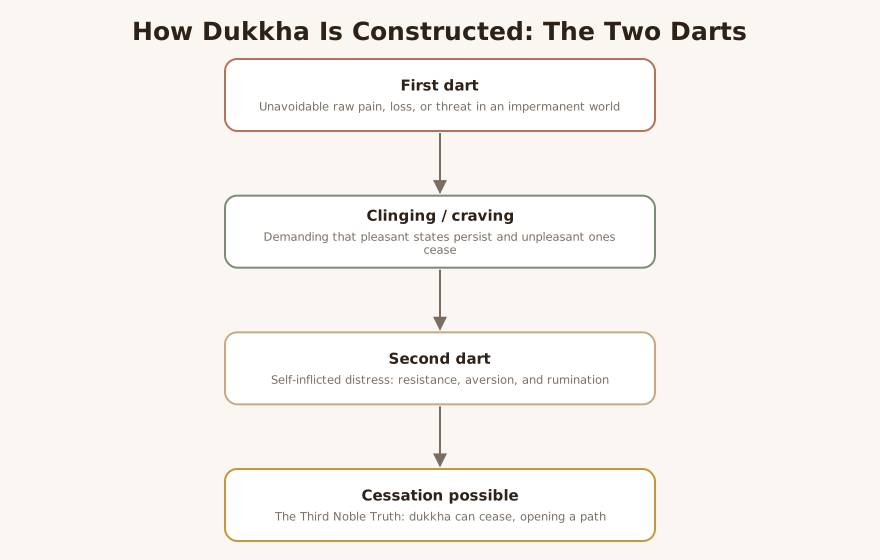
The central insight is that a large share of human suffering is constructed rather than simply received 5. Painful sensations, losses, and threats are unavoidable features of an impermanent world; dukkha in its fuller sense is the additional layer of distress generated by how the mind relates to those events 5. Teasdale and Chaskalson frame this as the difference between the unavoidable “first dart” of raw experience and the self-inflicted “second dart” of resistance, craving, and aversive rumination 5. The engine of this secondary suffering is clinging or craving — the demand that pleasant states persist, unpleasant states cease, and circumstances conform to preference 47. Because all conditioned experience is impermanent, clinging to it is structurally doomed to disappointment, which is why even success and pleasure carry a tinge of unsatisfactoriness 18. Crucially, the framework is fundamentally hopeful: the Third Noble Truth asserts that dukkha can cease, which makes the diagnosis a prelude to a path rather than a verdict 23.
Interventions & Techniques
Dukkha itself is not a procedure, but it informs a recognizable family of techniques delivered within mindfulness- and acceptance-based therapies LLM. The foundational move is mindful awareness: bringing non-judgmental, present-moment attention to experience so that the construction of secondary suffering becomes visible rather than automatic 6. From this, clinicians draw several applications LLM:
- Separating pain from suffering. Clients learn to distinguish unavoidable difficulty (the first dart) from the elaborative reactivity that compounds it (the second dart), often the single most useful translation of dukkha for a caseload 5LLM.
- Decentering from mental events. Observing thoughts and sensations as transient events rather than facts or commands undercuts the clinging that drives recurrence, a mechanism central to MBCT’s relapse-prevention model 5LLM.
- Reducing experiential avoidance. Reframing the urge to eliminate discomfort as itself a source of dukkha supports the acceptance and willingness work characteristic of ACT LLM.
- Working with craving and dissatisfaction. Naming the “if only” structure of craving helps clients see how the pursuit of permanence in impermanent conditions perpetuates distress 47LLM.
LLM-generated illustrative example (not a guideline): A client with chronic low back pain rates her pain at 4/10 but her distress at 9/10. The clinician maps this gap: the 4 is the sensation she cannot currently change; much of the 9 is the cascade of “this will never end,” self-blame, and frantic avoidance layered on top. Naming that layer as workable — without minimizing the pain — opens a treatment target. LLM
Evidence Base
Honesty about maturity requires a split distinction LLM. As a philosophical and psychological concept, dukkha is established and foundational — it is more than two millennia old and is among the most thoroughly elaborated models of suffering in any contemplative tradition 13. However, dukkha qua dukkha has no independent body of randomized trial evidence and is not itself a treatment that can be tested LLM. The empirical support sits with the clinical operationalizations it informs: MBSR and MBCT have a mature controlled-trial literature, and Kabat-Zinn’s work explicitly situates these interventions within the Buddhist understanding of suffering as their conceptual source 6. Teasdale and Chaskalson’s contribution is theoretical rather than a trial — a process model of how mindfulness might transform dukkha — and should be cited as a bridging hypothesis rather than as outcome evidence 5. The clinically responsible stance is therefore to use dukkha as a conceptual scaffold while anchoring claims of efficacy to the specific evidence-based protocols built on it, not to the concept alone LLM.
Populations & Indications
The dukkha framework is most clinically apt where distress is driven by relationship to experience rather than by experience alone LLM. It maps naturally onto adults in mindfulness-based programs and meditation practitioners who already use this vocabulary 6LLM. It is particularly resonant for people with chronic illness and chronic pain, where the original MBSR population sat and where the pain-versus-suffering distinction is directly usable 65. People with depression — especially recurrent, ruminative presentations — fit the MBCT model that grows from this lineage 5. The framework also speaks to people with anxiety, where craving for certainty and aversion to discomfort are central, and to people in grief, where impermanence and the impossibility of holding on are the core wound 1LLM. Across these groups, the concept is best offered as a shared map rather than as doctrine to be accepted LLM.
Problems-for-Work
- Rumination. Decentering reframes ruminative chains as the “second dart,” giving clients a non-suppressive way to relate to repetitive thought 5LLM.
- Experiential avoidance. Naming avoidance as a generator of dukkha supports willingness-based exposure to feared internal states LLM.
- Dissatisfaction and craving. The “if only” pattern is made explicit, helping clients notice the hedonic treadmill that keeps satisfaction perpetually out of reach 47LLM.
- Chronic pain. The pain/suffering split offers a target — distress — even when the sensation is not modifiable 56LLM.
- Grief and existential distress. Impermanence is repositioned from a private injustice to a universal condition, which can loosen the grip of “this should not be happening” 18LLM.
- Adjustment disorder. For clients reeling from a major life change, the dukkha of change (viparinama-dukkha) names their experience precisely and normalizes it 8LLM.
LLM-generated illustrative example (not a guideline): A client in adjustment distress after a layoff repeatedly says, “I just want things back the way they were.” The clinician gently introduces the dukkha of change — not to argue him out of his wish, but to validate that grasping at a vanished situation is itself painful, and to pivot toward what is workable now. LLM
Contraindications, Cautions & Cultural Humility
Dukkha is a religious and cultural concept being borrowed into a secular clinical setting, and that borrowing demands explicit humility LLM. Clinicians should avoid presenting a flattened “life is suffering” caricature, which both misrepresents the tradition and risks landing as nihilistic or invalidating 3LLM. The concept is descriptive, not prescriptive: it must never be used to imply that a client should simply accept abuse, injustice, oppression, or untreated medical conditions, nor to discourage indicated action LLM. For clients from Buddhist backgrounds, secular reframing can feel appropriative; for those from other faiths, the framing may feel like proselytizing — informed consent about the source of the model is appropriate LLM. Mindfulness practices that surface difficult material can be activating for trauma survivors and may require pacing or modification, and acceptance-oriented language can be misheard as resignation, so it should be paired clearly with valued action LLM. Where the underlying problem is biological (e.g., severe depression, psychosis), the framework is adjunctive and must not displace indicated medical or pharmacological care LLM.
Treatment-Plan Suggestions & SMART Objectives
| Goal | SMART objective (example) | Mechanism |
|---|---|---|
| Distinguish pain from suffering | Within 4 sessions, client will verbally separate “what happened” from “my reaction to it” in 3 of 4 logged distressing events | Reduces second-dart elaboration 5 |
| Reduce ruminative reactivity | Over 6 weeks, client will use a 3-minute breathing/decentering practice at rumination onset on ≥5 days/week, logged | Decentering from mental events 5 |
| Increase willingness toward discomfort | By week 8, client will complete 2 willingness exercises tolerating a feared sensation without avoidance, rated weekly | Lowers experiential avoidance LLM |
| Loosen craving/dissatisfaction patterns | Within 5 sessions, client will identify and name the “if only” thought in ≥3 craving episodes per week | Makes clinging structure explicit 47 |
| Normalize impermanence in grief | Over 4 sessions, client will articulate one way change is universal rather than personal injustice, in own words | Reframes viparinama-dukkha 18 |
| Build present-moment attention | Client will sustain a daily 10-minute formal mindfulness practice 5 of 7 days for 4 consecutive weeks | Mindful awareness as substrate 6 |
| Reconnect acceptance with action | By week 6, client will pair each acceptance practice with one valued-action step, tracked weekly | Prevents acceptance-as-resignation LLM |
Common Misconceptions
The most common error is translating dukkha flatly as “suffering” and concluding that Buddhism teaches life is nothing but misery; the term more accurately denotes unsatisfactoriness or “dis-ease,” including the subtle instability of pleasant states 15. A second misconception is that the First Noble Truth is pessimistic — Bhikkhu Bodhi stresses it is diagnostic and paired with a claim that suffering can cease 3. A third is conflating acceptance with passivity or resignation; in the clinical lineage, acceptance of present experience is meant to free energy for committed, values-based action, not to endorse the status quo LLM. Finally, clinicians sometimes treat dukkha as an evidence-based intervention; it is a concept that underwrites interventions, and outcome claims belong to the protocols, not to the philosophy LLM.
Training & Certification
There is no certification in “dukkha” as such, and clinicians should be wary of anyone who implies otherwise LLM. Competence comes from two streams: grounding in the source tradition through reputable scholarly texts, and formal training in the secular clinical protocols that operationalize it LLM. The latter includes recognized MBSR and MBCT teacher-training pathways, which require substantial personal practice, supervised teaching, and adherence to manualized curricula, and ACT training through workshops and peer consultation 6LLM. Kabat-Zinn’s framing underscores that teachers of these programs are expected to embody an ongoing personal mindfulness practice, not merely deliver content 6. For conceptual depth, primary and scholarly Buddhist sources are appropriate continuing study rather than clinical credentialing 34.
Key Terms
- Dukkha: Suffering, stress, or pervasive unsatisfactoriness; the First Noble Truth and a mark of existence 18.
- Dukkha-dukkha: The dukkha of ordinary, overt pain and discomfort 8.
- Viparinama-dukkha: The dukkha of change — distress arising when pleasant conditions inevitably alter 8.
- Sankhara-dukkha: The pervasive, subtle dukkha of all conditioned existence 8.
- Four Noble Truths: Dukkha, its origin (craving), its cessation, and the path to cessation 24.
- Craving / clinging: The grasping after experience identified as the origin of dukkha 47.
- Second dart: The clinical metaphor for self-generated suffering layered on unavoidable pain 5.
Resources & Further Reading
▶ Watch — a video introduction to this concept:
- Dukkha | Suffering, Impermanence, Four Noble Truths — Britannica
- Four Noble Truths | Definition & Facts — Britannica
- Bhikkhu Bodhi, “The Nobility of the Truths” — Access to Insight
- The Four Noble Truths: cattari ariya saccani — Access to Insight
- Teasdale & Chaskalson (2011), How does mindfulness transform suffering? I — Contemporary Buddhism
- Kabat-Zinn (2003), Mindfulness-Based Interventions in Context — Clinical Psychology: Science and Practice
- What are the Four Noble Truths in Buddhism? — Tricycle
- Duḥkha — Wikipedia
Reflective / Supervision Questions
- When a client uses the language of acceptance, how do I confirm they hear it as a path to action rather than resignation? LLM
- Am I borrowing a religious concept responsibly, with consent and humility about its origins, or flattening it into a slogan? LLM
- In a given case, can I clearly name which distress is the unavoidable “first dart” and which is the workable “second dart”? LLM
- Where might the dukkha framing risk invalidating legitimate anger at injustice or signaling premature acceptance of a changeable situation? LLM
- Do my outcome claims rest on the established protocols (MBSR/MBCT/ACT), or have I drifted into treating a philosophical concept as if it were tested treatment? LLM
- What is the state of my own mindfulness practice, and how does it shape my capacity to teach these ideas credibly? LLM