
Type & Discipline
Trauma-Informed Care (TIC) is best understood as a framework and organizing philosophy for how services are delivered, rather than as a discrete therapy you administer in a session LLM. One survey of counseling approaches describes it simply as “a model that recognizes the impact of trauma on individuals and seeks to create a safe and empowering environment for healing” 1. It sits within the discipline of behavioral health systems design, because its unit of change is often the organization, the team, and the care environment as much as the individual encounter LLM. This distinction matters clinically: TIC is a lens you apply across whatever evidence-based modality you are already using, not a substitute for trauma-specific treatments such as Trauma-Focused Cognitive Behavioral Therapy or Eye Movement Desensitization and Reprocessing LLM.
The framework rests on two empirical premises. First, trauma exposure is widespread in the general population and especially elevated among people with mental health conditions 4. Second, most children will experience some form of trauma during childhood, and many endure significant cumulative adversity 3. From those premises follows the core proposition: because trauma is so common, every service contact should be designed on the assumption that the person in front of you may carry a trauma history, whether or not it is disclosed or diagnosed LLM.
Creators & Lineage
The intellectual lineage of TIC draws on several converging streams: the trauma literature of the 1980s and 1990s, the Adverse Childhood Experiences research that linked early adversity to lifelong health consequences, and a systems-reform movement within public behavioral health LLM. Roger Fallot and Maxine Harris are widely credited with operationalizing trauma-informed systems in community mental health settings, distinguishing trauma-informed services (universal, environmental) from trauma-specific services (targeted clinical treatment of trauma) LLM. The Substance Abuse and Mental Health Services Administration (SAMHSA) later codified the framework into the form most clinicians now recognize, including the “4 Rs” and a set of guiding principles, which is why SAMHSA functions as the de facto reference point for the model LLM.
The neuroscience underpinning was consolidated in texts such as Evans and Coccoma’s account of how trauma alters brain structure across diverse populations and how that reshaping should inform practice 6. In pediatrics, the framework was anchored to the ACE Pyramid and to research on physiological stress responses, which made visible the long-term mental and physical health consequences of early psychological injury 2. These strands — community systems reform, ACEs epidemiology, and developmental neuroscience — together form the modern foundation of TIC LLM.
Core Principles
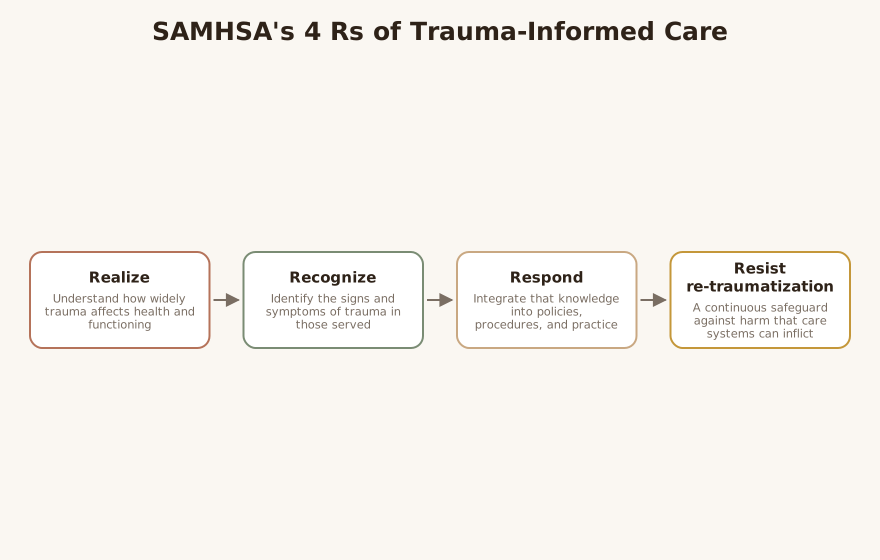
The most portable operational core is SAMHSA’s “4 Rs,” articulated in the pediatric literature as: realize how trauma affects health, recognize its signs and symptoms, respond by integrating that knowledge into practice, and resist re-traumatization 2. The first three orient the clinician’s stance; the fourth is a continuous safeguard against the iatrogenic harm that care systems can inflict 2.
Beyond the 4 Rs, TIC is typically described through a set of guiding principles. The ethics literature characterizes trauma-informed care as practice consistent with existing ethical frameworks, designed to establish care environments that are safe, transparent, empowering, and collaborative 4. Commonly, the framework is also taught with additional principles — trustworthiness, peer support, and attention to cultural, historical, and gender context — though these specific additions extend beyond what the sources here document and should be treated as framework convention rather than evidence-backed claims LLM. The unifying thread is the deliberate redistribution of power and predictability: the client gains transparency about what will happen, meaningful choice within it, and collaboration over decisions that affect them 4.
LLM-generated illustrative example (not a guideline): A clinic that adopts TIC might stop calling clients back from a crowded waiting room by shouting a full name, instead offering a quiet text-based check-in and letting the client choose where to sit relative to the door — small environmental changes that operationalize safety and choice without any change to the diagnosis or treatment plan LLM.
Interventions & Techniques
Because TIC is a delivery framework, its “interventions” are largely procedural and relational rather than technique-specific LLM. At the encounter level, the response component means delivering evidence-based care in a manner that does not re-traumatize — for example, explaining each step of an exam or assessment before it happens, asking permission, and giving the client control over pacing 2. The recognize component translates into screening: identifying symptoms and, where appropriate, screening for adverse childhood experiences so that presenting problems are understood in their trauma context rather than misread as defiance, non-adherence, or character pathology 2.
A central technique is the structural prevention of retraumatization in high-risk settings. The ethics literature is explicit that health care delivery itself may be traumatizing, “especially in settings of involuntary treatment, physical and chemical restraints, and/or seclusion” 4. TIC therefore drives concrete practice changes in those settings: minimizing coercive interventions, debriefing after any restraint or seclusion event, and prioritizing voluntary, collaborative alternatives 4.
At the organizational level, the dominant intervention is provider education. Proactive education enables clinicians to better assess family needs and to improve care quality for both patients and themselves 5. In case-management and outreach contexts, TIC has been framed as a paradigm shift in how services are structured — for instance, in services for homeless veterans, where engagement itself is the clinical problem and a trauma-informed posture is what makes engagement possible 7.
Evidence Base
Honesty about maturity is essential here. TIC is established in the sense that it is broadly endorsed, widely adopted, and codified by national bodies — but “established” should not be read as a deep base of randomized trials showing symptom reduction LLM. The 2024 pediatric review states plainly that trauma-informed care remains under-standardized in practice despite growing research attention, which is the most candid summary available of its current evidentiary status 5.
Several distinctions keep the evidence claim accurate. TIC is positioned as practice that is consistent with established ethical frameworks, which is a normative and consensus argument as much as an outcomes argument 4. The neuroscience literature supports the rationale — trauma demonstrably alters brain structure and function across populations — but a strong mechanistic rationale is not the same as outcome evidence that adopting TIC changes hard clinical endpoints 6. Crucially, TIC should not be conflated with trauma-specific treatments; those modalities carry their own separate evidence bases, and TIC’s value proposition is the environment and stance in which any treatment is delivered, not the treatment effect itself LLM. For the practicing clinician, the defensible position is that TIC is a well-justified, ethically grounded, and broadly adopted framework whose granular implementation and outcome standardization are still maturing 5.
Populations & Indications
A defining feature of TIC is that it is, in principle, universal: because trauma is so prevalent, the framework is applied to all clients rather than reserved for those with a trauma diagnosis 4. This is the indication logic that distinguishes a framework from a targeted treatment LLM.
That said, the sources concentrate on several populations where the case is especially strong. In pediatrics, the framework is indicated across varied medical settings precisely because most children experience trauma and the developmental stakes are high 3. Adults with mental health conditions show elevated trauma exposure and benefit from environments that reduce coercion and retraumatization 4. Survivors of childhood abuse and neglect — the original ACEs cohort — are a core population given the documented long-term health sequelae 2. Homeless veterans illustrate a population where trauma-informed restructuring of case management is framed as necessary for services to function at all 7. Finally, the framework extends to staff as an indicated population: clinicians experience vicarious trauma, secondary traumatic stress, and compassion fatigue, and TIC explicitly encompasses protecting them 45.
Problems-for-Work
- Retraumatization within care settings. When intake, examination, or crisis procedures replicate features of the original trauma, the encounter itself becomes harmful; the response is to redesign those procedures around consent and predictability 4. Application: introducing a “stop signal” the client can use at any point during a physical or psychiatric assessment LLM.
- Hypervigilance and threat reactivity. Clients scanning for danger may misread neutral provider behavior as threat; recognizing this as a trauma sign rather than hostility changes the clinical response 2.
- Treatment disengagement and avoidance. For populations such as homeless veterans, distrust of systems is itself the barrier; a trauma-informed, low-coercion posture is what enables initial and sustained engagement 7.
- Difficulty trusting providers. Transparency about what will happen and why directly targets the trust deficit that trauma histories produce 4.
- Power and control dynamics in the relationship. Collaboration and shared decision-making redistribute control that trauma stripped away 4.
- Provider secondary traumatic stress. Compassion fatigue degrades care quality; provider education and organizational support are the indicated responses 5.
Contraindications, Cautions & Cultural Humility
TIC is a delivery framework and therefore has no true “contraindication” in the way a medication does — there is no client who should receive non-trauma-informed care LLM. The meaningful cautions are about implementation. The first is that TIC is not a substitute for trauma-specific treatment; applying a trauma-informed stance does not by itself process or resolve a client’s trauma, and clinicians should be careful not to let a warm environment stand in for indicated clinical intervention LLM.
A second caution concerns universal ACE screening: identifying a trauma history without the capacity or pathway to respond can itself become a form of disclosure-without-containment, so the recognize and respond components must be coupled 2. The ethics literature underscores that autonomy, informed choice, and consent are central — a trauma-informed program that becomes paternalistic or coercive in the name of “safety” undermines its own principle 4.
Cultural humility is integral rather than additive. Trauma is shaped by historical, cultural, and gendered context, and a framework that ignores collective and intergenerational trauma will misjudge what “safety” and “trust” mean for a given client LLM. The ethical obligation is bidirectional, extending to staff who carry their own vicarious and lived trauma into the room 45.
Treatment-Plan Suggestions & SMART Objectives
| Goal | SMART objective (example) | Mechanism |
|---|---|---|
| Reduce retraumatization in sessions | Within 4 sessions, client and clinician will co-create a written “pause and grounding” protocol the client can invoke at any time, used in ≥1 documented instance | Restores choice and predictability; resists re-traumatization 4 |
| Increase felt safety | Over 6 weeks, client will rate subjective safety in session ≥7/10 on a session-end check-in for 3 consecutive sessions | Establishes safe, transparent environment 4 |
| Build provider trust | Within 8 weeks, client will attend ≥80% of scheduled sessions without same-day cancellation | Transparency and collaboration reduce engagement barriers 7 |
| Recognize and contextualize trauma signs | By session 3, clinician will complete a trauma-informed history and document ≥2 presenting symptoms reframed in trauma context | Realize/recognize components 2 |
| Reduce hypervigilance in care settings | Over 8 weeks, client will report ≤2 episodes/week of threat-driven exits or avoidance of appointments | Threat reactivity recognized and accommodated 2 |
| Strengthen collaborative decision-making | Within 4 sessions, client will co-author ≥1 treatment-plan goal in their own words | Empowerment and shared control 4 |
| Protect against provider secondary stress | Clinician will complete a structured peer debrief within 48 hours of any high-acuity trauma disclosure, ≥90% of the time over a quarter | Addresses vicarious trauma/compassion fatigue 5 |
Common Misconceptions
The headline misconception is that TIC is itself a therapy or modality you “do” to treat trauma LLM. It is not; it is the framework governing how any care is delivered, and the sources consistently describe it as a model, an environment, and a set of principles rather than a treatment protocol 14. A related error is assuming that being trauma-informed means asking everyone to recount their trauma in detail — in fact the framework’s emphasis on resisting re-traumatization often points the other way, toward not requiring disclosure 2.
A third misconception is that TIC applies only to clients with a trauma diagnosis; its logic is universal precisely because trauma is so common in the general and clinical population 4. A fourth is treating it as purely a clinician-skill issue when much of the work is organizational — environments, policies, and staff support — which is why provider education and system design feature so heavily 5. Finally, some assume the rich neuroscience rationale equals proven outcome efficacy; the rationale is strong but the framework remains under-standardized in measured practice 56.
Training & Certification
There is no single licensure or mandatory credential to “practice TIC,” consistent with its nature as a framework layered over existing professional practice LLM. The sources point instead to provider education as the primary training mechanism: proactive education equips clinicians to assess needs and improve care quality for patients and themselves 5. In pediatrics, professional bodies have published clinical guidance intended to be operationalized across varied medical settings, functioning as de facto training material 3.
Practically, training tends to occur through organizational initiatives, continuing education, and discipline-specific guidance rather than a standalone certificate LLM. Because the ethics of autonomy, consent, and avoiding coercion are central, ethics-focused training is an appropriate and underused component of TIC education 4.
Key Terms
- The 4 Rs — Realize, Recognize, Respond, and Resist re-traumatization; SAMHSA’s operational core of TIC 2.
- Re-traumatization — Harm caused when a care interaction replicates features of a person’s original trauma; especially acute in involuntary treatment, restraint, and seclusion 4.
- Adverse Childhood Experiences (ACEs) — Abuse, neglect, and traumatic experiences in childhood that directly affect long-term adolescent and adult health 2.
- Toxic stress — Prolonged adversity producing molecular, cellular, and organ-level changes with lifelong health consequences 3.
- Vicarious trauma / secondary traumatic stress / compassion fatigue — Trauma-related strain experienced by providers exposed to others’ trauma 45.
- Trauma-informed vs. trauma-specific services — The distinction between universal, environmental trauma-aware delivery and targeted clinical treatment of trauma LLM.
Resources & Further Reading
▶ Watch — a video introduction to this concept:
- Comprehensive List of Counseling Theories: Trauma-Informed Care (Luke Allen)
- Goddard A. Adverse Childhood Experiences and Trauma-Informed Care. J Pediatr Health Care. 2021
- Forkey H et al. Trauma-Informed Care. Pediatrics. 2021
- Rudolph K. Ethical Considerations in Trauma-Informed Care. Psychiatr Clin North Am. 2021
- Williams HN, Farley B. Trauma-informed care. Semin Pediatr Neurol. 2024
- Evans A, Coccoma P. Trauma-Informed Care: How Neuroscience Influences Practice. Routledge; 2014
- Dinnen S, Kane V, Cook JM. Trauma-Informed Care: A Paradigm Shift Needed for Services With Homeless Veterans. Prof Case Manag. 2014
Reflective / Supervision Questions
- Where in your own intake and crisis procedures might a client experience the encounter itself as a re-enactment of threat, and what one change would resist that? 4
- Are you treating TIC as a stance layered over your existing modality, or have you slipped into using “being supportive” as a substitute for indicated trauma-specific treatment? LLM
- When you screen for ACEs or trauma history, do you have a concrete response pathway ready, or are you eliciting disclosure you cannot yet contain? 2
- How do the meanings of “safety,” “trust,” and “choice” shift for clients whose trauma is collective, historical, or culturally specific rather than individual? LLM
- What organizational supports protect you from secondary traumatic stress, and would your caseload survive an honest audit of compassion fatigue? 5