
Type & Discipline
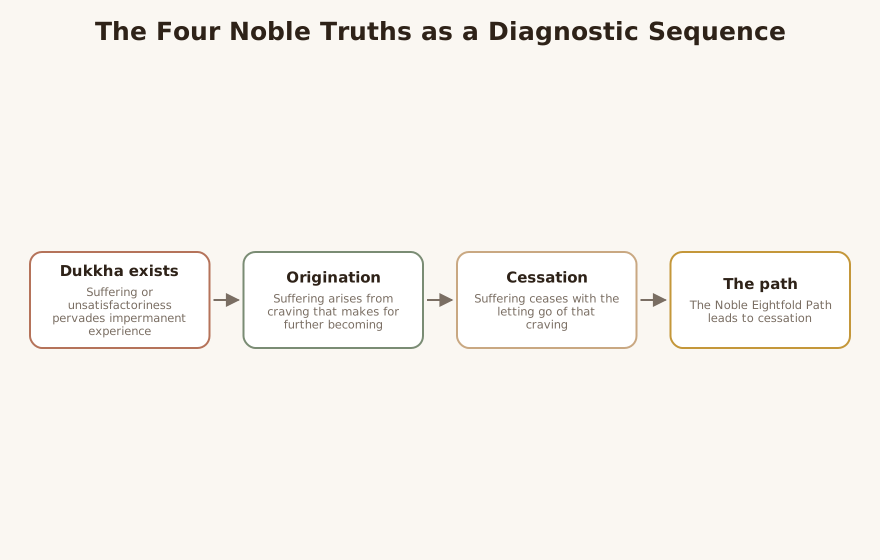
The Four Noble Truths is a foundational doctrine of Buddhism, not a psychotherapy, and reading it as one risks both clinical overreach and doctrinal distortion 5. It is best understood by clinicians as a framework — a structured way of understanding suffering and its resolution — drawn from Buddhist philosophy rather than from any empirical clinical tradition 3. The doctrine is attributed to the Buddha’s first sermon following his enlightenment and is presented in the Pali canon as cattāri ariyasaccāni (Sanskrit catvāryāryasatyāni) 5. Britannica notes a translation subtlety worth keeping in mind: “noble” describes not the truths themselves but the spiritually accomplished person who understands them, so a more precise rendering is “four truths for the [spiritually] noble” 3. For the practicing therapist, the value of this framework lies in its architecture — a sequence that moves from naming distress, to identifying its driver, to asserting that relief is possible, to specifying a method — which maps onto the assessment-formulation-prognosis-intervention logic clinicians already use LLM.
Creators & Lineage
The framework is attributed to the Buddha and was set out in the Dhammacakkappavattana Sutta (“Setting the Wheel of Dhamma in Motion,” SN 56.11), traditionally regarded as his first teaching after awakening 1. That discourse frames the truths between two rejected extremes — indulgence in sensual pleasure and self-affliction — and proposes instead a “middle way” that “produces vision, produces knowledge, and leads to calm” and awakening 1. This middle-way stance, refusing both gratification and punishing austerity, prefigures the balanced posture that modern therapies adopt toward difficult experience LLM. The lineage relevant to clinicians runs forward through the contemplative traditions into contemporary secular adaptations: the framework informs the conceptual scaffolding of Mindfulness-Based Stress Reduction (MBSR), Acceptance and Commitment Therapy (ACT), and Dialectical Behavior Therapy (DBT), each of which translates one or more of its core moves into a manualized intervention LLM. Wikipedia documents this trajectory explicitly, noting that contemporary mindfulness-based therapies present “pragmatic, experiential goals rather than traditional doctrines concerning rebirth and ultimate liberation” 5.
Core Principles
The four truths follow a fixed order. First, the truth of dukkha: “Birth is stressful, aging is stressful, death is stressful; sorrow, lamentation, pain, distress, and despair are stressful,” including separation from what one loves 1. Dukkha is routinely translated as “suffering,” but the rendering is misleading; more accurate glosses include “unsatisfactoriness,” “incapable of satisfying,” and even “standing unstable,” pointing at the insecurity inherent in all impermanent, conditioned experience rather than at acute pain alone 5. Second, the truth of origination (samudaya): suffering arises from “the craving that makes for further becoming — accompanied by passion and delight” 1. Third, the truth of cessation (nirodha): the “remainderless fading and cessation, renunciation, relinquishment, release, and letting go of that very craving” 1. Fourth, the truth of the path (magga): the Noble Eightfold Path of right view, right resolve, right speech, right action, right livelihood, right effort, right mindfulness, and right concentration 1.
The craving that drives suffering is itself analyzed into three forms — kāma-taṇhā, craving for sensual pleasure; bhava-taṇhā, craving to become or continue; and vibhava-taṇhā, craving to avoid or be rid of painful experience 5. That third form is the clinically loaded one: the wish to not-feel, to escape, to make the unwanted experience stop, which contemporary therapy names experiential avoidance LLM.
The single most useful principle for clinicians is that the sutta attaches a task to each truth rather than a belief. Suffering “is to be comprehended”; its origination “is to be abandoned”; its cessation “is to be realized”; and the path “is to be developed” 2. The Buddha is described as awakened only when his knowledge of these four tasks became “truly pure,” signaling that the framework is performative, not propositional — something done, not merely accepted 2.
Interventions & Techniques
Because the Four Noble Truths is a framework rather than a protocol, its “interventions” are the four tasks operationalized in session LLM. Comprehending suffering translates into validating and naming distress without rushing to fix it — turning toward the experience with curiosity, which mirrors the mindful awareness exercises common to MBSR and the observe-and-describe skills of DBT LLM. Abandoning craving translates into working with the pushes and pulls that maintain distress: noticing urges, reducing reactivity to wanting and not-wanting, and loosening attachment to outcomes, which parallels ACT’s defusion and willingness work LLM. Realizing cessation translates into helping clients notice, even briefly, the relief that appears when grasping relaxes — the lived discovery that suffering is contingent rather than total, which functions as in-session evidence that change is possible LLM. Developing the path translates into committed, values-consistent action across speech, conduct, livelihood, effort, and attention — closely echoing ACT’s committed action and the skill-building structure of DBT LLM.
The Eightfold Path itself is traditionally grouped into three trainings — ethical conduct, mental discipline (concentration), and wisdom — which gives the clinician a tidy way to sequence work: behavioral activation and interpersonal repair (conduct), attentional and self-regulation skills (concentration), and reappraisal or perspective-taking (wisdom) 4.
LLM-generated illustrative example (not a guideline): A client with persistent low mood says, “I just want to feel normal again.” The clinician works task by task — first sitting with the grief rather than problem-solving it (comprehend), then noticing how the demand to feel “normal now” intensifies the distress (abandon craving, specifically vibhava-taṇhā), then flagging a moment in session when the client laughed and the pressure briefly lifted (realize cessation), then co-building a week of small values-based actions (develop the path) LLM.
Evidence Base
Honesty matters here. The maturity of the doctrine is established and ancient, but the Four Noble Truths is not itself an empirically validated treatment, and none of the sources cited here is a clinical trial 5. There is no “Four Noble Truths therapy” with a randomized controlled evidence base LLM. What is empirically supported are the descendant interventions — MBSR, MBCT, ACT, and DBT — that operationalize pieces of this framework; the framework’s clinical credibility is therefore indirect, inherited from the therapies it informs rather than demonstrated on its own LLM. Wikipedia notes that contemporary teachers increasingly recast dukkha as “mental anguish” and present the truths as a means to attain happiness in this life, a reframing that has explicitly fed therapeutic applications 5. Clinicians should present the framework to clients as an orienting lens and a source of techniques, not as an evidence-based protocol in its own right, and should locate the actual evidence in the named, manualized modalities LLM.
Populations & Indications
The framework is most naturally indicated for adults who can engage reflectively with the meaning of their distress LLM. It speaks directly to people seeking spiritual or existential meaning, because its first move — naming suffering as intrinsic to conditioned existence — reframes pain as universal rather than personal failure 3. It fits individuals with chronic illness and people with chronic pain particularly well, since the doctrine distinguishes unavoidable pain (aging, sickness, death are named as stressful) from the additional suffering generated by craving for things to be otherwise 1. People in recovery from addiction map cleanly onto the origination truth, where craving (taṇhā) is the explicit engine of suffering 1. Caregivers, who often experience the suffering of separation and of wanting to fix what cannot be fixed, are addressed by the sutta’s inclusion of “separation from what is loved” within dukkha 1.
Problems-for-Work
Existential distress and suffering/dissatisfaction. The first truth normalizes the felt unsatisfactoriness of life, offering a non-pathologizing frame for clients who feel that something is fundamentally wrong 3.
Chronic pain and chronic illness. Separating bare pain from the second-arrow suffering of resistance gives a concrete handle for pain-acceptance work 1.
Generalized anxiety, depression, and rumination. Anxiety and rumination are forms of craving for certainty or for a different present; depression often carries craving for an idealized past or self, which the origination truth helps name and the cessation truth helps relativize LLM.
Craving and addiction. The framework treats craving not as a moral failing but as a mechanism to be comprehended and abandoned, aligning with non-shaming relapse-prevention approaches 1.
Experiential avoidance. Vibhava-taṇhā, the craving to be rid of painful experience, is a near-exact philosophical analogue of experiential avoidance, the process ACT targets directly 5.
Grief and stress. The naming of sorrow, lamentation, and loss as intrinsic to existence offers grieving clients company rather than correction 1.
LLM-generated illustrative example (not a guideline): A client in early sobriety describes intense urges as evidence of weakness. Reframing the urge as taṇhā — a recognized, impersonal mechanism that “makes for further becoming,” to be comprehended rather than condemned — reduces shame and opens space for urge-surfing skills LLM.
Contraindications, Cautions & Cultural Humility
The framework should not be used to encourage spiritual bypassing — using “acceptance of suffering” to avoid addressing treatable conditions, unsafe circumstances, or trauma — and acute risk, active psychosis, and severe trauma require evidence-based crisis and trauma care, not a contemplative reframe LLM. The first truth’s emphasis on the inevitability of suffering can be misheard by depressed or suicidal clients as validation of hopelessness, so the cessation truth (relief is possible) must be held alongside it explicitly LLM. Clinicians should also distinguish unavoidable pain from changeable circumstances, never implying that a client should simply “let go of craving” for safety, justice, or basic needs LLM.
Cultural humility is essential because this is a living sacred tradition, not a free-floating wellness tool. Wikipedia documents that the four truths were “simplified and popularized in western writings” during the colonial era, deliberately reduced to make Buddhism “accessible, pliable, and readily appropriated by non-Buddhists,” producing what scholars call “Protestant Buddhism” — Buddhist vocabulary carrying essentially Western religious and individualist attitudes 5. Clinicians borrowing this framework are participating in that history and should do so transparently, naming the source, avoiding claims of authenticity they cannot support, and being attentive to clients for whom Buddhism is a heritage faith rather than a self-help resource 5.
Treatment-Plan Suggestions & SMART Objectives
| Goal | SMART objective (example) | Mechanism |
|---|---|---|
| Build non-avoidant awareness of distress (comprehend suffering) | Within 4 weeks, client will complete a daily 2-minute “name it” log identifying the emotion present, on 5 of 7 days LLM | Mirrors the task that suffering “is to be comprehended” 2 |
| Reduce experiential avoidance | Over 6 sessions, client will practice one willingness exercise toward a previously avoided feeling and rate distress before/after each time LLM | Targets vibhava-taṇhā, craving to be rid of painful experience 5 |
| Loosen attachment to a fixed outcome (abandon craving) | By week 8, client will identify 3 “must” demands and reframe each into a preference in session LLM | Operationalizes that origination “is to be abandoned” 2 |
| Notice contingency of suffering (realize cessation) | Weekly, client will record one moment when grasping eased and distress lessened, for 4 weeks LLM | Provides lived evidence that cessation “is to be realized” 2 |
| Increase values-consistent action (develop the path) | Within 4 weeks, client will schedule and complete 2 actions per week aligned with a stated value LLM | Enacts that the path “is to be developed” 2 |
| Strengthen attentional regulation | Over 6 weeks, client will complete a 10-minute mindfulness practice 4 days/week and log adherence LLM | Trains the concentration division of the path 4 |
| Reduce rumination through reappraisal | By week 8, client will apply a perspective-taking prompt to a recurrent worry on 4 of 7 days LLM | Trains the wisdom division of the path 4 |
Common Misconceptions
“Buddhism (and this framework) teaches that life is nothing but suffering.” Dukkha is better read as unsatisfactoriness or instability than as relentless misery, and Britannica explicitly glosses it as “uneasiness” or “dissatisfaction” 4. The doctrine is fundamentally hopeful: the third truth asserts that suffering can cease 1.
“The goal is to eliminate all desire.” The origination truth targets taṇhā — clinging, grasping craving “accompanied by passion and delight” — not ordinary motivation or preference 1. The middle way explicitly rejects self-affliction as much as indulgence 1.
“It’s a passive resignation to suffering.” The truths are framed as tasks to be performed — comprehend, abandon, realize, develop — making the stance active and effortful rather than resigned 2.
“It’s a proven therapy.” The framework is established doctrine, but its clinical evidence is indirect, carried by the modalities it informs rather than by trials of the framework itself 5.
“It’s a clean medical diagnosis the Buddha intended.” The diagnosis/cause/prognosis/treatment reading is a useful clinical analogy, but it was proposed by the scholar Hendrik Kern in 1882, and there is not sufficient historical evidence that the Buddha deliberately drew on a defined medical model 5.
Training & Certification
There is no certification in the Four Noble Truths as a clinical intervention, because it is a doctrine rather than a treatment 5. Clinicians wishing to apply it responsibly should pursue training and credentialing in the empirically supported modalities that operationalize it — MBSR/MBCT teacher training, ACT consultation and peer-reviewed competency processes, or DBT intensive training — and should ground their understanding of the doctrine itself in primary translations of the Dhammacakkappavattana Sutta and reputable reference scholarship rather than secondary self-help renderings 1 5. Engaging a personal contemplative practice and, ideally, consulting practitioners within the living tradition supports the cultural humility the material demands LLM.
Key Terms
- Dukkha — suffering, but more precisely the unsatisfactoriness and instability of conditioned existence 5.
- Samudaya — the origin or arising of suffering, identified as craving 4.
- Nirodha — the cessation of suffering through the fading and letting go of craving 1.
- Magga — the path leading to cessation, i.e., the Noble Eightfold Path 4.
- Taṇhā — craving; the engine of suffering, analyzed into sensual craving (kāma-taṇhā), craving to become (bhava-taṇhā), and craving to be rid of experience (vibhava-taṇhā) 5.
- Noble Eightfold Path — right view, resolve, speech, action, livelihood, effort, mindfulness, and concentration, grouped into conduct, concentration, and wisdom 1 4.
- The four tasks — suffering is to be comprehended, origination abandoned, cessation realized, path developed 2.
- The middle way — the stance between sensual indulgence and self-affliction that “leads to calm” and awakening 1.
Resources & Further Reading
▶ Watch — a video introduction to this concept:
- Dhammacakkappavattana Sutta: Setting the Wheel of Dhamma in Motion (SN 56.11) — Access to Insight
- SN 56:11 Setting the Wheel of Dhamma in Motion — dhammatalks.org
- Four Noble Truths — Encyclopaedia Britannica
- Buddhism — The Four Noble Truths — Encyclopaedia Britannica
- The Four Noble Truths — Spirit Rock Meditation Center
- Four Noble Truths — Wikipedia
Reflective / Supervision Questions
- When a client names suffering, do I sit with it long enough to “comprehend” it, or do I move to problem-solving before the experience has been fully met? LLM
- Can I distinguish, in a specific case, between a client’s unavoidable pain and the additional suffering generated by craving for things to be otherwise? LLM
- Where might I be using “acceptance” language to permit spiritual bypassing of a treatable or unsafe situation? LLM
- Am I transparent with clients about borrowing from a living religious tradition, and am I attentive to clients for whom Buddhism is heritage rather than self-help? 5
- Do I represent this framework honestly as an orienting lens whose clinical evidence lives in MBSR, ACT, and DBT, rather than as a proven therapy in itself? 5
- How does the medical-diagnosis analogy help my formulation, and where might leaning on it overstate what the tradition itself claims? 5