
Type & Discipline
Non-attachment, also rendered as non-clinging, is a contemplative philosophical concept rather than a standalone, manualized psychotherapy LLM. Its native home is Buddhist and yogic ethics, where it names a particular relationship to experience: holding outcomes, possessions, identities, and even relationships without grasping after them or recoiling in fear of their loss 4. In the Buddhist framing it is a direct response to the observation that craving and clinging are primary engines of suffering, so that loosening the grip on experience is understood to loosen suffering itself 4. In the yogic tradition the same disposition appears as aparigraha, usually translated as non-grasping, non-possessiveness, or non-greed, one of the ethical restraints (yamas) in Patanjali’s eightfold path 5. For the clinician it is most useful to treat non-attachment as a transdiagnostic stance toward inner and outer experience that can be cultivated within recognized therapies, not as a billable modality in its own right LLM.
Crucially, non-attachment is not detachment, dissociation, or apathy 4. Non-attachment is a fully engaged, open relationship to experience minus the grasping; detachment and apathy are forms of withdrawal or numbing 4. This distinction matters clinically because the word “non-attachment” can be misheard by clients as a recommendation to care less, to suppress emotion, or to stop loving the people they love, which is the opposite of what the construct denotes LLM. The measurable form of the construct, developed in psychological research, explicitly defines it as the absence of fixation on, or insistence upon, ideas, images, and sense objects, together with a flexible, balanced way of relating to experience 1.
Creators & Lineage
Non-attachment has no single author; it is a doctrine that arose within two ancient contemplative traditions and was later operationalized by contemporary psychologists LLM. In the Buddhist lineage it is attributed to the teachings of the Buddha, where clinging (often discussed under terms such as craving and grasping) is identified as a root cause of suffering, and its relinquishment is woven into the path toward liberation 4. In the yogic lineage aparigraha is codified by Patanjali in the Yoga Sutras as one of the five yamas, the ethical restraints that form the first limb of classical yoga practice 5. These two streams developed in overlapping cultural and historical contexts and converge on a shared intuition: that the suffering generated by grasping can be reduced by changing one’s relationship to wanting and having, rather than by acquiring more or controlling more LLM.
The concept’s migration into clinical psychology is recent and is the part most relevant to evidence-based practice LLM. Sahdra, Shaver, and Brown introduced a psychometric definition and the Nonattachment Scale in 2010, explicitly positioning their work as a Buddhist complement to Western research on attachment and adaptive functioning 1. Their move was to take a contemplative ideal and render it measurable, distinguishing it from secure or insecure interpersonal attachment and showing that it could be studied alongside established constructs of mental health 1. The measure was later refined using Rasch modeling to improve its precision as an index of one mechanism of mindfulness, sharpening how the construct is assessed in research 2. From there, non-attachment has been examined cross-culturally, including in studies of Buddhist populations where its relationship to psychological well-being has been tested directly 3.
Within contemporary psychotherapy, the construct is most at home in the broad family of mindfulness- and acceptance-based interventions, where loosening the grip on thoughts, feelings, and outcomes is a recurring therapeutic theme LLM. Acceptance and Commitment Therapy, Mindfulness-Based Cognitive Therapy, Dialectical Behavior Therapy, and the wider field of Buddhist psychology all share family resemblance with non-attachment without using that exact label, and they offer the practical vehicles through which the disposition is cultivated in modern care LLM.
Core Principles
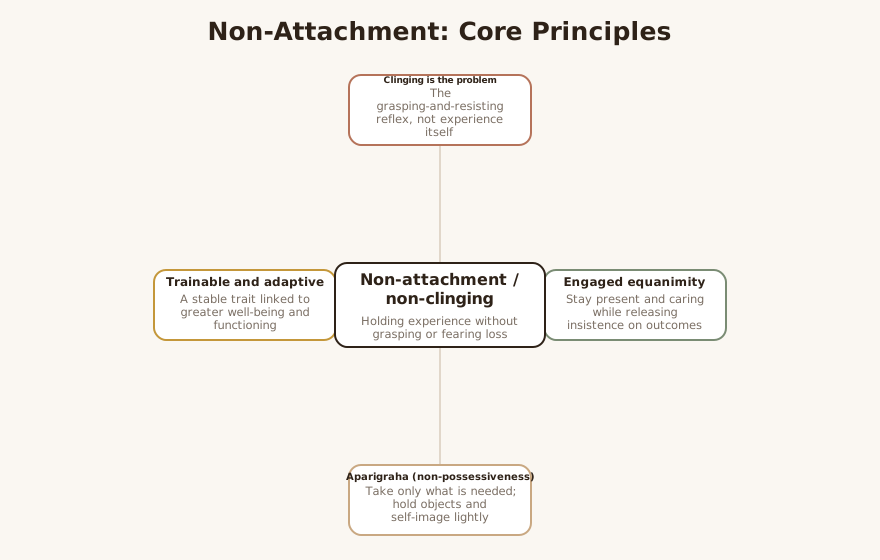
The first principle is that clinging, not experience itself, is the problem 4. Pleasant experiences are not the difficulty; the difficulty is the demand that they persist, and the corresponding aversion that demands unpleasant experiences cease immediately 4. Non-attachment therefore targets the grasping-and-resisting reflex rather than the contents of experience LLM.
The second principle is engaged equanimity rather than withdrawal 4. The aim is to remain fully present and caring while releasing the insistence that reality conform to one’s wishes, which is why the tradition is careful to separate non-attachment from detachment and indifference 4. The yogic articulation of aparigraha adds a material and relational dimension: non-possessiveness toward objects, people, and even one’s own self-image, taking only what is needed and holding it lightly 5.
The third principle is that this disposition is trainable and that it carries adaptive consequences 1. The psychometric program treats non-attachment as a stable, measurable individual difference that is associated with greater well-being and more adaptive functioning, demonstrating that the contemplative ideal corresponds to something observable and beneficial in ordinary psychological life 1. Cross-cultural work extends this, linking a non-attachment orientation to psychological well-being in Buddhist practitioners 3.
A fourth principle, drawn from the applied literature, is that releasing attachment to fixed outcomes can paradoxically support effective action and achievement, because energy otherwise spent defending a particular result or self-image is freed for flexible, present-focused engagement 6. This reframes non-attachment from a renunciation of goals into a more workable relationship with them 6.
Interventions & Techniques
Because non-attachment is a disposition rather than a protocol, it is cultivated through practices borrowed from contemplative and acceptance-based traditions and embedded in standard therapy LLM. The foundational practice is mindfulness of grasping: helping the client notice, in real time, the moment a pleasant state triggers the urge to cling or an unpleasant state triggers the urge to push away, and then practicing staying with the experience without acting on either urge 4. This observational stance is precisely the mechanism the refined measurement work treats as a facet of mindfulness 2.
A second technique is working with outcome attachment directly: identifying the specific result, image, or self-concept the client is gripping, and rehearsing a stance of full commitment to effort paired with openness about the result 6. The Psychology Today framing is useful here because it gives high-achieving clients a non-renunciatory rationale, namely that loosening the grip on a fixed outcome can improve performance and reduce the anxiety that accompanies clinging 6.
A third technique draws on aparigraha as a behavioral and relational practice: examining possessiveness and accumulation, distinguishing need from grasping, and practicing taking and holding only what is sufficient, whether the object is a material possession, a relationship role, or an identity 5.
LLM-generated illustrative example (not a guideline): A client preparing for a job interview is consumed by the thought “I have to get this offer or I am a failure.” The clinician helps her separate two things she has fused: her wholehearted preparation and effort, which she controls, and the hiring decision, which she does not. They rehearse a stance of full commitment to preparing well while practicing holding the outcome loosely, and they notice that the loosening lowers her anticipatory dread rather than her motivation LLM.
In practice these techniques are delivered through the surrounding evidence-based modality, for example as a defusion and acceptance exercise within Acceptance and Commitment Therapy, an attitudinal stance within Mindfulness-Based Cognitive Therapy, or a wise-mind and radical-acceptance practice within Dialectical Behavior Therapy LLM.
Evidence Base
Non-attachment is best described as an established contemplative construct with a maturing, but still modest, empirical psychology literature, rather than a discrete intervention with its own randomized controlled trial base LLM. The construct has a validated self-report measure, the Nonattachment Scale, which was developed with attention to construct validity and shown to relate to indicators of well-being and adaptive functioning 1. Its psychometric properties were subsequently strengthened through Rasch analysis, which improved the precision with which the construct can be measured and positioned it as an index of a specific mechanism of mindfulness 2. Cross-cultural research has tested the construct outside Western samples, examining its association with psychological well-being among Vietnamese Buddhists and supporting the claim that a non-attachment orientation tracks with better psychological functioning 3.
The honest limitations are equally important to state to clients and supervisees LLM. Much of the supporting research is correlational and cross-sectional, which means it establishes that non-attachment is associated with well-being, not that cultivating it causes improvement, and it does not by itself establish non-attachment as a treatment for any specific disorder 1. The construct’s strongest evidentiary footing is as a measurable correlate and a plausible mechanism within mindfulness- and acceptance-based therapies, which themselves carry the more robust outcome literature LLM. The defensible clinical stance is therefore to use non-attachment as an explanatory and motivational frame and as a target of practice within an evidence-based modality, while not presenting it as a freestanding validated treatment LLM.
Populations & Indications
Non-attachment as a clinical frame is well suited to adults whose distress is driven less by their circumstances than by the grip they hold on particular outcomes, possessions, or self-images LLM. Perfectionistic high achievers are a natural fit, because the construct offers a rationale for loosening attachment to flawless results without abandoning ambition, and the applied literature frames this loosening as compatible with, and even supportive of, success 6. Adults with anxiety are indicated where worry is organized around insistence on certainty and control, since the construct directly addresses the grasping after guaranteed outcomes LLM.
People experiencing grief and loss may be served by a non-clinging stance toward what cannot be held, provided it is offered with great care and never as a demand to “let go” prematurely 4. Individuals with chronic illness and chronic pain can use the disposition to change their relationship to symptoms they cannot eliminate, working with the aversion and resistance that amplify suffering 4. People in addiction recovery may find the framework relevant to craving, since clinging and craving are the explicit targets of the Buddhist account 4. Older adults facing mortality and clients confronting death anxiety are addressed by the tradition’s long engagement with impermanence and the relinquishing of grasping in the face of finitude 4.
Problems-for-Work
The construct speaks most directly to grasping-driven suffering across several presentations LLM. For rumination, the clinician targets the client’s fused, repetitive grip on a thought or grievance, training the observational stance that watches the thought arise and pass without seizing it 2.
LLM-generated illustrative example (not a guideline): A client replays a critical comment from a colleague for hours each evening. Rather than debating whether the comment was fair, the clinician helps him practice noticing the moment his mind grabs the memory and the urge to keep gripping it, then deliberately widening attention back to the present, repeating this as the thought recurs LLM.
For experiential avoidance, non-attachment reframes the goal: not getting rid of unwanted internal experience, but ending the war of grasping and pushing-away that sustains it 4. For perfectionism, the work loosens attachment to flawless outcomes and to a contingent self-image, using the achievement-compatible framing to make this acceptable to driven clients 6. For death anxiety and the distress of chronic illness, the work engages impermanence directly, helping the client hold what is precious without the unbearable insistence that it never change 4. For substance use and craving, the construct names craving itself as the target and cultivates the capacity to experience urges without obeying them 4. For adjustment difficulties after loss or change, a non-possessive stance toward a former role, relationship, or identity can ease the transition, again only when paced sensitively 5.
Contraindications, Cautions & Cultural Humility
The central caution is the risk of spiritual bypass: using “non-attachment” to justify emotional suppression, avoidance, or premature letting-go LLM. Because the construct is explicitly not detachment, apathy, or withdrawal, a clinician who introduces it without that distinction may inadvertently license a grieving client to numb or a traumatized client to dissociate, which is harmful and contrary to the construct’s meaning 4. With acute grief in particular, any framing that pressures a client to relinquish attachment to a lost person before they are ready is contraindicated, and the work should follow the client’s pace rather than impose an ideal 4.
Non-attachment language is also poorly matched to acute crisis, active psychosis, acute suicidality, and severe instability, where structure, safety planning, and stabilization take priority over contemplative reframing LLM. Clients with histories of trauma or dissociation need careful screening, because instructions that resemble “observe without reacting” can shade into derealization for some individuals if delivered without grounding and titration LLM.
Cultural humility is essential because non-attachment is rooted in specific Buddhist and yogic religious and philosophical traditions, and clinicians should neither strip it of its origins in a way that misrepresents it nor impose it as a universal spiritual prescription 5. For some clients the concept will resonate with their own faith or practice; for others it may conflict with religious commitments to attachment, devotion, or the goods of family and community LLM. The respectful stance is to offer the psychological mechanism, a more flexible relationship to grasping, while honoring each client’s tradition and language, and to recognize that the cross-cultural evidence, though encouraging, comes substantially from Buddhist samples and may not generalize uniformly 3.
Treatment-Plan Suggestions & SMART Objectives
| Goal | SMART objective (example) | Mechanism |
|---|---|---|
| Reduce outcome-attachment driving anxiety | Within 8 sessions, client will identify 3 situations where insisting on a guaranteed outcome fuels worry and practice a “full effort, loose outcome” stance in each | Loosening grasping after certainty 6 |
| Decrease rumination | Over 6 weeks, client will log 5 instances per week of noticing a gripped thought and returning attention to the present without engaging it | Observational, non-fixating awareness 2 |
| Reduce experiential avoidance | Within 10 sessions, client will allow 1 previously avoided internal experience to be present for 2 minutes without grasping or pushing it away, 3 times weekly | Ending the grasping/aversion cycle 4 |
| Loosen perfectionistic self-image | Over 8 weeks, client will complete 2 tasks per week to “good enough” standard and record the result without self-judgment | Non-attachment to contingent self-image 6 |
| Cultivate non-possessiveness (aparigraha) | Within 6 sessions, client will identify 2 areas of grasping (material, relational, or identity) and take one concrete step toward holding each more lightly | Aparigraha as behavioral practice 5 |
| Work with craving in recovery | Over 4 weeks, client will practice “urge surfing” with cravings 4 times weekly, observing the urge rise and pass without acting | Experiencing craving without clinging 4 |
| Engage impermanence and death anxiety | Within 10 sessions, client will articulate what they value about something impermanent and practice holding it with appreciation rather than dread, weekly | Relating to finitude without grasping 4 |
| Build measurable non-attachment as a skill | Over the episode of care, client’s self-reported non-attachment will increase from baseline on a validated measure with weekly reflective practice | Non-attachment as trainable disposition 1 |
Common Misconceptions
The most consequential misconception is that non-attachment means not caring, becoming detached, or suppressing emotion; in the source tradition it is the opposite, a fully engaged relationship to experience without grasping 4. A second is that it requires renouncing goals or ambition, when the applied framing holds that releasing attachment to fixed outcomes can actually support effective, less anxious pursuit of them 6. A third is conflating it with the interpersonal “attachment” of attachment theory; the psychometric work was explicitly designed to distinguish non-attachment from secure or insecure relational attachment, and the two are different constructs 1. A fourth is treating non-attachment as a purely spiritual ideal with no empirical content, when in fact it has been operationalized, measured, refined, and linked to well-being in research 2. A fifth, especially relevant to grief, is hearing it as a command to “let go” quickly; the tradition’s emphasis on engaged equanimity and the clinical need to follow the client’s pace both argue against any forced relinquishment 4.
Training & Certification
There is no license or certification in “non-attachment”; it is a concept practiced by licensed mental health professionals who incorporate it within their existing scope and modalities LLM. The most direct routes to competence are training in the acceptance- and mindfulness-based therapies that operationalize the disposition, namely Acceptance and Commitment Therapy, Mindfulness-Based Cognitive Therapy, and Dialectical Behavior Therapy, each of which has its own established training pathways LLM. Clinicians who wish to engage the construct seriously benefit from grounding in its source traditions, including the Buddhist account of clinging and craving and the yogic ethic of aparigraha, so that they represent it accurately rather than as a decontextualized self-help slogan 5. For research-oriented work, familiarity with the Nonattachment Scale and its Rasch-refined version supports measurement-based practice and program evaluation 2. As with any contemplative integration, clinicians should represent their competence and scope honestly and avoid implying religious or spiritual authority they do not hold LLM.
Key Terms
Non-attachment / non-clinging – a flexible, balanced relationship to experience, defined psychometrically as the absence of fixation on or insistence upon ideas, images, and sense objects 1. Clinging / craving – the grasping after pleasant experience and aversion toward unpleasant experience that the Buddhist tradition identifies as a root of suffering 4. Aparigraha – the yogic ethical restraint of non-grasping, non-possessiveness, or non-greed, one of Patanjali’s yamas 5. Detachment / apathy – withdrawal, numbing, or indifference, explicitly distinguished from non-attachment, which remains engaged 4. Nonattachment Scale (NAS) – the validated self-report measure of the construct, designed as a Buddhist complement to Western attachment research 1. Equanimity – an even, non-reactive relationship to experience that accompanies non-attachment without implying disengagement 4. Outcome attachment – a fixed, anxious grip on a particular result or self-image, the loosening of which is associated with more effective action 6. Impermanence – the changing, transient nature of experience and objects, engagement with which underlies non-grasping in the face of loss and mortality 4.
Resources & Further Reading
▶ Watch — a video introduction to this concept:
- A scale to measure nonattachment: a Buddhist complement to Western research on attachment and adaptive functioning (Sahdra, Shaver & Brown, 2010 — PubMed)
- Assessing Mechanisms of Mindfulness: Improving the Precision of the Nonattachment Scale Using a Rasch Model (Mindfulness)
- Buddhist Non-Attachment Philosophy and Psychological Well-Being in Vietnamese Buddhists (European Proceedings)
- What Is Non-Attachment in Buddhism? (Gassho)
- Aparigraha — practising non-attachment (YogaEasy)
- Why Non-Attachment May Be Key to Your Success (Psychology Today)
Reflective / Supervision Questions
- When I introduce non-attachment to a client, am I clearly distinguishing it from detachment and emotional suppression, or could the client hear it as permission to numb or avoid LLM?
- With a grieving client, am I following their pace, or am I imposing an ideal of “letting go” that the tradition itself does not demand LLM?
- Am I screening for trauma and dissociation before offering observe-without-reacting practices that could shade into derealization for some clients LLM?
- Am I honoring the Buddhist and yogic origins of this concept and my client’s own faith tradition, rather than presenting a decontextualized self-help version LLM?
- Am I representing the evidence honestly, as an established construct with a correlational well-being literature and a role as a mechanism within evidence-based therapies, rather than a freestanding validated treatment LLM?
- Where am I attached, as the clinician, to a particular outcome for this client, and how might that grip be shaping the work LLM?