
Type & Discipline
Mindfulness-Based Cognitive Therapy (MBCT) is a manualized, time-limited group intervention developed within clinical psychology and sits within the broader family of acceptance, mindfulness, and process-based therapies 3. It was designed specifically as a relapse-prevention program for people who have recovered from recurrent major depression rather than as an acute treatment for a current depressive episode 1. Structurally it is an eight-week course modeled on the Mindfulness-Based Stress Reduction (MBSR) program developed by Jon Kabat-Zinn, with cognitive therapy elements grafted on to target the specific cognitive vulnerabilities that drive depressive recurrence 5. In practice MBCT occupies a hybrid position: it teaches formal meditation like a mindfulness program while retaining the psychoeducational, skills-oriented spine of cognitive therapy LLM.
The defining theoretical move is that MBCT does not primarily aim to change the content of negative thoughts, as classical cognitive therapy does, but to change the patient’s relationship to those thoughts 6. Clients learn to relate to thoughts and feelings as transient mental events rather than as facts about the self or the world LLM. This reorientation toward awareness and acceptance, rather than dispute and restructuring, is what places MBCT firmly in the mindfulness-and-acceptance tradition while still drawing on its cognitive-behavioral parentage 6.
Creators & Lineage
MBCT was created by Zindel Segal, Mark Williams, and John Teasdale, who set out to develop a maintenance treatment that could be delivered to groups of recovered patients to reduce their high risk of relapse 3. Their starting point was the observation that depression tends to recur, and that with each successive episode the threshold for reactivation appears to lower, so that mild dysphoria can increasingly retrigger the depressogenic thinking patterns laid down in prior episodes 1. The developers reasoned that a portable skill for disengaging from this “depressogenic thinking” could interrupt the cascade before it escalated into a full relapse 1.
The intellectual lineage is explicit and braided. From Aaron Beck’s cognitive therapy, MBCT inherits the model of depressive cognition and the idea that thoughts are not facts 6. From MBSR it borrows almost the entire delivery architecture: the eight-week group format, the formal meditation practices, and the emphasis on daily home practice 5. The synthesis the developers produced was novel in combining the structured cognitive framework with sustained mindfulness training, and it was first formally described and tested as a relapse-prevention protocol in the late 1990s and 2000 1. The canonical clinician reference remains Segal, Williams, and Teasdale’s treatment manual, which lays out the session-by-session curriculum 3.
Core Principles
The central principle of MBCT is decentering: learning to observe thoughts and emotions as passing mental events rather than identifying with them or treating them as literal truth 6. A second principle is the deliberate shift from “automatic negative responses” toward a wider repertoire of more skillful responses, which gives the person a choice point where previously there was only reflexive reaction 6. Rather than trying to eliminate negative emotions, clients are taught to change their relationship with those emotions so they can tolerate and move through them 6.
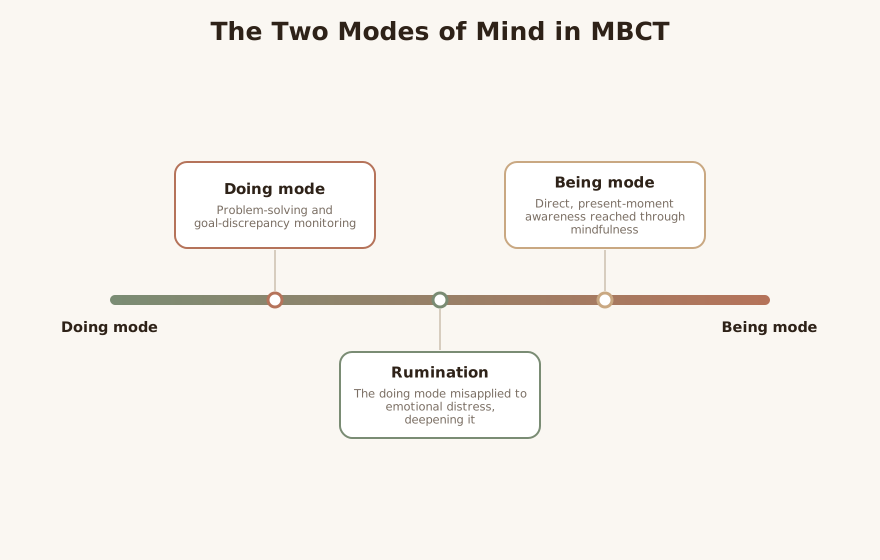
A related principle is the distinction between two modes of mind that MBCT trains people to recognize and toggle between: a “doing” mode oriented to problem-solving and goal-discrepancy monitoring, and a “being” mode of direct, present-moment awareness LLM. Rumination is understood as the doing mode misapplied to emotional distress, where the mind repeatedly tries to “solve” sadness and instead deepens it LLM. Mindfulness practice is the vehicle for stepping out of that loop and into present-moment awareness 7. The program is built on the premise that these capacities are skills, developed through repeated, sustained home practice between sessions rather than through insight alone 5.
Interventions & Techniques
MBCT is delivered as roughly eight weekly group sessions led by a trained facilitator, with substantial daily home practice expected between meetings 6. Core formal practices include sitting meditation, breathing exercises, and the body scan, in which attention is moved systematically through the body 6. These are complemented by informal practices that bring mindful, present-moment awareness to everyday activities such as eating, walking, and showering 6. The program characteristically includes a mindful-eating exercise early on to introduce the quality of attention being cultivated LLM.
A signature MBCT intervention is the three-minute breathing space, a brief, portable practice used to step out of automatic pilot during the day or at the first signs of distress LLM. Cognitive-therapy elements are woven through the course, including psychoeducation about depression, exercises that demonstrate how mood biases interpretation, and the development of a personalized relapse-prevention “action plan” identifying early warning signs and chosen responses LLM. The throughline across all techniques is repeated experiential practice in noticing experience and disengaging from rumination, rather than verbal disputation of beliefs 7.
LLM-generated illustrative example (not a guideline): A client in week 5 notices, during the three-minute breathing space, the thought “I’m slipping again, this always ends badly.” Instead of arguing with it or spiraling, she labels it (“here’s a catastrophic thought, and tightness in my chest”), returns attention to the breath, and then deliberately chooses to take a short walk rather than cancel her plans. She later names this as an early warning sign on her relapse-prevention plan. LLM
Evidence Base
The evidence base for MBCT as a relapse-prevention treatment is established, anchored by the founding randomized controlled trial and subsequent meta-analytic synthesis 12. In the original RCT, 145 recovered recurrently depressed patients were randomized to treatment as usual with or without MBCT and followed over 60 weeks 1. MBCT significantly reduced the risk of relapse/recurrence, but this benefit was confined to patients with three or more prior episodes, who made up 77% of the sample; for patients with only two prior episodes, MBCT did not reduce relapse 1. The authors concluded that MBCT offers a promising and cost-efficient psychological approach to preventing relapse in recurrently depressed patients 1.
That episode-count moderation has become a defining feature of the evidence and is reflected in subsequent practice, with MBCT typically recommended for those with at least three prior episodes 6. A systematic review and network meta-analysis of MBCT for prevention and time to depressive relapse has since examined its performance against comparators, situating MBCT within the broader landscape of relapse-prevention options 2. Beyond relapse prevention, mindfulness-based therapy has been reported to be roughly as effective as antidepressant medication for treating depression, and MBCT shows promise for depressive symptoms in people with physical conditions, though these indications are less firmly established than the core recurrent-depression use case 6. Clinicians should be honest with patients that MBCT’s strongest support is for relapse prevention in recovered, recurrently depressed individuals, not as a primary treatment for acute, severe depression 1.
Populations & Indications
The primary indicated population is adults with recurrent depression who are currently in remission, particularly those with three or more prior episodes 1. Because the model targets the reactivation of depressogenic thinking by mild dysphoria, it is best suited to people who are well enough to engage in sustained attention and group practice rather than acutely, severely symptomatic 1. The developers framed it explicitly as a maintenance intervention for the recovered phase 3.
Indications have broadened in practice to include people with anxiety disorders, including generalized anxiety, as well as bipolar disorder, emotional distress, and addictions 6. It also shows promise for depressive symptoms accompanying physical illness, such as vascular disease, traumatic brain injury, chronic pain, and fibromyalgia 6. Other populations encountered clinically include people with treatment-resistant depression, residual depressive symptoms, and older adults, where MBCT is offered as one component of a broader plan LLM. Across these groups the common requirement is the capacity and willingness to commit to daily home practice, which is integral to the model 5.
Problems-for-Work
- Depressive relapse prevention / recurrent depression. The core target: clients learn to recognize early warning signs and apply decentering and the breathing space to interrupt the slide back into depression 1.
- Rumination and residual depressive symptoms. MBCT directly addresses the repetitive, problem-solving “doing mode” applied to sadness by training a shift into present-moment awareness 7.
- Generalized anxiety and health anxiety. Clients practice relating to anxious thoughts and bodily sensations as passing events rather than threats requiring elimination 6.
- Stress. Drawing on its MBSR roots, the program builds general stress-regulation skills through formal and informal practice 5.
- Bipolar disorder. Used adjunctively, with awareness of mood state, to support emotion regulation between episodes 6.
- Suicidal ideation. Some MBCT work focuses on interrupting the reactivation of suicidal cognitions that can accompany depressive relapse, though this should be delivered with appropriate risk management and not as a stand-alone safety intervention LLM.
LLM-generated illustrative example (not a guideline): A clinician working with a client who has had four depressive episodes uses MBCT in remission to build a “relapse signature” (sleep disruption, social withdrawal, harsh self-talk) and pairs each sign with a planned mindful response, so the client has a rehearsed alternative to the old automatic spiral. LLM
Contraindications, Cautions & Cultural Humility
MBCT is not designed as a first-line treatment for acute, severe, or melancholic depression, and the evidence does not support substituting it for indicated acute care 1. The original trial showed no relapse-prevention benefit for people with only two prior episodes, so applying it indiscriminately across all depressed clients is not evidence-aligned 1. The program demands sustained daily home practice, and clients who cannot or will not commit to that practice are unlikely to derive the intended benefit, which the clinician should assess and discuss candidly at intake 5.
Intensive meditation can occasionally surface difficult memories, dissociation, or heightened distress in vulnerable individuals, so screening, monitoring, and a clear plan for adverse reactions are prudent, particularly with trauma histories or active suicidality LLM. There is no formal referral service for MBCT programs, and quality varies, so clinicians should verify that facilitators have appropriate mindfulness training and clinical background before referring 6. Cultural humility matters because mindfulness practices carry contemplative and sometimes religious associations; clinicians should frame practices in secular, collaborative terms, invite clients’ own meaning-making, and avoid presenting a single “correct” relationship to spiritual content LLM. Group formats also raise access and fit considerations, including language, disability, and comfort with disclosure, that the clinician should weigh when recommending MBCT versus individual work LLM.
Treatment-Plan Suggestions & SMART Objectives
| Goal | SMART objective (example) | Mechanism |
|---|---|---|
| Reduce depressive relapse risk | Client will complete all 8 MBCT group sessions over 10 weeks and log home practice on at least 5 days/week | Repeated mindfulness practice trains disengagement from depressogenic thinking 1 |
| Build decentering skill | Within 6 weeks, client will identify and label 3 recurrent negative thoughts as “mental events” during the breathing space, recorded in a practice log | Decentering reframes thoughts as transient events rather than facts 6 |
| Interrupt rumination | Client will use the three-minute breathing space at first signs of rumination on at least 4 days/week for 4 weeks | Shift from “doing” to “being” mode disrupts the rumination loop 7 |
| Recognize early warning signs | By session 7, client will produce a written relapse-prevention plan listing 3 personal warning signs and a planned response for each | Early detection plus rehearsed response prevents escalation LLM |
| Increase present-moment awareness | Client will complete a daily body scan or sitting practice 6 days/week for 8 weeks, tracked in a log | Formal practice strengthens attentional control and interoception 6 |
| Change relationship to negative affect | Over 8 weeks, client will report (0-10) increased willingness to allow difficult emotions without suppression in weekly review | Acceptance replaces avoidance, reducing secondary distress 6 |
| Apply mindfulness to daily life | Client will practice one informal mindfulness activity (eating, walking) daily for 4 weeks | Generalizes skills from formal practice to lived context 6 |
Common Misconceptions
A frequent misconception is that MBCT is a treatment for acute depression; in fact it was developed and validated as a relapse-prevention program for recovered patients, and its evidence is strongest there 1. A second is that MBCT works for everyone with depression, when the founding trial found benefit specifically in those with three or more prior episodes and not in those with two 1. A third is that MBCT is simply CBT with some meditation added; the deeper distinction is that it aims to change the relationship to thoughts rather than dispute their content 6.
Clinicians sometimes assume MBCT is “just relaxation,” but the goal is not relaxation per se and difficult emotions are deliberately approached rather than soothed away 6. Another misconception is that it is a passive, low-effort intervention, whereas it depends heavily on demanding daily home practice 5. Finally, some equate any mindfulness app or drop-in class with MBCT, but MBCT is a specific, manualized eight-week protocol with a defined curriculum and trained facilitation 3.
Training & Certification
MBCT is delivered by facilitators who hold clinical training plus additional, specific training in mindfulness practice, and patients are advised to look for therapists with that combined background 6. The treatment manual by Segal, Williams, and Teasdale provides the session-by-session curriculum that anchors faithful delivery, and competent facilitation is generally understood to require the facilitator’s own established personal mindfulness practice 3. Organizations in the mindfulness field, including foundations that have grown from the developers’ work, support training and dissemination of MBCT toward translating its evidence into routine practice 4.
A practical caution for the field is that there is no single formal referral service for MBCT programs, so credentialing and quality assurance fall to the referring clinician and the client 6. In practice this means verifying a facilitator’s clinical qualification, mindfulness teacher training, and adherence to the manualized protocol before referring or co-treating LLM.
Key Terms
- Decentering — Observing thoughts and feelings as passing mental events rather than as facts about the self 6.
- Automatic pilot — The habitual, unaware mode of reacting that mindfulness practice aims to interrupt LLM.
- Doing vs. being mode — Two modes of mind; the goal-driven “doing” mode misapplied to emotion fuels rumination, while “being” mode rests in present-moment awareness LLM.
- Three-minute breathing space — A brief, portable practice for stepping out of automatic reactions during the day LLM.
- Body scan — A formal practice of moving attention systematically through the body 6.
- Depressogenic thinking — The reactivatable patterns of negative cognition that MBCT trains patients to disengage from 1.
- Relapse signature / warning signs — The individualized early indicators a client learns to recognize and respond to LLM.
Resources & Further Reading
▶ Watch — a video introduction to this concept:
- Teasdale et al. (2000), Prevention of relapse/recurrence in major depression by MBCT — J Consult Clin Psychol
- MBCT for prevention and time to depressive relapse: Systematic review and network meta-analysis — Acta Psychiatrica Scandinavica
- Segal, Williams & Teasdale, Mindfulness-Based Cognitive Therapy for Depression: A New Approach to Preventing Relapse (treatment manual)
- Preventing depression with MBCT: From evidence to practice — Oxford Mindfulness Foundation
- About MBCT — MBCT.com
- Mindfulness-Based Cognitive Therapy — Psychology Today
- The Mindful Way Through Depression (video) — Mindful.org
Reflective / Supervision Questions
- For this client, is the indication genuinely relapse prevention in recovered recurrent depression, or am I reaching for MBCT outside its strongest evidence base? 1
- How many prior depressive episodes does this client have, and does that history align with where MBCT has shown benefit? 1
- Have I honestly assessed the client’s capacity and motivation for daily home practice, which the model requires to work? 5
- Am I framing the work as changing the relationship to thoughts, or am I drifting back into content-level disputation more characteristic of standard CBT? 6
- What is my plan for monitoring and responding if intensive practice surfaces distress, dissociation, or suicidal cognition? LLM
- How am I attending to cultural and spiritual associations of mindfulness for this particular client, and have I invited their own meaning-making? LLM
- If referring out, have I verified the facilitator’s clinical and mindfulness training given the absence of a formal referral service? 6