
Type & Discipline
Acceptance and Commitment Therapy (ACT, spoken as the word “act”) is a third-wave contextual behavioral therapy within the cognitive-behavioral tradition.5 The “waves” framing is useful: the first wave was behavior therapy (conditioning, exposure); the second wave added cognition (Beck, Ellis), working to change the content and accuracy of thoughts; the third wave — ACT, DBT, MBCT, CFT — shifts attention from the content of inner experience to a person’s relationship with it, drawing on acceptance, mindfulness, and values.15 ACT’s defining aim is therefore not symptom reduction as such but psychological flexibility: the capacity to remain in contact with the present moment and to persist in or change behavior in the service of chosen values, even when doing so brings discomfort.1
Creators & Lineage
ACT was originated by Steven C. Hayes in the early 1980s and developed over the following decades with Kirk Strosahl and Kelly Wilson; the clinical manual Acceptance and Commitment Therapy appeared in 1999, with a substantially revised second edition in 2012.56 What sets ACT apart from most therapies is that it grew upward from a basic science of language: Relational Frame Theory (RFT).1 RFT proposes that humans learn to relate events arbitrarily and bidirectionally (“framing”) — which is what gives a mere word or memory the power to evoke real distress and to dominate behavior far from the original event. Because language itself is the engine of much human suffering, ACT does not try to argue thoughts into accuracy; it works to change their function and grip. This places ACT in the lineage of Skinnerian behaviorism reinterpreted through modern language science, and in philosophical dialogue with Buddhist acceptance practices and Stoic ideas about judgments and values.15
Core Principles
ACT rests on a functional-contextual diagnosis of suffering: distress is amplified by cognitive fusion (being entangled with thoughts as if they were literal truths or commands) and by experiential avoidance (effortful attempts to control, suppress, or escape unwanted inner experiences), and it eases when a person can hold experience more openly and pour energy into valued living.1 Six interlocking processes — drawn as the “hexaflex” — together constitute psychological flexibility.
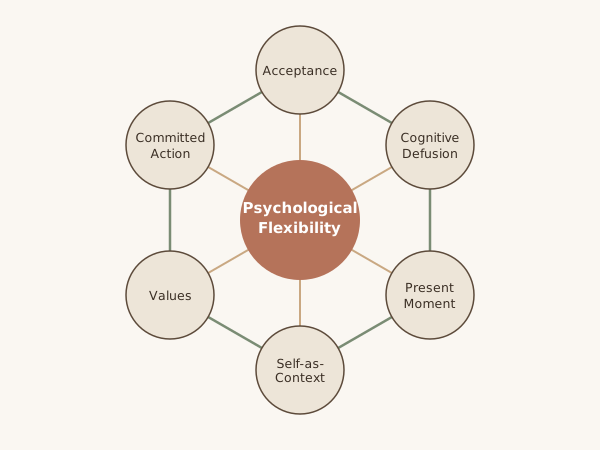
- Acceptance — actively making room for unwanted feelings, urges, and sensations rather than struggling to control them. Acceptance is a means to valued living, never an end or a demand to “like” pain.6
- Cognitive defusion — changing one’s relationship to thoughts so they are experienced as ongoing mental events rather than facts to obey. Techniques range from “I’m having the thought that…” to repeating a word until it loses meaning.1
- Contact with the present moment — flexible, voluntary, non-judgmental attention to what is here now, rather than being pulled into a conceptualized past or future.5
- Self-as-context — noticing the stable observing “self” from which all experience is witnessed, which provides a safe vantage point for difficult content.1
- Values — clarifying freely chosen life directions (“what do I want to stand for?”) across domains such as relationships, work, and health.6
- Committed action — building progressively larger patterns of values-consistent behavior, incorporating classic behavioral methods (goal-setting, skills, exposure).1
These are facets of one skill rather than sequential steps; a single intervention often touches several at once, and the therapeutic stance is experiential, metaphor-rich, and collaborative rather than didactic.6
Interventions & Techniques
ACT is delivered largely through experiential exercises and metaphors, which sidestep the verbal traps the model is trying to loosen.6 Commonly used methods include:
- Values clarification — card-sorts, the “84th birthday / retirement party” exercise, and “what do you want your life to be about?” conversations.6
- Defusion — “leaves on a stream,” naming the mind (“thanks, mind”), singing a distressing thought, or the “I’m having the thought that…” prefix.1
- Acceptance & willingness — the “passengers on the bus” metaphor, “making room,” and physicalizing emotion.6
- Present-moment / mindfulness — brief grounding and breath practices used flexibly, not as relaxation per se.5
- Self-as-context — the “observer self” and “chessboard” metaphors.1
- Committed action — values-linked goals, behavioral activation, and exposure reframed as willingness in the service of values.1
The Association for Contextual Behavioral Science (ACBS) maintains a large open library of exercises, measures, and protocols.3
How a Course of ACT Unfolds
A course of ACT is flexible rather than rigidly session-by-session, but it often moves through recognizable emphases.6 LLM Early work frequently begins with creative hopelessness — gently examining how the client’s control-and-avoidance strategies have actually worked over the long run — which loosens the agenda of symptom elimination and opens willingness.6 LLM Attention then turns to values (what makes the effort worthwhile), to acceptance and defusion skills that make room for the discomfort values-based action provokes, and to present-moment and self-as-context practices that stabilize attention.1 LLM The arc culminates in committed action: concrete, escalating, values-linked behavior change, frequently incorporating exposure for anxiety-related problems.1 Brief protocols (4–8 sessions) and longer courses both exist, and ACT is delivered individually, in groups, and in guided self-help formats.2 LLM
Evidence Base
ACT has a substantial and still-growing evidence base.27 A 2015 meta-analysis of 39 randomized controlled trials (1,821 patients) found ACT superior to control conditions overall (Hedges’s g ≈ 0.57), with the largest effects versus waitlist and smaller effects versus active treatments, and outcomes broadly comparable to traditional CBT.2
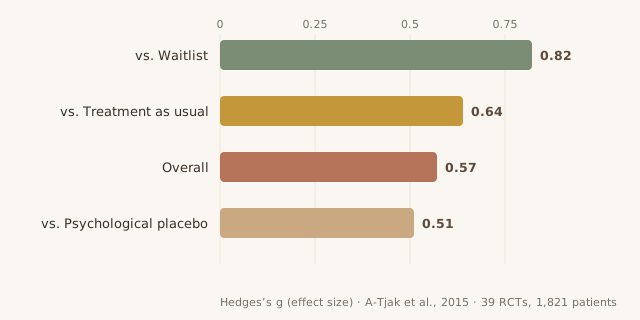
A larger 2020 review and meta-analysis of 133 RCTs concluded ACT is efficacious across many conditions and generally superior to inactive controls, while noting it is not reliably superior to established active treatments such as CBT.7 The APA Society of Clinical Psychology lists ACT among research-supported treatments, with ratings that vary by condition — strong for some (e.g., chronic pain), more modest for others (e.g., psychosis).4
Honest read: ACT is well-supported and a legitimate first-line option for several problems, but the best evidence indicates rough equivalence to CBT rather than superiority, and the strength of support varies sharply by target condition.27 LLM
Populations & Indications
ACT has been studied across the lifespan and across clinical and subclinical presentations — adults, adolescents, people living with chronic illness or pain, and stressed high-functioning professionals.25 Because it is transdiagnostic and process-focused, it is especially attractive when distress is maintained by avoidance and over-control rather than by a single discrete symptom, and when a client is seeking a values-anchored, meaning-centered approach.1 LLM
Problems-for-Work
ACT’s principles apply wherever experiential avoidance and cognitive fusion maintain a problem.1 Representative targets and how the principles are used:
- Chronic pain — the goal shifts from eliminating pain to living well with pain through acceptance and values-based activity.2
- Anxiety disorders — reducing the struggle to control anxiety; willingness combined with exposure to feared internal and external experience.27
- Depression — behavioral activation reframed as values-based committed action; defusion from depressive rumination.2
- OCD — defusing from intrusive thoughts and dropping mental control/neutralizing, often alongside exposure and response prevention.4
- Substance use — accepting cravings without acting on them, in the service of valued living.2
- Stress & burnout — values re-contact and workability questions for the over-controlled, over-extended professional. LLM
LLM-generated illustrative example (not a guideline): A client with panic practices “making room” for racing-heart sensations during interoceptive work, names “I’m having the thought that I’ll lose control,” and recommits to the valued action of attending their child’s recital rather than leaving early. LLM
Contraindications, Cautions & Cultural Humility
ACT is broadly tolerable, but several cautions apply.6 Acceptance language can be misheard as resignation — “just accept your suffering” — which is harmful where distress is driven by ongoing injustice, abuse, or unmet material need; the corrective is to foreground values and committed action (changing what can be changed), not acceptance alone.6 LLM In acute risk, active psychosis, or significant cognitive impairment, ACT’s abstract, metaphorical style may need adaptation, slowing, or a more structured approach.6 LLM Values work must elicit the client’s own values rather than the therapist’s or the dominant culture’s, which calls for explicit cultural humility. LLM
Treatment-Plan Suggestions & SMART Objectives
Goals center on increasing psychological flexibility and values-consistent action rather than symptom elimination alone. LLM
| Goal | SMART objective (example) | Process targeted |
|---|---|---|
| Reduce experiential avoidance | Within 6 weeks, client completes 1 daily 5-minute acceptance/defusion practice, logged ≥5 days/week | Acceptance, defusion |
| Clarify values | Within 3 sessions, client completes a values card-sort and names top 3 life domains | Values |
| Increase valued action | Over 8 weeks, client takes ≥2 values-consistent actions/week despite discomfort, tracked weekly | Committed action |
| Improve present-moment contact | Within 4 weeks, client uses a brief grounding practice at the first urge to avoid, ≥3×/week | Present moment |
| Strengthen cognitive defusion | Over 4 weeks, client applies a defusion technique to a recurrent sticky thought ≥4×/week, rating believability 0–100 | Defusion |
| Build willingness via exposure | Over 8 weeks, client approaches 1 avoided values-relevant situation/week while practicing acceptance, tracked | Acceptance + committed action |
| Develop self-as-context | Within 5 weeks, client uses an “observer self” practice during distress ≥3×/week, noting effect | Self-as-context |
These are illustrative; tailor to the client and measure with a validated instrument. LLM
Associated Measures
| Instrument | Measures |
|---|---|
| Acceptance and Action Questionnaire–II (AAQ-II) | Experiential avoidance / psychological inflexibility |
| Cognitive Fusion Questionnaire (CFQ) | Cognitive fusion |
| Valuing Questionnaire (VQ) | Progress in, and obstruction of, valued living |
The AAQ-II is the most widely used ACT process measure, though its discriminant validity from general distress is debated. LLM
Common Misconceptions
- “ACT is just mindfulness.” Mindfulness is one component; values and committed action are equally central, and ACT retains behavioral methods like exposure.5 LLM
- “Acceptance means giving up.” Acceptance makes room for experience so that values-based action becomes possible — the opposite of resignation.6 LLM
- “ACT rejects CBT.” ACT is part of the CBT family and frequently integrates exposure and behavioral activation.1 LLM
- “ACT ignores symptoms.” Symptoms often decrease as flexibility grows; ACT simply does not make symptom-elimination the primary target.2 LLM
In Relation to CBT, DBT & Mindfulness Approaches
ACT is best understood as a sibling within the cognitive-behavioral family rather than a rival.5 LLM Compared with traditional CBT, ACT does not dispute or restructure the content of thoughts; it changes their function through defusion and acceptance — yet both share behavioral roots and frequently use exposure, and outcome studies generally find them comparably effective.127 Compared with DBT — another third-wave therapy — ACT shares an emphasis on acceptance and mindfulness but lacks DBT’s structured skills-group architecture and its specific focus on emotion dysregulation and self-harm.5 LLM Compared with MBCT/MBSR, ACT uses mindfulness instrumentally (in the service of values and defusion) rather than as the central practice, and adds an explicit values-and-commitment dimension.5 LLM In day-to-day practice many clinicians integrate ACT processes with CBT and exposure rather than choosing a single camp.1 LLM
Limitations, Criticisms & Open Debates
Several honest caveats temper ACT’s appeal.7 LLM First, whether ACT is meaningfully distinct from CBT — or substantially a relabeling of shared processes — remains debated, and head-to-head trials rarely show ACT superior to good CBT.27 Second, the AAQ-II, ACT’s flagship process measure, has been criticized for overlapping heavily with general distress and neuroticism, which complicates claims that ACT works specifically through psychological flexibility.7 LLM Third, Relational Frame Theory, ACT’s basic-science foundation, is influential but not universally accepted, and the path from RFT to specific clinical technique is looser than is sometimes implied.1 LLM Fourth, evidence varies by condition, and some enthusiastic early claims have not held up — ACT for psychosis, for instance, is rated more modestly than for chronic pain or anxiety.47 None of this undercuts ACT as a solid, flexible, evidence-based option, but it argues for humility rather than evangelism. LLM
Training & Certification
ACT has no single licensing body; competence is developed through workshops, supervised practice, self-practice, and peer consultation, with resources coordinated by the Association for Contextual Behavioral Science (ACBS) — including trainings, a peer-reviewed trainer recognition process, and an open resource library.3 LLM
Key Terms
- Psychological flexibility — the overarching aim of ACT.1
- Experiential avoidance — effortful attempts to avoid/control unwanted inner experience.1
- Cognitive fusion / defusion — being entangled with vs. unhooked from thoughts.5
- Relational Frame Theory (RFT) — the behavior-analytic theory of language underlying ACT.1
- Hexaflex — the six-process model of psychological flexibility.5
- Workability — ACT’s pragmatic test: “is what you’re doing working, in terms of your values?” LLM
Resources & Further Reading
▶ Watch — a video introduction to this concept:
Organizations & training - Association for Contextual Behavioral Science (ACBS) — About ACT — exercises, measures, and trainings. - APA Division 12 — ACT for Chronic Pain — research-supported-treatment listing.
Research & reviews - A-Tjak et al. (2015) meta-analysis — PubMed - ACT for depression — meta-analysis (PMC) - ACT & mindfulness for chronic pain — APA (PDF) - Process & efficacy of ACT in adolescents — PubMed
Clinician explainers - Psychology Tools — ACT - Psychology Today — ACT - Wikipedia — Acceptance and commitment therapy
Related wiki articles: Stoicism · Erikson’s Psychosocial Stages. Explore in the graph: Cognitive Behavioral Therapy · Dialectical Behavior Therapy · or filter by Chronic pain and Generalized anxiety disorder.
Reflective / Supervision Questions
- Where in my own life do I confuse acceptance with resignation, and how might that bias my work?
- When a client’s stated “values” mirror social expectation, how do I help them locate what is genuinely theirs?
- Am I using ACT’s experiential style, or quietly converting it into another set of worksheets?
- How do I hold psychological flexibility as the goal while still honoring a client’s wish for symptom relief?