
Type & Discipline
Tonglen is a meditative technique drawn from Tibetan Buddhism, not a freestanding psychotherapy in the modern clinical sense 1. The name is a Tibetan term that translates literally as “giving and taking” (or “sending and receiving”), and the practice is built around the breath: the practitioner breathes in suffering and breathes out relief, spaciousness, and well-being 1. It belongs to the family of Tibetan compassion and mind-training (lojong) practices, where it functions as a method for cultivating bodhicitta — the awakened heart oriented toward the welfare of others 1. Within Buddhist taxonomy it is classed as a meditation or contemplative discipline rather than a doctrine or ritual, a technique a person performs and rehearses 4. Its defining and somewhat counterintuitive feature is that it deliberately reverses the ordinary human reflex to avoid pain and grasp at comfort, asking the practitioner to take in what is unwanted and send out what is wanted 2. For US clinical purposes Tonglen is best understood as an experiential exercise or skill that can be imported into recognized therapies, not as a separately reimbursable treatment in itself LLM.
Creators & Lineage
Tonglen is not the invention of a single modern author; it is a transmitted practice with a long lineage in Tibetan Buddhism 1. Its dissemination in Tibet is traditionally associated with the lojong (mind-training) teachings, a corpus of pithy compassion instructions carried into Tibet from the Indian master Atisha Dipankara Shrijnana in the eleventh century and systematized in texts such as the Seven Points of Mind Training attributed to the lineage of Geshe Chekawa 1. The practice therefore reaches contemporary clinicians through a centuries-old contemplative tradition rather than through a research program LLM. For Western and English-speaking audiences, the figure most responsible for making Tonglen widely known is the American Tibetan Buddhist teacher Pema Chödrön, whose accessible instructions and talks have introduced the practice to a broad lay and helping-professional readership 2. Chödrön teaches within the Shambhala lineage founded by her own teacher, Chögyam Trungpa, and her plain-language renderings of Tonglen circulate widely through organizations such as Lion’s Roar, Shambhala, and the Omega Institute 236. The clinically relevant point is that the practice carries genuine traditional authority while its popular contemporary form is shaped substantially by Chödrön’s teaching voice LLM.
Core Principles
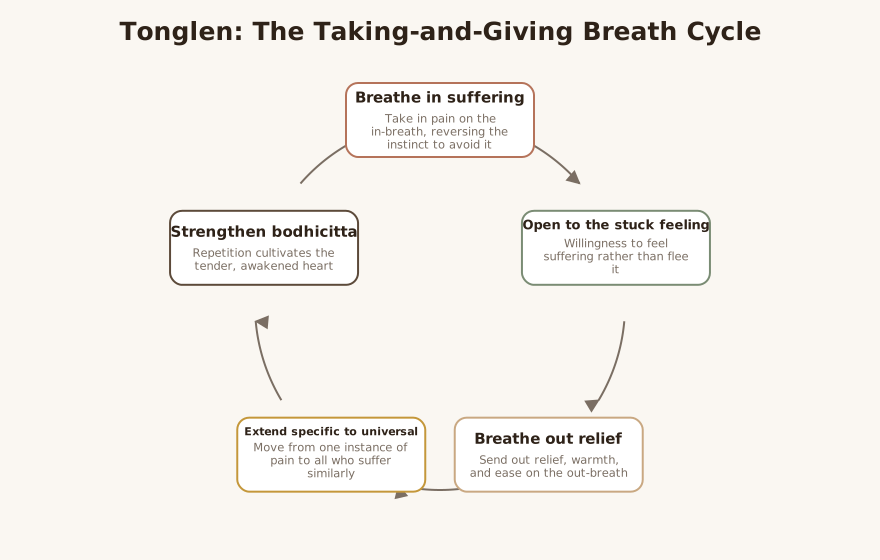
The organizing principle of Tonglen is reversal of the habitual avoidance pattern: instead of inhaling pleasure and exhaling pain, the practitioner intentionally takes in suffering on the in-breath and sends out relief, warmth, and ease on the out-breath 2. This is framed not as masochism but as a way of dismantling the self-protective armor that keeps a person closed off from their own and others’ pain 2. A second principle is that the practice works in two directions at once: by being willing to feel suffering rather than flee it, the practitioner both opens to others and addresses the same stuck feeling in themselves 2. Chödrön frames this as awakening compassion that is already present but blocked by the reflex to escape discomfort 2. A third principle is the cultivation of bodhicitta, the tender, awakened heart that wishes to relieve suffering, which Tonglen is designed to strengthen through repetition 1. The practice also rests on a movement from the specific to the universal: one begins with a concrete instance of pain and then extends the same wish for relief to all who suffer similarly 2. Underlying all of this is an attitudinal stance of openness and basic warmth toward experience rather than fixing or controlling it 3.
Interventions & Techniques
Tonglen is commonly taught as a four-stage sequence 2. The first stage is a brief moment of stillness or rest in open, spacious awareness, sometimes called flashing on openness or clarity, lasting only a second or two to set the tone 2. The second stage works with texture and imagery: the practitioner breathes in feelings of heat, heaviness, darkness, and claustrophobia, and breathes out coolness, lightness, brightness, and freshness, engaging all the senses so the practice is felt rather than merely thought 2. The third stage applies the breathing to a real situation of suffering — one’s own pain, the pain of someone specific, or a remembered instance of distress — breathing it in fully and breathing out spaciousness and relief 2. The fourth stage widens the circle: having connected with one person’s or one’s own suffering, the practitioner extends the practice to all beings who feel the same way, so that the in-breath takes in their shared pain and the out-breath sends relief to all of them 2. Chödrön emphasizes that one can begin Tonglen “on the spot,” using whatever arises in daily life — a flash of anger, fear, or another’s distress — as immediate material for the practice rather than reserving it for formal sitting 2. Guided audio and video instruction by Chödrön walks practitioners through this sequence step by step 56. A frequently taught adaptation, important clinically, is to begin with oneself or with a being one finds easy to feel for, building capacity before turning toward more difficult or charged targets 3.
Evidence Base
The honest characterization is that Tonglen is established as a traditional contemplative practice with centuries of transmission and a large contemporary teaching base, but it is not established as an independently evidence-based clinical intervention 12. None of the sources available here is a randomized controlled trial, systematic review, or other primary outcome study; the literature consists of encyclopedic reference entries and practitioner-oriented teaching from Buddhist organizations and teachers 123456. There is, in these sources, no trial-level efficacy data, no effect sizes, and no comparison with active controls LLM. Clinicians should therefore be careful not to overstate what is known: claims that Tonglen “treats” depression, anxiety, or trauma cannot be supported from this source base LLM. What can be said responsibly is that Tonglen shares mechanisms with practices that do have a maturing research literature — loving-kindness and compassion meditation, mindfulness-based programs, and compassion-focused therapy — namely the deliberate generation of compassionate affect, decentering from aversive experience, and reduced experiential avoidance LLM. A defensible clinical position is that Tonglen is a credible, well-described compassion technique whose plausible benefits are best framed through those related, better-studied mechanisms, and whose own direct evidence here is descriptive and traditional rather than experimental LLM.
Populations & Indications
Within its own framing, Tonglen is offered broadly to anyone wishing to cultivate compassion and tolerate difficult emotion, and it is taught explicitly as a way to relate to pain in the world rather than be overwhelmed by it 6. The populations for whom clinicians most often consider importing compassion practices, and to whom Tonglen is plausibly well suited, include people with chronic illness and pain who must live alongside unavoidable distress, and caregivers and helping professionals at risk of compassion fatigue, for whom a practice that processes rather than suppresses others’ suffering may be protective LLM. People experiencing grief may find that the structured taking-in of pain and sending-out of relief gives form to mourning and connects private loss to a shared human experience LLM. Established meditation practitioners are an obvious fit, since the practice assumes some capacity to sit with imagery and breath 2. End-of-life and palliative populations, and those who care for them, are a natural setting given the practice’s orientation toward suffering one cannot fix LLM. For clients with depression or anxiety, Tonglen may be considered as an adjunctive compassion exercise, with the strong caveat that “indication within the tradition” is not the same as “clinical indication,” and that primary evidence-based care should anchor treatment for those conditions LLM.
Problems-for-Work
The practice maps onto several presentations clinicians see regularly, and the mapping can be useful even when the metaphysics are held lightly LLM. Self-criticism, shame, and low self-compassion are among the most natural targets: directing Tonglen toward oneself — breathing in one’s own pain and breathing out warmth and relief — is a structured way to interrupt harsh self-relating and generate self-directed kindness 3.
LLM-generated illustrative example (not a guideline): Within a course of compassion-focused therapy, a client who berates herself after every perceived mistake practices a brief Tonglen on the spot: when the wave of self-attack arises, she breathes in the heaviness and shame as sensation, and breathes out coolness and “may I be at ease,” then extends the same wish to everyone caught in self-criticism. Over weeks the self-attacking spiral shortens and softens. LLM
Emotional avoidance is addressed almost by definition, since the practice is built on turning toward, rather than away from, what is unwanted 2. Grief and existential distress are worked through the taking-and-sending structure and the move from personal to universal suffering, which can reduce isolation in loss 2.
LLM-generated illustrative example (not a guideline): A bereaved client who feels alone in his loss is guided, within grief-focused therapy, to breathe in his own ache and then to breathe in “for everyone who is missing someone tonight,” sending relief outward. He reports the grief feels less like a private defect and more like a shared human weather, which loosens his shame about still hurting. LLM
Compassion fatigue and interpersonal difficulties can be approached by using the practice to stay open to others’ pain without armoring or shutting down 2.
Contraindications, Cautions & Cultural Humility
Tonglen is generally low-risk as a contemplative exercise, but it is not inert for every client LLM. Because it deliberately invites the practitioner to take in and feel suffering, it can intensify distress, flooding, or trauma reactivation in clients with limited affect-regulation capacity, active trauma symptoms, or a tendency toward over-identification with others’ pain — a real consideration for trauma survivors and for caregivers already near burnout LLM. Prudent practice is to titrate: begin with brief contact, with oneself or an easy object of compassion, and build capacity before turning to charged material, consistent with the traditional teaching to start where the heart can stay open 3. The practice should be presented as optional and choice-based, with grounding and an exit always available, and it should not be used as a primary treatment for conditions that require evidence-based care LLM. Clinicians should also be candid that Tonglen is a specifically Tibetan Buddhist practice embedded in a worldview of bodhicitta and rebirth, and importing it into secular therapy is an act of adaptation that warrants cultural humility 1. Therapists should avoid presenting it as a generic technique stripped of acknowledgment of its source, should not impose its spiritual frame on clients who do not share it, and should remain alert to clients for whom either the Buddhist origins or a secularized repackaging may feel alienating or appropriative LLM. Misapplied, the instruction to “take in suffering” could be heard as an injunction to absorb abuse or to bypass legitimate self-protection; the clinician must frame it as compassion practice, never as a rationale for tolerating harm LLM.
Treatment-Plan Suggestions & SMART Objectives
| Goal | SMART objective (example) | Mechanism |
|---|---|---|
| Increase self-compassion | Client will practice a 5-minute self-directed Tonglen (breathing in own pain, out warmth) 4 days/week for 6 weeks and rate self-kindness daily (0–10), targeting a 2-point mean rise | Generation of self-directed compassionate affect; interrupting self-attack 3 |
| Reduce self-criticism and shame | Client will apply “on-the-spot” Tonglen when a self-critical thought arises, logging frequency and intensity, with a 30% drop in rated intensity over 8 weeks | Decentering from shame; warmth replacing aversive self-relating 2 |
| Reduce emotional avoidance | Client will use Tonglen to breathe in one avoided feeling 3x/week for 6 weeks and record willingness to stay present (0–10) | Turning toward rather than away from unwanted experience 2 |
| Process grief | Client will practice Tonglen toward a loss, extending to “all who grieve,” 3x/week for 8 weeks, tracking felt isolation weekly | Moving from private to shared suffering; reducing isolation 2 |
| Mitigate caregiver compassion fatigue | Client will use a brief breathing-in/sending-relief practice after caregiving contact 5 days/week for 6 weeks, with burnout self-rating at weeks 0 and 6 | Staying open to others’ pain without armoring or shutdown 2 |
| Build affect tolerance (titrated) | Client will practice graded Tonglen starting with an easy object of compassion, advancing one step every 2 weeks over 8 weeks as tolerated | Capacity-building before contact with charged material 3 |
| Strengthen present-moment openness | Client will begin each formal practice with a brief “flash” of open awareness daily for 4 weeks and rate spaciousness | Spacious, non-reactive stance toward experience 2 |
Common Misconceptions
A frequent misconception is that Tonglen is masochistic or self-harming — that “breathing in suffering” means dwelling in or magnifying pain — when the practice is explicitly aimed at dismantling avoidance and awakening compassion, not at suffering for its own sake 2. A related error is believing the practitioner literally absorbs another’s illness or pain; the traditional framing is a training of the heart and attitude, with the breath as a vehicle for compassion rather than a transfer of physical malady 1. Some assume Tonglen requires a long formal sit, when Chödrön teaches it can be done “on the spot” in the middle of ordinary life using whatever feeling arises 2. Another misconception is that it is a relaxation or stress-reduction technique; its aim is a changed relationship to suffering and the cultivation of bodhicitta, not calm per se 16. It is also wrongly treated as a validated clinical treatment, when in fact the available evidence here is traditional and descriptive rather than experimental LLM. Finally, beginning practitioners sometimes assume they must start with the hardest possible suffering, whereas the practical teaching is to start where one can keep the heart open and widen gradually 3.
Training & Certification
There is no clinical licensing body, certification, or credential specific to Tonglen; it is a traditional practice transmitted through Buddhist teachers and communities rather than through a regulated training pathway 1. Instruction is available through the lineage organizations and teachers who carry it, most prominently the Shambhala community and the writings and recorded talks of Pema Chödrön, with accessible guided instruction widely available 35. Reputable teaching is distributed through Buddhist publishers and organizations such as Lion’s Roar, Shambhala, and the Omega Institute, where Chödrön has taught the practice 236. For clinicians, the responsible stance is to learn the practice well enough to do it themselves before offering it, ideally through direct instruction from a qualified teacher rather than text alone, and to integrate it only within their existing scope and modality LLM. Because Tonglen is not itself a licensed treatment, the clinician’s competence to deliver it rests on their credential in the host modality (CFT, mindfulness-based, or ACT-based therapy) plus genuine familiarity with the contemplative practice LLM.
Key Terms
Tonglen — Tibetan for “giving and taking” (or “sending and receiving”); a breath-based compassion practice of breathing in suffering and breathing out relief and well-being 1. Bodhicitta — the awakened, compassionate heart oriented toward relieving the suffering of others, which Tonglen is designed to cultivate 1. Lojong (mind training) — the Tibetan corpus of compassion-cultivation teachings, traced to Atisha, within which Tonglen sits 1. On-the-spot practice — Chödrön’s term for doing brief Tonglen in the midst of daily life using whatever feeling arises, rather than only in formal sitting 2. Taking and sending — the core movement of the practice: taking in pain on the in-breath, sending out relief and spaciousness on the out-breath 2. Widening the circle — extending the practice from a single instance of suffering to all beings who feel the same way 2.
Resources & Further Reading
▶ Watch — a video introduction to this concept:
- Tonglen — Wikipedia
- How to Practice Tonglen Meditation — Lion’s Roar (Pema Chödrön)
- How to Practice Compassion: Introduction to Tonglen Meditation — Shambhala
- Tonglen — Encyclopedia of Buddhism
- Pema Chödrön — Guided Tonglen Practice (video)
- Use Tonglen Meditation to Relieve Pain in the World — Pema Chödrön, Omega Institute (video)
Reflective / Supervision Questions
- How do I assess whether a given client has the affect-regulation capacity to take in suffering safely, and how will I titrate or stop the practice if it floods them? LLM
- Where might my client hear the instruction to “breathe in suffering” as pressure to absorb mistreatment, minimize their own needs, or spiritually bypass legitimate distress, and how do I guard against that? LLM
- Am I delivering Tonglen within a clearly documented, appropriate billable modality, and is my training in both the host therapy and the contemplative practice sufficient to offer it competently? LLM
- How do I hold cultural humility around adapting a specifically Tibetan Buddhist practice for secular therapy, including honest acknowledgment of its origins and attention to clients for whom the spiritual frame may not fit? LLM
- With clients who have depression, anxiety, or trauma, am I clear in my own mind that Tonglen is an adjunct to evidence-based care rather than a substitute for it, given the absence of trial-level efficacy data? LLM