
Type & Discipline
Loving-kindness meditation (LKM), known in Pali as metta bhavana (“the cultivation of loving-kindness”), is a phrase-based contemplative technique rather than a standalone psychotherapy 8. The practitioner silently repeats well-wishing phrases while holding successive people in mind, deliberately generating warmth and unbounded goodwill 8. It is a concentrative and generative practice — the attention rests on an intention and an affective tone, distinguishing it from open-monitoring mindfulness, which simply observes whatever arises LLM.
In clinical settings LKM is most often deployed as a component or adjunct within broader frameworks — mindfulness-based programs, compassion-focused therapy, and mindful self-compassion — rather than as a freestanding treatment 5. Its discipline of origin is Buddhist contemplative practice, but the modern secular versions used in research and clinics strip the religious framing and present metta as a skills-based emotion-regulation and connection practice accessible to people of any belief 8. For the practicing therapist, the most useful mental model is that of a transdiagnostic affective skill: a way to deliberately shift the emotional climate of the mind toward warmth, particularly toward the self LLM.
Creators & Lineage
LKM derives from the brahmaviharas (“divine abodes” or “sublime attitudes”), a set of four interrelated Buddhist cultivation practices: metta (loving-kindness), karuna (compassion), mudita (sympathetic or appreciative joy), and upekkha (equanimity) 5. In the traditional sequence each builds upon the prior, and the Buddha is described as prescribing them as antidotes to opposing states such as hatred, cruelty, and envy 5. The Pali word metta itself carries dual connotations — “gentle,” like a spring rain that nourishes whatever it touches, and “friend” — and is explicitly contrasted with romantic or conditional love; metta is meant to be unconditional and non-discriminatory 8.
The figure most responsible for translating metta into accessible Western practice is Sharon Salzberg, whose book Lovingkindness: The Revolutionary Art of Happiness helped introduce the practice to secular and clinical audiences 7. On the science side, Barbara Fredrickson and colleagues anchored LKM in affective science through the broaden-and-build framework, demonstrating that the positive emotions it generates accumulate into durable psychological resources 3. The contemporary clinical lineage runs through mindfulness-based stress reduction and its descendants, into compassion-focused therapy and mindful self-compassion, all of which incorporate metta-derived phrase practices 56.
Core Principles
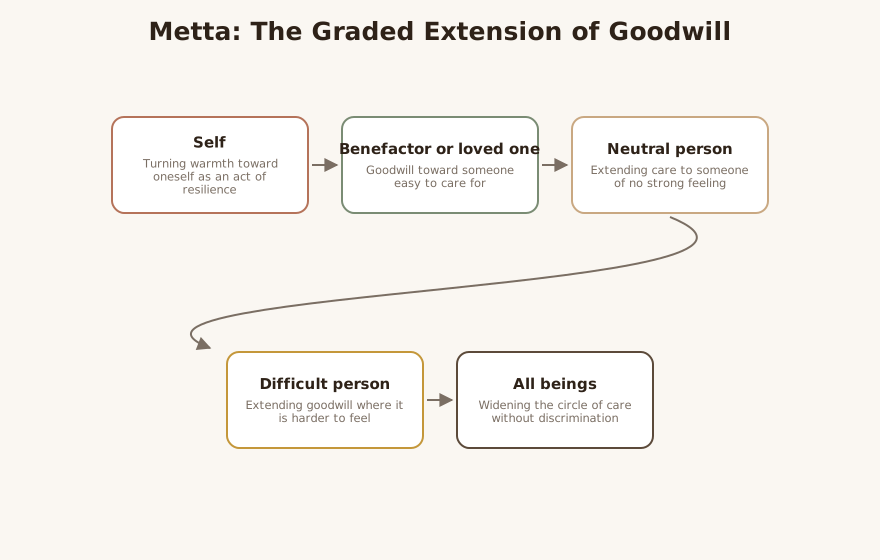
The central premise is that warmth and goodwill can be deliberately cultivated rather than merely awaited — that affection is a trainable disposition, not only a spontaneous feeling 8. The practice operates through repetition of intention phrases paired with mental imagery of the recipient, gradually widening the circle of care 5. A second principle is graded extension: the practitioner moves outward in a sequence of increasing difficulty, classically from self, to a benefactor or loved one, to a neutral person, to a difficult person, and finally to all beings 5.
A third principle, emphasized in Fredrickson’s work, is the upward spiral: positive emotions broaden momentary thought-action repertoires, which over time build lasting cognitive, psychological, social, and physical resources 3. A fourth, especially relevant clinically, is that metta is framed as strength-building rather than vulnerability-inducing — turning warmth toward the self is positioned as an act of resilience, not self-indulgence 5. Finally, the practice is non-discriminatory in aspiration: the same quality of goodwill is, in principle, extended to self and stranger alike, which is what makes it a candidate intervention for self-criticism, interpersonal resentment, and social disconnection simultaneously 8.
Interventions & Techniques
The canonical protocol begins with the body settled and a brief anchoring in the breath, then proceeds through the graded sequence of recipients while repeating phrases 4. Common phrase sets include “May I be filled with loving-kindness; may I be safe from inner and outer dangers; may I be well in body and mind; may I be at ease and happy,” later substituting “you” for “I” as the focus shifts outward 8. Other widely used phrasings are “May you be well in body and mind” and “May you be at ease and happy,” paired with deliberate visualization of the recipient 6.
The recipient sequence typically moves from oneself, to a loved one, to neutral persons, and eventually outward to all living beings 56. Some secular adaptations reorder or abbreviate this — the Greater Good in Action version, for example, begins by receiving goodwill from a benefactor and then sending it to someone in need, and notably omits the classic neutral-person, difficult-person, and all-beings stages 4. This illustrates a practical point: protocols vary, and clinicians should choose a structure matched to the patient’s tolerance rather than assume one fixed form LLM.
Dosing recommendations are pragmatic: sessions often start at around 5 minutes and build toward 20–30 minutes of daily practice, with some structured versions running about 7 minutes per sitting 64. Interventions that pair the meditation with didactic instruction — explaining the rationale and what to expect — have shown better outcomes than meditation-only delivery, an important design lesson for clinicians embedding LKM in treatment 1.
LLM-generated illustrative example (not a guideline): A therapist working with a self-critical client might begin not with the self (often the hardest target for this population) but with a beloved pet or a cherished mentor, letting the client first feel the warmth flow easily before gently redirecting a single phrase — “may I be at ease” — toward themselves at the very end of the session LLM.
Evidence Base
The evidence for LKM is most mature for positive affect. A meta-analytic review by Zeng and colleagues synthesized 24 studies with 1,759 participants and found that LKM reliably increases self-reported positive emotions, with medium effect sizes in randomized waitlist-controlled trials (Hedges’ g ≈ 0.39) and small-to-medium effects in non-randomized designs (g ≈ 0.29–0.32) 1. Loving-kindness–focused practice showed a medium effect (g ≈ 0.42), somewhat larger than compassion-focused practice (g ≈ 0.29) in that synthesis 1. On this outcome, the literature can reasonably be called established 1.
The foundational mechanistic trial is Fredrickson et al.’s “Open Hearts Build Lives,” a randomized longitudinal field experiment (~10 weeks, 139 completers) in which LKM increased daily positive emotions, which in turn predicted gains across nine personal resources — including mindfulness, sense of purpose, and social support — that subsequently predicted higher life satisfaction and reduced depressive symptoms 3. A systematic review and meta-analysis has likewise examined loving-kindness and compassion meditation in relation to life satisfaction 2. Converging secular summaries report associated improvements in self-acceptance, reduced self-criticism, and stronger feelings of connection to others 8.
Evidence for specific clinical disorders is real but less mature LLM. Reports describe a trial in which LKM reduced PTSD symptoms comparably to cognitive processing therapy while showing greater improvement on depressive symptoms, and another in which LKM combined with mindfulness-based cognitive therapy improved depression and quality of life 6. Among veterans with PTSD, symptom reductions have been characterized as “modest” 6. Across all of this work the cautions are consistent: expectancy effects, self-selection, predominantly white and educated samples, brief intervention windows, reliance on self-report, and heterogeneous protocols all temper the strength of conclusions 13.
Populations & Indications
LKM has been studied and applied across a broad range of adult populations, including trauma survivors, people with depression, and those with social anxiety 68. It is frequently used with helping professionals and caregivers as a resilience and burnout-prevention practice, where it is framed as strengthening rather than depleting 5. Veterans, particularly those with PTSD, are a population with a small but active evidence base 6.
Clinically, LKM is indicated wherever the therapeutic target involves the affective tone toward self or others — most directly self-criticism, shame, low self-compassion, interpersonal resentment or anger, and social disconnection 58. Because it generates positive emotion and broadens cognition, it is also a reasonable adjunct for rumination and the negative-affect bias seen in depression 3. Its proposed benefit for chronic pain is described in the secular literature, though clinicians should treat this as a supportive rather than primary indication 5. In general, LKM is best positioned as an emotion-cultivation skill layered onto a primary treatment, not a replacement for it LLM.
Problems-for-Work
- Self-criticism and shame. Directing well-wishing phrases toward the self is the core mechanism; the practice is explicitly described as reducing self-criticism and increasing self-acceptance 8. Application: a single self-directed phrase repeated at the close of each session, titrated up as tolerance grows LLM.
- Depression and rumination. By generating positive affect that broadens cognition, LKM can interrupt the narrowed, self-focused attention of depressive rumination 3. Application: brief daily practice paired with mindfulness-based cognitive therapy, as in reported combined protocols 6.
- PTSD and trauma. Trials report reductions in PTSD and trauma symptoms, with the practice framed as strength-building 65. Application: used adjunctively, with careful pacing and a benefactor-first sequence to avoid flooding LLM.
- Social anxiety and interpersonal difficulty. Extending goodwill to others increases felt connection and reduces self-focus, which may lower social-evaluative threat 84. Application: the neutral-person stage as graded exposure to benign social attention LLM.
- Anger and resentment. The traditional inclusion of a “difficult person” target offers a structured way to soften hostility 5. Application: introduced only after warmth is reliably accessible toward easier targets LLM.
- Burnout in helping professionals. Positioned as a resilience practice that prevents depletion 5. Application: a short pre-shift or end-of-day metta sitting LLM.
Contraindications, Cautions & Cultural Humility
The accessible secular literature presents no formal contraindications for LKM and frames it largely as benign 8. That absence of stated warnings should not be read as evidence of universal safety LLM. In clinical experience and in the broader meditation literature, turning attention inward or attempting to generate warmth toward the self can be activating for people with severe trauma, dissociation, or profound shame, sometimes producing paradoxical distress; clinicians should screen for this, pace deliberately, and treat the benefactor-first or other-directed forms as safer entry points than self-directed practice LLM. Because reported trials skew toward white, educated, self-selected samples, generalizability to other groups is genuinely uncertain 31.
Cultural humility is essential because metta is a living religious practice within Buddhist traditions, not merely a wellness technique 5. Secular adaptation can be appropriate and is widely done, but clinicians should avoid presenting a decontextualized version as the “real” or original practice, and should be sensitive to clients for whom either the Buddhist framing or its removal carries meaning LLM. The unconditional, non-discriminatory ideal of metta should also be offered as an invitation, not a demand — pressuring a client to feel warmth toward an abuser, for instance, risks invalidation and harm 8LLM.
Treatment-Plan Suggestions & SMART Objectives
| Goal | SMART objective (example) | Mechanism |
|---|---|---|
| Reduce self-criticism | Client will practice a 5-minute self-directed metta sitting 5 days/week for 6 weeks, logging frequency in a journal | Repeated self-directed goodwill phrases increase self-acceptance and reduce self-criticism 8 |
| Increase positive affect | Client will complete daily LKM and report a measurable rise in weekly positive-emotion ratings over 8 weeks | LKM reliably increases self-reported positive emotions (medium effect) 1 |
| Build psychological resources | Client will sustain daily practice for 9–10 weeks and review gains in purpose, mindfulness, and social support at session | Positive emotions broaden cognition and build durable personal resources 3 |
| Improve life satisfaction | Client will maintain ≥4 weekly sittings for 8 weeks and re-rate life satisfaction at midpoint and termination | Loving-kindness/compassion meditation is associated with improved life satisfaction 2 |
| Reduce social disconnection | Client will add a neutral-person and benefactor stage to practice 3x/week and rate felt connection weekly | Extending goodwill outward increases felt connection and reduces self-focus 84 |
| Soften anger/resentment | Client will introduce a “difficult person” target once warmth is reliably accessible, practicing 2x/week for 4 weeks | Structured extension of goodwill to a difficult figure softens hostility 5 |
| Prevent burnout (caregivers) | Clinician/caregiver will complete a 7-minute metta sitting before or after shifts ≥4 days/week for 6 weeks | Practice is framed as a resilience and burnout-prevention skill 5 |
Common Misconceptions
A frequent misconception is that metta is the same as ordinary love or sentimentality. In its tradition it is unconditional and non-discriminatory goodwill — closer to friendliness extended without preference — and is explicitly distinguished from romantic or conditional love 8. A second is that self-directed metta is self-indulgent or “soft”; the practice is in fact framed as strength-building rather than vulnerability-inducing, and self-warmth is treated as a foundation for extending care to others 5.
A third misconception is that any one script is the protocol. Phrasings and recipient sequences vary widely across traditions and secular adaptations, with some versions omitting whole stages 45. A fourth is that LKM is an empirically established treatment for clinical disorders; the strong evidence concerns positive affect and well-being, while disorder-specific findings remain emerging and modest 16. Finally, some assume benefits accrue from meditation alone — yet protocols that include didactic explanation outperform meditation-only delivery 1.
Training & Certification
LKM itself requires no certification; the phrases and sequence are openly published and freely taught 45. For clinicians, competence comes less from a credential than from personal practice plus training in the host modality — most commonly mindfulness-based stress reduction, mindfulness-based cognitive therapy, compassion-focused therapy, or mindful self-compassion — within which metta is taught and supervised 5. Foundational reading includes Sharon Salzberg’s Lovingkindness, which remains a standard accessible source for the practice 7. Practitioner-oriented guides and scripts are available through resources such as Greater Good in Action and PositivePsychology.com 45. Clinicians should pursue formal training in a parent modality before offering metta as a structured intervention, both for competence and for defensible documentation LLM.
Key Terms
- Metta (metta bhavana): Loving-kindness, and its cultivation; the practice of generating unconditional goodwill 8.
- Brahmaviharas: The four “divine abodes” — metta, karuna, mudita, upekkha — that ground the practice 5.
- Karuna: Compassion; the wish to relieve suffering 5.
- Mudita: Sympathetic or appreciative joy in others’ good fortune 5.
- Upekkha: Equanimity; balanced, non-reactive steadiness 5.
- Graded extension: Moving goodwill outward from self to benefactor to neutral to difficult person to all beings 5.
- Broaden-and-build: Fredrickson’s theory that positive emotions broaden cognition and build lasting resources 3.
Resources & Further Reading
▶ Watch — a video introduction to this concept:
- Zeng et al. (2015), meta-analysis on LKM and positive emotions — Frontiers in Psychology
- Gu et al., systematic review and meta-analysis on LKM/compassion meditation and life satisfaction — Applied Psychology: Health and Well-Being
- Fredrickson et al. (2008), “Open Hearts Build Lives” — Journal of Personality and Social Psychology
- Loving-Kindness Meditation — Greater Good in Action, UC Berkeley
- What Is Loving-Kindness Meditation? (Incl. 4 Metta Scripts) — PositivePsychology.com
- Loving Kindness Meditation: Benefits, How to Practice, and Examples — PsychCentral
- Lovingkindness: The Revolutionary Art of Happiness — Sharon Salzberg
- What loving-kindness meditation is and how to practice it — The Conversation
Reflective / Supervision Questions
- For a given client, is the appropriate first target the self, a benefactor, or another being — and what in the clinical picture (shame, trauma, dissociation) drives that choice? LLM
- How will you monitor for paradoxical activation or distress when a client turns warmth toward the self, and what is your plan if it arises? LLM
- Within which billable modality are you embedding metta, and does your documentation tie the practice to a specific clinical mechanism and target? 65
- Are you honoring the practice’s tradition with cultural humility, neither overclaiming a secular version as “original” nor imposing religious framing on clients who do not want it? 58
- Given that the strongest evidence is for positive affect rather than disorder-specific outcomes, are your stated treatment goals proportionate to the evidence? 16
- What is your own personal experience with the practice, and how does that inform — or limit — your ability to teach it credibly? LLM