
Type & Discipline
Self-compassion is a psychological construct rather than a freestanding treatment, sitting at the intersection of clinical and positive psychology 1. It describes a way of relating to oneself during suffering, failure, or perceived inadequacy, and is operationalized through a validated self-report measure, the Self-Compassion Scale (SCS) 2. Clinically, it belongs to the family of compassion-based approaches and is most often delivered inside recognized psychotherapies rather than as a standalone modality 7. Because it is a transdiagnostic process variable, it functions both as an outcome to cultivate and as a presumed mechanism of change across several evidence-based treatments LLM.
Creators & Lineage
The construct was defined and operationalized by Kristin Neff, who published the first SCS and the foundational three-component model 2. Its conceptual roots lie in Buddhist psychology, where compassion and mindfulness are described as inseparable, often framed as “two wings of one bird” 7. Neff and clinical psychologist Christopher Germer later co-developed the Mindful Self-Compassion (MSC) training program, a structured course pairing formal meditation with informal daily practices 7. In parallel, Paul Gilbert developed Compassion Focused Therapy (CFT), an evolutionary model teaching that anxiety and depression are natural threat responses and that the “soothing and safeness system” can be deliberately activated 7. Self-compassion also integrates closely with mindfulness-based interventions and Acceptance and Commitment Therapy (ACT), sharing an emphasis on acceptance and defusion from self-critical thought 7.
Core Principles
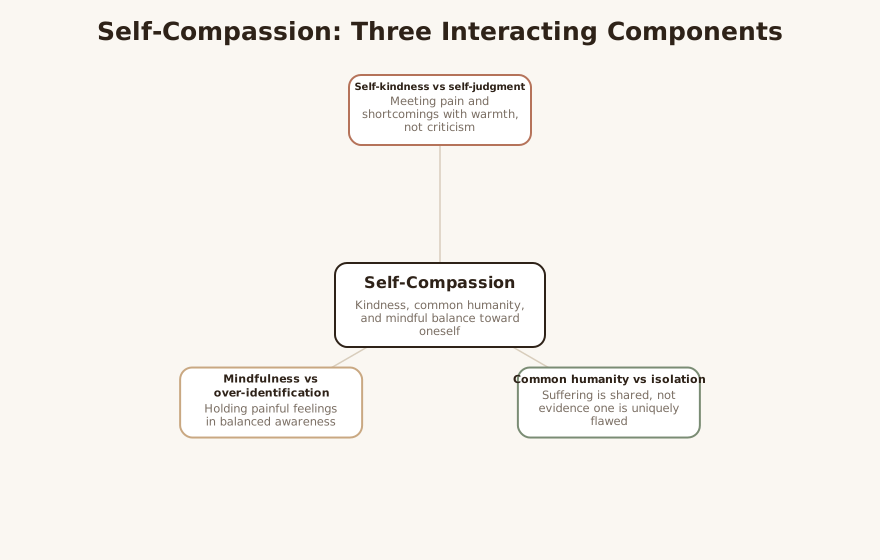
Neff frames self-compassion as three interacting components, each defined against its opposite 4. Self-kindness versus self-judgment means meeting pain and shortcomings with warmth rather than harsh self-criticism 7. Common humanity versus isolation means recognizing that suffering and failure are shared features of being human rather than evidence that one is uniquely flawed 7. Mindfulness versus over-identification means holding painful feelings in balanced awareness, neither suppressing nor exaggerating them 7. These are presented as mutually reinforcing: mindful awareness creates the space in which kindness and a sense of shared humanity can arise 3.
A central principle is that self-compassion differs from self-esteem. Self-esteem rests on positive self-evaluation and favorable comparison, whereas self-compassion is available precisely when one has failed and does not depend on outperforming others 7. Neff argues this offers comparable mental-health benefits without the costs sometimes linked to self-esteem, such as contingent self-worth or distorted self-perception 7. Self-compassion is also distinguished from self-pity, which amplifies the uniqueness of one’s suffering, and from self-indulgence, which neglects discipline and long-term wellbeing 2.
Interventions & Techniques
Self-compassion is cultivated through a recognizable set of experiential exercises 6. The Self-Compassion Break is a brief portable practice that walks the client through the three components in sequence: naming the moment of suffering (mindfulness), recalling that others struggle similarly (common humanity), and offering oneself a kind phrase (self-kindness) 6. Treating yourself as a friend asks the client to write how they would respond to a loved one facing the same difficulty, then redirect that tone inward 6. Supportive touch uses gestures such as a hand over the heart to engage the caregiving system 6.
LLM-generated illustrative example (not a guideline): A clinician guiding a Self-Compassion Break might offer, “This is a moment of suffering. Other parents feel this overwhelmed too. May I give myself the patience I need right now.” LLM
Other staples include compassionate letter writing, self-compassion journaling structured around the three components, and mindfulness practices such as body scans to observe emotion without over-identifying 6. These techniques form the backbone of MSC and overlap heavily with CFT’s imagery and soothing-system work 7. Clinicians should note that for some clients these practices trigger “backdraft” — a surfacing of grief or resistance when warmth meets long-standing self-criticism — which is worked with rather than avoided LLM.
Evidence Base
Maturity is best described as established for the construct and maturing for interventions LLM. Cross-sectional and correlational research consistently links higher self-compassion to greater life satisfaction, resilience, and wisdom, and to lower depression, anxiety, rumination, and perfectionism, with effects observed in cancer patients, people vulnerable to depression, and healthcare professionals 7. The SCS shows good internal consistency and construct validity, and large cross-cultural studies support its six-factor structure 7.
The intervention evidence is younger but real: MSC trials show significant increases in self-compassion and wellbeing sustained at six-month follow-up 7. Honesty requires flagging an active measurement debate 5. Muris and Otgaar argue that the SCS total score improperly combines compassionate self-responding (kindness, common humanity, mindfulness) with the reverse-scored uncompassionate items (self-judgment, isolation, over-identification) 5. They contend these are not simple bipolar opposites, and that in several datasets it is the uncompassionate responding that predicts psychopathology, while the contributions of compassionate responding can disappear once other variables are controlled 5. Their recommendation is to analyze the components separately so that protection and vulnerability are not conflated 5. Clinicians should therefore read total-score claims cautiously and attend to the reduction of self-criticism as a distinct target LLM.
Populations & Indications
Self-compassion has been applied across a broad clinical range 7. It is well suited to adults with anxiety or depression, where it targets the rumination and harsh self-evaluation that maintain symptoms 7. Perfectionists and highly self-critical clients are a natural fit, given the inverse association between self-compassion and perfectionism 7. Caregivers and healthcare workers facing burnout, and people with chronic illness managing ongoing distress, have been specific intervention populations 7.
It is also used with trauma survivors, adolescents, and people with eating disorders, where self-attacking and shame are prominent features LLM. Across these groups the indication is similar: a relationship with the self dominated by criticism, comparison, or felt isolation in suffering LLM. Because self-compassion is transdiagnostic, it is frequently added as an adjunct to a primary evidence-based treatment rather than used in isolation LLM.
Problems-for-Work
Self-criticism and shame are the prototypical targets; the self-kindness and common-humanity components directly counter the global, isolating self-attacks that drive shame 7. For a client who responds to any error with contempt, the “treat yourself as a friend” exercise externalizes and softens that voice 6.
Perfectionism is addressed by loosening contingent self-worth and reframing failure as shared human experience rather than personal defect 7. Major depressive disorder and generalized anxiety are worked through mindful, non-over-identified contact with painful affect, interrupting rumination 7. Burnout in caregivers is targeted by activating the soothing system and granting permission to receive care, not only give it 7. For eating disorders and body-image disturbance, self-compassion work counters the harsh evaluative stance toward the body and self LLM. For PTSD and emotional dysregulation, it is typically sequenced carefully alongside stabilization and trauma-focused work LLM.
Contraindications, Cautions & Cultural Humility
Self-compassion has no formal contraindications, but several cautions matter LLM. With trauma survivors and clients with severe shame, warmth toward the self can provoke backdraft or feel threatening, so practices are titrated and often preceded by grounding LLM. Self-compassion should not displace indicated first-line treatment for severe depression, active suicidality, or eating disorders requiring medical monitoring; it is an adjunct, not a substitute LLM. Clinicians should also correct the worry that self-compassion breeds passivity or self-indulgence, since research links it to greater motivation and prosocial behavior, not less 6.
Cultural humility is essential. The construct and its measure were largely validated on Western undergraduate samples, so norms and item interpretation may not transfer cleanly across cultures 2. Concepts such as common humanity, kindness, and emotional expression carry culturally specific meanings, and its Buddhist framing may resonate differently across belief systems 7. Clinicians should adapt language and practices to the client’s framework rather than imposing a fixed script LLM.
Treatment-Plan Suggestions & SMART Objectives
| Goal | SMART objective (example) | Mechanism |
|---|---|---|
| Reduce harsh self-criticism | Over 6 weeks, client will use a Self-Compassion Break at 3 self-critical moments per week, logged in journal | Self-kindness replacing self-judgment 6 |
| Decrease shame-driven isolation | Within 8 weeks, client will name “others struggle with this too” in 4 of 5 distress logs | Common humanity vs. isolation 7 |
| Interrupt rumination | Over 4 weeks, client will complete 3 weekly 10-minute mindfulness/body-scan practices | Mindfulness vs. over-identification 7 |
| Loosen perfectionistic standards | By session 10, client will reframe one “failure” per week as shared human experience in writing | Common humanity; reduced contingent self-worth 7 |
| Build self-soothing capacity | Within 6 weeks, client will use supportive touch during 3 high-distress episodes weekly | Activation of soothing/caregiving system 6 |
| Reduce caregiver burnout | Over 8 weeks, client will write one weekly compassionate letter to self about caregiving strain | Self-kindness; permission to receive care 6 |
| Improve emotion regulation | By week 8, client will report reduced intensity of self-critical episodes on weekly rating from 8 to 5 | Mindful balance reducing over-identification 7 |
Common Misconceptions
The most common error is conflating self-compassion with self-esteem; it does not require positive self-evaluation or favorable comparison and remains available in failure 7. A second is equating it with self-pity, when in fact self-pity exaggerates the uniqueness of one’s suffering while self-compassion emphasizes shared humanity 2. A third is the fear that it is self-indulgent or undermines motivation, which the evidence contradicts — it is associated with greater giving and motivation to improve 6.
Clinicians should also avoid the misconception that a high SCS total score straightforwardly indexes a single protective trait; the compassionate and uncompassionate components behave differently, and reduced self-criticism may be doing much of the predictive work 5. Treating the construct as monolithic can obscure what is actually changing in treatment 5.
Training & Certification
Self-compassion itself requires no license to practice as a clinical concept, but the structured programs have formal pathways LLM. Mindful Self-Compassion (MSC), developed by Neff and Germer, is an 8-week program with trained-teacher certification tracks for facilitators 7. Compassion Focused Therapy, developed by Gilbert, has its own training curriculum and supervision structures within the broader CFT community 7. For most practicing therapists, the practical route is integrating validated exercises and self-report measurement into an existing evidence-based modality while pursuing program-specific training if delivering MSC or CFT as named treatments LLM.
Key Terms
Self-kindness — meeting one’s own pain and failure with warmth rather than criticism 7. Common humanity — recognizing suffering and imperfection as shared rather than isolating 7. Mindfulness (in this model) — balanced, non-over-identified awareness of painful emotion 7. Over-identification — being swept up in and fused with negative emotion 7. Self-Compassion Scale (SCS) — Neff’s 26-item self-report measure with six subscales across the three components, also available in a 12-item short form 27. Compassionate vs. uncompassionate self-responding (CS/US) — the positively and negatively keyed item clusters whose combination into one total score is contested 5. Backdraft — the emergence of resistance or pain when self-warmth contacts entrenched self-criticism LLM.
Resources & Further Reading
▶ Watch — a video introduction to this concept:
- Self-Compassion: Theory, Method, Research, and Intervention — Neff, Annual Review of Psychology
- The Self-Compassion Scale — Kristin D. Neff (paper PDF)
- What is Self-Compassion? — self-compassion.org
- The Three Components of Self-Compassion — Greater Good, UC Berkeley (video)
- Deconstructing Self-Compassion: limits of the SCS total score (PMC)
- How to Practice Self-Compassion: 8 Techniques and Tips — PositivePsychology.com
- Self-compassion — Wikipedia
Reflective / Supervision Questions
- When a client cannot extend kindness to themselves, which component — mindfulness, common humanity, or self-kindness — is the actual sticking point, and how would you sequence the work LLM?
- How do you distinguish, in your own caseload, between reducing a client’s self-criticism and building active self-kindness — and does your treatment plan target both 5?
- With trauma survivors, how do you titrate self-compassion practices to avoid backdraft, and what stabilization precedes them LLM?
- How might your own relationship to self-criticism shape how convincingly you can model self-compassion for clients LLM?
- When does framing self-compassion in its Buddhist or meditative lineage help a client, and when should you translate it into the client’s own cultural or spiritual language 7?